
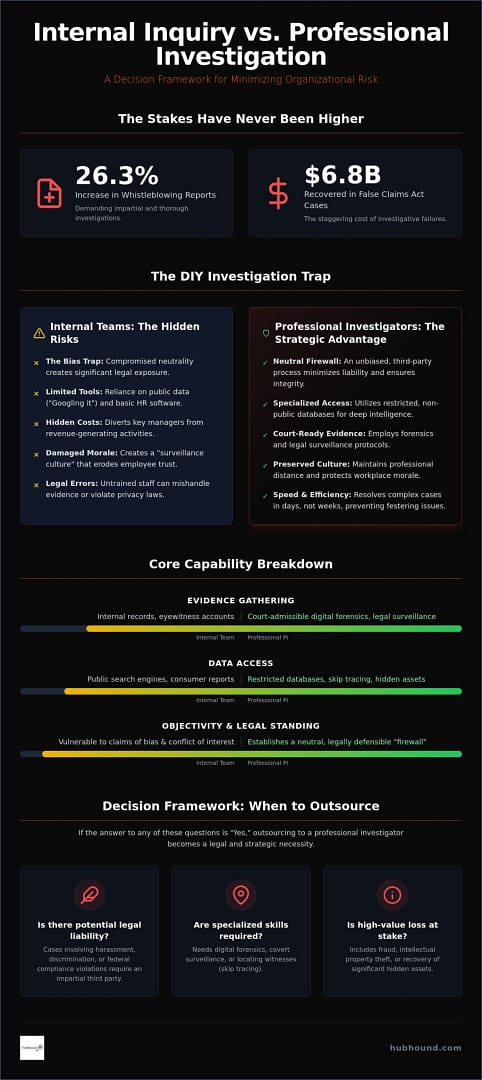
Is your organization’s standard internal investigation actually a ticking legal time bomb? While most leadership teams prefer to keep sensitive matters in-house to maintain control and reduce perceived costs, this approach often creates a bias trap that collapses under legal scrutiny. Understanding exactly when to hire a PI vs handling it internally is the difference between a clean resolution and a catastrophic lawsuit. With whistleblowing reports increasing by 26.3% in early 2026 and federal authorities recovering $6.8 billion in False Claims Act cases recently, the margin for investigative error has effectively disappeared.
You need a clear framework to determine when your internal capabilities have reached their limit. This guide identifies the critical thresholds where standard HR software fails and professional investigative expertise becomes a legal necessity. We’ll explore how to establish a neutral firewall that protects your organization from claims of bias while securing court-ready evidence. Discover how to minimize your liability and move from uncertainty to actionable, high-quality intelligence that supports your most difficult business decisions.
Key Takeaways
- Identify the specific operational thresholds where standard HR software and internal inquiries fail to capture critical red flags.
- Learn the strategic criteria for when to hire a PI vs handling it internally to avoid the “bias trap” that often compromises in-house investigations.
- Evaluate specialized capabilities like surveillance and skip tracing that are essential for securing admissible, court-ready evidence.
- Establish a professional “firewall” between your organization and the investigative process to minimize legal liability and ensure procedural integrity.
- Streamline your decision-making process with a framework that balances investigative complexity against potential organizational loss.
The DIY Investigation Trap: Understanding Internal Limitations
Internal inquiries often begin as casual conversations or routine administrative reviews. The threshold shifts to a formal investigation the moment a complaint involves potential legal liability, financial loss, or a violation of federal compliance standards. Many organizations fall into the “DIY” trap by assuming that standard HR tools provide sufficient protection. They don’t. While software can flag a criminal record, it rarely uncovers the nuanced behavioral patterns or non-disclosed civil disputes that signal a high-risk hire. Deciding when to hire a PI vs handling it internally requires a cold assessment of your team’s actual capabilities.
Most internal security teams reach a point of diminishing returns quickly. They lack the specific training and legal insulation required for high-stakes evidence gathering. There is also a significant psychological cost to consider. When internal staff lead an investigation, it often creates a “surveillance culture” that erodes trust and damages office morale. Utilizing a neutral third party maintains a professional distance and preserves the workplace environment. It keeps your leadership team focused on growth rather than policing their own colleagues.
The Hidden Costs of Internal Resource Diversion
Diverting a senior manager or HR director to lead a complex inquiry is rarely cost-effective. You must calculate the opportunity cost. Every hour spent reviewing surveillance footage or interviewing witnesses is an hour lost from core business growth. “Free” internal labor often leads to expensive legal errors. If an internal team mishandles evidence or violates privacy laws, the resulting lawsuits will dwarf the cost of professional services. Professional speed is another factor. An expert agency can often resolve a misconduct case in days, whereas an internal team might struggle for weeks, allowing the problem to fester.
When “Just Googling It” Fails: The Limits of Public Data
Public search engines and basic background software only scratch the surface. To protect your interests, you need a clear understanding of what a private investigator is and the specialized access they provide. Professional investigators utilize restricted, non-public databases that contain information omitted from standard consumer reports. Standard background checks often miss non-disclosed civil litigation or dormant financial liabilities. Software-generated reports are static; they don’t vet data for accuracy or context. An investigator-vetted report provides the depth necessary for true corporate due diligence, ensuring you aren’t blindsided by hidden risks.
Core Capabilities: Where Professional Investigators Outperform Internal Teams
Most organizations rely on internal IT or HR departments to spearhead inquiries. This approach works for minor policy infractions, but it fails when complexity increases. Standard IT departments aren’t forensic labs. While your internal team can identify that a file was deleted, they lack the tools to reconstruct the specific intent behind data exfiltration or to recover encrypted communications from non-company devices. Professional investigators bring digital forensics capabilities that go far beyond standard administrative access. Understanding when to hire a PI vs handling it internally often comes down to the depth of data required to prove your case in a courtroom.
Advanced surveillance is another area where internal teams struggle. Assigning an untrained employee to monitor a person of interest is a recipe for a harassment lawsuit. Professional investigators use sophisticated equipment and legal protocols to document activity without compromising the investigation’s integrity. They provide a level of technical precision that ensures every frame of video or log of activity is admissible. Relying on specialized workplace misconduct investigations ensures that your data collection remains unassailable from the start.
Access to Specialized Investigative Tools
Professional agencies utilize high-level skip tracing and locate investigations to find witnesses or hidden assets across the country. These databases are restricted to licensed professionals and provide real-time updates that public search engines can’t match. When a former employee or witness moves out of state, internal teams often hit a dead end. Investigators bridge this gap, ensuring that your legal team has the witnesses they need. Additionally, professional process service guarantees that legal documents are delivered according to strict statutory requirements, preventing procedural dismissals that can cost your company thousands in legal fees.
The Authority of Professional Witness Interviews
The dynamic of an interview changes the moment an outside expert enters the room. Employees are often more forthcoming with a neutral third party than with their own supervisors or HR reps. Investigators follow a rigorous framework for workplace investigations to ensure interviews are conducted fairly and legally. This neutrality is vital for obtaining actionable statements. Experts are trained to identify deceptive behavior and micro-expressions that internal staff might miss. They record statements using techniques that specifically withstand cross-examination, providing a solid foundation for any subsequent litigation or termination proceedings.
Risk Mitigation: The Legal Dangers of Internal Bias
Every internal investigation carries the inherent risk of a conflict of interest claim. When an HR manager or executive investigates a colleague, the defense will almost certainly challenge the findings as biased. This vulnerability often leads to “wrongful termination” or “retaliation” lawsuits that can cost millions. In 2025 alone, the Department of Justice recovered a record $6.8 billion in False Claims Act cases, many of which originated from internal compliance failures. Deciding when to hire a PI vs handling it internally is a strategic choice to install a “firewall” between your leadership and the evidence. A third-party investigator provides a layer of organizational neutrality that is difficult to replicate in-house.
Using an external expert transforms the process from a potential “witch hunt” into a documented commitment to due process. This distinction is critical in 2026 legal standards, where transparency and objectivity are under increased scrutiny. Professional investigators deliver a level of insulation that protects management from personal liability. They ensure that the facts speak for themselves, rather than being filtered through the lens of internal office politics or pre-existing professional relationships.
Preserving the Chain of Custody
The chain of custody is a chronological paper trail that documents the seizure, custody, control, transfer, and analysis of evidence. Internal teams frequently “taint” evidence by accessing digital files without forensic software or mishandling physical documents without proper logging. If the chain is broken, the evidence becomes inadmissible in court, rendering your entire investigation useless. A licensed investigator guarantees evidence integrity by maintaining a rigorous, court-certified log of every individual who interacts with a specific piece of data or property. This meticulous documentation ensures that your findings hold up under the most aggressive cross-examination.
Neutrality as a Defense Strategy
Proactive companies use external experts to establish a clear record of compliant workplace investigations. Hiring a corporate investigation firm demonstrates to shareholders and courts that the organization prioritizes accuracy over expediency. This approach is especially vital in complex workplace investigations where the accused may be a high-level executive. By outsourcing the inquiry, you eliminate the appearance of favoritism or prejudice. This strategic neutrality serves as your primary defense, proving that the organization acted reasonably and in good faith to uncover the truth.
Decision Framework: When to Outsource Your Investigation
Deciding when to hire a PI vs handling it internally requires a cold calculation of the potential fallout. If the investigation targets a senior executive or involves assets exceeding six figures, the cost of a licensed expert is negligible compared to the risk of a botched internal report. Internal HR teams are designed for policy enforcement; they aren’t built for litigation support. For strategic support and practical advice on navigating these complexities, many employers rely on Pioneer HR to ensure their internal processes remain robust. When federal or state laws mandate a neutral inquiry, attempting to keep the process in-house can be viewed as a deliberate attempt to obstruct justice or hide corporate negligence. This is especially true as whistleblowing reports have increased by 26.3% in early 2026, making it more likely that internal errors will reach regulatory bodies.
Your decision should follow a risk-to-reward logic. If the outcome of the investigation could lead to a court date, a professional investigator is mandatory. A third-party agency prevents the public perception of a cover-up, protecting your brand from the reputational risk of a public scandal. By outsourcing, you move the burden of proof to a licensed entity that operates under strict legal protocols, ensuring that your organization remains insulated from claims of bias or procedural misconduct.
Evaluating the Stakes of the Case
Determine the maximum potential loss before assigning an internal team. Is there a threat of civil litigation or criminal charges? If so, the evidence must be unassailable. Investigations involving executive-level personnel are particularly sensitive and prone to conflict of interest claims. Utilizing advanced surveillance techniques is often necessary for high-value asset searches or verifying non-compete violations. Professional investigators provide the technical precision required to track these assets without alerting the subject or violating privacy statutes.
The National Scope: When Investigations Cross State Lines
Internal teams struggle when inquiries move beyond the local office. Multi-jurisdictional skip tracing is a complex logistical challenge that requires access to national databases and a network of licensed professionals. Serving process and interviewing witnesses across the country requires a level of coordination that most HR departments cannot sustain. A national agency simplifies these complex operations, providing a single point of contact for multi-location due diligence. This ensures that your investigation remains consistent and legally compliant, regardless of where the evidence leads. Secure your organization’s future by choosing expert corporate due diligence services today.
Strategic Partnership: How HubHound Protects Your Interests
HubHound functions as a specialized expert curator for organizations navigating the difficult choice between internal resolution and professional intervention. Deciding when to hire a PI vs handling it internally often creates significant cognitive load and choice paralysis for business owners. We alleviate this burden by providing a clear, evidence-based path forward. With over three decades of industry experience, our licensed investigators offer a level of rigorous assessment that automated software-only solutions simply cannot replicate. We do the heavy lifting of research, filtering out noise to deliver high-quality intelligence that saves your team valuable time and protects your professional reputation.
Determining when to hire a PI vs handling it internally is a critical decision that defines your organization’s legal standing. Our approach is designed to integrate seamlessly with your existing legal and HR workflows, acting as a functional extension of your management team. We don’t just provide raw data; we provide a strategic partnership that prioritizes your organization’s long-term integrity. By acting as a neutral third-party firewall, HubHound ensures your investigations are unassailable in any legal forum. This specialized authority is essential for growth-focused companies that require precise, evaluative results without the inherent risk of internal bias or procedural errors.
Comprehensive Background Screening and Due Diligence
Standard reports often provide a false sense of security. HubHound moves beyond surface-level data to uncover actual risks through deep entity verification and comprehensive corporate due diligence. We mitigate the choice paralysis often felt when selecting investigative services by tailoring every screening plan to your specific operational environment. This ensures you aren’t just checking boxes. You are actually protecting your organizational interests from hidden liabilities, non-disclosed civil litigation, and dormant financial risks that standard software frequently misses.
For businesses managing global supply chains, due diligence must extend to physical site assessments. Utilizing a specialized firm like The Inspection Company for factory audits and product inspections in Asia ensures that your quality control standards are met and helps prevent the compliance issues that often trigger complex internal investigations.
Action-Oriented Litigation Support
From witness interviews to professional process service, we provide full-cycle support for your legal department. Whether your case involves criminal defense or civil litigation support, our team ensures every statement and piece of evidence is court-ready. We maintain the highest national standards for the chain of custody, ensuring that your findings are admissible and robust under the most aggressive cross-examination. Our 30 years of specialized expertise allows us to track down the highest quality solutions for even the most complex multi-jurisdictional cases. Contact HubHound today for a professional consultation on your investigative needs.
Securing Organizational Integrity through Professional Intervention
Identifying the specific point where internal resources become a liability is essential for effective risk management. You’ve seen how the DIY trap can compromise sensitive evidence and how professional tools like advanced surveillance provide a level of precision that standard HR departments lack. By establishing a neutral firewall through a third-party agency, you protect your organization from claims of bias and ensure every finding meets 2026 legal standards for the chain of custody.
Determining exactly when to hire a PI vs handling it internally is a strategic decision that safeguards your company’s future and reputation. HubHound provides comprehensive corporate and legal support services, utilizing licensed investigators with over 30 years of industry experience. We specialize in delivering court-ready evidence that resolves complex misconduct and due diligence cases with quiet confidence and technical accuracy. Secure your organization with HubHound’s professional investigative services and gain the actionable intelligence required to make your most difficult business decisions. You have the tools to move from uncertainty to total operational clarity.
Frequently Asked Questions
Can internal HR legally conduct a workplace investigation?
Yes, HR departments can legally conduct internal inquiries into policy violations or administrative issues. However, internal investigations lack the legal professional privilege that often applies to third-party investigations led by outside counsel. This means internal reports and interview notes are frequently discoverable in court, which can be a significant disadvantage during litigation.
Is it more cost-effective to handle an investigation internally?
Internal investigations often appear cheaper upfront but carry higher long-term costs due to liability risks and management diversion. Deciding when to hire a PI vs handling it internally involves weighing the hourly cost of an investigator against the potential for a million-dollar wrongful termination suit. Professional investigators prevent expensive procedural errors that untrained staff often make.
What are the main risks of a “DIY” investigation?
The primary risks include the “bias trap,” where internal relationships color the findings and make them easy to challenge in court. When evaluating when to hire a PI vs handling it internally, you must consider that untrained staff often break the chain of custody for digital or physical evidence. This oversight can make your entire case inadmissible and expose the company to retaliation claims.
When should I call a private investigator instead of law enforcement?
Call an investigator for civil litigation support, corporate due diligence, or workplace misconduct that doesn’t yet meet the threshold for criminal prosecution. Private investigators work specifically for your organization’s interests. Law enforcement prioritizes the public interest and may not share critical evidence or findings with your legal team during an ongoing inquiry.
How do private investigators access non-public information?
Licensed investigators utilize proprietary, restricted databases that are unavailable to the general public or standard HR software. These tools provide real-time data on assets, non-disclosed civil litigation, and dormant financial liabilities. Investigators also use advanced surveillance operations and skip tracing techniques to find individuals who have deliberately moved or hidden their tracks.
Can evidence gathered by a private investigator be used in court?
Yes, evidence is admissible provided the investigator follows state licensing requirements and strict evidence protocols. As of 2026, 45 states require professional investigators to be licensed. Maintaining a documented chain of custody is the standard requirement for ensuring that digital and physical evidence survives aggressive cross-examination during legal challenges.
What is the difference between a background check app and a professional PI?
Background check apps rely on aggregated public data that is often outdated, incomplete, or incorrectly matched to the subject. A professional investigator conducts a rigorous assessment of the data, vetting it for accuracy through multiple restricted sources. This human verification is essential for high-stakes pre-employment background checks where software-only errors can lead to negligent hiring claims.
Does a private investigator handle personal bodyguard services?
No, professional investigative agencies do not provide personal bodyguard services. Our expertise is focused on specialized investigative functions like surveillance, skip tracing, and witness interviews. We provide the intelligence and evidence required to support legal and corporate decision-making rather than physical security or protection details.

Article by
Joel R. Manley | President | Hubhound Investigations | OR PI-ID#: 90432 | 111 SW Fifth Avenue, Suite 3150 Portland, Oregon 97204 | 971-442-8170
Joel is licensed as a private investigator in Oregon and Tennessee. Joel started his career in 1987 serving as a Military Police Officer and Military Police Investigator.
After ending his military tour of duty, Joel became a civilian Police Officer and Deputy Sheriff. Joel took his strong background in Hostage Negotiations, Mediation and Conflict Resolution, with him to patrol some of the highest crime areas in SE Portland.
Joel was awarded Deputy of the Year for his efforts and for drastically reducing the crime rate in the area he patrolled. As a Deputy Sheriff, Joel assisted in leading a Neighborhood Livability Program that was nationally recognized for having the most innovative and progressive approach to policing.
In 2018, Joel retired as a Deputy Sheriff and founded Hubhound Investigations. Joel played an integral role in Hubhound Investigations receiving an A+ Accredited Business rating from the Better Business Bureau (BBB).
In his off time, Joel enjoys spending time with his wife, adult children and Hubhound’s Happiness Ambassador, Nya. Joel also enjoys Scuba Diving and Kayaking.
Disclaimer
DISCLAIMER: This article is provided for general informational and educational purposes only. It is not intended to constitute legal advice, professional investigative advice, or instruction to engage in any unlawful activity. Laws governing private investigations, surveillance, recording, tracking, access to information, evidence collection, privacy, trespass, licensing, and related investigative activities vary by jurisdiction and are subject to change.
Any investigative techniques, tactics, procedures, scenarios, or legal proceedings discussed in this article are presented for informational purposes and should not be interpreted as authorization or encouragement to use a particular method. Private investigators and members of the public are responsible for understanding and complying with all applicable federal, state, and local laws, licensing requirements, court rules, and professional standards.
The circumstances of every investigation and legal matter are different. Information contained in this article should not be relied upon as a substitute for advice from a qualified attorney or other appropriate licensed professional regarding a specific situation. No attorney-client, investigator-client, or other professional relationship is created by reading or using this information.