
That magnetic GPS tracker you found online might be the single biggest threat to your legal standing. DIY surveillance tools often lead to inadmissible evidence and privacy law violations that complicate an already painful situation. If you’re seeking clarity, you need professional alternatives to GPS tracking for infidelity cases that prioritize both discretion and legal compliance. Relying on unverified hardware creates a high risk of being caught and leaves you with data that won’t hold up in a courtroom.
We recognize the emotional exhaustion of not knowing the truth and the fear of making a mistake that could jeopardize your legal future. This article outlines how to secure professional, court-admissible evidence without the legal pitfalls of amateur tracking. You’ll learn how expert surveillance operations and digital forensics provide a clear, undeniable narrative of the facts. We’ll evaluate high-quality investigative methods that offer total discretion and the peace of mind you deserve during this transition.
Key Takeaways
- Identify the legal risks of DIY surveillance and learn how to maintain privacy law compliance during a sensitive investigation.
- Discover how professional surveillance operations establish a clear narrative of intent that location data alone cannot provide.
- Explore professional alternatives to GPS tracking for infidelity cases, including digital forensics for uncovering encrypted communications and hidden folders.
- Analyze financial patterns and lifestyle shifts to detect unexplained expenditures or the presence of hidden assets.
- Ensure all gathered evidence is court-ready from day one while protecting your mental health through expert-led intervention.
The Legal Risks of DIY GPS Tracking in Infidelity Cases
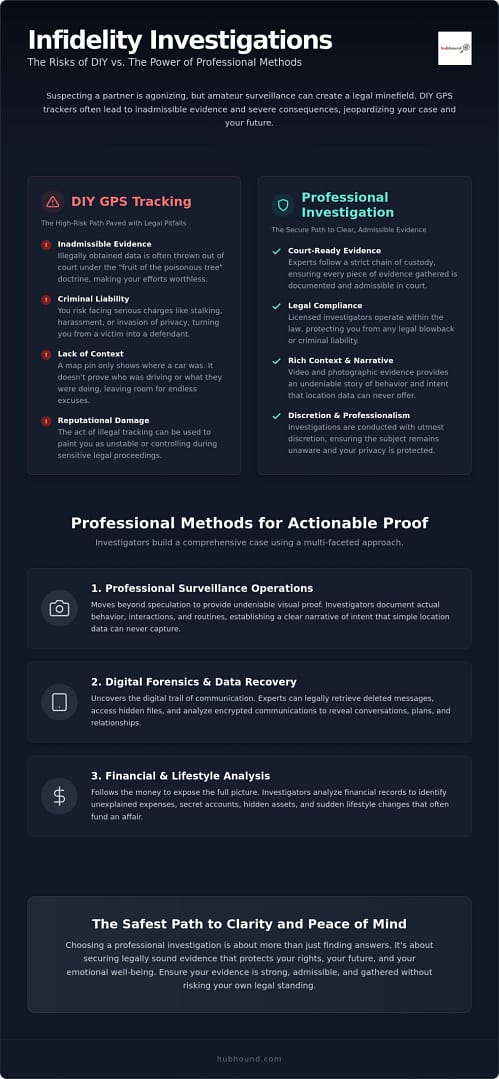
DIY GPS tracking is often the first instinct for someone suspecting a partner’s betrayal. It seems simple, cheap, and effective. However, the legal boundary between a legitimate investigation and a criminal invasion of privacy is razor thin. Using unauthorized tracking devices can quickly shift your status from a concerned spouse to a defendant facing stalking or harassment charges. Professional investigative methods serve as essential alternatives to GPS tracking for infidelity cases because they prioritize legal compliance over convenience.
Licensed experts understand the specific legal constraints governing surveillance. They operate within a framework that balances the need for truth with the target’s right to privacy. While a private citizen might assume marital status grants them tracking rights, the law frequently disagrees. Understanding the duties of a private investigator reveals that their value lies not just in finding facts, but in doing so through methods that survive judicial scrutiny. They provide a layer of legal protection that a store-bought magnet-mount tracker cannot offer.
Inadmissibility: Why Your Data Might Be Useless
In family court, the “fruit of the poisonous tree” doctrine often applies to civil matters. If you obtain location data through illegal means, a judge will likely strike that evidence from the record. This exclusion can devastate your strategy during alimony or custody hearings. Beyond losing the evidence, the act of illegal tracking can be used by opposing counsel to paint you as unstable or controlling. A licensed investigator maintains a strict chain of custody; they ensure that every piece of information is documented and verified for court use from the moment it’s collected.
Criminal Liability and Privacy Statutes
National privacy standards are becoming increasingly stringent as technology evolves. New comprehensive privacy laws in effect as of 2026 reflect a broader trend toward protecting individuals from unauthorized electronic monitoring. Installing a GPS device on a vehicle that you do not solely own or lease can constitute a criminal offense, regardless of your marital status. Consent is rarely implied in these scenarios. Courts typically require explicit permission or a warrant for electronic tracking, making DIY attempts a high-stakes gamble. Choosing professional alternatives to GPS tracking for infidelity cases protects your legal standing and ensures your search for the truth doesn’t result in a criminal record.
Professional Surveillance Operations: The Gold Standard for Evidence
Location coordinates provide a starting point, but they rarely provide a conclusion. A digital pin showing a vehicle parked at a hotel or a private residence only proves the car’s presence; it does not prove an affair. This lack of context leaves significant room for excuses and plausible deniability that can stall legal proceedings for months. Professional surveillance operations serve as superior alternatives to GPS tracking for infidelity cases by documenting actual behavior in real-time. This method moves beyond speculation and provides the high-definition visual proof required to establish the truth.
Video evidence establishes a clear, undeniable narrative of intent. In a legal setting, proving “affection” or “cohabitation” requires more than just proximity. It requires documented physical contact or repeated overnight stays. Licensed investigators use specialized equipment to capture these moments from a safe distance, ensuring the target remains unaware. They often rely on professional radio gear and guidance on communication regulations from Earpiece Hub to maintain coordination without detection. They identify the third party involved and document the nature of the relationship with precision. This transformation of suspicion into court-ready video evidence is what distinguishes professional work from amateur tracking attempts.
Visual Evidence vs. Location Data
Location logs are easily dismissed in family court. A spouse might claim they were visiting a friend nearby, attending a business meeting, or that someone else was driving the vehicle. Visual confirmation removes these defenses entirely. Professional observation focuses on the “who” and “how,” not just the “where.” By capturing specific interactions, investigators provide the qualitative data necessary for alimony or custody negotiations. Surveillance captures the nuances of domesticity, such as a partner carrying groceries into a third party’s home or using a personal key to enter. These details are vital for establishing a pattern of behavior that courts find credible and actionable.
Discretion and Professionalism
Maintaining anonymity in sensitive residential or workplace environments is a technical skill that requires more than just a hidden camera. It involves a deep understanding of social engineering and strategic positioning. Experts utilize advanced surveillance techniques to remain undetected in diverse surroundings. This professional distance prevents the heated confrontations that often derail DIY efforts. When an untrained individual attempts surveillance, they frequently alert the target, which can lead to accusations of harassment or other legal risks of digital surveillance. Professionals use long-range optics and covert vehicles to ensure the investigation remains confidential. For those who need definitive answers without the risk of exposure, partnering with an expert for surveillance operations ensures the truth is documented correctly from the start.
Digital Forensics and Data Recovery
Digital forensics provides a deeper level of insight than a simple location pin. While previous sections highlighted the power of visual surveillance, digital footprints establish the “why” behind the movements. Professional data recovery goes beyond simple screen-peeking. It involves analyzing encrypted messaging platforms, hidden folders, and cloud-based backups to reconstruct a detailed timeline of events. These digital trails are excellent alternatives to GPS tracking for infidelity cases because they provide a history of intent that physical tracking cannot replicate.
Deleted data is rarely permanently erased. Experts use advanced software to retrieve communications from platforms like WhatsApp, Signal, or Telegram. Even when a spouse is careful to delete messages, metadata remains. This metadata includes timestamps, geotags on photos, and login records that serve as a historical map of activity. By analyzing these “check-ins,” investigators create a comprehensive picture of a partner’s activities, offering robust alternatives to GPS tracking for infidelity cases while avoiding the legal risks associated with unauthorized hardware tracking.
Social Media and Open Source Intelligence (OSINT)
Social media analysis is a cornerstone of modern investigations. Investigators use OSINT to gather data from public and semi-public profiles to track movements and social circles. This process involves cross-referencing digital activity with known physical locations. For example, a photo posted with a specific background or a tagged location in a friend’s story can confirm a partner’s presence at a location they claimed to avoid. OSINT also helps identify the suspected third party, providing a name and background to a face seen during surveillance.
Locating the Third Party
Identifying the “other person” is a critical but often overlooked step in infidelity investigations. Establishing where the third party lives or works helps confirm a pattern of behavior and recurring visits. This is where skip tracing and locate investigations become invaluable tools. Knowing the identity and location of the third party is essential for potential legal actions, such as serving papers or conducting witness interviews during a divorce. Establishing these patterns through professional locate services provides the concrete evidence needed for civil litigation support. This approach ensures that every person involved in the narrative is identified and their role is documented within a legal framework.
Financial Forensics and Lifestyle Pattern Analysis
While visual surveillance and digital forensics provide direct evidence, financial records offer a paper trail that is often harder to refute in court. Financial forensics serve as highly effective alternatives to GPS tracking for infidelity cases because they prove the diversion of marital funds. This method shifts the focus from physical location to the movement of money; a metric that carries significant weight in family court. Unexplained “lifestyle creep,” such as sudden increases in travel or high-end gift purchases, often signals the existence of a secondary relationship.
Tracing these expenses requires a rigorous assessment of credit card statements and bank records. Investigators look for “infidelity spending,” which includes hotel bookings, restaurant tabs, or luxury retail purchases that don’t align with the family’s established spending habits. In cases where a partner owns a business, corporate due diligence becomes a vital tool for identifying hidden assets or entities used to fund an affair. This evidence directly supports claims regarding the dissipation of marital assets, ensuring that financial settlements reflect the true state of the couple’s finances.
Asset Searches and Hidden Accounts
Identifying undisclosed bank accounts or credit lines is a core component of a professional investigation. These financial records are often more admissible and less legally contentious than DIY GPS data because they relate directly to marital property and shared financial interests. A “business trip” can be easily debunked when travel logs and expense reports reveal personal rendezvous instead of corporate meetings. If you suspect your spouse is diverting funds, conducting civil litigation support through financial forensics is the most reliable way to secure your financial future.
Witness Interviews and Statements
Professional witness interviews provide a human element that technology cannot replicate. Investigators contact neighbors, hotel staff, or coworkers to gather objective observations of a partner’s behavior. These interviews result in sworn statements that can replace the need for invasive electronic tracking. A statement taken by a licensed professional carries significantly more weight in a legal proceeding than a spouse’s emotional accusation. By documenting the observations of third-party witnesses, you build a foundation of evidence that is both ethically sound and court-ready.
Why Professional Intervention is the Safest Path Forward
DIY investigations often lead to a cycle of obsession that shatters mental well-being. Watching location pins or checking mileage logs in real-time creates a state of constant hyper-vigilance. This emotional exhaustion prevents you from making clear, objective decisions about your future. By outsourcing the search for truth to professionals, you regain control over your life. Expert-led surveillance operations and forensic analysis serve as the primary alternatives to GPS tracking for infidelity cases, allowing you to distance yourself from the daily stress of tracking a partner’s every move.
Professional intervention guarantees that your evidence is court-ready from day one. In a legal environment, the source of the information is just as important as the information itself. A licensed investigator acts as an objective third party who can testify on your behalf. Their testimony carries a level of credibility that a spouse’s accusation lacks. This professional validation is essential for civil litigation support; it provides a verified account of events that judges and attorneys can rely upon without questioning the investigator’s bias.
Confidentiality and Expert Curation
Protecting your identity and data is a priority for high-level investigative firms. Amateur attempts at surveillance often leave a trail that alerts the target, leading to confrontation and the destruction of evidence. Experts maintain absolute confidentiality, ensuring that the target remains unaware of the investigation. This “expert curator” approach means selecting only the specific investigative methods that will hold up in a professional setting. Instead of using broad, unreliable tools, we focus on high-quality alternatives to GPS tracking for infidelity cases that deliver results without compromising your privacy or legal standing.
Taking the Next Step
Moving from suspicion to resolution requires a structured approach. Before starting a consultation, prepare a list of known schedules, vehicle information, and any specific behaviors that raised your concerns. This information allows an investigator to build a tailored strategy that prioritizes efficiency and discretion. Whether your goal is personal closure or gathering evidence for legal action, the transition should be as streamlined as possible. HubHound provides the specialized expertise necessary to uncover the truth through rigorous assessment and validated techniques. Contact HubHound today to schedule a professional infidelity investigation and secure the clarity you need to move forward.
Securing Your Legal Standing and Personal Peace of Mind
Choosing professional alternatives to GPS tracking for infidelity cases ensures that your search for the truth remains within legal boundaries. DIY methods often result in inadmissible data and potential criminal liability; professional surveillance provides high-definition proof of behavior and intent. By utilizing digital and financial forensics, you uncover a comprehensive narrative that location pins alone cannot replicate. This strategic approach protects your mental health and significantly strengthens your position in any future legal proceedings or domestic negotiations.
HubHound brings over three decades of experience to every case, specializing in court-ready evidence and sophisticated surveillance operations. Our licensed investigators maintain the highest standards of confidentiality and professional ethics to protect your reputation throughout the process. We prioritize efficiency and clarity so you can make informed decisions with confidence. Contact HubHound for a confidential infidelity investigation consultation to begin your transition from uncertainty to resolution. You deserve a clear path forward built on verified facts and expert guidance.
Frequently Asked Questions
Is it legal to put a GPS tracker on my spouse’s car if I am on the title?
Legal ownership of a vehicle title does not automatically grant you the right to track a spouse’s movements. Many jurisdictions interpret unauthorized electronic monitoring as an invasion of privacy or stalking, even between married couples. Relying on professional investigative methods prevents these criminal risks and ensures the search for truth doesn’t result in personal legal complications.
Can I use evidence from a GPS tracker in a divorce court?
Evidence from a DIY tracker is often inadmissible in divorce court if it was obtained by violating privacy laws. Judges frequently apply the “fruit of the poisonous tree” doctrine to exclude illegally gathered data. To ensure your findings carry weight during alimony or custody hearings, you must use evidence collected through licensed, professional surveillance methods.
What is the best alternative to GPS tracking for proving infidelity?
Professional surveillance operations represent the most effective alternatives to GPS tracking for infidelity cases. These operations provide high-definition visual confirmation of behavior that a simple location pin cannot replicate. By documenting physical interactions and cohabitation, investigators deliver qualitative evidence that is far more persuasive in a courtroom setting than raw GPS logs.
How much does a professional infidelity investigation cost compared to a GPS device?
Professional investigations involve a higher upfront cost than purchasing a retail GPS device. The primary difference is the quality and legality of the output. While a tracker provides unverified data, a licensed investigator delivers a court-ready report. This investment ensures your evidence is admissible and avoids the potential legal fees associated with privacy violations.
Can a private investigator track a cell phone without the owner knowing?
Private investigators cannot legally track a cell phone’s real-time location without the owner’s consent. Accessing private data through hacking or unauthorized software violates federal privacy statutes and makes any gathered information useless in court. Instead, professionals use digital forensics on authorized devices or conduct physical surveillance to establish a subject’s movements and social connections.
How long does a typical professional surveillance operation take?
Surveillance operations typically take several days or weeks to complete depending on the subject’s routine. Investigators need to document a clear pattern of behavior rather than an isolated event to establish a credible case. A structured timeline allows for the collection of comprehensive visual evidence that accurately reflects the nature of the suspected relationship.
What happens if a private investigator gets caught during surveillance?
Expert investigators utilize advanced social engineering and strategic positioning to remain undetected. If an investigator suspects they have been spotted, they immediately disengage to protect the case’s confidentiality. Professionals prioritize discretion above all else; they use long-range equipment and covert vehicles to ensure the subject remains unaware of the ongoing observation throughout the process.
Is “digital cheating” on social media enough evidence for a divorce?
Digital infidelity can be used as evidence of marital misconduct depending on your specific jurisdiction’s laws. While it may not always be the sole cause for divorce, it can heavily influence decisions regarding the dissipation of marital assets or alimony. Professional digital forensics can recover deleted messages and establish a timeline of intent that supports your legal claims.

Article by
Joel R. Manley | President | Hubhound Investigations | OR PI-ID#: 90432 | 111 SW Fifth Avenue, Suite 3150 Portland, Oregon 97204 | 971-442-8170
Joel is licensed as a private investigator in Oregon and Tennessee. Joel started his career in 1987 serving as a Military Police Officer and Military Police Investigator.
After ending his military tour of duty, Joel became a civilian Police Officer and Deputy Sheriff. Joel took his strong background in Hostage Negotiations, Mediation and Conflict Resolution, with him to patrol some of the highest crime areas in SE Portland.
Joel was awarded Deputy of the Year for his efforts and for drastically reducing the crime rate in the area he patrolled. As a Deputy Sheriff, Joel assisted in leading a Neighborhood Livability Program that was nationally recognized for having the most innovative and progressive approach to policing.
In 2018, Joel retired as a Deputy Sheriff and founded Hubhound Investigations. Joel played an integral role in Hubhound Investigations receiving an A+ Accredited Business rating from the Better Business Bureau (BBB).
In his off time, Joel enjoys spending time with his wife, adult children and Hubhound’s Happiness Ambassador, Nya. Joel also enjoys Scuba Diving and Kayaking.
Disclaimer
DISCLAIMER: This article is provided for general informational and educational purposes only. It is not intended to constitute legal advice, professional investigative advice, or instruction to engage in any unlawful activity. Laws governing private investigations, surveillance, recording, tracking, access to information, evidence collection, privacy, trespass, licensing, and related investigative activities vary by jurisdiction and are subject to change.
Any investigative techniques, tactics, procedures, scenarios, or legal proceedings discussed in this article are presented for informational purposes and should not be interpreted as authorization or encouragement to use a particular method. Private investigators and members of the public are responsible for understanding and complying with all applicable federal, state, and local laws, licensing requirements, court rules, and professional standards.
The circumstances of every investigation and legal matter are different. Information contained in this article should not be relied upon as a substitute for advice from a qualified attorney or other appropriate licensed professional regarding a specific situation. No attorney-client, investigator-client, or other professional relationship is created by reading or using this information.