
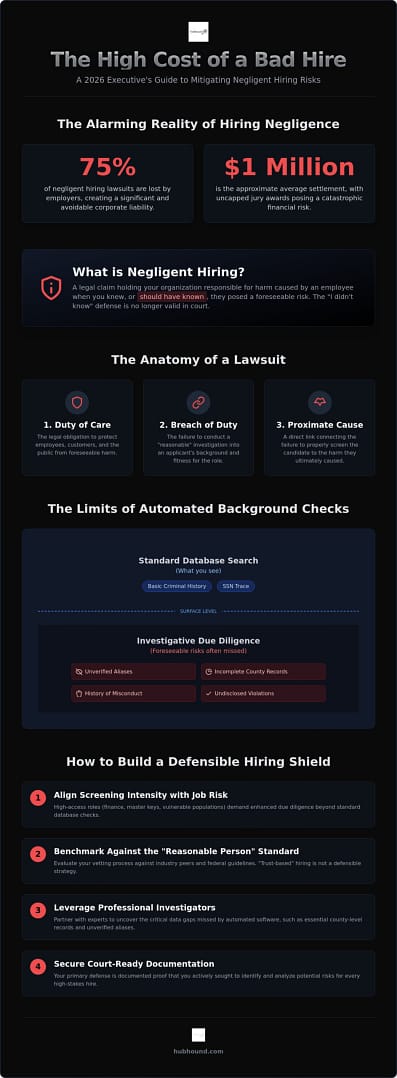
Employers lose 75% of negligent hiring cases, with the average settlement now reaching approximately $1 million. In 2026, simply running a standard background check is no longer a sufficient defense against claims of workplace violence or theft. Reducing the risk of a negligent hiring lawsuit requires a shift from passive screening to an active, investigative process that proves your organization exercised reasonable care. You need a strategy that identifies foreseeable risks before a candidate ever joins your team.
You likely feel the pressure to fill roles quickly while simultaneously fearing the massive jury awards that follow a single bad hire. We understand that balancing speed with thorough vetting is a constant challenge for modern executives. This guide provides the blueprint you need to build a defensible hiring framework that protects your organization from liability and misconduct. We will explore the latest 2026 legislative shifts, including the rise of Clean Slate and Fair Chance laws, and the specific steps necessary to achieve peace of mind during the onboarding process.
Key Takeaways
- Analyze the legal theory of “should have known” to understand how recent multi-million dollar settlements redefine corporate liability in 2026.
- Benchmark your current vetting process against the “Reasonable Person” standard to ensure your documentation survives modern legal scrutiny.
- Deploy a standardized 5-step framework for reducing the risk of a negligent hiring lawsuit by aligning screening intensity with specific job-related risks.
- Recognize the critical data gaps in automated background check software that frequently miss unverified aliases and essential county-level records.
- Establish a defensible hiring shield by leveraging professional investigators to secure verified, court-ready documentation for every high-stakes hire.
What is Negligent Hiring? Defining Your Liability in 2026
Negligent hiring is a legal theory that holds your organization responsible for harm caused by an employee when you knew, or should have known, that the individual posed a risk. In 2026, the “I didn’t know” defense has effectively vanished from the courtroom. Modern litigation focuses on whether a reasonable investigation would have uncovered the threat. The financial consequences are severe. Average settlements for these claims hover around $1 million, and employers lose approximately 75% of these cases. High-stakes industries like transportation and healthcare are particularly vulnerable. For instance, recent multi-million dollar awards have followed incidents of workplace violence, sexual harassment, or large-scale corporate theft where a candidate’s history of misconduct was discoverable but ignored during the onboarding phase.
The Three Elements of a Negligent Hiring Claim
To understand What is Negligent Hiring, you must recognize the three components of a successful claim. First, the plaintiff must establish a Duty of Care. This means your organization had a legal obligation to protect employees, customers, and the public from foreseeable harm. Second, there must be a Breach of Duty. This occurs when you fail to conduct a “reasonable” investigation into an applicant’s background. Finally, the plaintiff must prove Proximate Cause. This links your failure to screen directly to the harm committed. If a driver with multiple undisclosed traffic violations causes a fatal accident, your failure to check their driving record is the proximate cause of the liability. Reducing the risk of a negligent hiring lawsuit depends entirely on addressing these three pillars before a contract is signed.
Negligent Hiring vs. Vicarious Liability
It’s critical to distinguish between negligent hiring and vicarious liability. Vicarious liability holds an employer responsible for an employee’s “on-the-clock” actions performed within the scope of their employment. Negligent hiring is different. It focuses on the employer’s own negligence in bringing the person into the company. Because this is a direct claim against the business, it often bypasses standard workers’ compensation limits, exposing your assets to uncapped jury awards. Utilizing comprehensive workplace investigations can help identify existing internal risks, but the focus remains on the initial vetting. Prioritizing thorough pre-employment screening is the most effective method for reducing the risk of a negligent hiring lawsuit while maintaining organizational integrity.
The Legal Pillars: Duty of Care and Foreseeability
Courts evaluate your hiring process through the lens of the “Reasonable Person” standard. This legal benchmark asks whether a prudent executive, facing similar circumstances, would have performed the same level of due diligence. In modern litigation, juries compare your internal protocols against established industry peers and federal guidelines. To understand how these standards are applied, executives should review The Legal Pillars: Duty of Care and Foreseeability provided by the EEOC. These guidelines clarify the balance between thorough vetting and non-discriminatory practices. Relying on “trust-based” hiring or gut instincts creates a significant “Lack of Scrutiny” trap. If an employee causes harm, the court will look for documented proof that you actively sought to identify potential risks. Documentation is your primary defense; without it, you cannot prove that you met your legal obligations.
Foreseeability is the second critical pillar. It determines whether you could have predicted an employee’s harmful behavior based on available records. If a candidate has a history of violence that a standard search would have uncovered, any future workplace incident is considered foreseeable. Reducing the risk of a negligent hiring lawsuit requires a proactive approach to discovery. You must demonstrate that you didn’t just check a box, but actually analyzed the information to protect your staff and clients.
Establishing Foreseeability in Pre-Employment Screening
The depth of your investigation must match the sensitivity of the job role. High-access positions, such as those involving financial data, master keys, or vulnerable populations, require enhanced due diligence. For these roles, a standard database sweep is insufficient. You must investigate resume gaps and follow up on vague reference checks. These “red flags” are often the first indicators of a problematic history. Ignoring these signals makes any subsequent misconduct legally foreseeable, directly increasing your liability exposure.
The Burden of Proof: What Juries Expect Today
Juries in 2026 expect more than a simple criminal “hit/no-hit” report. They want to see a comprehensive vetting process that reflects the candidate’s level of responsibility. When hiring for leadership roles, verifying corporate due diligence is essential to uncover hidden conflicts of interest or past professional misconduct. Duty of Care is the proactive obligation to verify an applicant’s suitability for a specific role. Meeting this burden requires a shift from automated software to investigative rigor. To ensure your process meets these evolving legal expectations, consider upgrading to professional Pre-Employment Background Checks that provide court-ready documentation for every hire.
Beyond the Database: Why Automated Background Checks Often Fail
Low-cost, automated screening apps offer a dangerous false sense of security. These tools prioritize speed over depth, often missing the very records that trigger liability. Standard software typically scrapes multi-jurisdictional databases that are notoriously outdated or incomplete. They frequently fail to capture county-level records, unverified aliases, or recent filings that haven’t been indexed. Professional investigators go beyond these digital snapshots to uncover primary source documents. Incorporating comprehensive pre-employment background checks into your risk management strategy is the only way to ensure your data is both current and accurate. This level of rigor is non-negotiable for reducing the risk of a negligent hiring lawsuit in a litigious 2026 environment.
Software-only solutions are designed for volume, not validation. They can’t navigate the nuances of sealed records, expungements, or the “Clean Slate” laws that have expanded across the country. When your vetting process relies on a computer algorithm, you’re betting your company’s reputation on the hope that every court clerk in the nation has perfectly digitized their records. Real-world data is messy. It requires a human expert to connect the dots between disparate records and unverified identifiers.
Automated Screening vs. Professional Investigation
A 24-hour turnaround time usually signals a shallow search. Speed often comes at the expense of accuracy. While software identifies “hits,” it cannot interpret court documents or resolve conflicting identifiers. The human element is essential for verifying that a record actually belongs to the applicant. In one instance, standard screening software returned a clean report for a high-level candidate. However, a professional investigator uncovered a court martial record that was hidden in a non-indexed military archive. This discovery prevented a catastrophic hire and protected the firm from massive future liability.
The Risk of “Clean” Reports
A “no record found” result doesn’t guarantee a clean history. It often means the software looked in the wrong place. Record-keeping varies wildly across different jurisdictions, and many local courts don’t share data with national aggregators. For high-stakes executive positions, you must verify every claim with precision. In some cases, legal advanced surveillance techniques are necessary to confirm a candidate’s lifestyle or professional associations. Relying on automated summaries leaves your organization exposed to the gaps between digital databases. True security comes from investigative depth, not just a software subscription.
A Defensible 5-Step Framework for Reducing Hiring Risk
A defensible hiring process requires more than just a background check; it demands a repeatable, documented framework. Reducing the risk of a negligent hiring lawsuit is achieved through active risk management that evolves with the role. Executives must move beyond simple compliance to build an investigative shield around the organization. This five-step framework provides a structured approach to identifying foreseeable risks before they become liabilities. Consistency is your greatest asset in a courtroom. When every applicant for a specific role undergoes the same rigorous vetting, you eliminate the gaps that plaintiffs’ attorneys exploit.
The transition from “hiring” to “retention” is where many organizations fail. Liability doesn’t end on the employee’s first day. Negligent retention is the legal risk of keeping a dangerous individual on the payroll after they’ve demonstrated harmful behavior or misconduct. A modern framework must account for the entire employee lifecycle. This involves documenting every verification step and being prepared to act when warning signs appear post-hire. By following a standardized process, you prove that your organization exercised reasonable care at every stage of the relationship.
Step 1 & 2: Creating the Policy and Tailoring the Search
Start by defining “high-risk” positions within your organizational chart. These roles typically involve access to financial assets, sensitive data, or vulnerable populations. Your screening policy must comply with the latest federal and local regulations, including the nationwide trend toward Clean Slate and Fair Chance legislation. Consistency in screening is the best defense against discrimination claims. Tailor the depth of your investigation to the specific risks associated with the job. A warehouse worker may require a standard criminal search, while a high-level executive requires a deep-dive investigation into their professional history and associations.
Step 3, 4 & 5: Verification, Documentation, and Retention
Verification must move beyond the resume to confirm education, employment history, and professional licenses directly with the source. For senior-level hires, conducting witness interviews & statements provides qualitative data that automated software cannot replicate. When “red flags” appear, document your analysis and the steps taken to resolve the concern. If warning signs emerge after an employee is hired, you must be prepared to conduct Workplace Misconduct Investigations immediately. This proactive stance prevents negligent retention and demonstrates your ongoing commitment to workplace safety. Secure your organization by implementing professional Pre-Employment Background Checks to ensure every hire is a safe one.
Partnering with Professional Investigators: Your Shield Against Liability
Software vendors often hide behind complex terms of service that limit their liability. These disclaimers effectively shift the burden of accuracy back onto your organization. If an automated “clean” report fails to reveal a history of misconduct, the software provider isn’t the one facing a jury. Professional investigators operate under a much higher standard of accountability. They provide a documented trail of active inquiry that fulfills the “Reasonable Care” requirement in a way that automated algorithms cannot. This proactive partnership is the most robust strategy for reducing the risk of a negligent hiring lawsuit in a 2026 legal environment where “I didn’t know” is no longer a valid defense.
Licensed investigators deliver court-ready evidence. When an incident occurs, a PDF summary from a low-cost app rarely survives rigorous cross-examination. HubHound provides comprehensive reports that demonstrate a commitment to workplace safety through verified, primary-source documentation. By transitioning from software-based screening to professional Corporate Due Diligence, you ensure that every high-stakes hire is backed by an investigative shield. This approach reduces the cognitive load on your HR team, allowing them to focus on talent acquisition while we handle the complexities of deep-dive verification.
The HubHound Advantage in Risk Mitigation
HubHound provides access to professional investigators with decades of industry experience. Our approach goes beyond simple database scraping to include specialized services that software-only solutions ignore. We offer a comprehensive suite of tools designed to uncover hidden risks:
- Skip Tracing / Locate Investigations: Verifying the true history of applicants who use aliases or have unexplained gaps in their residential history.
- Asset Searches: Identifying potential conflicts of interest or financial pressures that could lead to corporate theft.
- Surveillance Operations: Confirming the validity of professional claims for high-level executive positions.
These methods ensure your hiring process meets the highest standards of professional due diligence, protecting your organization from multi-million dollar liability.
Next Steps: Evaluating Your Current Risk Profile
Start by conducting an audit of your existing background check protocols. If your current system relies solely on automated apps, you likely have significant gaps in your “Reasonable Care” documentation. Transitioning to professional investigative services is essential for roles that involve access to sensitive data, financial assets, or vulnerable populations. Don’t wait for a workplace incident to reveal the weaknesses in your vetting process. Contact HubHound today for a professional consultation on your high-stakes hiring needs and secure a Pre-Employment Background Check that stands up in court.
Secure Your Organization with Investigative Rigor
The legal landscape of 2026 demands a higher standard of due diligence than ever before. Relying on automated software creates dangerous gaps in your defense, leaving your company vulnerable to multi-million dollar settlements. Reducing the risk of a negligent hiring lawsuit requires a commitment to a standardized, investigative framework that prioritizes human verification over digital speed. By establishing a clear duty of care and documenting every step of your vetting process, you build a defensible shield against future claims of workplace misconduct or violence.
Don’t leave your organization’s reputation to chance with unverified database scrapes. HubHound provides the specialized expertise needed to navigate complex hiring environments. Our licensed investigators bring over three decades of experience to every case, offering specialized corporate due diligence and workplace investigations that software-only solutions miss. We provide the comprehensive litigation support and evidence gathering necessary to protect your interests. Protect your business with professional pre-employment background checks from HubHound and ensure your onboarding process is as secure as it is efficient.
Building a safer workplace starts with the right information. Take the first step toward total organizational integrity today.
Frequently Asked Questions
What is the most common cause of a negligent hiring lawsuit?
Workplace violence is the most frequent trigger for these claims. Juries often hold employers liable when an employee with a discoverable history of assault or threats harms a coworker, customer, or member of the public. If a reasonable investigation could have uncovered a propensity for violence, the harm is considered legally foreseeable. To further protect your physical premises and staff, you can discover 11 Bravo Security for professional armed and unarmed guard services.
Can an employer be sued for negligent hiring if they did a criminal background check?
Yes, you can still face litigation if the background check was deemed “unreasonable” or insufficient for the role’s risk level. Relying on a low-cost, automated database that misses recent convictions or fails to verify aliases doesn’t satisfy your duty of care. Courts expect the depth of your search to match the candidate’s level of access and responsibility.
How far back can an employer look into a candidate’s criminal history to avoid negligence?
Most employers use a seven-year lookback period, but 2026 regulations are rapidly shifting this standard. New “Clean Slate” and “Fair Chance” laws in various jurisdictions have reduced the lookback period for certain misdemeanors to four years. It’s essential to align your search depth with both federal FCRA standards and evolving local requirements to maintain a defensible process.
What is the difference between negligent hiring and negligent retention?
Negligent hiring occurs when an employer fails to screen out a dangerous applicant during the onboarding phase. Negligent retention happens when an employer keeps an individual on the payroll after they demonstrate harmful behavior or misconduct post-hire. Both legal theories hold the organization responsible for failing to protect others from a known or discoverable threat.
How does the Fair Credit Reporting Act (FCRA) impact negligent hiring defenses?
The FCRA provides the procedural floor for how you must handle background data. Following the mandatory two-step adverse action process is critical for reducing the risk of a negligent hiring lawsuit. Failure to follow these federal transparency requirements can be used as evidence that your organization lacks a standardized, reasonable hiring policy.
Is “Open Hiring” a viable way to avoid negligent hiring lawsuits?
Open hiring is extremely risky for any role that involves a duty of care toward others. By intentionally bypassing the vetting process, you essentially waive your ability to argue that harm wasn’t foreseeable. In roles with access to vulnerable populations, financial assets, or private homes, open hiring is often viewed as a per se breach of duty.
What should I do if a background check reveals a criminal record?
Perform an individualized assessment rather than implementing an automatic disqualification policy. You must evaluate the nature of the crime, how much time has passed, and whether the offense is directly related to the job duties. Documenting this analysis proves that you exercised reasonable care while complying with EEOC non-discrimination guidelines.
How much does a professional pre-employment investigation cost compared to a lawsuit?
The cost of a professional investigation is a fraction of the financial damage caused by a bad hire. While a thorough check is a minor operational expense, the average settlement for a negligent hiring claim is approximately $1 million. Even if you win, the average legal fee to defend an employment lawsuit is about $200,000, making pre-employment vetting a necessary investment.

Article by
Joel R. Manley | President | Hubhound Investigations | OR PI-ID#: 90432 | 111 SW Fifth Avenue, Suite 3150 Portland, Oregon 97204 | 971-442-8170
Joel is licensed as a private investigator in Oregon and Tennessee. Joel started his career in 1987 serving as a Military Police Officer and Military Police Investigator.
After ending his military tour of duty, Joel became a civilian Police Officer and Deputy Sheriff. Joel took his strong background in Hostage Negotiations, Mediation and Conflict Resolution, with him to patrol some of the highest crime areas in SE Portland.
Joel was awarded Deputy of the Year for his efforts and for drastically reducing the crime rate in the area he patrolled. As a Deputy Sheriff, Joel assisted in leading a Neighborhood Livability Program that was nationally recognized for having the most innovative and progressive approach to policing.
In 2018, Joel retired as a Deputy Sheriff and founded Hubhound Investigations. Joel played an integral role in Hubhound Investigations receiving an A+ Accredited Business rating from the Better Business Bureau (BBB).
In his off time, Joel enjoys spending time with his wife, adult children and Hubhound’s Happiness Ambassador, Nya. Joel also enjoys Scuba Diving and Kayaking.
Disclaimer
DISCLAIMER: This article is provided for general informational and educational purposes only. It is not intended to constitute legal advice, professional investigative advice, or instruction to engage in any unlawful activity. Laws governing private investigations, surveillance, recording, tracking, access to information, evidence collection, privacy, trespass, licensing, and related investigative activities vary by jurisdiction and are subject to change.
Any investigative techniques, tactics, procedures, scenarios, or legal proceedings discussed in this article are presented for informational purposes and should not be interpreted as authorization or encouragement to use a particular method. Private investigators and members of the public are responsible for understanding and complying with all applicable federal, state, and local laws, licensing requirements, court rules, and professional standards.
The circumstances of every investigation and legal matter are different. Information contained in this article should not be relied upon as a substitute for advice from a qualified attorney or other appropriate licensed professional regarding a specific situation. No attorney-client, investigator-client, or other professional relationship is created by reading or using this information.