
What if the only thing standing between you and a successful trial is a witness who simply refuses to be found? You’ve likely dealt with the frustration of witnesses ghosting your team or gatekeepers blocking every point of entry. When standard delivery fails, serving a subpoena to an uncooperative witness requires a tactical shift from administrative tasking to professional investigation. Wasted time and failed service attempts don’t just hurt your bottom line; they risk the dismissal of your case.
It’s a challenge every litigation professional faces, but you don’t have to let an evasive subject dictate your timeline. This article provides the expert advice you need to master investigative techniques and secure a valid affidavit of service that stands up in court. We’ll explore the latest 2026 updates to Federal Rule of Civil Procedure 45, including the authority to compel remote testimony from witnesses within 100 miles of their home. You’ll learn how to leverage skip tracing and surveillance to ensure your witness appears for their deposition or trial as required.
Key Takeaways
- Differentiate between subpoenas for testimony and those for documents to ensure your legal filing is precise and enforceable.
- Recognize common evasion tactics such as ghosting and gatekeeping to shift your strategy from standard delivery to tactical investigation.
- Utilize skip tracing and surveillance to establish a “pattern of life” when serving a subpoena to an uncooperative witness.
- Prioritize licensed investigative agencies to secure a valid affidavit of service that withstands rigorous court scrutiny.
- Leverage 2026 legal updates, such as the authority to compel remote testimony, to bypass geographic obstacles.
The Legal Mandate: Why Subpoenas Are Necessary for Uncooperative Witnesses
A subpoena isn’t a polite request for participation; it’s a high-stakes court order that demands compliance. When you’re serving a subpoena to an uncooperative witness, you’re exercising the court’s authority to compel evidence. Understanding what is a subpoena is the first step in managing a hostile subject. These documents come in two primary forms. A Subpoena Ad Testificandum requires an individual to provide oral testimony, while a Subpoena Duces Tecum mandates the production of physical evidence or documents. Both are essential tools for building a complete evidentiary record.
Many witnesses believe that simply stating “I don’t want to get involved” provides a legal shield against participation. This is a common misconception. The law doesn’t recognize personal preference or inconvenience as a valid defense for ignoring service. If a witness is validly served and fails to appear, they face severe consequences, including being held in contempt of court. This can result in significant fines or even incarceration. The judicial system relies on the availability of all relevant evidence to function correctly, and judges don’t take kindly to individuals who obstruct that process by ignoring a mandate.
The Power of Compulsory Process
The Sixth Amendment grants defendants the right to compulsory process to obtain witnesses in their favor. This constitutional framework ensures that subpoenas protect the integrity of the judicial system by ensuring all relevant evidence is heard, regardless of a witness’s willingness to speak. In the eyes of the law, the distinction between a friendly witness and a hostile witness is purely behavioral. Both are equally subject to the court’s power. Without this mechanism, trials would become voluntary exercises rather than rigorous searches for the truth.
When ‘Standard’ Service Isn’t Enough
Routine process servers often hit a wall when faced with a witness who is actively evading service. This is the critical point where an administrative task must evolve into a tactical operation led by an investigator. “Bad service” is a massive liability. If the service is ruled invalid, your entire litigation strategy could collapse at the worst possible moment. Specialized criminal defense investigations are often necessary to bridge the gap between a witness’s location and their actual appearance in court. These investigators go beyond simple delivery, using professional techniques to ensure that serving a subpoena to an uncooperative witness is executed flawlessly and survives legal challenges.
Identifying Obstacles: Common Tactics Used by Evasive Witnesses
Success in serving a subpoena to an uncooperative witness depends on recognizing the difference between someone who is merely reluctant and someone who is actively hiding. While the legal definition of a subpoena makes participation mandatory, many subjects use “ghosting” to avoid the initial hand-off. They change their daily routes, block phone numbers, and scrub their immediate social media presence to become invisible. This behavior turns a routine legal delivery into a game of cat and mouse that can stall your case for weeks.
Some subjects escalate to “hard evasion.” This involves using aliases or moving residences every few weeks to stay ahead of process servers. In these cases, a routine delivery attempt won’t work. You need a deep dive into their current lifestyle to establish a pattern of movement. If you find yourself stuck behind these smoke screens, professional skip tracing investigations can often identify the subject’s current location by analyzing non-public data points that standard searches miss.
The “refusal to open” tactic is another common legal hurdle. Process servers generally cannot force entry into a private residence without specific court authorization. If a witness sees a server through a window or doorbell camera and refuses to engage, the server must remain on public property or in common areas. This creates a stalemate. You can’t kick the door down, so you must wait for the subject to exit. This requires patience and a sophisticated surveillance approach to catch the witness during a transition, such as leaving for work or running errands.
Passive vs. Active Evasion
Passive evasion is often driven by fear or a desire to avoid “drama.” The subject simply stops answering the door or phone, hoping the problem goes away. Active evasion is more calculated. It involves proactive steps to deceive, such as parking blocks away from home, using back entrances, or even wearing disguises. Identifying these motivations helps determine your strategy. A fearful witness might respond to a professional explanation of their rights, while a malicious evader requires a rigorous surveillance operation to ensure service is completed during a window of vulnerability.
The Gatekeeper Challenge
Gatekeepers like family members, coworkers, or security guards present a unique legal challenge. You can’t harass them, but you can professionally inform them of the witness’s legal obligations. There’s a fine line between a protective spouse and someone committing obstruction of justice by providing false information to an officer of the court. Learn to cross-reference gatekeeper claims against data-driven facts. If a receptionist claims the witness doesn’t work there, but your surveillance shows them entering the building daily, you have the evidence needed to challenge that gatekeeper’s narrative and potentially involve law enforcement if the obstruction continues.
Beyond Standard Delivery: Tactical Strategies for Serving the Uncooperative
When standard delivery fails, the process moves from simple courier work to tactical investigation. Successfully serving a subpoena to an uncooperative witness requires a structured, multi-step approach. Start with a comprehensive background scan to verify current residential and employment data. Don’t rely on outdated records or word-of-mouth. Once location data is confirmed, transition to surveillance to establish a “pattern of life.” This analysis identifies the exact window when the witness is most vulnerable to service, such as when they are leaving their home for work or returning from daily errands.
If personal service remains impossible after multiple attempts, employ legally recognized alternatives like “Substituted Service” or “Nail and Mail” where jurisdictions permit. These methods often require a specific number of documented personal attempts before they become legally valid. If the subject remains elusive, consider creative approaches such as serving at public events or during transit. Throughout this process, document every attempt with meticulous detail, including dates, times, and descriptions of the surroundings. This log is the foundation for a motion for alternative service, proving to the court that you have exhausted all reasonable efforts.
Alternative Methods of Service
Service by publication is the final remaining option when a witness has completely disappeared. This involves placing a notice in a newspaper of record, but it’s a high bar to clear. You must first file an Affidavit of Diligent Search, proving you’ve checked utility records, credit headers, and last known addresses. By 2026, more courts have begun entertaining service via social media or email. However, these digital methods are highly specific to the jurisdiction and usually require a separate court order after traditional methods fail to yield results.
The Stakeout: Using Surveillance to Close the Gap
Discreet surveillance techniques allow a server to wait for the witness to leave their perceived fortress. Timing is everything. By observing predictable movements over several days, an investigator can pinpoint when a witness is most likely to be in a public space where service can be legally executed. It’s vital to ensure all surveillance remains within the bounds of privacy laws; never trespass or utilize invasive technology that violates a subject’s reasonable expectation of privacy. This professional restraint ensures that the resulting service survives any motion to quash while ensuring the witness is held accountable to the court’s mandate.
The Role of Skip Tracing and Surveillance in Legal Service
Skip tracing is the bridge between a witness who has gone dark and a successful court appearance. While a standard process server might check a phone book or a basic search engine, professional investigators use high-level data analysis to locate individuals who don’t want to be found. Successfully serving a subpoena to an uncooperative witness requires accessing non-public databases that track credit headers, utility records, and updated mailing addresses. These proprietary tools provide a much higher level of accuracy than anything available to the general public, allowing investigators to filter through noise and identify a subject’s current physical location.
Investigators also analyze the subject’s digital footprint to supplement database findings. Social media check-ins, geotagged photos, and public interactions on professional platforms often provide real-time location data that a static address cannot. There is a powerful synergy between this data-driven skip tracing and boots-on-the-ground surveillance. Data points tell an investigator where a witness should be; surveillance confirms exactly where they are. This combined approach ensures that service attempts are not wasted on empty houses or outdated workplaces.
Locating the ‘Unlocatable’
In extreme cases, missing adults investigations are required to find witnesses who have completely severed ties with their known life. These operations go deeper than standard skip tracing, often involving interviews with former associates or neighbors. Investigators may use pretexting, which involves a legally permissible ruse to confirm a subject’s presence, provided it stays within legal boundaries and doesn’t impersonate law enforcement. Workplace investigations also serve as a vital fallback when a witness has fortified their home against service attempts.
Verifying Identity Before Service
Denial of service is a common tactic used by evasive subjects who claim the server has the wrong person. To counter this, investigators use advanced techniques to confirm identity before the hand-off occurs. Body-worn cameras are now a standard tool for recording the interaction, providing indisputable evidence that the correct individual was served. For high-profile cases, corporate investigation firms handle service with a level of discretion and professionalism that ensures the legal mandate is respected. If your case is stalled by a witness who has vanished, you can secure the evidence you need by utilizing professional skip tracing and locate investigations to find them.
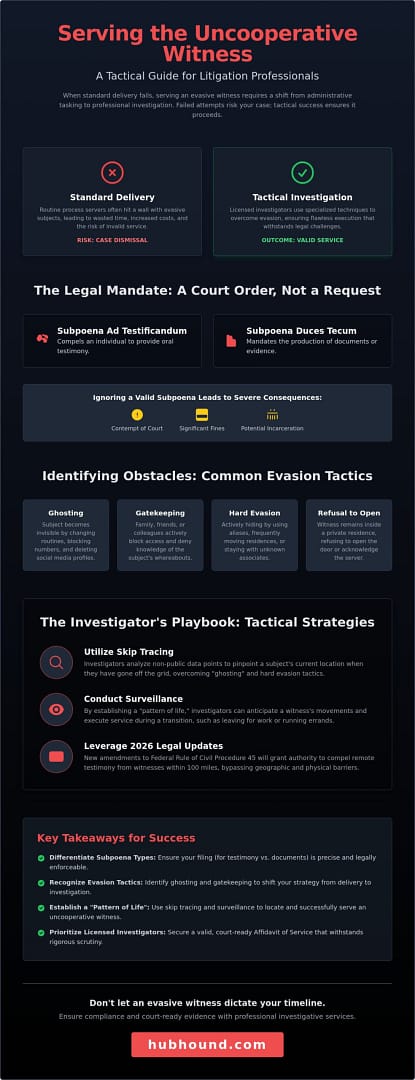
Professional Process Service: Ensuring Compliance and Court-Ready Evidence
Hiring a licensed professional investigative agency provides a strategic advantage that standard couriers or county sheriffs cannot match. While a sheriff’s department is often overburdened with a high volume of routine tasks, an investigator treats the assignment as a targeted operation. This distinction is critical when serving a subpoena to an uncooperative witness. Investigators possess the persistence required to navigate complex gatekeeper scenarios and the legal knowledge to execute “drop service” correctly. If a witness refuses to physically touch the documents, a professional server can legally leave the papers in their immediate presence while identifying the contents. This ensures the action complies with the Due Process Clause of the Constitution by providing the subject with actual notice of their legal obligations.
The integrity of your litigation depends on the quality of the evidence documenting the service. A routine “delivery confirmed” notification isn’t enough to withstand a rigorous legal challenge. You need a foundational document that proves the witness was given every opportunity to comply. Professional investigators prioritize the creation of a comprehensive record that tracks every interaction, movement, and refusal. This level of detail transforms a simple administrative act into a fortified legal event that protects your case from claims of improper notice.
Handling Hostile Encounters
Hostile witnesses often react with anger or physical aggression to avoid being served. Professional servers use proven de-escalation techniques to maintain safety while fulfilling their legal mandate. They are trained to remain calm, avoid inflammatory language, and keep a safe distance. If a situation becomes dangerous, an investigator knows how to coordinate with local law enforcement for standby assistance. This ensures the service is completed without violating any laws or compromising the server’s safety. Many jurisdictions recognize the importance of this role by providing specific legal protections to servers acting in their official capacity.
The Final Product: The Affidavit of Service
A bulletproof Affidavit of Service is your best defense against a “Motion to Quash.” This document must include the precise date, time, and location of the service, along with a detailed physical description of the person served. Modern investigators supplement their written testimony with photographic or video evidence from body-worn cameras to eliminate any “denial of service” claims. If the witness later challenges the service in court, the investigator is prepared to provide expert testimony regarding the encounter. This comprehensive approach ensures that serving a subpoena to an uncooperative witness results in a court-ready record that keeps your litigation moving forward.
Mastering the Art of Tactical Legal Service
Success in litigation often hinges on your ability to secure testimony from those who would rather remain in the shadows. Transitioning from standard delivery to a tactical investigative approach ensures that evasion tactics like ghosting or gatekeeping don’t derail your case. By leveraging high-level data analysis and discreet surveillance, you can establish the necessary “pattern of life” to execute service with precision. This proactive strategy provides the court-ready evidence required to move your proceedings forward without unnecessary delay.
Professional investigators bring a level of persistence and legal expertise that administrative couriers simply cannot match. When serving a subpoena to an uncooperative witness, you need the support of licensed experts who understand the nuances of skip tracing and the production of bulletproof affidavits. With over 30 years of experience, HubHound provides the specialized capabilities and court-ready documentation necessary to protect your legal strategy. Secure your testimony today with HubHound’s professional legal support services. You have the legal right to the truth; we provide the tools to ensure it is heard in court.
Frequently Asked Questions
What happens if a witness refuses to touch the subpoena papers?
Service remains legally effective even if the target refuses to physically take the papers in their hand. If the server identifies the witness and clearly states the nature of the legal documents, they can leave the papers at the subject’s feet or in their immediate vicinity. This “drop service” is a standard investigative technique that prevents evasive individuals from stalling a case through simple physical non-compliance.
Can you serve a subpoena to a witness at their place of employment?
Serving a subpoena at a place of employment is generally permitted and often effective when home service fails. While you must respect the employer’s private property rights and security protocols, a witness cannot legally refuse service just because they’re at work. It’s often a preferred method for serving a subpoena to an uncooperative witness who is intentionally shielding their residential address from public records.
How many times will a process server try to serve an uncooperative witness?
Most professional servers make between three and five attempts at different times of day before declaring a subject evasive. If these initial efforts fail, the process typically shifts to an investigative phase involving skip tracing and surveillance. Meticulous documentation of these failed attempts is required to petition the court for alternative methods of service, such as service by publication.
Is it legal to serve a subpoena on a Sunday or a holiday?
The legality of service on Sundays or holidays varies by jurisdiction; some regions strictly prohibit it while others allow it without restriction. You should verify the specific rules governing the area where the witness is located to ensure the service isn’t ruled invalid. Professional investigators always check these specific statutes before scheduling a high-stakes delivery to avoid any procedural challenges later.
What is ‘substituted service’ and when can it be used for uncooperative witnesses?
Substituted service allows a server to leave the subpoena with a person of suitable age and discretion at the witness’s home or office. This method is used after a server has demonstrated “due diligence” in attempting personal service. It typically requires a follow-up mailing to the witness’s last known address to satisfy constitutional due process requirements and ensure the court accepts the service.
Can a witness be arrested for avoiding a subpoena?
A witness cannot be arrested simply for evading a process server, but they face significant legal jeopardy once service is successfully completed. If a witness is validly served and fails to appear for their scheduled testimony, a judge may issue a bench warrant for their arrest. This is categorized as contempt of court and can lead to significant fines or even jail time.
How much does it cost to hire an investigator for difficult process service?
The cost of hiring an investigator for difficult cases depends on the complexity of the subject’s evasion tactics and the resources required to find them. Factors such as the need for deep-web skip tracing, long-term surveillance, or multiple stakeout locations will influence the total investment. serving a subpoena to an uncooperative witness usually requires more specialized labor and investigative hours than a routine delivery.
Can I serve a subpoena myself if the witness is being difficult?
You generally cannot serve a subpoena yourself if you’re a party to the litigation. Most rules of civil procedure require a neutral third party over the age of 18 to perform the service. Hiring a professional is especially important with uncooperative subjects to ensure the affidavit of service is legally sound and to avoid personal confrontations that could jeopardize the case.

Article by
Joel R. Manley | President | Hubhound Investigations | OR PI-ID#: 90432 | 111 SW Fifth Avenue, Suite 3150 Portland, Oregon 97204 | 971-442-8170
Joel is licensed as a private investigator in Oregon and Tennessee. Joel started his career in 1987 serving as a Military Police Officer and Military Police Investigator.
After ending his military tour of duty, Joel became a civilian Police Officer and Deputy Sheriff. Joel took his strong background in Hostage Negotiations, Mediation and Conflict Resolution, with him to patrol some of the highest crime areas in SE Portland.
Joel was awarded Deputy of the Year for his efforts and for drastically reducing the crime rate in the area he patrolled. As a Deputy Sheriff, Joel assisted in leading a Neighborhood Livability Program that was nationally recognized for having the most innovative and progressive approach to policing.
In 2018, Joel retired as a Deputy Sheriff and founded Hubhound Investigations. Joel played an integral role in Hubhound Investigations receiving an A+ Accredited Business rating from the Better Business Bureau (BBB).
In his off time, Joel enjoys spending time with his wife, adult children and Hubhound’s Happiness Ambassador, Nya. Joel also enjoys Scuba Diving and Kayaking.
Disclaimer
DISCLAIMER: This article is provided for general informational and educational purposes only. It is not intended to constitute legal advice, professional investigative advice, or instruction to engage in any unlawful activity. Laws governing private investigations, surveillance, recording, tracking, access to information, evidence collection, privacy, trespass, licensing, and related investigative activities vary by jurisdiction and are subject to change.
Any investigative techniques, tactics, procedures, scenarios, or legal proceedings discussed in this article are presented for informational purposes and should not be interpreted as authorization or encouragement to use a particular method. Private investigators and members of the public are responsible for understanding and complying with all applicable federal, state, and local laws, licensing requirements, court rules, and professional standards.
The circumstances of every investigation and legal matter are different. Information contained in this article should not be relied upon as a substitute for advice from a qualified attorney or other appropriate licensed professional regarding a specific situation. No attorney-client, investigator-client, or other professional relationship is created by reading or using this information.