
What if your spouse’s intentional disappearance isn’t a legal dead end, but a tactical hurdle that can be cleared with the right investigative framework? It’s incredibly frustrating to watch legal fees climb while your divorce remains stalled because one party refuses to be found. You’re likely exhausted by the cycle of unsuccessful service attempts and the stress of a life kept on hold. This guide provides the strategic roadmap you need to learn how to serve divorce papers to a spouse who is hiding, moving your case from a standstill to a clear resolution.
Evasion shouldn’t dictate your future. We’ll examine the rigorous skip tracing methods used to track elusive individuals and the specific legal workarounds, such as substituted service, that courts authorize when personal delivery fails. You’ll discover how to document your due diligence to meet constitutional requirements and gain court approval for alternative methods. By applying these professional investigative tactics, you can resume your divorce timeline and regain control over your legal proceedings with confidence and efficiency.
Key Takeaways
- Understand why service of process is a mandatory constitutional requirement and how evasion merely delays, rather than prevents, the finalization of your divorce.
- Master the tactical investigative methods used to identify the current location and daily patterns of an evasive individual when learning how to serve divorce papers to a spouse who is hiding.
- Evaluate the legality of serving papers in public spaces or at a place of employment to bypass common door-dodger evasion strategies.
- Identify the specific requirements for court-ordered alternatives, including substituted service and service by publication, as a final resort for missing spouses.
- Discover how professional skip tracing and process service integration can streamline your legal timeline and prevent escalating costs from failed attempts.
Understanding Service of Process: Why You Cannot Proceed Without It
Service of process isn’t just a bureaucratic hurdle; it’s a fundamental constitutional right. The Fifth and Fourteenth Amendments guarantee that no person shall be deprived of life, liberty, or property without due process of law. In the context of domestic litigation, this means your spouse must receive formal, legal notification of the case. Many people mistakenly believe that by disappearing, they can permanently halt a legal filing. This is a misconception. Evasion merely delays the timeline; it doesn’t grant immunity. If you’re struggling with a partner who has gone off the grid, you need to master Understanding Service of Process to ensure your case remains on track. Learning how to serve divorce papers to a spouse who is hiding is the first step in overcoming these intentional delays.
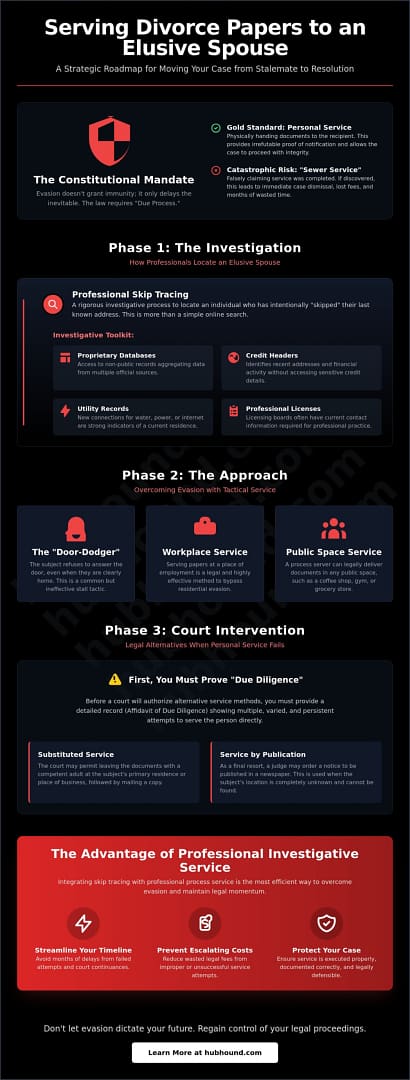
Courts consider personal service the gold standard. This involves physically handing the documents to the recipient, providing irrefutable proof that the party is aware of the action. However, the pressure to complete service sometimes leads to “sewer service.” This occurs when a server falsely claims to have delivered papers that they actually discarded. This is a catastrophic risk for your case. If a judge discovers service was fraudulent or improper, they’ll dismiss your case immediately. You’ll lose your filing fees, your legal momentum, and months of progress. Reliable delivery is the only way to protect the integrity of your filing.
The Role of the Process Server
While you can hire a county sheriff or constable, these officials often lack the resources for investigative work. They typically make a few attempts during standard business hours and move on to the next task. A professional process server operates with higher agility and specialized focus. They’re trained to track evasive subjects and document every attempt with precision. Once successful, they provide an Affidavit of Service. This sworn statement is the critical evidence the court requires to verify that the spouse was legally notified and that the case can proceed.
Consequences of Evasion
Service of process is the constitutional bridge between filing a petition and receiving a judgment. When a spouse intentionally hides, they aren’t just inconveniencing you; they’re obstructing the court’s authority. Judges don’t look kindly on “door-dodging” tactics. If evasion is documented, the court may eventually issue sanctions or allow the case to proceed as a default. This often results in unfavorable rulings for the hiding party regarding asset division or child custody. Knowing how to serve divorce papers to a spouse who is hiding ensures you don’t become a victim of their stall tactics while protecting your right to a timely resolution.
Skip Tracing: How Professionals Locate a Spouse Who Is Hiding
Finding a spouse who doesn’t want to be found requires more than a casual social media search. Professionals utilize skip tracing, which is the technical investigative process of locating an individual who has intentionally “skipped” their last known address. This process is far more rigorous than standard attempts to locate missing persons. It involves a transition from simple identification to active monitoring. Knowing how to serve divorce papers to a spouse who is hiding starts with a professional skip trace that identifies not just where they were, but where they are right now.
Investigators access proprietary databases that are unavailable to the general public. These systems aggregate data from credit headers, utility connection records, and professional license registrations. While a spouse might change their phone number or move to a new residence, they rarely stop consuming services or working in their licensed field. Verifying a current address is the most critical step. Attempting service at an outdated location wastes time and increases legal costs. If a diligent skip trace fails to yield a physical address, you may eventually need to pursue Service by Publication as a court-ordered alternative.
The Investigative Toolkit for Locates
Modern skip tracing relies on a blend of digital forensics and physical verification. Investigators analyze utility records and credit headers to find recent financial footprints. Social media forensics play a massive role; even if the subject is careful, their associates often aren’t. By identifying routines and geolocated posts, investigators can narrow down a subject’s location to a specific neighborhood or workplace. Once a high-probability location is identified, professionals use surveillance techniques to confirm the subject’s presence before the process server arrives. This ensures the first attempt has the highest chance of success.
5 Steps to Locate an Evasive Spouse
- Step 1: Information gathering. Compile every known detail, including vehicle descriptions, social security numbers, and previous employment history.
- Step 2: Database deep-dives. Run the subject through non-public investigative databases to find recent address updates or hidden assets.
- Step 3: Verification. Confirm the data through discreet inquiries or third-party interviews that don’t alert the subject to the investigation.
- Step 4: Pattern of life analysis. Determine the subject’s daily habits to identify the best time and place for a successful encounter.
- Step 5: Coordinated execution. Share real-time intelligence with the process server to ensure they’re in position when the subject is most vulnerable to service.
If your initial attempts have stalled, engaging a professional for Skip Tracing / Locate Investigations can provide the intelligence needed to move your case forward. This systematic approach transforms a frustrating search into a calculated legal operation, ensuring you finally learn how to serve divorce papers to a spouse who is hiding.
Tactical Service: Serving the Evasive or Combative Spouse
Locating a spouse is only half the battle. When a subject is aware that legal action is imminent, they often transition from being “missing” to being “evasive.” This is the “door-dodger” phenomenon. These individuals refuse to answer the door, use secondary exits, or even hide in their own homes to avoid contact. Learning how to serve divorce papers to a spouse who is hiding requires a shift from passive searching to tactical execution. If a standard attempt fails, you must utilize strategies that intercept the subject in environments they cannot easily control.
Service in public places is entirely legal and often highly effective. A subject might hide behind a locked door at home, but they eventually have to visit the grocery store, the gym, or a gas station. Serving someone in a public setting eliminates the physical barrier of a front door. In some high-conflict scenarios, “drop service” becomes necessary. This occurs when a server identifies the subject, announces the nature of the documents, and places them in the subject’s immediate vicinity after they refuse to physically accept them. Courts generally accept this as valid service if the server can prove the subject was clearly identified and informed. Engaging professional investigative support ensures these encounters are managed legally and safely.
Surveillance and Stakeouts
Surveillance is the most reliable way to bypass a door-dodger. By establishing a stakeout based on the pattern of life analysis conducted during the skip trace, a server can catch the subject as they exit for work or return home. It’s about timing. Using photographic or video evidence is vital during these operations. This footage serves as irrefutable proof for the court record that the subject was indeed served. Maintaining professional distance is critical to avoid “harassment” claims, ensuring the service remains a strictly legal transaction rather than a personal confrontation.
Serving at the Workplace
The workplace offers a tactical advantage because it’s a predictable location. While entering a private office may require permission, serving a subject in a parking lot or a common lobby is often permissible. Handling gatekeepers, such as receptionists or security personnel, requires a professional and direct approach. In many cases, informing security that a legal process is being served can facilitate access, as businesses rarely want a scene on their premises. This method forces the subject to confront the legal reality in a professional environment where they’re less likely to cause a combative scene. Mastering how to serve divorce papers to a spouse who is hiding involves using these environmental pressures to your advantage.
Legal Alternatives: Substituted Service and Service by Publication
When tactical attempts fail and personal delivery remains elusive, the legal system provides specific workarounds. Substituted service is a court-ordered alternative that allows a server to leave documents with a competent adult at the subject’s known residence or place of business, followed by mailing a copy. This method bypasses the need for a direct hand-to-hand encounter. If the spouse’s location is entirely unknown, the court may authorize Service by Publication. This involves placing a notice in a court-approved newspaper for a set period, typically four consecutive weeks. Because this is a last resort that impacts constitutional rights, judges require rigorous proof that you’ve exhausted all other options while learning how to serve divorce papers to a spouse who is hiding.
The key to accessing these alternatives is the Affidavit of Diligent Search. This document serves as a formal record of every effort made to locate the individual. A professional investigator’s report provides the strongest evidence of due diligence. It moves beyond simple assertions and provides a verified trail of data, showing the court that the spouse is intentionally evasive rather than simply missing. Without this level of documentation, courts are unlikely to approve alternative service methods, which can stall your case indefinitely. Establishing this evidentiary trail is the only way to move a deadlocked case forward.
The Due Diligence Checklist
Judges expect a comprehensive search before they waive the requirement for personal service. Your documentation should include specific, verifiable actions. For a successful application for alternative service, ensure your record covers the following investigative steps:
- Documenting at least three service attempts at different times of the day and different days of the week to show a persistent effort.
- Verifying records with the Post Office, the Department of Motor Vehicles (DMV), and local jails or hospitals to rule out involuntary absence.
- Obtaining written statements or documenting interviews with neighbors, relatives, or known associates who confirm the subject is actively hiding.
- Searching utility records and voter registration to confirm the subject’s last known physical presence.
Modern Alternatives: Service via Social Media or Email
The legal landscape is evolving to include digital service of process. In some jurisdictions, courts now permit service via social media or email when traditional methods fail. This isn’t a DIY option. You must first obtain a specific court order. Judges typically evaluate whether the digital account is active enough to ensure the subject will actually see the notice. This often requires proving recent login activity or public interactions. If you need to establish this level of proof for the court, consider utilizing Civil Litigation Support to build a defensible case for digital service. This modern approach provides another vital tool when determining how to serve divorce papers to a spouse who is hiding.
The Advantage of Professional Investigative Service
DIY attempts to handle legal delivery often fail because the average person lacks the tools to bypass intentional evasion. Attempting to handle this yourself usually alerts the spouse, causing them to dig in deeper or move to a new location. This creates a cycle of wasted filing fees and stalled timelines. By the time you realize you need help, the trail may have gone cold. Learning how to serve divorce papers to a spouse who is hiding is about recognizing when to delegate the search to those with the proper credentials and technical access.
Finalize Your Service and Resume Your Future
Evasion is a temporary barrier, not a permanent legal shield. You’ve learned that professional skip tracing and tactical surveillance can intercept even the most dedicated “door-dodger.” By documenting these efforts with precision, you create the evidentiary trail judges require to approve substituted service or publication. These investigative strategies provide the definitive solution for how to serve divorce papers to a spouse who is hiding, ensuring your case moves toward a final judgment without further delay.
Don’t let a missing spouse stall your life or inflate your legal costs. HubHound provides access to licensed investigators with over three decades of experience in skip tracing and high-conflict process service. We offer comprehensive litigation support for complex family law cases, delivering the court-ready documentation you need to proceed with confidence. Our team specializes in finding the high-quality solutions required to bridge the gap between a stalled petition and a successful service of process.
You have the tools to overcome this hurdle. Take the next step today and regain control of your legal journey.
Frequently Asked Questions
What is skip tracing in the context of a divorce?
Skip tracing is a specialized investigative technique used to locate individuals who have moved without providing a forwarding address or who are actively avoiding legal obligations. In a divorce, this process is essential for identifying the current physical location of an evasive spouse to ensure valid service of process. Investigators utilize non-public databases, credit headers, and utility records to track movements that aren’t visible through standard public search engines.
Can I serve divorce papers to my spouse myself?
You cannot legally serve divorce papers to your own spouse. Legal regulations require that service be performed by a disinterested third party who is at least 18 years old. Hiring a professional process server or utilizing a sheriff’s department ensures the service is impartial and documented correctly. This neutrality is vital for the court to accept the Affidavit of Service as a valid record of notification, preventing claims of bias or improper delivery.
What happens if my spouse refuses to sign the divorce papers?
Your spouse’s signature isn’t required for service of process to be legally binding. The primary goal of service is notification, not consent. If a spouse refuses to physically touch the documents, a process server can utilize “drop service” by placing the papers in the subject’s immediate presence after identifying them. Once the server completes the delivery and files the affidavit, the legal timeline for the divorce proceeds regardless of the recipient’s cooperation.
How many times will a process server try to deliver papers?
Most professional process servers include three attempts at different times of the day and different days of the week in their standard fee. If these attempts are unsuccessful, you’ll need to evaluate more aggressive investigative tactics. Documenting these specific failures is a mandatory step in learning how to serve divorce papers to a spouse who is hiding, as it builds the necessary evidence for court-ordered alternative service methods.
What is an Affidavit of Diligent Search and why do I need one?
An Affidavit of Diligent Search is a sworn legal document that details every action taken to locate an evasive spouse. It serves as formal evidence that you’ve exhausted all reasonable search methods, including checking utility records, post office boxes, and known associates. Judges require this document before they’ll authorize substituted service or service by publication, as it proves you’ve met the constitutional requirement for due diligence in trying to find the party.
Can I serve divorce papers if I only have an email address?
Serving papers via email is only permissible if you obtain a specific court order for alternative service. You must first demonstrate that traditional personal service is impossible and provide evidence that the email account is currently active and monitored by your spouse. While digital service is an evolving area of family law, it remains a secondary option that requires judicial approval based on the documented failure of physical service attempts and a thorough investigative report.
How long does it take to find a spouse who is intentionally hiding?
The timeline for locating an evasive individual depends on their level of sophistication and the resources applied to the search. Professional skip tracing can often identify a current address within a few business days by accessing proprietary data streams. Manual searching by a layperson can take months and often yields outdated information. Professional intervention streamlines this process, moving your case from a standstill to active litigation much faster than standard DIY methods.
Is it legal for a process server to lie about who they are to get someone to open the door?
Process servers are generally allowed to use ruses or “pretexting” to confirm a subject’s identity and complete service. While they cannot impersonate law enforcement or government officials, they can pose as delivery drivers or neighbors to get an evasive spouse to open the door. These creative tactics are often necessary when dealing with “door-dodgers” who are intentionally avoiding their legal responsibilities to stall the divorce proceedings and increase your legal fees.

Article by
Joel R. Manley | President | Hubhound Investigations | OR PI-ID#: 90432 | 111 SW Fifth Avenue, Suite 3150 Portland, Oregon 97204 | 971-442-8170
Joel is licensed as a private investigator in Oregon and Tennessee. Joel started his career in 1987 serving as a Military Police Officer and Military Police Investigator.
After ending his military tour of duty, Joel became a civilian Police Officer and Deputy Sheriff. Joel took his strong background in Hostage Negotiations, Mediation and Conflict Resolution, with him to patrol some of the highest crime areas in SE Portland.
Joel was awarded Deputy of the Year for his efforts and for drastically reducing the crime rate in the area he patrolled. As a Deputy Sheriff, Joel assisted in leading a Neighborhood Livability Program that was nationally recognized for having the most innovative and progressive approach to policing.
In 2018, Joel retired as a Deputy Sheriff and founded Hubhound Investigations. Joel played an integral role in Hubhound Investigations receiving an A+ Accredited Business rating from the Better Business Bureau (BBB).
In his off time, Joel enjoys spending time with his wife, adult children and Hubhound’s Happiness Ambassador, Nya. Joel also enjoys Scuba Diving and Kayaking.
Disclaimer
DISCLAIMER: This article is provided for general informational and educational purposes only. It is not intended to constitute legal advice, professional investigative advice, or instruction to engage in any unlawful activity. Laws governing private investigations, surveillance, recording, tracking, access to information, evidence collection, privacy, trespass, licensing, and related investigative activities vary by jurisdiction and are subject to change.
Any investigative techniques, tactics, procedures, scenarios, or legal proceedings discussed in this article are presented for informational purposes and should not be interpreted as authorization or encouragement to use a particular method. Private investigators and members of the public are responsible for understanding and complying with all applicable federal, state, and local laws, licensing requirements, court rules, and professional standards.
The circumstances of every investigation and legal matter are different. Information contained in this article should not be relied upon as a substitute for advice from a qualified attorney or other appropriate licensed professional regarding a specific situation. No attorney-client, investigator-client, or other professional relationship is created by reading or using this information.