
What if a single fragmented record or a decades-old address was actually the key to unlocking your entire family history? Most people beginning this journey quickly hit a wall of redacted documents and disconnected phone numbers. It’s frustrating to feel so close to an answer yet remain stuck behind a lack of professional record access. You likely feel the weight of choice paralysis, wondering which DNA kit or database will finally yield results. We understand that the fear of reaching out to the wrong person is just as paralyzing as the data gaps themselves.
This guide offers a clear, authoritative roadmap for finding a biological parent with limited information by utilizing advanced investigative strategies. You’ll learn how to transition from a simple DNA match to a verified physical identity using professional tools and skip tracing methods. While DNA provides the biological map, professional locate investigations provide the current GPS coordinates for a successful reunion. We will preview the latest 2026 legislative shifts in adoption record access and explain how to synthesize fragmented data into a reliable contact method. By the end of this article, you’ll have the technical framework needed to move past dead-ends and secure the answers you’ve been seeking.
Key Takeaways
- Identify why standard social media searches often fail when finding a biological parent with limited information and learn how to professionalize your search strategy.
- Discover the mechanics of DNA triangulation and autosomal testing to isolate specific family branches from fragmented lineage data.
- Understand how professional skip tracing leverages non-public databases to bypass common data gaps and verify current contact information.
- Establish a rigorous search methodology by organizing existing data points and identifying high-priority clusters within your DNA matches.
- Learn how to integrate technical locate investigations with professional surveillance to confirm identities before initiating contact.
The Challenge of Finding a Biological Parent with Limited Information
Professional investigators define “limited information” as a dataset that lacks actionable identifiers. You might have a first name, a general birth year, or a workplace from twenty years ago. These details are fragments rather than a complete profile. Finding a biological parent with limited information requires a shift from casual browsing to technical data analysis. Without a Social Security number or a specific date of birth, the search space remains too broad for standard tools to provide a reliable match. This stage of the process involves filtering out the noise to find a unique signal.
Social media platforms are designed for connection, not investigation. They rely on current, user-generated content that people can easily hide or falsify. If you’re searching for a common name, you’ll likely face hundreds of “false positives.” Reaching out to the wrong person isn’t just a waste of time; it can be an emotional disaster for everyone involved. Professional data verification ensures that every lead is cross-referenced against non-public records before any contact occurs. This rigorous process sets a realistic timeline for the search, as verifying high-quality leads takes more effort than a simple Google search.
Common Roadblocks in Biological Searches
Several technical factors can stall a search for years. These include:
- Surnames and Naming Conventions: Common last names without middle initials create massive result sets that are difficult to filter.
- Data Decay: Contact information from decades ago is often obsolete. People move, change names through marriage, or disappear from public view.
- Legal Barriers: For those reviewing an Adoption overview, sealed records often require professional intervention to navigate legally.
Why DIY Searches Often Hit a Dead End
Public “people finder” websites usually provide outdated information scraped from old marketing lists. These tools lack the depth of professional investigative databases used by firms like HubHound. Licensed investigators access credit header data, utility records, and proprietary archives that aren’t available to the general public. A DIY approach also risks alerting the wrong individual. If you contact someone who isn’t your biological parent, you may inadvertently cause distress or tip off a target who prefers to remain unfound. Professional skip tracing provides a layer of anonymity and precision that protects your emotional well-being and the integrity of the search.
Leveraging Modern DNA and Public Record Databases
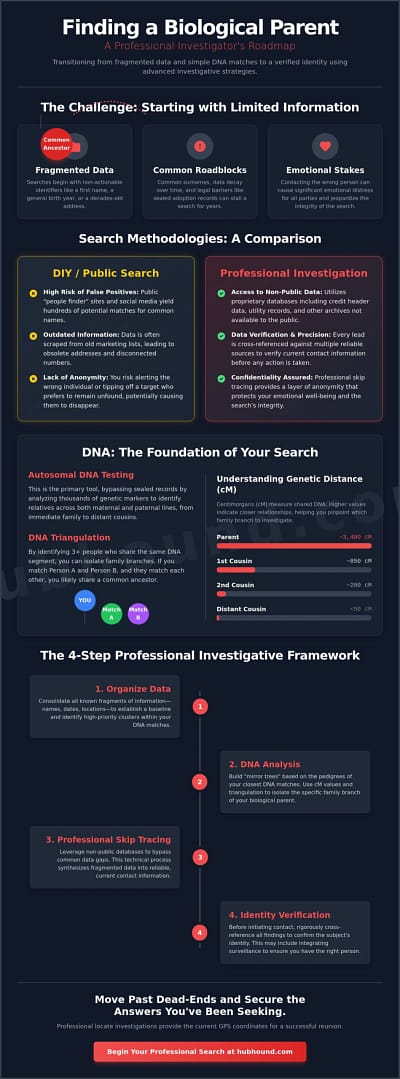
Autosomal DNA testing is the primary tool for finding a biological parent with limited information because it bypasses redacted paperwork and sealed files. This testing analyzes thousands of genetic markers to identify relatives across both maternal and paternal lines. Unlike older testing methods, autosomal results provide a broad spectrum of matches, ranging from immediate family to distant fourth cousins. These matches serve as the raw data needed to reconstruct a missing lineage.
Use DNA triangulation to isolate specific family branches and narrow your search. This technique involves identifying three or more people who share a specific DNA segment. If Match A and Match B both share a genetic connection with you and with each other, you likely share a common ancestor. By mapping these overlaps, you can determine which branch of a family tree your biological parent belongs to. This process is essential when your closest matches are distant, as it allows you to work backward from a shared great-grandparent to identify their descendants.
DNA as a Foundation, Not a Final Step
Successful searches require a technical understanding of genetic distance. Consider these essential steps:
- Analyze Centimorgan (cM) Counts: Centimorgans measure the size of DNA segments you share with a match. A parent will typically share approximately 3,400 cM, while a second cousin might share around 200 cM. Use these values to estimate the exact branch of the tree you need to investigate.
- Build Mirror Trees: Create private family trees based on the pedigrees of your DNA matches. Look for where these trees intersect to find the common ancestor who links your matches to your biological parent.
- Identify Data Gaps: Transition from genealogical research to active locate investigations once you have identified a specific group of siblings or a cluster of first cousins.
Mining Public Records for Clues
Once DNA identifies a candidate family, public records provide the historical footprint needed to track an individual’s movement. Census data and historical city directories offer a chronological view of where a family lived and who resided in the household. Military records and professional licensing databases are also high-value resources; they often contain middle names, birth dates, and previous employers that general search engines miss. A marriage certificate often serves as a critical “last known” data point by revealing a spouse’s name or a residential address at a specific moment in time. If your search reaches a point where public records no longer provide a current location, you can consult with a professional investigator to access restricted databases and verify a subject’s current residence.
Professional Skip Tracing: The Key to Locating Missing Parents
Skip tracing is the professional process of locating an individual whose current whereabouts are unknown. While DNA results identify the family branch, skip tracing provides the specific front door. It serves as the vital bridge between a name on a genealogical chart and a physical meeting. Finding a biological parent with limited information often requires moving beyond public archives into the world of regulated, non-public data. Licensed investigators use these tools to track individuals who may have changed names, moved frequently, or maintained a minimal digital footprint over several decades.
The core of a professional locate investigation involves analyzing credit header data and utility records. Credit headers contain information extracted from credit applications, such as name variations, aliases, and address history. These records are highly accurate because they’re linked to financial activity. Utility searches identify active accounts for electricity, water, or telecommunications, which are excellent indicators of current residency. These sources are updated in real time. This is a significant advantage over public search sites that often display cached data from several years ago.
What Makes Professional Databases Different?
Professional databases pull from proprietary sources that require specific licensing and a documented “permissible purpose” to access. These systems are designed for accuracy rather than ad revenue. Unlike cached web results that rely on social media or old marketing lists, professional platforms cross-reference hundreds of data points simultaneously. This allows an investigator to confirm an identity by matching a subject’s birth date with their professional licenses and historical residential patterns. This level of due diligence prevents the emotional distress of contacting the wrong person based on fragmented data.
Locate Investigations vs. Simple People Searches
A standard people search is a passive query; a locate investigation is an active pursuit. When digital records are insufficient, investigators follow a physical paper trail. This might involve discreet neighbor inquiries or witness interviews to confirm that a subject still resides at a specific location. These methods are essential when a biological parent lives in a multi-unit dwelling or uses a P.O. Box to shield their privacy. For a deeper look at these professional tactics, read our comprehensive guide to finding missing adults. Verification is the final step that ensures you’re reaching out to the correct individual at their current primary residence, saving you time and potential embarrassment.
Strategic Steps for Your Search Methodology
A successful search requires a shift from passive curiosity to a structured investigative framework. Finding a biological parent with limited information is a challenge that demands rigorous data management. Don’t rely on memory or scattered browser bookmarks. Centralize every data point into a single repository to identify patterns that aren’t visible at a glance. This methodical approach transforms fragmented clues into a cohesive lead list, allowing you to prioritize the most viable paths forward.
Consolidating Fragmented Data
Begin by creating a chronological timeline of the parent’s known movements. Even if you only have a partial name or a general region, document every associated date and location. Identify “key associates” such as former neighbors, coworkers, or distant relatives found through DNA matches. These individuals often serve as the path of least resistance. Use skip tracing to locate these associates first; they can often provide the specific identifiers needed to find the primary subject. If the biological parent is potentially deceased, focus on locating siblings or children who can confirm family history through witness interviews.
Once you have identified a candidate, verify the findings through secondary investigative measures. Professional skip tracing turns a name into a current physical location, but verification ensures that the person living there is indeed the individual you’re seeking. This process often includes cross-referencing utility registrations with professional licenses and historical residential patterns. Never move to the contact phase without this final validation. If you need professional assistance to execute these steps, hire a licensed investigator to ensure your search is both accurate and discreet.
The Importance of a Professional Intermediary
The transition from discovery to contact is the most sensitive part of the process. Utilize a professional intermediary to facilitate the first outreach. This approach protects both parties and manages expectations before an emotional connection is established. An investigator can conduct discreet witness interviews to gauge a parent’s willingness to connect without revealing your identity prematurely. This layer of confidentiality maintains your privacy and prevents the potential fallout of a direct, unannounced encounter. Professional guidance ensures that the outreach is handled with the necessary tact and legal compliance, providing a secure environment for a potential reunion. Finding a biological parent with limited information is as much about the quality of the approach as it is about the data itself.
Partnering with Professional Investigators for Success
Transitioning from a personal search to a professional investigation is often the turning point in finding a biological parent with limited information. While digital tools and DNA databases provide the initial leads, they frequently stop short of providing a verified, current location. HubHound approaches these sensitive cases with a focus on data integrity and tactical precision. We move beyond the fragmented records found on public sites by utilizing a combination of high-level skip tracing and field verification. This ensures that the final report you receive isn’t just a list of possibilities, but a confirmed identity with actionable contact methods.
Professional resolution relies on more than just access to restricted databases. It requires the ability to synthesize disparate data points into a “court-ready” evidence package. Even if your goal is a private reunion rather than legal action, having a verified report provides the psychological certainty needed to initiate contact. If the digital trail remains ambiguous, we utilize discreet surveillance to confirm a subject’s identity and residency without alerting them to the investigation. This balance of technical data analysis and physical observation eliminates the guesswork that often leads to DIY frustration.
Why Expertise Matters in Locate Investigations
Family matters require a high degree of ethical consideration and procedural discretion. A licensed investigator understands the legal boundaries of data privacy and the sensitivity of biological reunions. HubHound utilizes advanced surveillance techniques to confirm a target’s daily patterns and residency status without being intrusive. This professional oversight saves you months of fruitless searching through outdated records and prevents the emotional risk of approaching the wrong individual. Our tools are designed for efficiency, allowing us to filter through millions of nationwide records to find the specific person you’re looking for in a fraction of the time a manual search would take.
Taking the Next Step in Your Search
The move from random online searches to a structured locate investigation provides the clarity you need to move forward. Instead of navigating dead-end leads, you’ll receive a comprehensive overview of the subject’s current status, verified through multiple proprietary sources. This structured approach is the most reliable way to secure a successful outcome when starting with minimal data. If you’re ready to move past the frustration of incomplete records, the process begins with a professional assessment of your existing information. Contact HubHound for a professional locate investigation to discuss your case and identify the most effective strategy for your search.
Securing the Answers You Deserve
Finding a biological parent with limited information doesn’t have to be a journey defined by dead-ends and fragmented data. You’ve seen how modern DNA triangulation narrows your search to a specific family branch. You also understand that professional skip tracing is the only way to convert genealogical leads into a current, verified physical location. Moving from a DIY search to a professional locate investigation ensures that every step is backed by rigorous data rather than guesswork.
HubHound provides the expert curation needed to finalize your search. Our licensed investigators bring over 30 years of experience to these sensitive cases, utilizing proprietary professional databases that far exceed the capabilities of public search engines. We prioritize discreet and confidential search methodologies to protect your privacy and the integrity of a potential reunion. Stop struggling with outdated records and start moving toward a definitive resolution.
Start your locate investigation with HubHound today to secure the professional expertise your search requires. You’ve already done the initial research; now let a specialist handle the heavy lifting of verification and discovery.
Frequently Asked Questions
Can a private investigator find a parent with just a name?
Yes. A licensed investigator utilizes proprietary databases to cross-reference a name with other identifiers such as age, known relatives, or historical residential patterns. This process filters out individuals with the same name to isolate the correct subject. Success often depends on the uniqueness of the name and the availability of secondary clues like a general birth year or a former workplace.
How much does it cost to hire an investigator to find a biological parent?
Industry data from 2026 indicates that most private investigators charge between $50 and $200 per hour, with a national average falling between $75 and $125 per hour. Many firms offer flat-rate person locates or skip tracing services that typically range from $150 to $600. You should discuss your specific case requirements during a consultation to get a precise fee structure for your search.
Is it legal to hire a private investigator to find someone?
What information do I need to provide to an investigator to start a search?
Finding a biological parent with limited information is possible if you provide any known identifiers like full names, approximate birth years, or last known locations. Even fragmented details such as a former employer, a military branch, or a sibling’s name can serve as a starting point. The more data you provide, the faster an investigator can narrow the search parameters.
What happens if the parent I am looking for has passed away?
The investigator will verify the death record through non-public indices and official death notices to provide you with definitive closure. Once a death is confirmed, the search can pivot to locate surviving siblings or other close relatives. These family members often possess the medical history or genealogical information you originally sought from the parent.
How long does a professional locate investigation typically take?
Most professional locate investigations are completed within a few business days to three weeks. The timeline depends on the accuracy of the initial data and the subject’s current digital footprint. A complex case involving a subject who hasn’t been seen in decades may require more extensive cross-referencing and witness interviews to verify their current residence.
Can an investigator help me if I only have a DNA match but no name?
Yes. Investigators use genetic genealogy to identify parents when you only have a DNA match. By triangulating shared ancestors among your closest matches, they can reconstruct the family tree and work forward to identify living biological parents. This technical approach is often the most effective method for finding a biological parent with limited information in 2026.
What is the difference between a people search website and a private investigator?
People search websites rely on cached, public data that is often several years out of date and highly inaccurate. Licensed investigators access regulated, real-time databases that aren’t available to the general public. They also perform physical verification and neighbor inquiries to guarantee that the identity and current location of the subject are 100% correct before delivering a report.

Article by
Joel R. Manley | President | Hubhound Investigations | OR PI-ID#: 90432 | 111 SW Fifth Avenue, Suite 3150 Portland, Oregon 97204 | 971-442-8170
Joel is licensed as a private investigator in Oregon and Tennessee. Joel started his career in 1987 serving as a Military Police Officer and Military Police Investigator.
After ending his military tour of duty, Joel became a civilian Police Officer and Deputy Sheriff. Joel took his strong background in Hostage Negotiations, Mediation and Conflict Resolution, with him to patrol some of the highest crime areas in SE Portland.
Joel was awarded Deputy of the Year for his efforts and for drastically reducing the crime rate in the area he patrolled. As a Deputy Sheriff, Joel assisted in leading a Neighborhood Livability Program that was nationally recognized for having the most innovative and progressive approach to policing.
In 2018, Joel retired as a Deputy Sheriff and founded Hubhound Investigations. Joel played an integral role in Hubhound Investigations receiving an A+ Accredited Business rating from the Better Business Bureau (BBB).
In his off time, Joel enjoys spending time with his wife, adult children and Hubhound’s Happiness Ambassador, Nya. Joel also enjoys Scuba Diving and Kayaking.
Disclaimer
DISCLAIMER: This article is provided for general informational and educational purposes only. It is not intended to constitute legal advice, professional investigative advice, or instruction to engage in any unlawful activity. Laws governing private investigations, surveillance, recording, tracking, access to information, evidence collection, privacy, trespass, licensing, and related investigative activities vary by jurisdiction and are subject to change.
Any investigative techniques, tactics, procedures, scenarios, or legal proceedings discussed in this article are presented for informational purposes and should not be interpreted as authorization or encouragement to use a particular method. Private investigators and members of the public are responsible for understanding and complying with all applicable federal, state, and local laws, licensing requirements, court rules, and professional standards.
The circumstances of every investigation and legal matter are different. Information contained in this article should not be relied upon as a substitute for advice from a qualified attorney or other appropriate licensed professional regarding a specific situation. No attorney-client, investigator-client, or other professional relationship is created by reading or using this information.