
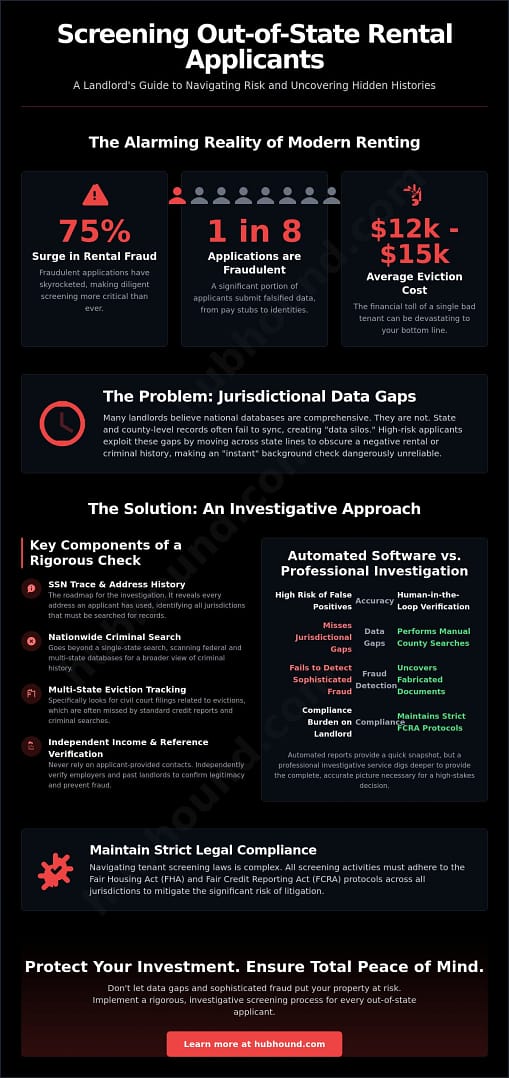
Did you know that rental fraud surged by 75% over the last year? With one in eight applications now containing fraudulent data, the financial risk of a bad tenant is staggering. When you perform a background check for out-of-state rental applicants, you aren’t just looking at a credit score; you’re defending your property against potential eviction costs that now average between $12,000 and $15,000 per instance. This level of risk requires a move beyond automated snapshots toward a more rigorous investigative approach.
It’s natural to feel concerned about the blind spots that come with cross-state moves. Verifying employment across state lines or tracking down criminal records in unfamiliar jurisdictions can feel like an impossible task, especially as privacy laws continue to evolve. You need a reliable way to ensure that your applicant is being honest about their history without getting bogged down in administrative complexity. This guide provides a clear, professional framework for multi-state screening that prioritizes accuracy and risk mitigation. You’ll learn how to navigate the technical nuances of modern identity verification and implement a rigorous assessment process that protects your bottom line and gives you total peace of mind.
Key Takeaways
- Understand how jurisdictional silos create data blind spots and why applicants may move across state lines to obscure a negative rental or criminal history.
- Implement a multi-layered background check for out-of-state rental applicants that includes nationwide criminal searches and multi-state eviction tracking.
- Evaluate the critical trade-offs between instant automated software and professional investigative services to ensure data accuracy and reduce false positives.
- Maintain strict legal compliance with the Fair Housing Act and FCRA protocols across all jurisdictions to mitigate the risk of litigation.
- Discover how human-in-the-loop verification uncovers hidden records and sophisticated fraud that standard automated platforms frequently miss.
The Unique Challenges of Screening Out-of-State Rental Applicants
Screening a local applicant is a relatively linear task. Screening someone from the other side of the country is entirely different. The fundamental problem lies in jurisdictional silos. Many property managers mistakenly believe that national databases provide a comprehensive view of an individual’s history. They don’t. State-level databases often fail to sync with one another, creating significant gaps in a standard tenant screening process. This fragmentation allows critical red flags to remain hidden from view.
Some applicants move across state lines specifically to escape a negative rental or criminal history. If a previous eviction hasn’t been uploaded to a national aggregator yet, an “instant” report will likely return a clean result. This is a primary reason why a professional background check for out-of-state rental applicants must account for reporting lag times. While national databases provide a broad overview, they frequently miss recent county-level filings that signal ongoing legal issues or recent non-payment of rent.
Logistical barriers further complicate the process. Verifying employment or landlord references across multiple time zones is time-consuming. These delays often pressure landlords into making quick, uninformed decisions. High-risk applicants rely on this pressure to bypass a more rigorous evaluation of their credentials. A thorough background check for out-of-state rental applicants requires patience and a systematic approach to data verification.
Understanding Jurisdictional Data Gaps
Not every state reports its data to centralized repositories. If you rely solely on automated software, you’re betting on the software’s ability to access every local record. It can’t. In many cases, a conviction exists but hasn’t been digitized for national access. For high-stakes rentals, manual county-seat searches are essential. This process involves verifying records directly at the source to ensure no recent filings were missed by the digital aggregators.
The Risk of Identity and Income Fraud
Rental fraud surged by 75% according to the 2026 Multifamily Fraud Report. Remote applicants often use sophisticated digital tools to fabricate pay stubs or offer letters from distant employers. To counter this, you must cross-reference SSN traces with a comprehensive address history. Ensure the applicant’s reported movements align with their data footprint. Don’t rely on the contact information provided in the application. Verify out-of-state employers through independent channels to confirm the business exists and the applicant is actually on the payroll.
Essential Components of a Comprehensive Multi-State Background Check
A standard credit report is a surface-level diagnostic tool. It provides a snapshot of financial behavior but fails to capture the behavioral nuances required for a secure placement. To perform a rigorous background check for out-of-state rental applicants, you need a multi-layered strategy that synthesizes data from disparate sources. This process ensures that no records are left behind in jurisdictional silos. A comprehensive screening must include nationwide criminal searches, multi-state eviction tracking, and a thorough verification of both income and references.
Digital nomads and frequent movers present a unique challenge in 2026. These applicants often have fragmented histories that automated systems struggle to connect. You must move beyond the surface to identify patterns of non-payment or legal issues that span multiple regions. Maintaining legal compliance for tenant screening is also critical during this phase. Federal regulations dictate how you handle this data, and failure to follow proper protocols can lead to significant liability. Utilizing professional landlord and tenant screening services can help you manage these complexities while ensuring data accuracy.
The Role of SSN Tracing in Out-of-State Checks
The SSN trace is the roadmap for your entire investigation. It doesn’t just verify the number; it reveals every address where the applicant has established credit or utility accounts. This history is vital for identifying which specific county-level databases need a manual search. If an applicant lived in three different regions over five years, a “nationwide” database might miss a recent filing in one of those areas. The trace also uncovers aliases or maiden names that might be associated with records the applicant didn’t disclose.
Verification of Out-of-State Income and Employment
Forged paystubs are increasingly common as digital editing tools become more sophisticated. Don’t rely on the documents provided by the applicant alone. For out-of-state employers, you should contact the HR department directly using a verified business phone number found through independent research. This is especially important for remote workers or self-employed individuals whose income may fluctuate. Confirm the business is active and the applicant’s role is secure before finalizing any lease agreement. This direct contact often reveals more about an applicant’s stability than a PDF ever could.
Automated Screening Software vs. Professional Investigative Services
Modern property management often relies on high-volume software platforms that promise “instant” results. These tools prioritize throughput and speed, which can be useful for initial sorting but often fail during a rigorous background check for out-of-state rental applicants. Software is a tool; investigation is a process. While an algorithm can pull data from a digital aggregator, it lacks the cognitive ability to verify that data against real-world records. Professional investigators don’t just aggregate; they curate. They filter out the “false positives” that frequently occur when applicants share common names or birthdates, ensuring your decisions are based on accurate matches.
The depth of search also varies significantly between these two approaches. Much of the nation’s most critical legal data remains non-digitized or sits behind local paywalls that national software doesn’t access. A professional service goes beyond publicly indexed records to uncover the details that silos hide. This level of expert analysis is essential for interpreting complex records from different legal systems. You need to know if a specific out-of-state code represents a minor infraction or a serious breach of rental policy. Automated reports simply can’t provide that context.
Why Instant Reports Often Miss Critical Information
The primary weakness of automated systems is the reporting lag time. There’s often a significant delay between a local court filing and its appearance in a national database. If an applicant is moving to stay ahead of a recent eviction or criminal charge, an “instant” report will likely return a clean result. This is why thorough workplace investigations and high-stakes tenant screenings require a human-in-the-loop approach. Automated identity matching is also prone to errors, which can lead to rejecting qualified applicants or, worse, admitting high-risk ones based on incomplete data.
The Advantage of Human-Led Investigations
Human investigators follow digital breadcrumbs that software is programmed to ignore. They can perform skip tracing to identify missing gaps in a rental history or locate previous landlords who weren’t listed on the application. When you conduct a background check for out-of-state rental applicants, you’re dealing with varying legal terminology. A human expert understands these nuances and can provide a clear, evaluative summary of what a record actually means for your property’s safety. This investigative mindset allows you to see the full story, not just a fragmented data point. Choose precision over speed to protect your investment.
Legal Compliance and Best Practices for Nationwide Screening
Compliance is the bedrock of any secure leasing strategy. When you conduct a background check for out-of-state rental applicants, you must navigate a dense network of federal and local regulations. The Fair Credit Reporting Act (FCRA) remains the primary framework. It mandates that you obtain clear, written authorization before pulling any data. If you decide to reject an applicant based on their report, you must follow the adverse action process. As of March 1, 2026, the Federal Trade Commission clarified that a “reasonable period” for this process is typically at least five business days. This window allows the applicant to dispute inaccuracies before you finalize your decision.
Consistency is your best defense against discrimination claims. The Fair Housing Act requires that you apply the same screening criteria to every applicant, regardless of where they are moving from. Digital nomads and remote workers often trigger complex legal questions. If an applicant has a history spanning multiple regions, you must ensure your screening process respects the look-back periods and privacy protections of each jurisdiction. Managing this manually is a recipe for error. Professional tenant screening services ensure that your data collection remains within legal bounds while protecting your property from high-risk placements.
Navigating Cross-State Privacy Laws
State-specific legislation is evolving rapidly in 2026. Many regions have enacted “Clean Slate” or “Fair Chance” laws that automatically seal certain misdemeanors or lower-level felonies. These records are considered non-reportable. In some jurisdictions, you cannot inquire about criminal history until after a conditional offer has been made. You must determine if the law of the applicant’s current residence or the location of your property takes precedence. Establishing a standardized, nationwide screening policy helps mitigate this uncertainty and ensures you don’t inadvertently access or use prohibited information.
The Importance of Accurate Documentation
Maintaining a digital audit trail is essential for risk management. Every step of your screening process, from initial authorization to the final decision letter, should be documented and stored securely. This documentation serves as your primary evidence in the event of a legal challenge. Standardizing the adverse action process is non-negotiable. Ensure your templates are updated to reflect current federal ceilings on disclosure charges, which reached $16.00 in late 2025. High-tier corporate investigation firms maintain these standards of due diligence to protect their clients from litigation. Accurate record-keeping isn’t just a legal chore; it’s a strategic asset that preserves your reputation and financial stability.
Why HubHound is the Preferred Choice for Rigorous Tenant Screening
HubHound operates at the intersection of traditional investigative rigor and modern data accessibility. While automated platforms provide a filtered view of an applicant’s history, they often fail to capture the nuanced risks associated with a background check for out-of-state rental applicants. Our firm approaches every screening as a dedicated investigation rather than a software-driven transaction. We leverage decades of professional experience to locate information that remains hidden from standard public indexes. This level of scrutiny is essential for high-value rental properties where the average cost of an eviction in 2026 can reach $15,000.
Our reports provide a comprehensive synthesis of data that goes far beyond basic credit scores. We specialize in navigating the complexities of multi-jurisdictional searches, ensuring that every state an applicant has resided in is thoroughly vetted. This focus on accuracy mitigates the risk of missing critical criminal or eviction records that often slip through the cracks of “instant” digital checks. By prioritizing human-led verification, we deliver a level of certainty that software simply can’t match. We identify the red flags that silos hide, providing you with a clear assessment of an applicant’s true history.
Investigative-Grade Screening for Modern Landlords
We apply advanced surveillance techniques and skip tracing to uncover missing rental history gaps. This investigative mindset allows us to verify identities and income with a degree of precision that protects your property from sophisticated fraud. Unlike faceless software platforms, our team provides personalized service and court-ready evidence. We don’t just deliver data; we provide verified intelligence that supports your decision-making process. This commitment to quality ensures that your screening process is both legally compliant and highly effective at reducing future turnover costs.
Start Your Nationwide Screening Process Today
Partnering with HubHound is a straightforward process designed for the busy professional. Whether you have a single out-of-state applicant or require ongoing screening support for a large portfolio, we offer a scalable solution. Our investigative team does the heavy lifting of research, saving you time and reducing your exposure to rental risk. To begin a professional background check for out-of-state rental applicants, simply contact our team to discuss the specifics of your case. We provide customized assessments that reflect the unique requirements of your property and the applicant’s history. Protect your investment with HubHound’s professional screening services.
Secure Your Rental Portfolio with Investigative Precision
The complexity of multi-state screening demands more than a passive software solution. As rental fraud rates continue to rise, relying on automated snapshots leaves your property vulnerable to sophisticated deception and high-cost evictions. A thorough background check for out-of-state rental applicants must bridge the gaps between jurisdictional silos through manual verification and expert analysis. By prioritizing human-led due diligence, you ensure that every address history and criminal record is accurately matched and legally reportable.
HubHound provides the specialized expertise necessary for this rigorous assessment. Our licensed investigators bring over 30 years of experience to every case, focusing on multi-jurisdictional due diligence that standard platforms miss. We deliver comprehensive reports that include skip tracing and asset searches to provide a complete picture of your applicant’s reliability. Don’t leave your investment to chance with instant data that lacks context.
Get a Professional Out-of-State Background Check Now and gain the confidence that comes from professional investigative precision. Your property deserves the highest standard of protection and a tenant history you can actually trust.
Frequently Asked Questions
How far back does an out-of-state background check go?
A standard background check for out-of-state rental applicants typically spans seven years for criminal and credit history, as dictated by the Fair Credit Reporting Act. While some jurisdictions allow for longer look-back periods for certain convictions, others impose stricter limits on non-conviction records. You must ensure your screening process respects these varying local regulations. Relying on an investigator who understands these nuances prevents the use of non-reportable data in your decision-making process.
Can a landlord check criminal records in every state?
Yes, you can access criminal records across every jurisdiction, but no single master database exists that captures every local filing. A comprehensive search requires querying multiple state and county repositories to ensure accuracy. Because state-level databases don’t always communicate, manual searches at the county level are often necessary. This multi-layered approach ensures that you don’t miss recent or non-digitized records that automated systems frequently overlook.
What happens if a tenant has a common name during an out-of-state check?
Automated systems often generate false positives when an applicant shares a common name with an individual who has a criminal record. Professional investigators solve this by cross-referencing the name with additional identifiers like Social Security numbers, middle names, and dates of birth. This manual verification process ensures that you don’t unfairly reject a qualified applicant based on someone else’s history. It also protects you from potential litigation related to inaccurate reporting.
Is it legal to charge a higher screening fee for out-of-state applicants?
No, you shouldn’t charge a higher fee based solely on an applicant’s current location. Screening fees must generally align with the actual out-of-pocket costs incurred during the investigative process. Several jurisdictions have strict caps on what you can charge, often limiting fees to the actual cost of the report. Applying a consistent fee structure for all applicants is a best practice that helps avoid discrimination claims and ensures compliance with nationwide fair housing standards.
How do you verify employment if the company is in another state?
You should verify out-of-state employment by contacting the company’s human resources department directly. Don’t rely on the contact information provided by the applicant, as digital nomads and remote workers can easily fabricate documents or provide fake references. Perform independent research to find a verified business number. This direct contact allows you to confirm the applicant’s position, salary, and tenure with a level of certainty that a digital pay stub cannot provide.
What is a “National Criminal Database” and is it enough?
A National Criminal Database is an aggregator that collects information from various sources, but it isn’t a complete record of an individual’s history. These databases often suffer from reporting lags, meaning a recent filing might not appear for months. Relying solely on these aggregators is risky for out-of-state screenings. You should use them as a starting point, supplemented by targeted county-level searches based on the applicant’s verified address history to ensure total accuracy.
How long does a professional out-of-state background check take?
A thorough background check for out-of-state rental applicants typically requires two to five business days to complete. While automated platforms promise instant results, these reports often lack the depth and verification required for high-stakes rentals. The extra time allows investigators to perform manual county searches, verify employment directly, and filter out false positives. This thorough process is essential for mitigating the financial risks associated with rental fraud and potential future evictions.
Can I perform a background check on a tenant moving from another country?
Yes, you can screen international applicants, but the process is significantly more complex and requires specialized expertise. International background checks involve navigating different privacy laws, language barriers, and fragmented record-keeping systems. These searches often take longer than domestic investigations and may require specific authorizations from the applicant. If you’re dealing with a tenant moving from another country, it’s best to partner with an investigative firm that has experience in global due diligence.

Article by
Joel R. Manley | President | Hubhound Investigations | OR PI-ID#: 90432 | 111 SW Fifth Avenue, Suite 3150 Portland, Oregon 97204 | 971-442-8170
Joel is licensed as a private investigator in Oregon and Tennessee. Joel started his career in 1987 serving as a Military Police Officer and Military Police Investigator.
After ending his military tour of duty, Joel became a civilian Police Officer and Deputy Sheriff. Joel took his strong background in Hostage Negotiations, Mediation and Conflict Resolution, with him to patrol some of the highest crime areas in SE Portland.
Joel was awarded Deputy of the Year for his efforts and for drastically reducing the crime rate in the area he patrolled. As a Deputy Sheriff, Joel assisted in leading a Neighborhood Livability Program that was nationally recognized for having the most innovative and progressive approach to policing.
In 2018, Joel retired as a Deputy Sheriff and founded Hubhound Investigations. Joel played an integral role in Hubhound Investigations receiving an A+ Accredited Business rating from the Better Business Bureau (BBB).
In his off time, Joel enjoys spending time with his wife, adult children and Hubhound’s Happiness Ambassador, Nya. Joel also enjoys Scuba Diving and Kayaking.
Disclaimer
DISCLAIMER: This article is provided for general informational and educational purposes only. It is not intended to constitute legal advice, professional investigative advice, or instruction to engage in any unlawful activity. Laws governing private investigations, surveillance, recording, tracking, access to information, evidence collection, privacy, trespass, licensing, and related investigative activities vary by jurisdiction and are subject to change.
Any investigative techniques, tactics, procedures, scenarios, or legal proceedings discussed in this article are presented for informational purposes and should not be interpreted as authorization or encouragement to use a particular method. Private investigators and members of the public are responsible for understanding and complying with all applicable federal, state, and local laws, licensing requirements, court rules, and professional standards.
The circumstances of every investigation and legal matter are different. Information contained in this article should not be relied upon as a substitute for advice from a qualified attorney or other appropriate licensed professional regarding a specific situation. No attorney-client, investigator-client, or other professional relationship is created by reading or using this information.