
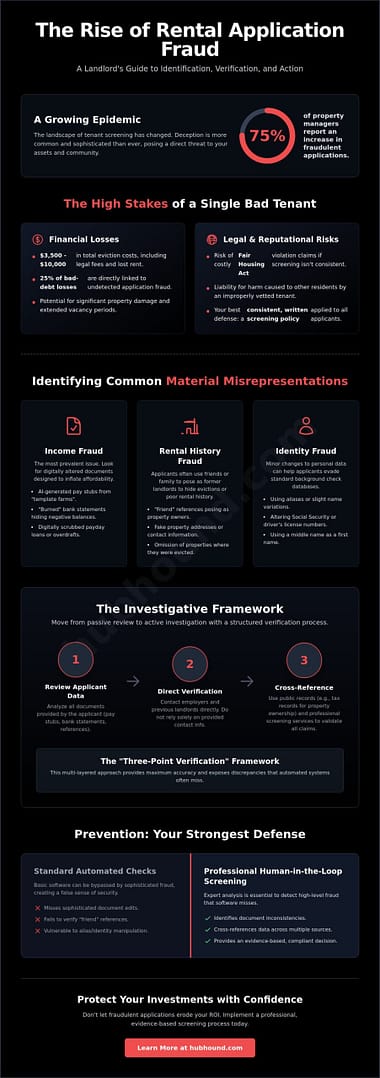
Did you know that 75% of property managers reported an increase in fraudulent rental applications this past year? It’s a staggering figure that highlights a growing risk for landlords and property stakeholders. When you realize an applicant provided false information, the pressure to act quickly often clashes with the fear of a costly Fair Housing Act violation. Learning how to handle a tenant lying on a rental application is no longer just a precaution; it’s a vital investigative process required to protect your assets and your professional reputation.
You likely feel the frustration of a deceptive applicant who seems perfect on paper but fails a rigorous assessment. It’s exhausting to filter through AI-generated pay stubs and “template farm” references while trying to keep your vacancy rates low. This guide provides the exact protocol you need to identify fraud, categorize the severity of the misrepresentation, and respond with legal precision. We’ll examine how to verify data effectively and establish a clear denial process that minimizes your risk of a $10,000 eviction or significant bad-debt losses. Our objective is to move you from uncertainty to a streamlined, evidence-based decision process.
Key Takeaways
- Differentiate between material misrepresentation and minor clerical errors to ensure your legal response is appropriate and enforceable.
- Identify sophisticated red flags in income documentation, such as “burned” bank statements or mass-produced fake pay stubs from digital template farms.
- Establish a clear protocol on how to handle a tenant lying on a rental application based on the specific stage of the leasing lifecycle.
- Implement a “Three-Point Verification” framework to cross-reference applicant data across multiple independent sources for maximum accuracy.
- Evaluate the necessity of human-in-the-loop professional screening to detect high-level fraud that standard automated background check software often misses.
The Legal and Financial Stakes of Rental Application Fraud
Material misrepresentation is the technical term for a lie that influences a landlord’s decision to approve a lease. In the context of residential leasing, this occurs when an applicant provides false data that, if known, would have resulted in a denial. A single fraudulent tenancy isn’t just an administrative error; it’s a high-stakes financial risk. According to industry data from 2026, roughly 25% of bad-debt losses in the rental sector are directly linked to fraud that was not caught during the screening process. When you’re determining how to handle a tenant lying on a rental application, you must view the lie as a precursor to future lease violations.
Professional tenants often use sophisticated fraud to secure housing they cannot afford or to hide a history of prior evictions. These individuals understand legal loopholes and use them to occupy properties rent-free for months. This creates a massive financial burden. Beyond lost revenue, you have a duty to maintain a safe environment for your existing residents. Allowing an unvetted or deceptive individual into your community can lead to liability if that person causes harm to others. Rigorous assessment is the only way to protect your property and your professional reputation.
Why “Small” Lies Lead to Large Losses
Fraudulent applicants frequently bypass standard software-based filters by using sophisticated digital edits. These “small” lies about income or employment are highly correlated with future non-payment. Research from the National Multifamily Housing Council shows that nearly one-quarter of eviction filings are linked to fraudulent applications. When you’re forced to remove a tenant, the costs are significant. Legal fees and lost rent for a single eviction can range from $3,500 to $10,000. These hidden costs, combined with potential property damage, quickly erode the ROI of your investment.
The Legal Landscape of Application Verification
Understanding the Fair Housing Act is essential when conducting a rigorous assessment of an applicant. Your best legal defense against discrimination claims is a consistent, written screening policy. This ensures every individual undergoes the same search and discovery process. While common rental scams often target unsuspecting landlords, a standardized protocol allows you to reject applicants based on objective data rather than subjective intuition. This structured approach is critical when deciding how to handle a tenant lying on a rental application to ensure you remain compliant with federal regulations. Utilizing professional Landlord/Tenant screening services provides the validated data needed to make these high-stakes decisions with confidence.
Identifying Common Material Misrepresentations and Red Flags
Identifying deception requires a shift from passive review to active investigation. Sophisticated applicants no longer rely on obvious lies; they use AI-powered editors to create convincing documentation. According to data from 2026, the average fraud rate in submissions is approximately 5.1%. This makes spotting fraudulent applications a technical skill rather than a matter of intuition. When considering how to handle a tenant lying on a rental application, you must first recognize the specific methods used to bypass your existing filters.
Income fraud is the most prevalent issue. Applicants often provide “burned” bank statements where negative balances or payday loans are digitally scrubbed. They may also utilize template farms to produce pay stubs that look identical to those from legitimate payroll providers. To counter this, verify income directly through employer databases rather than relying on documents provided by the applicant. This direct verification removes the opportunity for digital manipulation.
Rental history misrepresentation is equally common. Many applicants provide “friend” references who pose as former landlords. You can expose this by cross-referencing the property address with public tax records to see if the reference actually owns the property. If the names don’t match, you’ve likely identified a material lie. Similarly, criminal history is often obscured using aliases or slight name variations. An applicant might change a single letter in their last name or use a middle name as a first name to avoid triggering a match in basic databases. Professional Landlord/Tenant screening ensures these nuances are caught before the lease is signed.
The “Professional Tenant” Playbook
Professional tenants manipulate credit scores by becoming authorized users on high-limit accounts, briefly inflating their rating. They often leave gaps in their residency history to hide prior evictions. By applying advanced surveillance techniques to the residency discovery process, investigators can uncover a history of physical occupancy that the applicant attempted to bury. This level of scrutiny is often the only way to find undisclosed addresses.
The ESA Loophole and Legal Exceptions
Emotional Support Animals (ESAs) are a frequent point of contention. While you cannot charge pet fees for a legitimate ESA, you can request documentation from a healthcare professional with whom the applicant has an established relationship. Fraudulent ESA letters bought online often lack this specific nexus. Handle these situations carefully to avoid Fair Housing violations while still requiring valid verification. Knowing how to handle a tenant lying on a rental application regarding animals requires a strict adherence to federal guidelines; never assume a letter is valid without verifying the source.
The Investigative Framework: Fraud vs. Innocent Mistakes
A rigorous assessment requires moving beyond intuition. Deciding how to handle a tenant lying on a rental application depends entirely on whether the discrepancy indicates a material intent to deceive or a simple clerical error. A typo in a zip code is an oversight; a fabricated landlord name is fraud. To maintain objectivity, implement a selective filtering process that subjects every data point to a “Three-Point Verification” rule. For income, this means cross-referencing a pay stub with a bank statement and a direct verbal confirmation from a verified HR department. For residency, it involves matching the application data against property tax records and a third-party credit report. This multi-layered approach removes the guesswork from your decision-making process.
Analyzing the intent behind a discrepancy is critical for legal protection. Look for patterns rather than isolated incidents. A single transposed digit in a phone number often points to an innocent mistake. Conversely, providing a social security number that belongs to a deceased individual or a different person indicates a deliberate attempt at identity fraud. Maintaining a professional, objective tone during this verification phase is essential. Never accuse an applicant of lying during the discovery process. Instead, request clarification on the conflicting data points and observe if their explanation aligns with the verified facts you’ve gathered.
Applying Corporate Standards to Tenant Screening
Sophisticated landlords should adopt the level of scrutiny typically found in a corporate investigation firm. This professional-grade approach uses deep cross-referencing to validate social security numbers and past addresses against historical data. If an applicant provides a residency history that omits certain periods, utilize Skip Tracing / Locate Investigations to uncover undisclosed prior evictions or collection actions. This investigative rigor ensures that you aren’t just checking boxes but actively uncovering hidden risks. Professional Landlord/Tenant screening services provide the infrastructure needed to perform these high-level searches efficiently.
Documenting the Discovery Process
Every discrepancy must be documented with precision to protect against future litigation. If you find a lie, save the original application alongside the verified evidence of the falsehood. Learning how to spot rental application fraud is only half the battle; you must also be able to prove it. Write a single, objective sentence to summarize each finding, such as: “Applicant stated residency at [Address] from 2022 to 2024; however, public records indicate the property was vacant and for sale during that period.” This factual record is your strongest tool when determining how to handle a tenant lying on a rental application during the denial process. Keeping the tone professional and neutral prevents emotional escalations and maintains your authority as a curator of high-quality tenancies.
Actionable Guidance: Immediate Steps After Discovering a Lie
Once your selective filtering process uncovers a material misrepresentation, you must act with speed and precision. The protocol for how to handle a tenant lying on a rental application depends on the current status of the lease. If the applicant hasn’t signed the lease, the path is straightforward: issue an immediate rejection based on the failure to meet your screening criteria. This prevents the problem before it begins. Don’t engage in negotiations or allow the applicant to “correct” a deliberate lie, as this only invites future deception.
The situation becomes more complex if the lease is signed but the applicant hasn’t taken possession. In this scenario, you should immediately consult legal counsel to rescind the lease offer based on “fraud in the inducement.” Because the contract was signed under false pretenses, it’s often voidable. However, if the tenant is already occupying the property, you must follow formal eviction procedures. Research from the National Multifamily Housing Council indicates that nearly 25% of eviction filings are linked to fraudulent applications. While an eviction can cost between $3,500 and $10,000 in legal fees and lost rent, removing a fraudulent tenant early is more cost-effective than allowing long-term bad debt to accumulate.
Issuing a Legal Adverse Action Notice
When you deny an applicant based on information found in a background or credit report, the Fair Credit Reporting Act (FCRA) requires you to issue an Adverse Action Notice. This document must include the name of the reporting agency and a statement of the applicant’s rights. State your reason for rejection clearly but concisely, such as “inability to verify provided information.” Avoid revealing your specific investigative secrets or the exact tools used during your search and discovery process. Providing too much detail can help professional tenants improve their deceptive tactics for their next application.
Eviction Based on Application Fraud
If a tenant is already in place, your lease should contain a clause stating that any material misrepresentation on the application constitutes a default. Filing for eviction based on a material breach requires robust documentation. You can apply the same rigorous principles found in workplace investigations to build a factual case for court. This involves maintaining a clear chain of evidence that connects the original lie to the verified truth. For landlords who need to ensure their data is bulletproof before entering a courtroom, utilizing professional Landlord/Tenant screening is the most reliable way to secure verified evidence. Professional-grade verification protects your assets from the high costs of fraudulent tenancies.
Preventing Future Fraud with Professional Screening
Stop treating screening as a checkbox exercise. Basic background check software often relies on outdated, aggregated databases that professional tenants know how to manipulate. Moving to professional-grade screening involves a shift toward investigative due diligence. This is the most effective way to understand how to handle a tenant lying on a rental application before they ever receive a key. By integrating skip tracing and deep-web searches into your standard workflow, you uncover the physical occupancy history and undisclosed legal filings that automated reports routinely miss. This level of scrutiny ensures that you’re making decisions based on verified facts rather than curated fiction.
Skip Tracing / Locate Investigations are particularly powerful for identifying applicants who omit entire years of residency to hide past evictions. While standard software looks for a “match,” an investigative approach looks for the “gap.” It cross-references social media footprints, utility records, and professional licenses to build a comprehensive profile. This rigorous vetting process signals to applicants that your property is a high-quality, professionally managed environment. This reputation naturally deters individuals looking for an easy target for rental fraud, saving you from future “fraud in the inducement” legal battles.
The HubHound Advantage in Tenant Vetting
Licensed investigators provide a “human-in-the-loop” verification that no algorithm can replicate. While AI might miss a subtly altered font on a bank statement, a trained eye identifies the digital artifacts of manipulation. Real-world examples of caught fraud often involve spotting inconsistencies during witness interviews or uncovering shell companies used as fake employment references. Establishing a long-term partnership for Landlord/Tenant screening ensures your portfolio remains protected by experts who have already done the heavy lifting of research. This proactive defense is far more cost-effective than a $10,000 eviction process.
Building an Indispensable Ally for Property Growth
Selecting verified, high-quality residents is the most direct way to reduce turnover and eliminate the anxiety of potential lease violations. A curated tenant base creates a stable community and protects your property’s long-term market value. You don’t have to navigate the complexities of identity fraud or synthetic identities alone. Contact HubHound for professional tenant screening support. By outsourcing the investigative process, you gain the peace of mind that comes from knowing every resident has passed a rigorous, professional-grade assessment. This proactive strategy is the ultimate answer to how to handle a tenant lying on a rental application while scaling your property interests.
Secure Your Portfolio Through Investigative Rigor
Managing rental properties requires more than just high occupancy; it requires the selection of verified, high-quality residents. You’ve learned that identifying material misrepresentation is a technical skill that separates professional investors from those vulnerable to deceptive applicants. By implementing a selective filtering process and understanding the legal nuances of how to handle a tenant lying on a rental application, you can mitigate the risk of costly evictions and significant bad-debt losses.
Relying on automated software alone is no longer sufficient in an era of sophisticated digital fraud. Our team of licensed investigators brings over three decades of experience to every search and discovery process. We specialize in skip tracing and deep due diligence to uncover the physical occupancy history and undisclosed filings that standard reports miss, ensuring your legal compliance through professional process service. Protect your property with professional tenant screening from HubHound. Take control of your vetting process today and build a community you can trust.
Frequently Asked Questions
Is it illegal for a tenant to lie on a rental application?
Lying on a rental application is a form of material misrepresentation. While it’s rarely prosecuted as a criminal offense, it constitutes civil fraud. This gives you the legal right to deny the application or terminate a lease if the lie is discovered later. Always ensure your application includes a signature line where the applicant certifies that all provided information is true to simplify how to handle a tenant lying on a rental application.
Can I evict a tenant immediately if I find out they lied on their application?
You cannot bypass the formal legal eviction process even if you discover a blatant lie. You must serve a formal notice of lease violation based on material misrepresentation. If the tenant doesn’t vacate, you’ll need to file a “fraud in the inducement” case in court. This process requires documented evidence of the lie to prove the lease was signed under false pretenses. Consult with legal counsel to ensure your filings are accurate.
What should I do if a tenant lied about their income but pays rent on time?
Determine if the lie constitutes a material breach of your specific lease agreement. Even if they pay on time, a lie about income indicates high financial risk and a lack of integrity. You should document the discrepancy immediately. Many landlords choose not to renew the lease at the end of the term to avoid future liability. This is a critical part of how to handle a tenant lying on a rental application while protecting long-term cash flow.
How can I verify a tenant’s previous landlord is a real person and not a friend?
Cross-reference the provided landlord’s name with public property tax records to confirm ownership. If the names don’t match, the reference might be a friend or relative. You should also search the phone number and name in professional directories. Genuine landlords often have a digital footprint associated with property management or real estate. If the reference is unsearchable, it’s a significant red flag that warrants a more rigorous investigative approach.
Does lying about having a pet count as a material breach of the lease?
Lying about a pet is generally a material breach if your lease requires disclosure or prohibits animals. However, federal laws protect Service Animals and Emotional Support Animals (ESAs). You cannot deny an applicant solely for having a legitimate ESA, but you can request verification from a healthcare provider. Always distinguish between a pet and a protected animal before taking legal action to avoid Fair Housing violations and potential litigation.
What is an Adverse Action Notice, and when do I need to send one?
An Adverse Action Notice is a legal requirement under the Fair Credit Reporting Act (FCRA). You must send this notice whenever you deny an application or require a higher deposit based on information from a background or credit report. The notice informs the applicant of their right to see the report and dispute inaccuracies. Failing to send this can result in penalties of up to $1,000 per violation plus attorney fees.
Can a tenant sue me for denying their application if I found a lie?
Tenants can file lawsuits for discrimination, but documented evidence of fraud is a powerful defense. If you deny an applicant because they provided false information, you’re rejecting them based on their conduct, not a protected class. Consistency is key. Apply the same rigorous assessment to every applicant to prove that your decision was based on objective data found during your search and discovery process.
How do professional investigators catch fake pay stubs?
Investigators identify fake pay stubs by looking for inconsistent fonts, rounded numbers, or tax calculations that don’t match the stated income. They often use specialized software to detect digital edits in PDF files. For high-stakes rentals, professional Landlord/Tenant screening involves verifying income directly with the employer’s payroll department. This “human-in-the-loop” verification is the most reliable way to catch sophisticated document fraud and protect your property assets.

Article by
Joel R. Manley | President | Hubhound Investigations | OR PI-ID#: 90432 | 111 SW Fifth Avenue, Suite 3150 Portland, Oregon 97204 | 971-442-8170
Joel is licensed as a private investigator in Oregon and Tennessee. Joel started his career in 1987 serving as a Military Police Officer and Military Police Investigator.
After ending his military tour of duty, Joel became a civilian Police Officer and Deputy Sheriff. Joel took his strong background in Hostage Negotiations, Mediation and Conflict Resolution, with him to patrol some of the highest crime areas in SE Portland.
Joel was awarded Deputy of the Year for his efforts and for drastically reducing the crime rate in the area he patrolled. As a Deputy Sheriff, Joel assisted in leading a Neighborhood Livability Program that was nationally recognized for having the most innovative and progressive approach to policing.
In 2018, Joel retired as a Deputy Sheriff and founded Hubhound Investigations. Joel played an integral role in Hubhound Investigations receiving an A+ Accredited Business rating from the Better Business Bureau (BBB).
In his off time, Joel enjoys spending time with his wife, adult children and Hubhound’s Happiness Ambassador, Nya. Joel also enjoys Scuba Diving and Kayaking.
Disclaimer
DISCLAIMER: This article is provided for general informational and educational purposes only. It is not intended to constitute legal advice, professional investigative advice, or instruction to engage in any unlawful activity. Laws governing private investigations, surveillance, recording, tracking, access to information, evidence collection, privacy, trespass, licensing, and related investigative activities vary by jurisdiction and are subject to change.
Any investigative techniques, tactics, procedures, scenarios, or legal proceedings discussed in this article are presented for informational purposes and should not be interpreted as authorization or encouragement to use a particular method. Private investigators and members of the public are responsible for understanding and complying with all applicable federal, state, and local laws, licensing requirements, court rules, and professional standards.
The circumstances of every investigation and legal matter are different. Information contained in this article should not be relied upon as a substitute for advice from a qualified attorney or other appropriate licensed professional regarding a specific situation. No attorney-client, investigator-client, or other professional relationship is created by reading or using this information.