
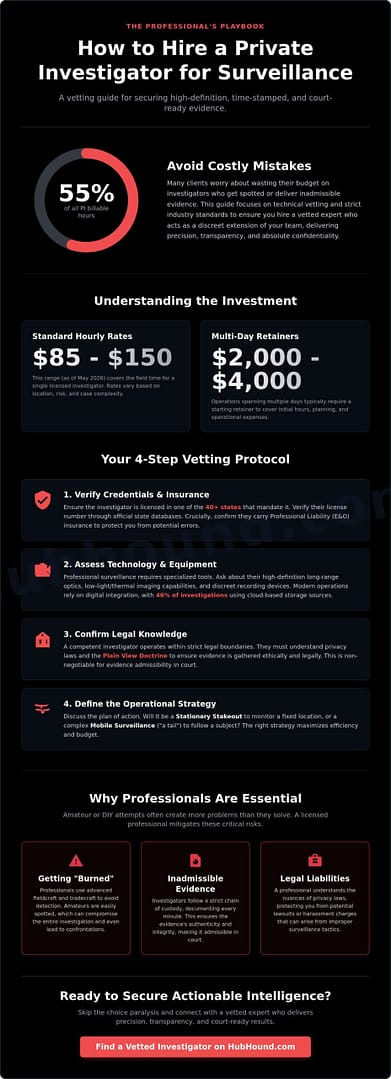
Surveillance operations account for 55% of all billable hours for private investigators globally, yet many clients still struggle to find professionals who can deliver court-ready results. If you’re worried about legal repercussions or wasting your budget on an investigator who gets spotted, you aren’t alone. Most professionals feel this same anxiety when they need to secure high-definition, time-stamped evidence without compromising their reputation. Learning how to hire a private investigator for surveillance is the only way to mitigate these risks and ensure your case remains legally sound.
We understand that you need a vetted expert who acts as a discreet extension of your team. This guide allows you to skip the choice paralysis by focusing on technical vetting and strict industry standards. You’ll learn how to evaluate the cost-to-value ratio, navigate the requirements in the 40 states that mandate licensing, and ensure your evidence is admissible. We’ll also cover why standard hourly rates as of May 2026 range from $85 to $150 and how to manage retainers that typically start between $2,000 and $4,000 for multi-day operations. We’ve done the heavy lifting to help you track down a professional who delivers precision, transparency, and absolute confidentiality.
Key Takeaways
- Verify state-issued licenses and professional liability insurance through official databases to ensure your agency is vetted and reliable.
- Identify the specific high-definition optics and thermal imaging tools required to capture court-ready evidence in any lighting condition.
- Master the legal frameworks of the Plain View doctrine to understand how to hire a private investigator for surveillance who operates within strict privacy boundaries.
- Differentiate between stationary stakeouts and mobile operations to select the most efficient strategy for your specific case requirements.
- Streamline the onboarding process by providing actionable intelligence and securing a comprehensive professional service agreement before fieldwork begins.
Defining the Scope of Professional Surveillance Operations
Professional surveillance is the systematic observation of persons, places, or objects to gather objective evidence. It isn’t a casual hobby or a simple task of taking photos from a distance. It’s a calculated, technical operation designed to produce results that hold up under legal scrutiny. When you are researching What is a Private Investigator?, you’ll find that surveillance is a core competency that requires specialized training and equipment. Understanding the operational boundaries of these services is the first step in learning how to hire a private investigator for surveillance.
Operations generally fall into two categories: stationary and mobile. Stationary surveillance, often called a stakeout, involves monitoring a fixed location from a concealed vantage point. This is ideal for documenting who enters or exits a specific building. Mobile surveillance is significantly more complex. It requires “the tail,” where an investigator follows a subject through varying environments, such as heavy traffic or public transit, without being detected. Professionals often use multiple vehicles to “leapfrog” the subject, ensuring the target never sees the same car twice.
Types of Investigative Surveillance
Physical surveillance relies on the human element. An investigator uses advanced fieldcraft to blend into an environment, whether it’s a corporate office or a public park. Technical surveillance utilizes specialized hardware like high-definition long-range optics and thermal imaging. Remote surveillance involves monitoring locations using unmanned technology or cloud-based platforms. This is a growing trend. 2026 data indicates that cloud-based storage sources appear in 46% of all investigations, making digital integration a necessity for modern field operations.
Why Professionals are Essential
DIY attempts usually end in disaster. Amateurs often get “burned,” which means the subject realizes they’re being watched. This can lead to confrontations or legal trouble. Professionals avoid this through years of experience and specialized tradecraft. Furthermore, evidence must follow a strict chain of custody to be admissible in court. If you gather evidence yourself, the opposing counsel can easily challenge its authenticity. A licensed investigator documents every minute of the operation, ensuring the evidence remains untainted. They also understand the nuances of privacy laws, protecting you from potential lawsuits or harassment charges.
Common use cases for these operations include corporate due diligence, civil litigation support, and workplace misconduct investigations. Whether you are dealing with a complex fraud case or a sensitive domestic matter, professional surveillance provides the clarity you need to make informed decisions. Knowing how to hire a private investigator for surveillance ensures that your case is handled with the precision and confidentiality required for a successful outcome.
The Vetting Protocol: How to Verify Investigative Expertise
Finding a professional requires more than a simple web search. Because surveillance services account for 55% of billable hours in the industry, many generalist firms claim expertise they don’t actually possess. When you are learning how to hire a private investigator for surveillance, your first step is a rigorous vetting protocol. You aren’t just looking for someone with a camera. You’re looking for a licensed professional whose work product can withstand a cross-examination in a court of law.
Licensing and Credentials
As of July 2025, more than 40 states require private investigators to maintain active licensure. This isn’t a mere formality. A license ensures the investigator has met minimum age, education, and experience requirements. Hiring an unlicensed “consultant” is a significant liability. Evidence gathered by unlicensed individuals is often inadmissible, and you could face legal repercussions for hiring them. You can check the official definition of a private investigator to understand the regulatory floor for this profession. Always cross-reference agency numbers with state regulatory databases before signing a contract.
Beyond the license, verify professional liability insurance. Specifically, look for Errors and Omissions (E&O) coverage. This protects you if the investigator makes a mistake that leads to a lawsuit. A reputable agency will provide a Certificate of Insurance (COI) upon request. If they hesitate, walk away. You can also evaluate their commitment to the craft by looking for affiliations with organizations like the National Association of Legal Investigators (NALI). These memberships indicate that the investigator follows a strict code of ethics and stays updated on technical trends.
Evaluating Specialization
Experience in one area doesn’t guarantee success in another. An expert who specializes in pre-employment background checks might struggle with the complexities of mobile surveillance. Ask about their specific background. Former law enforcement or military personnel often bring high-level fieldcraft, but career PIs have a unique understanding of civil privacy boundaries. Interview them about the environments they know best. An investigator who excels in dense urban settings may not have the right equipment or vehicle for rural operations. You need a partner who is vetted and verified for your specific operational needs.
Finally, request redacted sample reports. A high-quality report should be clear, chronological, and supported by high-definition, time-stamped video evidence. This work product is what you are ultimately paying for. If the sample report is vague or lacks detail, the final evidence will likely be just as disappointing. Reliable professionals value transparency and will show you exactly what their reporting standards look like before you pay a retainer.
Private Investigations Equipment: The Tech Behind the Evidence
High-quality evidence depends on high-quality hardware. As you evaluate how to hire a private investigator for surveillance, the agency’s equipment locker is just as critical as their license number. Professional investigators in 2026 utilize military-grade technology to capture identifiable images from distances that would leave a standard smartphone camera useless. This technical edge ensures that the evidence you receive is admissible and clear enough to stand up in a courtroom.
The Role of High-End Optics
Standard 4K video is no longer a luxury; it’s the baseline for professional operations. High-optical zoom is the primary differentiator between an amateur and a pro. Digital zoom simply enlarges pixels, resulting in grainy, useless images. Optical zoom uses physical glass to bring the subject closer, maintaining clarity for license plate identification and facial recognition. In 2026, many investigators have moved to 8K sensors to allow for post-capture cropping without losing detail. This is essential when documenting subjects in varying weather conditions where visibility might be compromised.
Thermal imaging and low-light sensors have also become standard tools for 24/7 operational capability. These assets allow for successful monitoring in total darkness, ensuring that a stakeout doesn’t end just because the sun went down. If an investigator doesn’t mention their night-vision capabilities, they aren’t equipped for full-spectrum surveillance.
Covert and Specialized Tools
Close-quarters verification requires a different set of tools. Investigators use button cameras and covert body-worn systems to document interactions in public spaces without being detected. These tools are indispensable for workplace misconduct or domestic verification cases. Additionally, vehicle-mounted systems allow for long-duration stationary monitoring. These systems often include multi-camera arrays that provide a 360-degree view around the surveillance vehicle.
Technology trends from November 2025 indicate a massive increase in drone-assisted surveillance. Drones provide an operational reach that was previously impossible, particularly in difficult-to-access areas. However, data security is the ultimate priority. 2026 industry reports from Cellebrite show that mobile devices and cloud storage are sources of evidence in 66% and 46% of cases respectively. A professional firm must use encrypted storage and secure transfer protocols to protect your digital evidence from breaches. When you learn how to hire a private investigator for surveillance, always ask about their data retention and encryption standards to ensure your sensitive information remains confidential.
Legal Standards and Evidence Admissibility in Surveillance
Legal integrity is the bedrock of any investigative operation. If you are learning how to hire a private investigator for surveillance, you must understand that “getting the shot” is only half the battle. The other half is ensuring that shot is admissible in court. Evidence obtained through trespassing, wiretapping, or violating privacy laws is often excluded from legal proceedings. This renders the entire operation a waste of resources and potentially exposes you to civil or criminal liability.
The “Plain View” doctrine serves as the primary legal framework for field operations. This doctrine allows investigators to record anything visible from a public vantage point. However, this authority stops at the threshold of a “Reasonable Expectation of Privacy.” For instance, an investigator can legally film a subject walking in a public park, but they cannot use a ladder to peer over a six-foot privacy fence or use specialized audio equipment to record conversations inside a private residence. Professional firms strictly adhere to these boundaries to avoid anti-stalking or harassment charges. They rely on “legitimate purpose” exemptions that protect licensed professionals conducting authorized investigations.
Admissibility in Court
To be useful in litigation, surveillance evidence must be unedited and time-stamped. Any gap in the footage or sign of digital manipulation can lead to a motion to suppress. Chain of Custody is the chronological documentation of evidence handling. This log proves that the evidence remained secure and unaltered from the moment it was captured until it reached the courtroom. The investigator’s testimony supplements the visual evidence, providing the necessary context for a judge or jury. This is why working with a reputable corporate investigation firm is vital for protecting business interests. These agencies provide investigators who are trained to testify clearly and professionally under high-pressure cross-examination.
Privacy Ethics and Boundaries
The line between public observation and private intrusion is thin. Reliable professionals refuse to use illegal tools like spyware or phone hacking software. While these might seem like shortcuts to the truth, they are federal offenses that can result in criminal charges for both the investigator and the client. As of May 2026, new regulations like the California Senate Bill 1454 require investigators to have written contracts that specify the scope of work, fees, and dates. This adds a layer of transparency and legal protection for the client. Additionally, proposed laws like South Carolina’s H. 3269 highlight the industry’s move toward prohibiting investigators from representing multiple parties with opposing interests.
When you decide how to hire a private investigator for surveillance, prioritize firms that demonstrate a deep literacy in these evolving legal standards. They protect your case by operating within the law, ensuring that every piece of evidence they deliver is a precision tool for your success.
Initiating the Investigation: Onboarding and Reporting
Successful surveillance begins long before an investigator sits in a vehicle. Once you understand how to hire a private investigator for surveillance, the focus shifts to the onboarding phase. This stage requires you to share “actionable intelligence” with your chosen firm. Provide the subject’s physical description, known vehicles, daily routines, and high-activity locations. This data reduces the “burn” risk and ensures the investigator doesn’t waste billable hours searching for a target who isn’t there.
Transparency regarding costs is a hallmark of a professional agency. As of May 2026, standard hourly rates for surveillance typically fall between $85 and $150. For complex operations involving multiple agents or specialized equipment, rates can exceed $250 per hour. Expect to sign a Professional Service Agreement (PSA) that outlines the scope of work and fee structure. Most agencies require a retainer before deployment. Basic case retainers often start between $1,000 and $3,000, while multi-day surveillance retainers typically range from $2,000 to $4,000. These financial commitments ensure the investigator can dedicate the necessary time and resources to your case without interruption.
The Strategic Planning Phase
Defining “success” is the most critical part of the initial consultation. You must establish clear objectives, such as identifying a co-conspirator or documenting a specific activity. Investigators use these goals to determine “Go/No-Go” criteria. For example, they may decide not to deploy if weather conditions make clear identification impossible. For corporate clients, this phase often involves coordinating with workplace investigations to ensure the surveillance aligns with internal disciplinary or legal strategies.
Establish strict communication protocols during this phase. Decide how and when you want to receive updates. Most professionals provide daily “sitreps” (situation reports) via encrypted messaging or secure portals. This prevents you from making uninformed decisions while the operation is active.
Analyzing the Final Report
The final work product is more than just a video file. A professional surveillance report includes a detailed chronological narrative of all observations, cross-referenced with time-stamped media. If the investigator utilized advanced surveillance techniques, the report should explain how that technology supported the findings. Review the narrative for objectivity; it should describe actions without projecting intent or emotion.
Finally, ensure the agency follows proper data retention policies. Given that 2026 industry data shows mobile and cloud sources appear in a combined 112% of case evidence instances, secure data destruction is vital once the legal utility of the evidence has passed. Confirm that your investigator has a policy for shredding physical logs and wiping digital drives to protect your long-term confidentiality.
Securing Your Investigative Results
Mastering the process of how to hire a private investigator for surveillance transforms a high-risk operation into a strategic asset. Success depends on more than just tracking a subject. It’s a technical discipline that requires verifying state-issued licenses, evaluating high-definition 4K optics, and maintaining a strict chain of custody. By prioritizing legal literacy and technical expertise, you ensure that every hour of field deployment produces unedited, court-ready evidence that withstands scrutiny.
HubHound simplifies this selection process by acting as your expert filter. Our team consists of licensed investigators with over 30 years of experience who specialize in high-stakes surveillance and corporate due diligence. We maintain vetted and verified professional standards to eliminate the choice paralysis often associated with finding reliable help. Vet your investigative needs with HubHound’s expert team today to secure the clarity and precision your case deserves. You’re now equipped to move forward with confidence and obtain the results you need.
Frequently Asked Questions
Is it legal for a private investigator to follow someone?
It is legal for a licensed investigator to follow a subject in public spaces. They operate under the Plain View doctrine, which permits the observation of activities visible from public roads or parks. Understanding these legal boundaries is a key part of learning how to hire a private investigator for surveillance. Licensed professionals are protected by legitimate purpose exemptions, provided they maintain a respectful distance and don’t engage in trespassing.
Can a private investigator record audio during surveillance?
Generally, investigators can’t record private audio without the consent of at least one or both parties. State laws vary significantly regarding one-party or two-party consent for audio recording. Because recording private conversations often triggers federal wiretapping violations, most professionals focus exclusively on high-definition video evidence. It’s an approach that protects the client from legal liability while ensuring the gathered evidence remains admissible in court proceedings.
How much does it cost to hire a private investigator for surveillance?
Hourly rates for private investigator surveillance typically range from $75 to $150 per hour, though these can vary significantly based on location, complexity, and the investigator’s experience. Flat fees are also common for specific tasks, such as background checks ranging from $200 to $600. For specific pricing in your area, contacting a reputable agency like HubHound is the best way to get an accurate estimate when you’re learning how to hire a private investigator for surveillance.
Will the person being watched find out they are under surveillance?
They’re highly unlikely to discover the surveillance when you work with a professional. Investigators use long-range optics and leapfrogging techniques with multiple vehicles to ensure the subject never sees the same car twice. While amateurs often get burned by following too closely, a vetted professional maintains a safe distance. This discretion is vital for maintaining the integrity of the case and preventing the subject from altering their behavior.
How long does a typical surveillance operation take to get results?
Most results are obtained within 3 to 5 days of active monitoring. It’s common for patterns of behavior to emerge within the first 72 hours of a stakeout or mobile operation. While some cases conclude quickly, complex corporate or domestic matters may require 40 or more billable hours to secure a comprehensive evidence package. Professionals use this time to document consistent behavior rather than isolated incidents.
Can surveillance evidence be used in a divorce or child custody case?
Surveillance evidence is frequently used in divorce and child custody cases to document cohabitation or neglect. Time-stamped video and detailed narrative reports provide objective proof that can influence court decisions. For example, evidence of a parent’s lifestyle or the presence of unauthorized individuals can be pivotal. To be effective, the evidence must be legally obtained and supported by a clear chain of custody documentation to ensure it’s admissible.
What happens if a private investigator is caught by the subject?
If an investigator is spotted, they’ll immediately terminate the operation to avoid a confrontation. This situation, known as a burn, requires the investigator to pull back and wait for the subject’s suspicion to subside. The agency will then reassess the strategy, often swapping investigators or vehicles to resume at a later date. This cautious approach protects the client’s interests and prevents the subject from becoming permanently hyper-vigilant.
Do private investigators use drones for surveillance?
Yes, drones are frequently utilized to improve operational reach and accuracy. Drone-assisted surveillance has become a standard tool for gathering evidence in difficult-to-access areas. These unmanned assets provide a unique vantage point while maintaining a safe distance from the subject. They’ll strictly follow FAA regulations and respect privacy boundaries to ensure the drone footage remains legally admissible.

Article by
Joel R. Manley | President | Hubhound Investigations | OR PI-ID#: 90432 | 111 SW Fifth Avenue, Suite 3150 Portland, Oregon 97204 | 971-442-8170
Joel is licensed as a private investigator in Oregon and Tennessee. Joel started his career in 1987 serving as a Military Police Officer and Military Police Investigator.
After ending his military tour of duty, Joel became a civilian Police Officer and Deputy Sheriff. Joel took his strong background in Hostage Negotiations, Mediation and Conflict Resolution, with him to patrol some of the highest crime areas in SE Portland.
Joel was awarded Deputy of the Year for his efforts and for drastically reducing the crime rate in the area he patrolled. As a Deputy Sheriff, Joel assisted in leading a Neighborhood Livability Program that was nationally recognized for having the most innovative and progressive approach to policing.
In 2018, Joel retired as a Deputy Sheriff and founded Hubhound Investigations. Joel played an integral role in Hubhound Investigations receiving an A+ Accredited Business rating from the Better Business Bureau (BBB).
In his off time, Joel enjoys spending time with his wife, adult children and Hubhound’s Happiness Ambassador, Nya. Joel also enjoys Scuba Diving and Kayaking.
Disclaimer
DISCLAIMER: This article is provided for general informational and educational purposes only. It is not intended to constitute legal advice, professional investigative advice, or instruction to engage in any unlawful activity. Laws governing private investigations, surveillance, recording, tracking, access to information, evidence collection, privacy, trespass, licensing, and related investigative activities vary by jurisdiction and are subject to change.
Any investigative techniques, tactics, procedures, scenarios, or legal proceedings discussed in this article are presented for informational purposes and should not be interpreted as authorization or encouragement to use a particular method. Private investigators and members of the public are responsible for understanding and complying with all applicable federal, state, and local laws, licensing requirements, court rules, and professional standards.
The circumstances of every investigation and legal matter are different. Information contained in this article should not be relied upon as a substitute for advice from a qualified attorney or other appropriate licensed professional regarding a specific situation. No attorney-client, investigator-client, or other professional relationship is created by reading or using this information.