
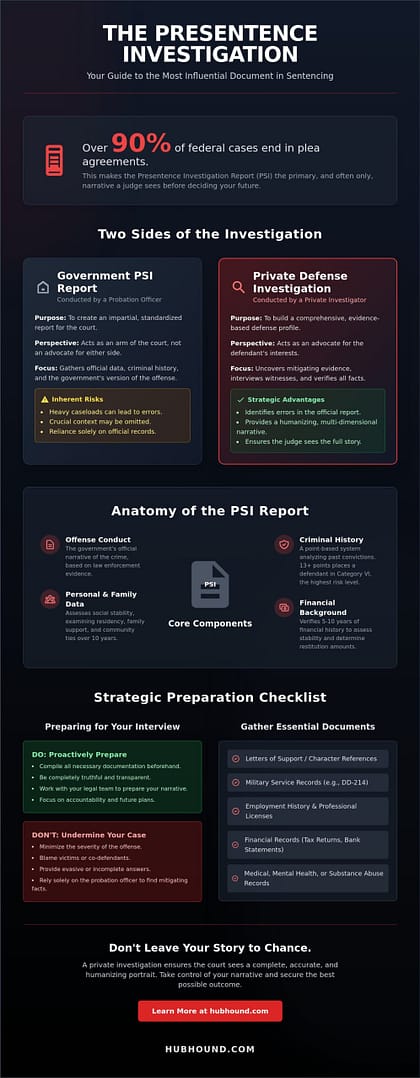
What if the most influential document in your legal case isn’t the verdict, but a single report written behind closed doors? For those facing the sentencing phase, the p investigation often feels like a black box controlled entirely by government officials. We understand the anxiety that comes with this process. Data from the Administrative Office of the U.S. Courts shows that over 90% of federal cases end in a plea agreement, which means the sentencing report is often the only narrative the judge sees before making a decision.
You’ll learn the critical differences between mandatory legal investigations and professional private inquiries to ensure your story is told accurately. This guide provides the clarity you need to influence the judicial narrative through concrete evidence. We’ve curated a breakdown of the process, including three specific ways to prepare for your interview and strategies to mitigate biased reporting. It’s time to move from uncertainty to an actionable plan for your future.
Key Takeaways
- Distinguish between government-mandated reports and private-sector inquiries to better navigate the complexities of the justice system.
- Understand the core components of a p investigation, including how official offense conduct and criminal history are documented for the court.
- Discover the critical role private investigators play in uncovering mitigating evidence and independent witness statements that government officers might miss.
- Learn the strategic “dos and don’ts” of preparing for a presentence interview to ensure your personal narrative is accurately represented.
- Identify the essential documentation, from military records to character letters, needed to build a comprehensive and effective defense strategy.
Understanding the ‘P Investigation’: Definitions and Intent
The term “p investigation” is frequently used as shorthand for the Presentence Investigation (PSI), a process that marks the most critical phase of post-conviction litigation. It isn’t just a routine background check. It’s a comprehensive deep dive into a person’s entire existence. This investigation serves two masters: the government’s need for standardized sentencing and the defendant’s right to a fair, individualized assessment. Judges use this report to move beyond the cold facts of a crime and look at the human being behind the file. Because the judge wasn’t present for the defendant’s upbringing or career, this document provides the necessary context for a life they’ve never seen.
The dual nature of these inquiries is what makes them complex. On one side, you have government-mandated reports generated by court staff. On the other, you have private-sector inquiries designed to protect the defendant’s interests. Both aim to create a profile, but their perspectives often differ. The p investigation is the single most influential document in the post-conviction phase, often carrying more weight than the trial testimony itself when it comes to the final sentencing outcome.
The Legal Framework of Presentence Reports
Courts rely on these reports to adhere to federal and state standards, specifically the mandate that sentences remain “sufficient but not greater than necessary” to achieve justice. Under statutory guidelines like 18 U.S.C. § 3553(a), the court must consider the history and characteristics of the defendant before making a ruling. The probation officer acts as an impartial arm of the court. They aren’t there to advocate for the defendant or the prosecution. Instead, they curate a Presentence Investigation Report that details criminal history, financial status, and personal background. A PSI is a curated history of a defendant’s life and conduct that serves as the definitive roadmap for a judge’s sentencing decision.
When Private Investigation (P.I.) Becomes Necessary
Relying solely on a government-issued report carries inherent risks. Probation officers often handle heavy caseloads, which can lead to factual errors or omitted context in a p investigation. Savvy defendants frequently hire a personal investigator to conduct a parallel inquiry. This private-sector approach focuses on verifying facts that a government profile might overlook or misinterpret.
A private agency looks for mitigating evidence, interviews character witnesses, and identifies gaps in the official narrative. While the court’s report provides the baseline, a private inquiry ensures the judge sees an evidence-based defense profile rather than a one-dimensional summary. This proactive strategy turns a passive report into a dynamic tool for the defense, ensuring that no stone is left unturned before the final gavel falls.
The Core Components of a Presentence Investigation Report
The p investigation serves as the definitive document for judicial decision-making. It functions as a curated overview of the defendant’s life and the specific circumstances of the crime. The Offense Conduct section acts as the official narrative. It details the government’s version of events based on evidence gathered by law enforcement. This section often includes statements from investigating officers and co-defendants to establish the total scope of the offense.
Criminal history analysis involves a deep dive into prior contacts with the legal system. Probation officers assign points based on the severity and frequency of previous convictions. A defendant with more than 13 points typically falls into Criminal History Category VI, the highest risk level. Personal and family data sections assess social stability by examining 10-year patterns of residency and domestic support. These factors help the court determine if a defendant has a reliable network to aid in successful reentry.
Victim Impact Statements provide a critical perspective on the harm caused. According to Department of Justice standards, these documents allow victims to articulate physical, financial, or emotional damages. Judges rely on this data to calculate restitution and ensure the sentence aligns with the human cost of the offense. The p investigation ensures these voices are integrated into the final judgment.
Financial and Professional Background
Investigators apply rigorous due diligence standards to a defendant’s personal finances. They typically verify 5 to 10 years of tax returns and bank statements to assess the capacity for paying fines or restitution. Professional standing is vetted through direct employment verification and professional licensing checks. This process ensures the court understands the defendant’s economic footprint. For professionals seeking to optimize their business connections or find vetted service providers, a curated directory of experts offers a reliable way to navigate complex ecosystems.
Health, Substance Use, and Mental Well-being
Accurate health documentation is a high-stakes requirement for sentencing. A 2017 Bureau of Justice Statistics report found that 37% of state and federal prisoners had a history of mental health issues. Documenting these conditions guides the court toward appropriate placement in medical or mental health facilities. It also helps distinguish between the need for punitive measures and the necessity of rehabilitation. Every medical claim requires verification through official records to influence the final sentencing recommendation effectively.
The Critical Role of Private Agency Support in Legal Investigations
Government investigators often operate under extreme caseload pressures. A 2022 report from the Bureau of Justice Statistics highlighted that public investigative resources are frequently stretched thin, which can lead to overlooked details. A private agency provides the dedicated hours necessary for a comprehensive p investigation. These professionals uncover mitigating evidence that state officers might miss during a standard inquiry. By vetting “official” evidence through meticulous record review and field inquiry, private experts ensure that the defense has a complete picture of the facts.
Securing independent witness interviews & statements is a vital step in building a robust defense. These interviews often reveal nuances that weren’t captured in initial police reports. When key individuals are difficult to find, agencies utilize skip tracing. Since approximately 10% of the U.S. population moves every year, professional location services are essential for finding favorable witnesses who have relocated or changed contact information. This proactive approach ensures that every voice relevant to the case is heard.
Surveillance and Fact Verification
Professional investigators use surveillance techniques to establish a factual timeline of events. This isn’t just about following a subject; it’s about verifying alibis and observing professional conduct through discreet, legal methods. Surveillance provides objective, court-ready data for defense counsel by providing a visual and chronological record of activities. This data often contradicts or clarifies the narrative presented by the prosecution. It’s a method that relies on patience and precision to yield high-quality results.
Digital Forensics and Data Recovery
Digital evidence is often the deciding factor in a modern p investigation. Experts retrieve deleted communications, such as texts or emails, that provide critical context for a case. They also analyze GPS and cell tower data to challenge proximity claims made by the state. This technical analysis requires a high level of expertise to remain admissible. A vetted expert plays a crucial role in presenting this complex data to the court in a way that is clear and impactful. They transform raw data into a narrative that can be used to support a legal strategy.
- Mitigating Evidence: Finding facts that reduce culpability or provide alternative explanations.
- Record Review: Identifying inconsistencies in police logs, lab results, and official statements.
- Field Inquiry: Visiting scenes to verify if witness perspectives were physically possible.
- Expert Testimony: Providing a professional voice to explain findings during trial proceedings.
The efficiency of a private investigation agency lies in its ability to focus on a single case without the distractions of a public sector workload. It’s a targeted, high-stakes process that prioritizes accuracy and depth. By filling the gaps left by the initial inquiry, private investigators provide the balance necessary for a fair legal process.
Comparing Government Probation Reports and Private Investigative Evidence
A government probation officer functions as an officer of the court. Their access is broad. They view sealed records, financial statements, and internal law enforcement databases. However, their inquiry is often limited by heavy caseloads. A private p investigation fills the gaps left by these standardized government templates. While the probation officer seeks to categorize a defendant within existing guidelines, a private investigator hunts for the exceptions that justify a lighter sentence.
The neutrality of government reports is frequently a myth. These inquiries rely heavily on the prosecution’s version of events and police reports. Data from industry workload assessments indicates that a private agency typically spends 5x more time on a single case than a government employee. This depth allows for the discovery of mitigating factors that a checklist-driven approach misses. According to 2023 United States Sentencing Commission data, downward departures occurred in approximately 26 percent of cases where specific mitigating circumstances were presented effectively. A private report provides the granular evidence needed to reach these outcomes.
Scope of Inquiry and Speed
Government investigations follow a linear path. They move slowly and stick to a predetermined set of questions. Private agencies operate with greater agility. They pivot to new leads the moment they emerge. You need an investigator who maintains a hound-like focus on the truth, rather than one who simply fills out forms. This specialized search ensures that no character witness or historical record is overlooked because of a bureaucratic deadline.
Confidentiality and Privilege
Information given to a probation officer becomes part of the court record. In contrast, a private p investigation is protected by the work-product doctrine. This ensures that sensitive findings stay within the defense team until they’re ready to be used strategically. Always choose a vetted investigator who adheres to high ethical standards. A curated selection process ensures your investigative partner is as reliable as the software integrations you use to run your business.
Optimize your defense strategy by finding the right experts. Compare vetted investigative agencies to find a partner that fits your specific legal needs.
Strategic Preparation: How to Manage an Active Investigation
Managing a p investigation requires a proactive stance rather than a reactive one. The Presentence Investigation (PSI) interview serves as the foundation for the final report, directly influencing your trajectory within the legal system. Prepare for this meeting by practicing concise, truthful responses. Don’t minimize the offense or shift blame. Probation officers are trained to detect a lack of remorse, and a negative assessment here can impact sentencing guidelines by 20% or more.
Gathering your own documentation is a critical step in building a counter-narrative. Relying on the government to find your positive attributes is a mistake. You should compile a comprehensive package that includes:
- Military discharge papers (DD-214) to verify service history.
- Certificates of completion for professional development or rehabilitation programs.
- Character letters that highlight specific instances of community service or integrity.
- Medical records that document physical or mental health challenges.
Your legal team must review the draft report within the standard 14-day window provided under federal rules. This is your primary window to correct factual errors before they become permanent. Hiring a private agency should happen weeks before the p investigation begins. Waiting until the report is written makes corrections 75% harder to implement. Early intervention allows your team to present a curated narrative that balances the government’s perspective with vetted, objective facts.
Identifying Red Flags in the Process
Recognize when an investigator’s report contains hearsay or unsubstantiated claims. Probation officers often include “relevant conduct” from police reports that wasn’t proven in court. You must challenge these factual errors in the Presentence Report (PSR) immediately. In a high-stakes legal ecosystem, only vetted information holds weight. Ensure every claim in your defense file is backed by a timestamped document or a sworn statement to maintain credibility with the court.
Final Steps and Advocacy
Leverage investigative findings during the sentencing hearing to provide a complete picture of your background. A private investigator’s testimony can humanize a defendant by providing context that a standard government report misses. Data from 2023 sentencing trends indicates that comprehensive defense-led investigations often lead to more favorable outcomes than those relying solely on public records. Take the next step by consulting with a curated investigative firm to ensure your defense is optimized for the final hearing.
Take Control of Your Investigative Strategy
Successfully navigating a p investigation requires more than simple compliance; it demands a proactive approach to evidence and reporting. You’ve seen how the distinction between government probation reports and private investigative evidence can fundamentally alter a legal trajectory. Strategic preparation isn’t just a recommendation. It’s a necessity for those managing active inquiries. By integrating private agency support, you ensure that every detail of your case receives the scrutiny it deserves. HubHound serves as your professional guide through this process, functioning as a specialized expert curator for legal and corporate needs.
We leverage over 30 years of licensed investigative experience to connect you with top-tier professionals. Our network focuses on criminal defense and corporate due diligence, providing the niche expertise required for complex cases. As a trusted curator of professional investigative resources, we’ve done the heavy lifting to verify skills and reliability. This high-level vetting saves you time and alleviates the stress of selecting the right agency during a high-stakes investigation. You can move forward with the confidence that your defense is backed by verified experts. Discover how HubHound’s vetted investigative experts can support your legal defense.
The right resources are available to help you secure a fair and comprehensive outcome.
Frequently Asked Questions
What exactly is a P investigation in the criminal justice system?
A presentence investigation, often called a p investigation, is a legal inquiry conducted by a probation officer to help a judge determine an appropriate sentence. It involves a deep dive into your criminal history, financial status, and personal background. According to Rule 32 of the Federal Rules of Criminal Procedure, this report must contain specific data points like sentencing guideline calculations and victim impact statements.
How long does a typical presentence investigation take to complete?
The process generally takes between 60 and 90 days from the date of the conviction or guilty plea. Federal guidelines require the initial draft to be disclosed to the defense at least 35 days before the scheduled sentencing hearing. This timeline ensures the court has sufficient time to review the findings and address any objections raised by legal counsel before the final judgment.
Can a private investigator really help with a government-mandated P investigation?
Yes, a private investigator provides an independent layer of verification that can supplement or challenge the findings of a government report. By conducting a parallel p investigation, these professionals can uncover mitigating factors or character witnesses that a busy probation officer might overlook. This vetted data gives legal teams the evidence needed to argue for downward departures or alternative sentencing options effectively.
Is the final presentence investigation report a public document?
No, the final report is a confidential document and isn’t available to the general public. Access is strictly limited to the judge, the prosecutor, the defendant, and the defense attorney. Under federal law, these documents remain sealed to protect the sensitive personal and financial information contained within the report’s detailed sections. It’s never filed in the public court docket.
What happens if I lie during my P investigation interview?
Providing false information can lead to an obstruction of justice enhancement, which typically adds 2 levels to a sentencing guideline score. This increase can result in a longer prison term than the original offense carried. Probation officers verify statements through 100 percent of available records; discrepancies are easily identified and reported directly to the sentencing judge, which damages your credibility.
Can I request a specific private investigator to assist my legal counsel?
You can hire any licensed private investigator to assist your defense team in conducting a supplemental p investigation. While the court-appointed probation officer is assigned by the government, your right to private counsel includes the ability to choose your own experts. Selecting a professional who’s vetted and experienced in federal sentencing procedures ensures your defense strategy remains robust and evidence-based.
What is the difference between a pre-plea and a presentence investigation?
A pre-plea investigation occurs before a defendant officially enters a plea, while a presentence investigation happens after a conviction or plea is recorded. Pre-plea reports are less common and usually require the consent of both the defendant and the prosecutor. They’re primarily used when the decision to plead guilty depends on a clear understanding of the likely sentencing range based on specific facts.
How much does it cost to hire a private investigator for legal support?
Costs vary based on the complexity of the case and the investigator’s experience level. Industry data from national associations indicates that hourly rates often range from 50 to 150 dollars. Many firms require an initial retainer, which typically covers the first 10 to 20 hours of investigative work and administrative overhead. Always request a clear fee schedule before starting the discovery process.

Article by
Joel R. Manley | President | Hubhound Investigations | OR PI-ID#: 90432 | 111 SW Fifth Avenue, Suite 3150 Portland, Oregon 97204 | 971-442-8170
Joel is licensed as a private investigator in Oregon and Tennessee. Joel started his career in 1987 serving as a Military Police Officer and Military Police Investigator.
After ending his military tour of duty, Joel became a civilian Police Officer and Deputy Sheriff. Joel took his strong background in Hostage Negotiations, Mediation and Conflict Resolution, with him to patrol some of the highest crime areas in SE Portland.
Joel was awarded Deputy of the Year for his efforts and for drastically reducing the crime rate in the area he patrolled. As a Deputy Sheriff, Joel assisted in leading a Neighborhood Livability Program that was nationally recognized for having the most innovative and progressive approach to policing.
In 2018, Joel retired as a Deputy Sheriff and founded Hubhound Investigations. Joel played an integral role in Hubhound Investigations receiving an A+ Accredited Business rating from the Better Business Bureau (BBB).
In his off time, Joel enjoys spending time with his wife, adult children and Hubhound’s Happiness Ambassador, Nya. Joel also enjoys Scuba Diving and Kayaking.
Disclaimer
DISCLAIMER: This article is provided for general informational and educational purposes only. It is not intended to constitute legal advice, professional investigative advice, or instruction to engage in any unlawful activity. Laws governing private investigations, surveillance, recording, tracking, access to information, evidence collection, privacy, trespass, licensing, and related investigative activities vary by jurisdiction and are subject to change.
Any investigative techniques, tactics, procedures, scenarios, or legal proceedings discussed in this article are presented for informational purposes and should not be interpreted as authorization or encouragement to use a particular method. Private investigators and members of the public are responsible for understanding and complying with all applicable federal, state, and local laws, licensing requirements, court rules, and professional standards.
The circumstances of every investigation and legal matter are different. Information contained in this article should not be relied upon as a substitute for advice from a qualified attorney or other appropriate licensed professional regarding a specific situation. No attorney-client, investigator-client, or other professional relationship is created by reading or using this information.