
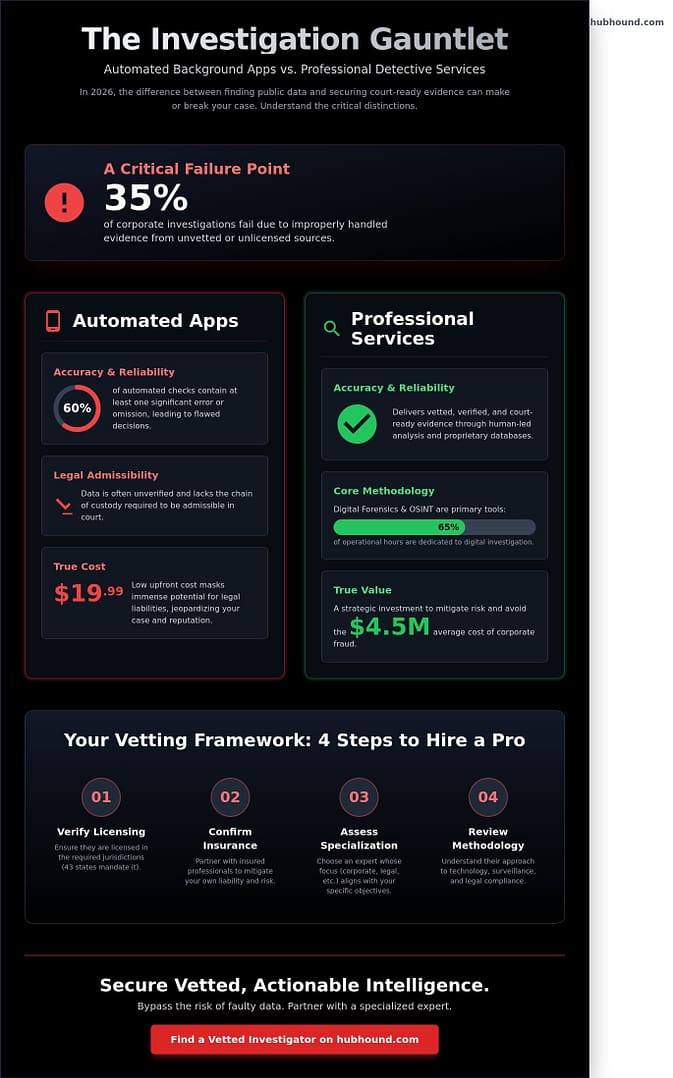
The $19.99 automated background check app you just downloaded could be your biggest legal liability in 2026. While digital databases provide instant gratification, they often lack the vetted accuracy required for high-stakes litigation or corporate due diligence. Relying on unverified data for serious decisions isn’t just risky; it’s often inadmissible. To secure evidence that holds up in court, you need professional private detective services that operate within strict legal frameworks. A 2024 industry report found that 35% of corporate investigations fail because of improper evidence handling by unlicensed firms.
You likely understand that accurate information is the cornerstone of risk management, yet finding a reliable partner in a crowded market feels like a full-time job. We’ll help you navigate the investigative ecosystem by detailing the differences between service tiers and providing a clear framework to vet professionals. This guide explores how to identify licensed investigators who deliver actionable intelligence while avoiding the cowboy operators that jeopardize your legal standing. Discover how to select a specialized expert who protects your interests and your reputation.
Key Takeaways
- Learn to distinguish between outdated “private eye” stereotypes and modern investigative consulting tailored for the 2026 digital landscape.
- Evaluate the strategic differences between corporate, legal, and domestic investigations to ensure your chosen methodology aligns with your specific objectives.
- Identify why automated background check tools often fail and when to bypass budget apps for professional private detective services that provide verified, high-stakes data.
- Understand the advanced technology used in modern skip tracing and surveillance to locate high-profile subjects or conduct deep-dive due diligence.
- Apply a rigorous vetting framework to verify investigator credentials and insurance, ensuring you partner with a specialized expert who mitigates risk.
Understanding Modern Private Detective Services in 2026
The 2026 investigative landscape has moved past the cinematic tropes of the 20th century. Modern private detective services operate as high-level consulting firms that specialize in risk mitigation and truth verification. They don’t just follow leads. They synthesize massive amounts of digital information into court-ready evidence. A licensed private investigator now acts as a bridge between raw data and legal action. They spend roughly 65% of their operational hours on digital forensics and open-source intelligence (OSINT). This shift reflects a world where 90% of a person’s footprint is digital. Businesses and legal teams no longer view these services as a last resort. Instead, they integrate them into standard due diligence protocols to avoid the $4.5 million average cost of corporate fraud.
The demand for professional private detective services has grown by 12% annually since 2023. This growth stems from the increasing complexity of global digital transactions. Clients need more than a person with a camera. They need a strategist who understands the intersection of privacy law and data recovery. These experts provide a vetted layer of intelligence that software alone cannot replicate.
The Scope of Professional Investigations
Professional investigations are structured around three core service lines. Corporate investigations focus on intellectual property theft and executive vetting. Legal teams rely on investigators for skip tracing and process serving that meets strict jurisdictional requirements. Domestic services provide clarity in personal disputes or estate matters. Licensing is mandatory. Currently, 43 states require rigorous background checks and exams for investigators. These professionals utilize proprietary databases that update in real-time. These systems track asset transfers and social connections that standard search engines miss.
Why Raw Data Isn’t Enough
Search engines provide results, but they don’t provide evidence. There’s a massive difference between finding a public record and establishing a pattern of liability. A 2025 industry report found that 60% of automated background checks contain at least one significant error or omission. Context is the most valuable asset in a 2026 investigation. While an automated report might show a past lawsuit, a specialist explains the outcome and the risk it poses to your current project. This human-led analysis prevents the misinterpretation of data points. Professional investigative services are a blend of high-speed technology and human intuition that delivers actionable clarity.
Comparing Service Categories: Corporate, Legal, and Domestic
Selecting the right private detective services requires a clear understanding that investigative objectives vary significantly by sector. Business investigations prioritize risk mitigation and ROI, while domestic cases often focus on emotional resolution or legal leverage in family court. Digital forensics offers a high data recovery rate for corporate fraud, providing a superior cost-benefit ratio compared to traditional surveillance, which may require 40 or more hours of field work to yield a single actionable lead. Most professional firms now utilize a hybrid approach to maximize efficiency.
- Timelines: Standard background checks take 48 to 72 hours; complex fraud probes can last 3 to 6 months.
- Resource Allocation: Use a single investigator for stationary surveillance. Deploy a task force for mobile targets in high-traffic areas to increase success rates by 60%.
- Objectives: Corporate cases seek to protect assets; domestic cases seek to confirm or deny suspicions.
Corporate Due Diligence and Workplace Misconduct
Corporate investigations protect a firm’s intangible asset value by vetting leadership and internal culture. Standard pre-employment screening checks basic criminal history, but executive due diligence involves 10 years of deep-dive financial and social mapping. When investigating workplace theft or harassment, investigators act as neutral third parties to preserve brand reputation. This objectivity helps prevent the 25% productivity drop typically seen during internal scandals. If you need to find vetted investigators for business needs, our curated directory simplifies the search.
Legal Support and Litigation Services
Attorneys rely on investigators for more than simple process serving. While skip tracing locates a witness in 24 to 48 hours, a criminal defense investigator may spend weeks uncovering exculpatory evidence. Vetting Your Investigator ensures they understand the 1963 Brady v. Maryland requirements for evidence disclosure. Sworn statements and professional witness interviews provide the foundation for civil litigation, turning hearsay into admissible court testimony. This level of precision is vital for cases involving high-stakes liability or intellectual property theft.
Domestic and Infidelity Investigations
Domestic cases require a balance of high-quality 4K video evidence and extreme discretion. In high-net-worth divorces, asset searches identify hidden accounts or offshore holdings that can impact settlements by millions of dollars. Most domestic surveillance operations last 3 to 5 days, typically peaking during weekend hours or late evenings. Using a two-person team instead of a lone operative ensures continuous coverage during subject transitions. This resource allocation is essential for maintaining a “loose” tail that remains undetected by the subject.
Professional Investigators vs. Automated Background Search Tools
Don’t fall for the app trap. Many business owners believe a $20 digital background check suffices for high-stakes vetting. It doesn’t. These platforms often scrape data from outdated caches that haven’t been refreshed since 2023 or 2024. They frequently miss recent litigation, protective orders, or cross-jurisdictional movements. Professional private detective services utilize proprietary data streams like TLOxp or Tracers. These tools are restricted to licensed professionals and provide real-time updates that consumer-grade apps simply can’t access.
Using non-FCRA compliant software for housing or employment decisions creates massive legal exposure. If you reject a candidate based on an unverified hit from a mobile app, you’re open to costly litigation. Human investigators manually verify every red flag at the primary source. This process ensures you aren’t acting on a false positive caused by a common surname or a data entry error at the county clerk’s office. The National Council of Investigation and Security Services sets the benchmark for these professional standards, ensuring that investigators operate within the strict bounds of federal privacy laws. This level of oversight is entirely absent in the world of automated search engines.
Limitations of Automated Data
Algorithms can’t assess credibility or nuance. A software sweep might show a 2022 misdemeanor but won’t explain the context or the reliability of the reporting party. Automated tools produce false positives at a rate of nearly 30% in some database segments, flagging innocent individuals due to naming similarities. Private detective services filter this noise. They deliver a concise, actionable summary report rather than a 60-page raw data dump. This saves you hours of manual review and prevents the choice paralysis that comes with unverified data.
When DIY Investigations Become a Liability
Attempting your own surveillance is a fast track to a stalking or harassment charge. You lack the legal protections and technical training required to follow a subject without violating their privacy rights. Professional investigators act as a legal firewall for their clients. They collect evidence, such as high-definition video or witness statements, that’s actually admissible in court. Selecting a professional private investigation near me ensures compliance that software ignores. This vetted approach minimizes your personal risk while maximizing the quality of the intelligence gathered.
Evaluating Methodology: Surveillance, Skip Tracing, and Due Diligence
Methodology defines the caliber of professional private detective services. Modern investigators utilize 4K high-definition optics and real-time GPS tracking to maintain visual contact from distances exceeding 500 yards. This technology reduces the risk of detection while ensuring evidentiary quality that holds up under scrutiny. Digital forensics integrates into this process by analyzing metadata from workplace devices; a practice that identifies internal threats in 85% of corporate fraud cases according to 2024 industry benchmarks.
Surveillance Operations and Ethics
Investigators operate under strict legal frameworks rooted in the Fourth Amendment. They can film in public spaces where no reasonable expectation of privacy exists. They can’t film inside private residences or through obscured windows. Static surveillance involves monitoring a single location for 8 to 12 hours. Mobile follows require multiple vehicles to prevent “burning” the tail. Reports are structured chronologically. They include time-stamped video logs and detailed narratives to meet court-admissibility standards. This systematic approach ensures that every minute of footage serves a specific evidentiary purpose.
Advanced Asset and Locate Investigations
Finding individuals who’ve intentionally disappeared requires high-level skip tracing. This science goes beyond basic database searches. It involves analyzing “digital breadcrumbs” and utility records. Professionals specialize in locating a witness by cross-referencing non-public records and proprietary databases. Due diligence frameworks now prioritize identifying offshore interests and shell companies. Before hiring, always verify a private investigator number through national licensing boards. This ensures the professional has the legal authority to access sensitive financial data.
Effective due diligence involves several critical layers of verification:
- Entity Mapping: Identifying parent companies and subsidiaries that obscure ownership.
- Asset Recovery: Locating hidden bank accounts or real estate holdings through forensic accounting.
- Lifestyle Audits: Comparing reported income against visible expenditures to detect fraud.
Workplace investigations have shifted toward digital forensics. The Association of Certified Fraud Examiners (ACFE) 2024 report indicates that organizations lose 5% of their annual revenue to fraud. Private detective services mitigate this by recovering deleted communications and tracking unauthorized data transfers. These methods provide the objective data needed for termination or litigation. Using vetted professionals ensures these techniques are applied ethically and legally. Families dealing with finding missing adults face a similarly complex landscape, where professional investigators bridge the gap between privacy laws and the urgent need for answers.
Ready to secure your business interests? Find and compare vetted investigative agencies through the HubHound ecosystem.
Vetting Your Investigator: A Framework for Informed Selection
Selecting the right private detective services requires a systematic approach to mitigate risk and ensure high-quality evidence. Professional investigations are significant investments; 78% of legal professionals cite the quality of the initial investigator vetting as the primary factor in case success. Follow this five-step framework to secure a qualified partner.
- Step 1: Verify Credentials. Confirm the firm holds an active license in their operating jurisdiction. Validate professional liability insurance with a minimum $1,000,000 coverage limit to protect your interests during field operations.
- Step 2: Assess Niche Specialization. A generalist often lacks the technical depth needed for complex tasks. Ensure the investigator has a documented track record in your specific area, whether it’s corporate due diligence or high-net-worth asset recovery.
- Step 3: Evaluate Reporting Protocols. Demand clarity on communication. Top-tier firms provide digital portals with 24-hour update cycles. Avoid investigators who rely solely on verbal updates or text messages.
- Step 4: Review Fee Structures. Scrutinize the contract for transparency. Professional firms provide detailed line-item estimates, including travel, equipment fees, and administrative costs.
- Step 5: Conduct a Technical Consultation. Use the initial meeting to gauge their professional chemistry and technological literacy. If they don’t understand modern data privacy laws or encrypted communication, they’re a significant liability.
Red Flags to Avoid During the Hiring Process
Ethical investigators never guarantee a specific outcome. The National Association of Legal Investigators (NALI) dictates that promising a result is a major ethical violation since facts are discovered, not manufactured. Be wary of firms lacking a physical office or a professional digital presence; these “ghost” operations often lack the stability to see long-term cases through. Watch for unusually low hourly rates, often 30% or more below the national industry average, which typically signal a lack of insurance or the use of unlicensed subcontractors.
The HubHound Standard of Vetting
HubHound eliminates the uncertainty of the discovery process by applying rigorous standards to every firm we recommend. We curate private detective services specifically for growth-focused companies that value efficiency and legally sound reporting. Our ecosystem ensures you’re matched with experts who understand the intersection of physical security and digital intelligence. Don’t waste time on unverified leads. Explore our vetted investigative services today and secure the authoritative insights your business requires.
Secure Your Facts with Precision
In 2026, the distinction between automated search tools and professional investigators is sharper than ever. Basic digital reports often fail to provide the depth needed for complex corporate or legal matters. Choosing high-quality private detective services ensures you receive court-ready evidence backed by rigorous surveillance and skip tracing methodologies. It’s about moving beyond surface-level data to secure actionable intelligence that protects your interests.
HubHound eliminates the friction of vetting by connecting you with licensed investigators who bring 30+ years of experience to every case. Our curated network specializes in corporate compliance and discreet, action-oriented reporting. We’ve done the heavy lifting to ensure your investigative partner meets the highest standards of professionalism and reliability. You don’t have to waste time on unverified leads when a hand-picked expert is ready to deliver the results you need. Our specialized ecosystem focuses on quality and compatibility, matching your specific requirements with the right investigative professional. For those navigating the emotionally charged process of locating missing adults when law enforcement resources fall short, our network includes specialists who apply these same rigorous standards to personal search cases.
Take the first step toward clarity and resolve your case with professional certainty today.
Frequently Asked Questions
What is the average hourly rate for private detective services in 2026?
Expect to pay between $75 and $200 per hour for professional private detective services in 2026. These rates fluctuate based on the investigator’s specialized expertise and the technical requirements of your specific case. High-demand services like digital forensics or complex corporate surveillance often command the higher end of this price scale. Always request a transparent fee schedule to ensure your project budget aligns with the projected billable hours.
Is the evidence gathered by a private investigator admissible in court?
Evidence gathered by a licensed investigator is generally admissible in court if the professional obtained it legally. This includes high-resolution photos, video footage, and witness statements collected without violating privacy laws or trespassing on private property. Investigators must maintain a strict chain of custody for all physical and digital assets. If an investigator breaks the law to acquire information, a judge will likely strike that evidence from the record.
What is the difference between a private investigator and a private detective?
The terms private investigator and private detective are functionally identical in the modern investigative industry. Most regulatory boards use the title Private Investigator for official licensing and certification purposes. Some professionals choose the detective designation to highlight their previous experience in law enforcement or criminal inquiries. Regardless of the label, you should prioritize hiring a vetted professional who holds a valid license and carries professional liability insurance.
Can a private investigator access private cell phone records or bank accounts?
Private investigators cannot legally access private cell phone records or bank statements without a court-ordered subpoena or direct owner consent. Federal laws like the Gramm-Leach-Bliley Act protect financial privacy and make it a crime to obtain this data through pretexting. Investigators instead use advanced database access and public records to identify assets or communication patterns. They provide the curated intelligence your legal team needs to request a formal subpoena.
How long does a typical background check or skip trace investigation take?
A standard background check typically takes 48 to 72 hours to complete. More complex skip trace investigations or deep-dive corporate due diligence can extend to 10 or 14 business days depending on the depth of the search. Speed depends on the availability of digital records and the responsiveness of third-party verification sources. Professional firms prioritize accuracy over speed to ensure every data point is vetted and verified before delivery.
Is it legal for a private investigator to follow someone without their knowledge?
It’s legal for a licensed investigator to conduct surveillance on an individual in public spaces. Professionals follow strict operational guidelines to avoid stalking or harassment charges while documenting a subject’s activities. They must remain on public property and cannot use invasive technology to peer into private residences. This legal boundary ensures the gathered intelligence remains useful for corporate or legal proceedings without triggering civil liability for the client.
Do I need a lawyer to hire a private investigator for my business?
You don’t need a lawyer to hire an investigator, but involving counsel often protects the investigation under attorney-client privilege. This strategy is common for 85% of corporate litigation cases to ensure sensitive findings remain confidential during the discovery phase. A lawyer helps define the scope of work to meet specific legal objectives. Direct hiring is often more efficient for routine tasks like employee vetting or simple background checks.
What should I look for when verifying a private investigator’s license?
Verify an investigator’s credentials by checking their license number against the official regional regulatory database. Look for an active status, a current expiration date, and a clean disciplinary record with no recent sanctions. Most reputable investigators display their license number clearly on their website and digital marketing materials. Confirming these details protects your business from the risks associated with unverified operators who lack professional accountability and insurance.

Article by
Joel R. Manley | President | Hubhound Investigations | OR PI-ID#: 90432 | 111 SW Fifth Avenue, Suite 3150 Portland, Oregon 97204 | 971-442-8170
Joel is licensed as a private investigator in Oregon and Tennessee. Joel started his career in 1987 serving as a Military Police Officer and Military Police Investigator.
After ending his military tour of duty, Joel became a civilian Police Officer and Deputy Sheriff. Joel took his strong background in Hostage Negotiations, Mediation and Conflict Resolution, with him to patrol some of the highest crime areas in SE Portland.
Joel was awarded Deputy of the Year for his efforts and for drastically reducing the crime rate in the area he patrolled. As a Deputy Sheriff, Joel assisted in leading a Neighborhood Livability Program that was nationally recognized for having the most innovative and progressive approach to policing.
In 2018, Joel retired as a Deputy Sheriff and founded Hubhound Investigations. Joel played an integral role in Hubhound Investigations receiving an A+ Accredited Business rating from the Better Business Bureau (BBB).
In his off time, Joel enjoys spending time with his wife, adult children and Hubhound’s Happiness Ambassador, Nya. Joel also enjoys Scuba Diving and Kayaking.
Disclaimer
DISCLAIMER: This article is provided for general informational and educational purposes only. It is not intended to constitute legal advice, professional investigative advice, or instruction to engage in any unlawful activity. Laws governing private investigations, surveillance, recording, tracking, access to information, evidence collection, privacy, trespass, licensing, and related investigative activities vary by jurisdiction and are subject to change.
Any investigative techniques, tactics, procedures, scenarios, or legal proceedings discussed in this article are presented for informational purposes and should not be interpreted as authorization or encouragement to use a particular method. Private investigators and members of the public are responsible for understanding and complying with all applicable federal, state, and local laws, licensing requirements, court rules, and professional standards.
The circumstances of every investigation and legal matter are different. Information contained in this article should not be relied upon as a substitute for advice from a qualified attorney or other appropriate licensed professional regarding a specific situation. No attorney-client, investigator-client, or other professional relationship is created by reading or using this information.