
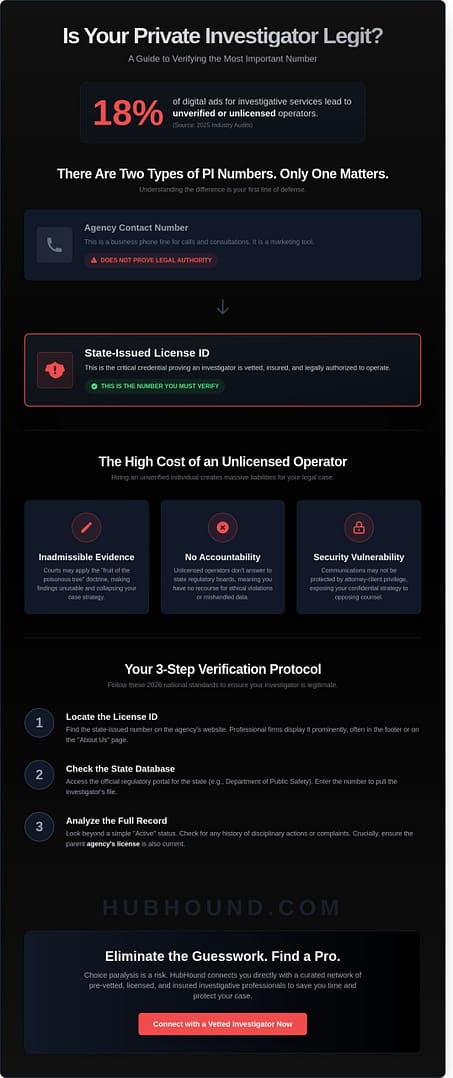
What if the 10-digit private investigator number you just dialed belongs to an unlicensed operator with zero legal authority to handle your sensitive data? Recent industry audits from 2025 suggest that nearly 18% of digital ads for investigative services lead to unverified agents. You’re likely searching for a direct line to a professional, but finding a valid private investigator number requires a clear understanding of the difference between a business phone line and a state-issued license credential.
It’s natural to feel anxious about case confidentiality and the legal standing of your hire. You need an investigator who has already passed a rigorous vetting process. This guide promises to clarify those distinctions, ensuring you don’t waste time or risk your reputation on an amateur. We’ll walk you through the 2026 verification protocols, identify the red flags of fraudulent listings, and show you how to connect with a curated professional who meets every national legal standard.
Key Takeaways
- Distinguish between state-issued license IDs and agency contact numbers to ensure your investigator is legally authorized to operate.
- Use national regulatory databases to verify credentials and confirm that an investigative firm meets current professional standards.
- Evaluate any private investigator number to determine if a firm provides the stability of a vetted agency or the risks of an independent contractor.
- Master the intake process by asking specific, court-focused questions that move your strategy from theory to actionable results.
- Eliminate choice paralysis by understanding how professional curators pre-verify licenses and credentials to save you valuable time.
The Significance of a Private Investigator Number: License vs. Contact
A private investigator number serves two distinct purposes in the professional investigative ecosystem. Most clients first encounter the agency contact number used for consultations. However, the state-issued license number is the critical identifier that defines a firm’s legal standing. In 2026, this license ID acts as the digital DNA for an investigative agency. It proves the firm has passed rigorous background checks, maintains active bonding, and carries professional liability insurance. You should treat an unverified number as a red flag for your legal security.
Verifying this number isn’t just a formality. It’s a mandatory step to protect attorney-client privilege. If an investigator operates without a valid license, the communications you share might not be protected under legal privilege. This vulnerability exposes your strategy to discovery by opposing counsel. Professional firms display their license numbers prominently on all digital assets to ensure transparency and build immediate trust with high-stakes clients.
Why License Numbers are Mandatory for Legal Investigations
State regulatory boards oversee the issuance of investigative credentials to maintain industry standards. Because private investigator licensing varies by state, a professional must hold a specific ID for each jurisdiction where they maintain an office. As of 2026, 45 states require a formal license to conduct private investigations. This credential ensures the investigator is bonded, providing a financial safety net for the client if errors occur during the field work. You can typically find these numbers in the footer of a website or on the “About” page of a vetted agency.
The Risks of Unlicensed “Investigators”
Hiring an unlicensed individual creates a massive liability for your legal case. Courts often apply the “fruit of the poisonous tree” doctrine to evidence gathered by unlicensed actors. If your investigator lacks a valid private investigator number, a judge may rule their findings inadmissible. This disqualification can collapse a multi-year litigation strategy in seconds. Unlicensed operators also lack ethical oversight from state boards. They don’t answer to a regulatory body, which means you have no recourse if they mishandle your sensitive data or engage in illegal surveillance tactics. A low-cost, unlicensed option usually results in a high-cost legal disaster when the evidence is challenged in court. Before hiring anyone, reviewing a comprehensive breakdown of private detective services can help you understand the critical differences between licensed tiers and avoid costly mistakes.
- Admissibility: Licensed investigators provide testimony that stands up to cross-examination.
- Accountability: State boards can revoke licenses for ethical violations, protecting the public.
- Security: Licensed firms must follow strict data handling protocols to maintain their credentials.
Professionalism starts with verification. By prioritizing the license ID over the contact number, you ensure your investigation is built on a foundation of legal authority. This simple check separates curated experts from high-risk amateurs.
How to Verify a Private Investigator License Number Nationally
Confirming a private investigator number is the first step in ensuring your case remains legally sound and confidential. Start by accessing the official regulatory database for the state where the investigator operates. These portals are typically managed by the Department of Public Safety or the Secretary of State. Enter the license number directly into the search field to pull the current file. A professional search should yield the investigator’s full legal name, their associated agency, and the expiration date of their credentials.
Effective verification requires looking beyond a simple “Active” status. Check the database for a history of disciplinary actions or formal complaints. Regulatory bodies update these records in real-time, often providing “Final Orders” or “Consent Agreements” if the investigator violated state ethics or laws. Because state licensing requirements for private investigators are rigorous, any suspension or lapse is a major red flag. Always cross-reference the individual investigator with their parent agency. If the individual is active but the agency license has expired, the investigator cannot legally take your case.
Decoding License Prefixes and Classifications
License numbers often include prefixes that define the scope of work allowed. A Class A license typically denotes a full investigative agency, while a Class C or CC license identifies a private investigator or an intern. Understanding these codes prevents you from hiring an individual who lacks the legal authority to run a firm. Don’t assume a “retired law enforcement” title replaces a valid license. While 15% of investigators come from police backgrounds, they must still maintain an active private investigator number to operate legally in the private sector.
National Databases and Professional Associations
While most licensing happens at the state level, national associations provide an extra layer of vetting. Organizations like the National Association of Legal Investigators (NALI) or the National Council of Investigation and Security Services (NCISS) maintain high standards for their members. Verifying an investigator’s standing within these groups confirms they follow a national code of ethics.
For business owners who need to skip the manual research, HubHound acts as an expert curator to help you find vetted professional services. We prioritize transparency by highlighting providers with verified credentials and proven track records. Always verify the “qualifying agent” behind an agency number. This is the individual responsible for the agency’s legal compliance. If the qualifying agent leaves the firm, the agency’s license may become void within 30 days, regardless of the number displayed on their website.
Evaluating a Private Investigation Firm Before You Call
A dedicated private investigator number serves as a primary indicator of professional stability. It’s more than a contact point; it’s a marker of business legitimacy. Established firms invest in enterprise-grade communication systems that link to a verifiable physical office. 82% of enterprise-level investigations now require firms to demonstrate this level of infrastructure before a contract is signed. When you see a dedicated business line, you’re looking at a firm that’s committed to long-term operations rather than a temporary side hustle.
Analyzing the digital footprint of a firm is a mandatory step in 2026. Verify that the phone number matches the registered business address on official filings. Professional agencies ensure their contact information is consistent across their website, social profiles, and state registries. This alignment prevents the confusion often caused by “ghost” agencies that use rotating VOIP numbers to evade accountability. A stable number suggests the firm has the staying power to see a complex, months-long investigation through to its conclusion.
Professional Agency vs. Individual Contractors
The “vetted agency” model offers a depth of resources that solo contractors can’t match. Agencies maintain a centralized intake number for corporate due diligence, ensuring that your sensitive data is handled by a coordinated team. If your case requires multi-state surveillance or diverse technical skills, a solo operator will likely struggle. When searching for private investigation near me, prioritize firms that provide agency-level support. This structure allows for 24/7 responsiveness and specialized expertise in both corporate and domestic matters. Consulting the National Council of Investigation and Security Services allows you to verify state-level requirements and find established firms with proven track records. Efficiency matters in high-stakes cases. Don’t settle for a limited resource pool.
Red Flags in PI Contact Information
Anonymity is a major red flag in professional services. Be cautious of firms that only provide anonymized VOIP numbers without a corresponding physical office location. While VOIP has its place, it shouldn’t be the only way to reach a professional. 2024 industry benchmarks show that reputable firms display their license number prominently on all marketing materials. If an agency refuses to provide their license number before a consultation, end the call immediately. Look for these specific warning signs:
- Inconsistent branding between the phone number and the state registry name.
- Automated systems that prevent you from speaking to a licensed investigator.
- Numbers that frequently change or redirect to untraceable cell phones.
- A private investigator number that isn’t listed on the firm’s official LinkedIn or Google Business profile.
Transparency is the foundation of trust. Reliable firms want you to verify their credentials. They’ll provide a clear path from their phone number to their professional license and physical headquarters. Check the license. Verify the address. Protect your interests from the start.
5 Critical Questions to Ask When Calling a Private Investigator Number
Dialing a private investigator number is the start of a high-stakes partnership. You shouldn’t spend time asking if they’re capable. Instead, focus on how they’ll execute your specific strategy. Professional vetting in 2026 requires a granular look at an investigator’s operational framework. You’re hiring a process that must withstand intense legal scrutiny and deliver actionable results.
Start by asking about their evidence standards. Modern court-ready evidence means more than just a grainy photo. It requires 4K video, timestamped metadata, and a documented chain of custody. If the investigator doesn’t have a written protocol for maintaining evidence integrity, their findings might be dismissed during a deposition. Professional firms treat evidence with the same rigor as law enforcement agencies to ensure it remains admissible.
Establish a communication rhythm early. High-tier firms use secure, encrypted portals to share updates rather than relying on unsecured email threads. Ask if they provide daily logs or if they only contact you when a milestone is reached. This transparency prevents budget creep and keeps the strategy on track. When you call a private investigator number, you’re looking for an expert who treats your data with the same security as a financial institution.
Verifying Specialization and Case History
Confirm the investigator has handled cases similar to yours within the last 12 months. Generalists often lack the technical depth needed for complex litigation or corporate fraud. Ask for a breakdown of their surveillance or background screening methodology. If your situation involves legal protection, ensure they understand the nuances of criminal defense investigator work. This includes specific knowledge of discovery rules and expert witness testimony. They should also demonstrate proficiency with tools like proprietary skip tracing databases or digital forensic hardware. If you’re starting your search from scratch, our 2026 guide to finding a professional PI near me walks through the exact verification steps and fee structures you need to evaluate before signing any contract.
Discussing Confidentiality and Data Security
Data security is a non-negotiable requirement. Ask how the firm stores sensitive case data and background reports. Professional agencies utilize AES-256 encryption and strict access controls. You need to know their protocol for maintaining anonymity during surveillance to prevent burn-offs. A botched operation creates immediate liability for the client. Finally, understand the contract terms before any fees are exchanged. A clear agreement should outline the scope of work, hourly rates, and expected expenses to ensure there are no surprises on the final invoice. Understanding the full spectrum of professional private detective services available in 2026 will help you ask sharper questions and evaluate whether a firm’s capabilities truly match your case requirements. For cases involving finding missing adults, confirm that the investigator is familiar with the specific legal boundaries and advanced search tools required to navigate privacy laws while conducting a thorough and compliant investigation.
HubHound: Connecting You with Vetted Investigative Professionals
HubHound functions as a strategic filter for organizations that can’t afford to waste time on unverified leads. Finding a valid private investigator number shouldn’t feel like an obstacle course. We’ve removed the choice paralysis that plagues modern procurement by building a high-performance ecosystem of pre-screened professionals. Decision-makers today face 300% more service options than they did a decade ago, which often leads to analysis paralysis. HubHound solves this by acting as an expert curator. We don’t just list investigators; we audit them for quality and compliance.
This commitment to professional verification is valuable across all service industries, ensuring that whether you are hiring a legal expert or a pet care specialist, quality is guaranteed. To see an example of high-standard pet care, check out H&H Dog for expert training and walking services.
Our platform bridges the gap between complex investigative needs and reliable solutions. Whether you’re a legal professional requiring litigation support or a corporate leader managing risk, the goal remains the same: obtaining accurate information without the administrative burden of vendor verification. By centralizing top-tier talent, we ensure that your focus stays on the results rather than the search process.
The HubHound Vetting Standard
Our team manages the heavy lifting of credentialing so your staff doesn’t have to. We verify every private investigator number against state regulatory databases and historical performance records before any professional joins our network. This rigorous process ensures that 100% of our partners meet the standards required for high-stakes corporate and legal environments. According to 2024 industry benchmarks, manual vendor verification takes an average of 14 days. HubHound reduces this timeline to minutes by providing a curated list of active, licensed experts.
Efficiency and transparency drive our vetting model. We only partner with investigators who have proven track records in their specific niches. This curated approach saves growing companies and legal teams significant resources. Instead of gambling on an unverified search result, you gain access to an elite tier of professionals who understand the nuances of evidence collection and chain of custody. Our focus on expert-level results means you receive actionable intelligence that holds up under scrutiny.
Ready to Start Your Investigation?
Initiating a consultation with a vetted professional is a seamless process. Once you identify your specific needs, our platform connects you with the right expert to move from discovery to actionable evidence. We support a comprehensive range of services, including asset searches, executive pre-employment checks, and specialized litigation support. This streamlined transition ensures that no time is lost between identifying a problem and launching an investigation.
The HubHound ecosystem is built for speed and reliability. We prioritize your time by providing an insider’s access to the best investigative talent available nationwide. You can bypass the uncertainty of the open market and work directly with professionals who have already cleared our high bar for entry. Take the next step in securing the information your business needs to thrive.
Take action now: Consult with a Vetted Investigator Today
Secure Your Investigation with Verified Expertise
Securing a valid private investigator number is the first step toward protecting your interests and ensuring legal compliance. Professional licensing isn’t optional when you require court-admissible evidence or complex corporate due diligence. By verifying credentials through national databases and asking the five critical questions we’ve outlined, you eliminate the risks associated with unvetted operators. You deserve a partner who prioritizes transparency and professional standards over quick, unreliable results.
HubHound simplifies this discovery process by acting as your expert curator. We leverage over 30 years of combined investigative experience to identify elite professionals across the country. Every partner in our network undergoes a rigorous 10-point vetting process to guarantee quality and reliability. We’ve already done the heavy lifting of research so you can move forward with confidence. You don’t have to navigate the complexities of the investigative ecosystem alone.
Your path to clarity starts with a verified professional who is ready to deliver the facts you need today.
Frequently Asked Questions
How do I check if a private investigator is licensed?
Verify credentials through the state’s licensing board or Department of Public Safety database. Most states provide an online lookup tool where you enter the individual’s name or agency ID. According to 2024 industry standards, 43 states require a formal license to operate. Always cross-reference the active status with the expiration date listed on the official registry. This step ensures you’re working with a professional who meets current regulatory requirements.
What is a PI license number and where can I find it?
A PI license number is a unique alphanumeric identifier issued by a state regulatory agency to track professional compliance. You can find this private investigator number on their official website, business cards, and all marketing materials as required by state law. Vetted professionals display this ID prominently to establish transparency and trust within the investigative ecosystem. It serves as your primary tool for tracking down an investigator’s professional history.
Can a private investigator work in multiple states with one number?
No, investigators must typically hold a separate license for every state where they conduct business. While some states have reciprocity agreements, such as those found in the 2023 Multi-State Reciprocity Agreement, these are limited. An investigator must register and obtain a specific state-issued number to legally perform surveillance or background checks outside their primary jurisdiction. Always ask for the specific credentials for the state where your investigation takes place.
Is it legal to hire a private investigator without a license number?
Hiring an unlicensed investigator is illegal in 43 states and carries significant legal risks for the client. Engaging an unverified individual can lead to the dismissal of evidence in court under standard judicial rules. Protect your interests by only hiring vetted agencies that provide a valid private investigator number during the initial consultation. This ensures that the data they collect is admissible and that the professional follows strict ethical guidelines.
What happens if I call a private investigator number and they won’t give me their ID?
Terminate the call immediately if an investigator refuses to provide their license credentials. Transparency is a non-negotiable standard for professional investigators in the modern marketplace. Reliable experts provide their ID number upfront to facilitate your due diligence process. A refusal often indicates a lack of proper certification or a history of regulatory violations. Don’t waste time on professionals who hide their credentials, as it puts your case at risk.
Do all private investigators have a badge number?
No, private investigators are not law enforcement officers and don’t possess official government badge numbers. While some agencies issue internal ID shields for branding, these hold no legal authority. You should prioritize verifying their state-issued license number rather than a decorative badge, as the license is the only legal proof of their right to operate. According to 2024 regulatory data, a badge doesn’t grant any special legal powers or access.
How much does it cost to hire an investigator after I call their number?
Average hourly rates for professional investigators range from $75 to $200 according to 2024 industry reports. Total costs depend on the complexity of the case and the technology required for the search. Most agencies require a retainer fee, which typically starts at $1,500 for standard domestic or corporate surveillance operations. Always request a written contract that outlines these fees before you authorize the investigator to begin tracking down information for you.
Can I verify a private investigator number through the Better Business Bureau?
The Better Business Bureau (BBB) tracks consumer complaints but cannot verify the legal validity of a professional license. You must use a state-run licensing portal to confirm an investigator is authorized to work. The BBB serves as a secondary tool for checking an agency’s reputation and historical performance after you’ve confirmed their legal credentials. Use the platform to see if the firm has a history of resolved disputes or high-quality service ratings.

Article by
Joel R. Manley | President | Hubhound Investigations | OR PI-ID#: 90432 | 111 SW Fifth Avenue, Suite 3150 Portland, Oregon 97204 | 971-442-8170
Joel is licensed as a private investigator in Oregon and Tennessee. Joel started his career in 1987 serving as a Military Police Officer and Military Police Investigator.
After ending his military tour of duty, Joel became a civilian Police Officer and Deputy Sheriff. Joel took his strong background in Hostage Negotiations, Mediation and Conflict Resolution, with him to patrol some of the highest crime areas in SE Portland.
Joel was awarded Deputy of the Year for his efforts and for drastically reducing the crime rate in the area he patrolled. As a Deputy Sheriff, Joel assisted in leading a Neighborhood Livability Program that was nationally recognized for having the most innovative and progressive approach to policing.
In 2018, Joel retired as a Deputy Sheriff and founded Hubhound Investigations. Joel played an integral role in Hubhound Investigations receiving an A+ Accredited Business rating from the Better Business Bureau (BBB).
In his off time, Joel enjoys spending time with his wife, adult children and Hubhound’s Happiness Ambassador, Nya. Joel also enjoys Scuba Diving and Kayaking.
Disclaimer
DISCLAIMER: This article is provided for general informational and educational purposes only. It is not intended to constitute legal advice, professional investigative advice, or instruction to engage in any unlawful activity. Laws governing private investigations, surveillance, recording, tracking, access to information, evidence collection, privacy, trespass, licensing, and related investigative activities vary by jurisdiction and are subject to change.
Any investigative techniques, tactics, procedures, scenarios, or legal proceedings discussed in this article are presented for informational purposes and should not be interpreted as authorization or encouragement to use a particular method. Private investigators and members of the public are responsible for understanding and complying with all applicable federal, state, and local laws, licensing requirements, court rules, and professional standards.
The circumstances of every investigation and legal matter are different. Information contained in this article should not be relied upon as a substitute for advice from a qualified attorney or other appropriate licensed professional regarding a specific situation. No attorney-client, investigator-client, or other professional relationship is created by reading or using this information.