
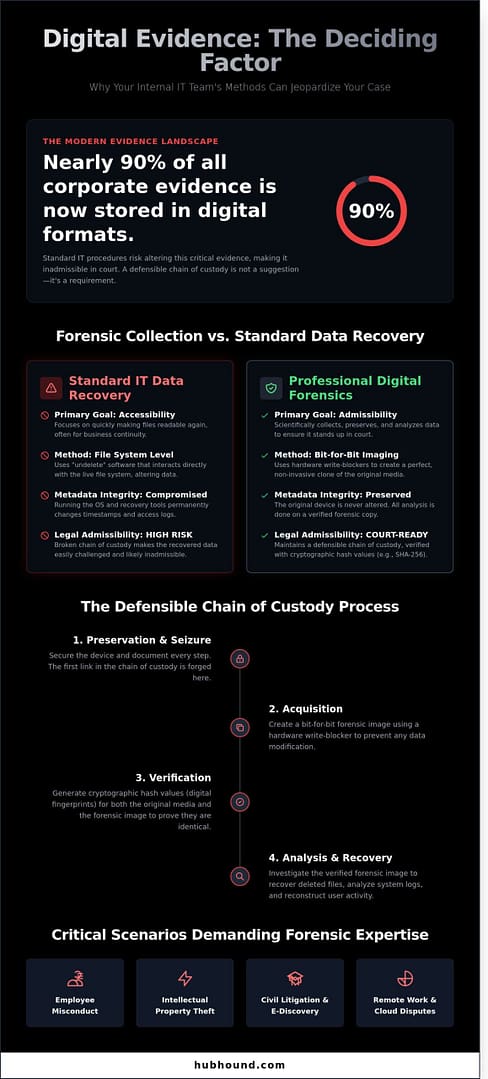
Your internal IT team is often the greatest risk to your legal strategy. While they excel at keeping systems running, the standard methods they use to check a hard drive can permanently alter metadata and render critical files inadmissible. You know that digital proof is the deciding factor in modern litigation, but the anxiety of data being overwritten or a chain of custody being broken is a heavy burden. According to the 2024 ABA Legal Technology Survey Report, nearly 90% of all corporate evidence is now stored in digital formats, making professional digital forensics & data recovery a vital component of any risk management plan.
This guide ensures you don’t lose your case before it even reaches a judge. You’ll learn how specialized recovery techniques transform raw, fragmented data into a powerful, court-admissible investigative asset that stands up to the most rigorous cross-examination. We’ll provide a clear framework to help you identify when to hire a vetted investigator and how to maintain a pristine evidentiary record from the moment a device is seized. It’s time to replace uncertainty with a curated, expert-led approach to data preservation and discovery.
Key Takeaways
- Learn why “Digital DNA” has become more reliable than physical evidence in modern corporate and legal environments.
- Understand the technical distinctions that allow professional digital forensics & data recovery to transform raw data into a court-admissible asset.
- Explore the essential “Write-Blocker” protocols and bit-for-bit acquisition methods required to maintain a defensible chain of custody.
- Identify high-stakes scenarios where digital evidence acts as the primary catalyst for resolving complex remote-work and cloud-based disputes.
- Discover the strategic benefits of utilizing licensed investigative firms over standard IT departments for sensitive data discovery.
The Evolution of Evidence: Why Digital Forensics & Data Recovery are Essential
Digital forensics involves the scientific collection, analysis, and preservation of electronic data to ensure its admissibility in a court of law. By 2026, defense attorneys have come to rely on “Digital DNA” because it offers a level of precision that physical evidence often lacks. While a witness might misremember a timeline, a system log records a specific event with millisecond accuracy. This technical certainty provides a reliable foundation for any legal defense strategy.
The field of digital forensics has evolved from a niche technical skill into a cornerstone of modern litigation. Unlike paper records, which are easily lost, shredded, or altered, digital footprints are remarkably permanent. Even when a user deletes a file, the underlying data often remains on the storage medium until it’s overwritten by new information. This persistence allows experts to reconstruct events long after they occurred, providing a factual counter-narrative to witness testimony.
Defense teams don’t just need data; they need a verified chain of custody. Standard IT departments often lack the specialized tools required for forensic-grade imaging. When a technician runs a basic file recovery program, they risk overwriting the very slack space where deleted data resides. These “undelete” methods often modify metadata, such as the “last accessed” date, which can compromise the integrity of the evidence. Professional digital forensics & data recovery protocols prioritize bit-stream imaging to preserve every byte of data without altering the original source.
From Paper Trails to Binary Footprints
Corporate record-keeping has undergone a total transformation over the last 10 years. Over 90% of business communications now occur via encrypted messaging apps or cloud-based platforms. Hidden system files, such as registry entries or application logs, provide context that a printed email cannot show. These artifacts reveal user attribution, proving exactly who was logged into a device when a specific action occurred. Timestamps are now the primary tool for building or dismantling an alibi with mathematical certainty.
The Role of ESI in Modern Litigation
Electronically Stored Information (ESI) encompasses all digital data subject to discovery, including emails, databases, and social media posts. Legal teams have a strict duty to preserve ESI as soon as litigation is reasonably anticipated. Failing to issue a timely litigation hold can lead to severe sanctions and adverse inference instructions. Modern civil litigation support relies on the seamless integration of ESI into discovery workflows. Expert digital forensics & data recovery ensures that no relevant data is overlooked during the collection phase, protecting the defense from claims of spoliation and ensuring a vetted, transparent process.
Forensic Collection vs. Standard Data Recovery: Understanding the Difference
Legal professionals often mistake simple file retrieval for a full investigation. While both involve digital forensics & data recovery, the methodologies differ significantly. Standard recovery focuses on accessibility. Forensic collection focuses on admissibility. The distinction determines whether evidence stands up in court or gets dismissed during a preliminary hearing.
Experts use physical hardware known as write-blockers during the collection phase. These devices prevent the operating system from making any changes to the original media. You never work on the original drive. Instead, you create a bit-for-bit clone. To prove this copy is identical to the source, analysts use hashing algorithms like MD5 or SHA-1. These act as digital fingerprints. If a single bit of data changes, the hash value fails to match. This level of precision is vital for maintaining a defensible chain of custody as outlined by NIST standards published in 2006.
Data Recovery: Restoring Accessibility
The primary goal here is making corrupted or deleted files readable again. It’s a common solution for the 75% of data loss incidents caused by hardware failure or accidental deletion. Recovery tools scan the drive for file headers that the operating system no longer recognizes. However, recovery alone doesn’t tell a story. It doesn’t prove who clicked “delete” at 2:00 AM. It simply hands you the file without the surrounding metadata required for a robust defense.
Digital Forensics: Establishing Context and Intent
This discipline answers the “who, what, when, where, and how.” Analysts examine artifacts like registry keys, browser history, and system log files. They can identify if a specific USB drive was connected or if a user manually altered the system clock. This evidence proves intent. In 2023, forensic analysis of metadata often became the deciding factor in proving “willful misconduct” rather than simple human error. Forensics provides the timeline that data recovery lacks.
The final investigative report is often more valuable than the recovered files. It translates complex technical jargon into clear, actionable testimony for a jury. If you need to find vetted experts who specialize in these high-stakes investigations, selecting an agency with the right toolset is the first step. A comprehensive report includes:
- Detailed logs of the collection process and write-blocker verification.
- Hash values for every image and file to ensure zero tampering.
- A chronological timeline of user activity leading up to the incident.
- Expert interpretations of system artifacts and hidden data structures.
Standard recovery might find a deleted document. A digital forensics & data recovery expert finds the document, proves who wrote it, and shows exactly when they tried to hide it. This depth of insight is what wins cases.
Critical Scenarios for Forensic Data Discovery in Corporate and Legal Environments
Digital evidence serves as the primary catalyst for modern legal resolution. In 2024, approximately 70% of legal disputes involve some form of electronic discovery. The massive shift toward remote work has moved the investigative focus to cloud-native apps like Slack, Jira, and Microsoft Teams. These platforms store volatile data that requires immediate preservation to prevent overwriting. Specialized expertise is mandatory in high-liability environments where a single missed metadata tag can cause an entire case to collapse. Modern investigators don’t just look at files; they integrate physical surveillance logs with digital footprints to create a chronological map of events. This intersection of physical and virtual data creates a vetted timeline that stands up to intense scrutiny in court.
Investigating Workplace Misconduct and Internal Threats
Corporate environments face increasing vulnerability from internal risks. Intellectual property theft is a top concern, as 2023 reports indicate trade secret leaks cost the global economy over $600 billion annually. Forensic teams hunt for unauthorized data exfiltration by auditing file transfer protocols and cloud storage access logs. In harassment or discrimination claims, digital evidence provides an objective record of employee interactions that shifts the case away from “he-said, she-said” scenarios. Maintaining strict privacy compliance is critical during these internal probes. Professionals follow NIST forensic data collection standards to ensure all captured data remains court-admissible and ethically sourced. This level of optimization protects the organization’s reputation while identifying bad actors within the corporate ecosystem. For investigations requiring additional layers of verification, specialized services like morganpolygraph.com offer professional credibility assessments that complement forensic findings.
Strengthening Criminal Defense with Digital Alibis
Digital forensics & data recovery can provide the specific evidence needed to clear a defendant’s name. GPS coordinates and cell tower pings establish a person’s location with high accuracy, often proving they weren’t at a crime scene at a specific time. Encrypted applications aren’t always the dead ends they appear to be. Expert recovery techniques can often pull exonerating messages from secure platforms like Signal or Telegram, even if the user attempted to delete them. A criminal defense investigator uses these technical insights to dismantle the prosecution’s narrative by highlighting inconsistencies in the digital record. They don’t just find data; they interpret the context of every byte. This process turns raw binary into a powerful alibi that can change the outcome of a trial. Utilizing digital forensics & data recovery ensures that defense teams have the tools to challenge technical claims with scientific precision.
The Forensic Process: Ensuring a Defensible Chain of Custody
Digital evidence is inherently fragile. A single improper interaction can alter file metadata or overwrite critical logs. Defense attorneys rely on a rigorous, four-step lifecycle to ensure evidence remains admissible. This process moves from the initial seizure to the final courtroom presentation. An unbroken chain of custody isn’t just a procedural hurdle; it’s the foundation of a viable defense. Without it, even the most exonerating data can be excluded by a judge.
- Identification and Seizure: Experts secure the physical and virtual perimeter to prevent data loss or remote wiping.
- Acquisition: This stage involves digital forensics & data recovery techniques to create a bit-for-bit forensic image. This clone ensures the original device stays in its pristine, seized state.
- Analysis: Technicians use specialized software to parse system artifacts, hidden folders, and unallocated space where deleted files often reside.
- Reporting: The final output translates complex binary code into a narrative that a jury can understand.
Identification and Preservation of Volatile Data
Volatile data refers to information stored in a device’s RAM. It’s temporary and vanishes if the power cuts out. Forensic experts choose between “Live Box” and “Dead Box” extractions based on the situation. A live approach captures active connections and encryption keys while the machine runs. A dead approach involves immediate power-down to stop ongoing data destruction. Follow these steps when a device is seized:
- Don’t power on a device that’s already off.
- Don’t browse through files to “see what’s there.”
- Disconnect the network or use a Faraday bag to block remote wipe commands.
- Document every person who touches the hardware.
Analysis, Hashing, and Reporting
Hashing serves as the digital fingerprint of a file. Forensic tools generate a unique alphanumeric string for every piece of evidence. If the hash of the file in court matches the hash of the file at the crime scene, it proves zero tampering occurred. This technical verification is vital for digital forensics & data recovery professionals. An expert witness then takes these findings and bridges the gap for the jury. Reports must include a clear, non-technical executive summary. A 2023 study by the Journal of Digital Investigation found that 68% of legal professionals believe the summary is the most influential part of a forensic report. Clear communication prevents technical details from burying the truth.
Need to find a vetted expert to handle your case data? Explore our curated list of forensic specialists today.
Integrating Digital Forensics into Your Investigative Strategy
Digital forensics isn’t a siloed IT task. It’s a foundational element of a modern legal defense. Treating evidence retrieval as a simple technical fix misses the legal nuances required for court admissibility. Defense teams must treat digital forensics & data recovery as a strategic asset that informs every stage of litigation, from initial discovery to the final trial. Effective integration requires moving past a reactive “fix-it” mindset and adopting a curated, investigative approach.
Why Professional Investigators Outperform Internal IT
Professional investigators bring a level of technical depth that far exceeds standard IT training, often drawing from backgrounds in elite cybersecurity. For those looking to build the skills necessary to work in these high-stakes environments, 8200PRO offers specialized preparation for candidates aiming to enter top-tier technological units where advanced forensic and cyber capabilities are developed.
Scaling Your Legal Strategy with Vetted Experts
Vetted forensic partners help attorneys move beyond reactive responses. By integrating forensic findings into witness interviews & statements, you can verify statements against hard metadata in real time. If a witness denies access to a specific server on August 14, 2023, forensic logs can provide definitive proof of their activity. This level of due diligence strengthens the defense’s position during depositions and mitigates corporate risk. Proactive data preservation is the best defense against claims of spoliation. It’s about being prepared before the subpoena arrives, ensuring your evidence ecosystem is optimized and ready for scrutiny.
To ensure your firm is prepared, follow this roadmap for implementing a robust digital evidence response plan:
- Audit your data footprint: Identify exactly where sensitive information lives, including cloud backups and encrypted drives.
- Define a response protocol: Establish clear, written steps for the moment a legal hold is triggered.
- Secure a vetted partner: Choose a firm with documented experience in digital forensics & data recovery to act as your expert filter.
- Implement regular training: Ensure your legal team understands how to handle digital evidence without compromising its integrity.
Master the Future of Digital Evidence
Success in the 2026 legal landscape depends on the absolute integrity of your electronic discovery. Standard data retrieval often fails to meet the stringent requirements of modern courtrooms, making specialized digital forensics & data recovery a critical component of any investigative strategy. By prioritizing a defensible chain of custody and using vetted methodologies, organizations protect themselves against evidence spoliation and procedural challenges. You need a partner who understands that a single oversight can compromise an entire case.
HubHound provides the expertise required to navigate these high-stakes environments. Our licensed investigators leverage over 30 years of industry experience to deliver results that stand up to judicial scrutiny. We focus on a verified approach for corporate and legal clients, ensuring your evidence is both comprehensive and court-admissible. We’ve refined our process to eliminate the choice paralysis often associated with technical investigations. Contact HubHound for expert digital forensics and investigative support.
Your path to a successful resolution starts with clear, undeniable facts. We’re ready to help you secure the evidence you need for a decisive win.
Frequently Asked Questions
Is digital forensics the same as data recovery?
Digital forensics isn’t the same as data recovery. Data recovery focuses on restoring lost or damaged files for personal use, while digital forensics involves the legal preservation and analysis of data for use in court. Forensic experts use vetted tools to ensure the integrity of the evidence remains 100% intact throughout the investigation.
Can deleted messages from apps like WhatsApp or Signal be recovered forensically?
Yes, experts can often recover deleted messages if the device’s storage hasn’t been overwritten. Forensic tools extract data from SQLite databases and system logs where traces of messages remain. A 2023 report from the National Institute of Standards and Technology confirms that data often persists in unallocated space long after a user hits delete.
How long does a typical digital forensic investigation take to complete?
A standard forensic investigation typically takes 14 to 21 business days to complete. Complex cases involving encrypted 1-terabyte drives or massive cloud backups can extend this timeline to 45 days or more. This duration allows for a thorough process of imaging, analysis, and the generation of a comprehensive report that meets legal standards.
Will the evidence collected through digital forensics be admissible in a court of law?
Evidence is admissible if it follows the Federal Rules of Evidence and is handled by a certified expert. The integrity of the digital forensics & data recovery process must be documented to prove the data wasn’t altered. Using specialized software ensures that 100% of the metadata is preserved, which is a key requirement for judicial acceptance.
What is a ‘chain of custody’ and why is it critical for digital evidence?
A chain of custody is a chronological log that tracks every person who handled the evidence from the moment of seizure. It’s critical because it prevents claims of evidence tampering or unauthorized access. If a gap exists in this log, a judge may rule the evidence inadmissible, potentially impacting the outcome of the entire case.
Can you forensically recover data from cloud storage like Google Drive or iCloud?
Analysts can recover data from cloud platforms using specialized API integrations and legal discovery protocols. This process captures a point-in-time snapshot of the account, including 100% of the files and hidden access logs. This data provides a clear timeline of user activity that isn’t visible through a standard web browser interface.
Do I need a search warrant for a private investigator to perform digital forensics?
You don’t need a search warrant if the client owns the device or has provided written consent for the search. Warrants are a Fourth Amendment requirement for law enforcement, not private investigators. However, 100% of forensic searches must still comply with the Electronic Communications Privacy Act of 1986 to remain legal.
What is the difference between a forensic image and a standard file copy?
A forensic image is a bit-for-bit duplicate of the entire storage medium, including hidden system files and unallocated space. A standard file copy only replicates active files visible to the user. This distinction is vital for digital forensics & data recovery because it allows experts to find deleted fragments that a simple copy-paste would miss. In cases where key individuals have gone off the grid or cannot be served, the ability to locate missing person data through professional skip tracing frameworks becomes an essential complement to the digital forensic process.

Article by
Joel R. Manley | President | Hubhound Investigations | OR PI-ID#: 90432 | 111 SW Fifth Avenue, Suite 3150 Portland, Oregon 97204 | 971-442-8170
Joel is licensed as a private investigator in Oregon and Tennessee. Joel started his career in 1987 serving as a Military Police Officer and Military Police Investigator.
After ending his military tour of duty, Joel became a civilian Police Officer and Deputy Sheriff. Joel took his strong background in Hostage Negotiations, Mediation and Conflict Resolution, with him to patrol some of the highest crime areas in SE Portland.
Joel was awarded Deputy of the Year for his efforts and for drastically reducing the crime rate in the area he patrolled. As a Deputy Sheriff, Joel assisted in leading a Neighborhood Livability Program that was nationally recognized for having the most innovative and progressive approach to policing.
In 2018, Joel retired as a Deputy Sheriff and founded Hubhound Investigations. Joel played an integral role in Hubhound Investigations receiving an A+ Accredited Business rating from the Better Business Bureau (BBB).
In his off time, Joel enjoys spending time with his wife, adult children and Hubhound’s Happiness Ambassador, Nya. Joel also enjoys Scuba Diving and Kayaking.
Disclaimer
DISCLAIMER: This article is provided for general informational and educational purposes only. It is not intended to constitute legal advice, professional investigative advice, or instruction to engage in any unlawful activity. Laws governing private investigations, surveillance, recording, tracking, access to information, evidence collection, privacy, trespass, licensing, and related investigative activities vary by jurisdiction and are subject to change.
Any investigative techniques, tactics, procedures, scenarios, or legal proceedings discussed in this article are presented for informational purposes and should not be interpreted as authorization or encouragement to use a particular method. Private investigators and members of the public are responsible for understanding and complying with all applicable federal, state, and local laws, licensing requirements, court rules, and professional standards.
The circumstances of every investigation and legal matter are different. Information contained in this article should not be relied upon as a substitute for advice from a qualified attorney or other appropriate licensed professional regarding a specific situation. No attorney-client, investigator-client, or other professional relationship is created by reading or using this information.