
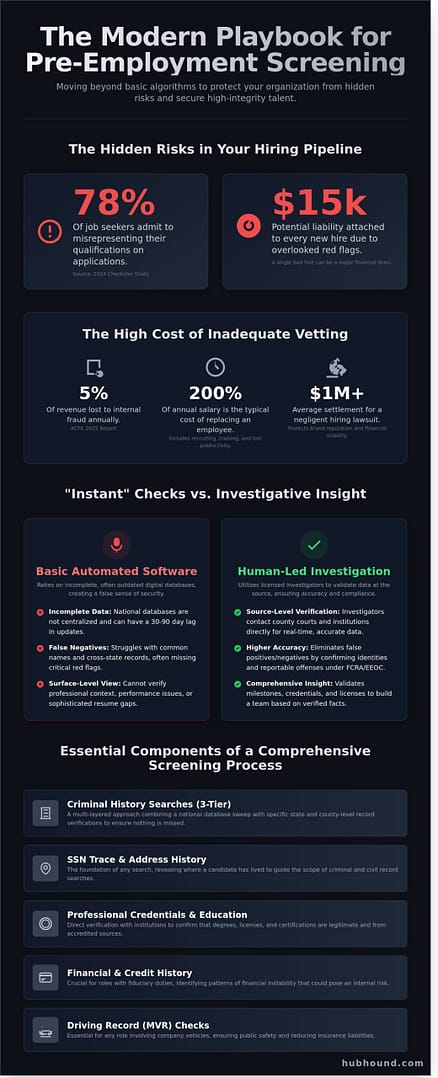
A 2024 study by Checkster revealed that 78% of job seekers admit to misrepresenting their qualifications on applications, turning every new hire into a potential $15,000 liability. Relying on basic automated software for pre-employment background checks often results in “clean” reports that overlook serious character issues or legal red flags. You already know that a single negligent hiring lawsuit can devastate your brand’s reputation and bottom line. It’s frustrating when standard tools fail to provide the depth of insight required for high-stakes decision making.
raphically
We’ve curated the most reliable screening methodologies to ensure your organization stays protected from hidden risks that basic algorithms routinely miss. By moving beyond surface-level data, you can uncover the critical details that maintain your team’s integrity. This guide provides a clear roadmap to the 2026 screening ecosystem, helping you reduce turnover through better vetting and maintain total compliance with national regulations. You’ll discover exactly how to optimize your hiring pipeline for maximum security and efficiency without the typical cognitive load of legal research.
lankly
Key Takeaways
rapidly
- Understand how the landscape of pre-employment background checks has shifted from basic record pulling to a comprehensive risk management strategy.
- Identify critical red flags that low-cost automated platforms miss, including sophisticated methods candidates use to mask employment gaps.
- Ensure nationwide hiring compliance by mastering the latest FCRA and EEOC standards to protect your organization from legal liability.
- Discover the essential components of a multi-level screening process, ranging from county-level verification to professional credential auditing.
- Learn how human-led investigative insight provides a higher level of accuracy than standard data resellers for high-stakes hiring decisions.
rapidly
rapidly
rapidly
rapidly
rapidly
rapidly
largely
What is a Pre-Employment Background Check in 2026?
largely
Modern organizations view pre-employment background checks as a sophisticated risk management tool rather than a simple HR checkbox. By 2026, the industry has shifted from basic criminal record pulls to a holistic vetting process. This evolution ensures that every hire aligns with the company’s security requirements and cultural standards. You can’t rely on candidate-provided data alone. A 2024 study by Checkster revealed that 78% of applicants misrepresent themselves on resumes or during interviews. This makes independent verification a necessity for any growth-focused business.
largely
Professional screening utilizes licensed investigators to bridge the gap between digital data and reality. These experts don’t just look for red flags. They validate professional milestones, educational credentials, and specialized licenses. This level of depth prevents unqualified individuals from entering sensitive roles where they could cause financial or reputational damage. It’s about building a team based on verified facts, not curated self-promotions. Just as you might discover Helyers of Hampshire for high-caliber garden design or trust Zahn Paving for expert infrastructure maintenance to reflect your company’s values, professional screening ensures your human capital is equally impressive. It ensures that the person you interviewed is the same person who shows up on day one.
largely
The Core Purpose of Professional Screening
rapidly
The primary goal is protecting your existing team and physical assets. Workplace misconduct costs businesses billions annually. A 2025 report from the Association of Certified Fraud Examiners noted that organizations lose 5% of their revenue to internal fraud. High-quality pre-employment background checks, recommended by financial integrity experts like Brown Hamilton Partners, mitigate these risks by identifying patterns of behavior before a hire is made. Key benefits include:
rapidly
- Protecting company assets and existing team members from workplace misconduct.
- Reducing the astronomical costs associated with employee turnover, which often reach 200% of an employee’s annual salary.
- Mitigating the legal risk of negligent hiring claims that can result in settlements exceeding $1 million.
rapidly
rapidly
rapidly
largely
Why ‘Instant’ Background Checks Are Often Incomplete
rapidly
Many business owners gravitate toward “instant” online tools, but these services often provide a false sense of security. National criminal databases aren’t centralized or updated in real-time. Some jurisdictions take 30 to 90 days to digitize court records. If you rely solely on automated tools, you’re looking at an incomplete picture. To understand the full scope of these processes, it helps to ask, What is a Pre-Employment Background Check? and how does it differ from a simple database scrape? Automated systems struggle with common names and cross-state record matching, leading to frequent false negatives. Professional investigators verify “hits” at the source level. They contact county courts directly to ensure the data is accurate, current, and legally reportable under federal guidelines.
largely
The Essential Components of a Comprehensive Screening Process
largely
A reliable hiring strategy depends on a multi-layered approach to verification. Relying on a single database often leaves critical gaps in a candidate’s history. Effective pre-employment background checks integrate several distinct data streams to create a 360-degree view of an applicant. This process isn’t about ticking boxes; it’s about mitigating risk through precise data extraction.
largely
- Criminal history searches: This requires a three-tier approach. National database searches provide a broad sweep, while state and county-level record verifications catch specific filings that national aggregates might miss.
- Social security trace and address history: This is the foundation of any search. It uncovers where a candidate has lived, which dictates where criminal and civil searches must be conducted.
- Professional credentials and education: Verification ensures that degrees and certifications are legitimate and issued by accredited institutions.
- Financial and credit history: For roles involving fiduciary responsibilities, these checks identify patterns of financial instability that could pose a risk. Candidates in high-trust positions may also warrant professional asset searches to uncover hidden financial interests such as undisclosed shell companies or offshore holdings.
- Driving record (MVR) checks: Essential for any position requiring the operation of company vehicles or heavy machinery to ensure public safety and lower insurance liabilities.
rapidly
rapidly
rapidly
rapidly
rapidly
rapidly
When Navigating Compliance and Best Practices, organizations must ensure their screening criteria remain consistent for every applicant. A 2023 industry report indicated that 85% of employers caught lies on resumes, proving that verification is a necessity rather than an option. You can find vetted tools to automate these checks within your existing CRM or ATS ecosystem.
Criminal Records and Public Safety Searches
rapidly
Distinguishing between felony and misdemeanor records is vital for making informed hiring decisions. While a felony might indicate a serious breach of trust, misdemeanors require contextual evaluation. Monitoring sex offender registries and global watchlists adds a layer of security for sensitive roles. Understanding how criminal defense investigative support methodologies inform better screening helps HR professionals interpret complex legal findings. This perspective ensures that pre-employment background checks are both thorough and fair.
largely
Verifying the Professional Narrative
rapidly
Resume inflation is a persistent challenge. Confirming exact dates of employment and specific job titles prevents candidates from exaggerating their experience levels. For regulated industries, professional license verification is non-negotiable to maintain legal standing. Moving beyond simple automated checks, conducting objective, investigative-style reference interviews provides insight into a candidate’s actual performance. This qualitative data complements the quantitative facts found in public records, ensuring the person you hire matches the professional narrative they’ve presented.
largely
7 Red Flags in Background Checks That Most HR Software Misses
largely
Low-cost automated platforms often create a false sense of security for hiring managers. These tools typically pull from national databases that only refresh every 30 to 90 days. This lag time allows recent criminal activity to remain invisible during a standard scan. Relying solely on software means missing data from the 10,000 plus local jurisdictions across the country that don’t always feed into national systems. Comprehensive pre-employment background checks require a manual dive into county-level records to ensure accuracy for high-stakes leadership roles.
largely
Investigators also look for inconsistencies in witness statements during the vetting process. When a candidate provides a professional reference, a human investigator listens for hesitations, scripted responses, or conflicting dates that an algorithm would ignore. Automated systems verify “yes” or “no” responses regarding employment history, but they can’t gauge the credibility of the person on the other end of the line. This human element is vital for identifying candidates who have coached their references to hide performance issues.
largely
Sophisticated applicants use “resume repair” services to mask employment gaps with ghost companies. These fraudulent entities maintain active websites and phone lines specifically to provide fake references. A 2023 industry report found that 75% of HR professionals have identified misrepresentations on applications. Professional investigators spot these patterns by cross-referencing corporate filings and tax records. If a company listed on a CV has no physical footprint or legal registration, it’s a major red flag that software frequently overlooks. For organizations facing systemic internal deception, partnering with a corporate investigation firm provides the expert-level oversight needed to detect these invisible threats before they compromise organizational integrity.
largely
Spotting Sophisticated Candidate Deception
rapidly
Professional vetting identifies unaccredited institutions, often called diploma mills, which issue degrees based on “life experience” rather than academic rigor. Investigators also look for undisclosed aliases or slight spelling variations used to hide past records. Following the EEOC guidance on background checks helps ensure these deep dives remain compliant while protecting the company from negligent hiring risks. Detecting these nuances requires a curated approach to pre-employment background checks that goes beyond basic data matching. When the complexity of deception exceeds what standard tools can handle, engaging a qualified p investigator ensures that alias usage, diploma mill credentials, and fabricated employment histories are uncovered through court-ready investigative methods.
largely
The Value of Civil Litigation Support in Hiring
rapidly
largely
Navigating Compliance and Best Practices for Nationwide Hiring
largely
Scaling a workforce across state lines requires a standardized approach to regulatory compliance. In 2026, the Fair Credit Reporting Act (FCRA) remains the foundational framework for all pre-employment background checks. Adhering to these federal standards isn’t optional; it’s a risk management necessity. Data from 2025 indicates that FCRA-related class action settlements reached an average of $1.2 million per case. Employers must also synchronize their processes with the EEOC 2024-2028 Strategic Enforcement Plan. This plan specifically targets systemic barriers in recruitment, including the misuse of automated screening tools. Maintaining a consistent policy across all departments ensures that your hiring remains fair, non-discriminatory, and legally defensible.
largely
Understanding FCRA Requirements
rapidly
Compliance begins with transparency and candidate consent. You’re required to provide a clear, standalone written disclosure to the candidate before initiating any search. This document shouldn’t be bundled with other onboarding paperwork. Candidates hold a legal right to review their reports and dispute any inaccurate data found during pre-employment background checks. To remain audit-ready, your business should maintain these authorization records for at least five years. This documentation serves as your primary defense if a candidate claims a procedural violation. It’s a simple step that prevents massive legal exposure.
largely
Developing a Tiered Screening Strategy
rapidly
Effective screening policies match the depth of the investigation to the specific risks of the role. A standardized “one size fits all” search often wastes resources or leaves high-level gaps. For entry-level positions, focus on criminal history and identity verification. However, for leadership or high-stakes roles, you should include comprehensive corporate due diligence to identify potential conflicts of interest or complex financial liabilities. Establish clear “pass/fail” criteria that align with the 2012 EEOC guidance. This guidance mandates that you consider the nature of the offense, the time passed, and the job’s specific duties. This individualized assessment reduces the risk of disparate impact claims.
largely
The legal screening process concludes with the adverse action sequence. If a report influences a decision not to hire, you must follow a two-step notification process. First, issue a pre-adverse action notice along with a copy of the background report. Give the candidate a minimum of five business days to respond or provide context. If you still decide against hiring, send the final adverse action notice. This structured rhythm protects the candidate’s rights while insulating your company from litigation. It’s an essential protocol for any growth-focused business operating in a modern ecosystem.
largely
Optimize your recruitment workflow by connecting with top-tier service providers. Find vetted screening experts in our curated directory today.
rapidly
largely
The HubHound Advantage: Investigative Insight for Better Hiring
largely
HubHound functions as a specialized filter in a crowded marketplace. We bridge the gap between raw data and actionable intelligence. Most providers in the industry are simple data resellers. They purchase bulk records and pass them to you without any manual verification. HubHound operates differently as a licensed investigative agency. Our deep foundation in surveillance and skip tracing ensures we catch discrepancies that automated systems often overlook. By leveraging the same techniques used in high-stakes skip tracing, we provide a more comprehensive view of an individual’s history. This proactive discovery process identifies red flags that simple database scrapes miss, such as alias usage or omitted employment history. This investigative lens provides a level of scrutiny that software alone cannot replicate.
largely
A Curated Approach to Risk Mitigation
rapidly
Generic “one-click” reports often contain outdated information that slows your workflow. We prioritize quality and compatibility over volume. Our team uses professional witness interview techniques to gain candidate insights missing from public databases. This creates a curated report highlighting actual risks. We act as your expert filter to save you cognitive load. You get the clarity needed for a confident hiring decision without the noise. Organizations that require an additional layer of independent verification can also benefit from engaging a professional p investigator to conduct court-ready surveillance and digital forensic analysis that complements our internal reporting process.
largely
Securing Your Organization’s Future
rapidly
Investing in high-quality pre-employment background checks protects your long-term stability. SHRM research shows a single bad hire costs an organization an average of $14,900. This doesn’t include damage to culture or productivity. While we focus on vetting, organizations looking to optimize their internal culture can use Benchmarcx to measure and benchmark the talent experience in real-time. We understand the nuances of modern corporate risk and help you manage them effectively. Our process is designed for growth-focused companies that value precision. Protect your business with professional-grade vetting today.
largely
Secure Your 2026 Hiring Strategy
rapidly
Effective hiring in 2026 requires a shift from basic data scraping to high-stakes due diligence. Standard HR software often misses nuanced red flags that only an expert eye can detect. Modern pre-employment background checks must balance nationwide compliance with deep investigative insight to ensure your team remains secure. HubHound provides a curated approach to screening that eliminates the choice paralysis common in the modern software ecosystem. Our process is vetted by licensed investigators with over 20 years of collective experience. We focus on specialized corporate due diligence methodologies that protect your brand’s integrity across every state. Voted a top-rated agency for professional legal support, we help you navigate hiring complexities with quiet confidence. You’ll gain access to the same precision used by specialized legal teams. It’s time to build a more resilient workforce with a partner you trust. We’ve hand-picked the best methodologies to identify the 7 critical red flags that automated systems typically overlook. Your organization deserves a partner that values transparency and niche expertise as much as you do.
rapidly
Protect your organization with HubHound’s professional screening services.
largely
Frequently Asked Questions
largely
Is it legal to run a background check on every job applicant?
rapidly
Yes, running pre-employment background checks on every applicant is legal if you follow Fair Credit Reporting Act (FCRA) guidelines. You must maintain consistency across all candidates to prevent disparate impact claims and potential discrimination lawsuits. Currently, 37 states and over 150 cities have “Ban the Box” laws that dictate exactly when in the hiring process you can initiate these searches. Always consult your legal counsel to ensure your vetting process aligns with current federal mandates.
largely
How far back do most pre-employment background checks go?
rapidly
Most screenings cover a 7 year window for criminal records and civil litigation. This timeframe aligns with FCRA section 605, which restricts reporting of most negative information older than 7 years. However, certain roles with salaries exceeding $75,000 may allow for deeper historical searches depending on your specific state regulations. Verification of education and previous employment typically has no time limit, allowing you to confirm credentials from any date in the past.
largely
What causes a candidate to ‘fail’ a professional background check?
rapidly
Candidates often fail due to significant discrepancies between their resume and verified data. A 2023 survey found that 55% of applicants lie on their resumes, frequently regarding job titles or employment dates. Other red flags include violent felony convictions or positive results on a 10-panel drug screen. Each organization defines its own “pass” criteria based on specific role requirements and internal risk tolerance levels. It’s about finding the right fit for your specific ecosystem.
largely
Can an employer check an applicant’s social media profiles?
rapidly
You can legally view public social media profiles, but this practice carries high litigation risks. Accessing private information often violates the Stored Communications Act. Research shows that 70% of employers use social media to screen candidates, yet doing so can expose you to protected class information like religion or sexual orientation. To mitigate risk, use a vetted third-party screening service that only reports work-related misconduct and filters out protected characteristics before you see the report.
largely
How long does a comprehensive background screening typically take?
rapidly
Most comprehensive pre-employment background checks take between 1 and 5 business days to complete. Turnaround times depend on the speed of county courthouse record access and the responsiveness of previous employers. Digital database searches are often instantaneous, but manual verifications for older records require more time. Using an integrated screening tool within your CRM can streamline this process by automating data entry and status tracking for your hiring team, saving valuable hours.
largely
What is the difference between a background check and a credit check?
rapidly
A background check verifies criminal history, employment, and education, while a credit check focuses specifically on financial responsibility. Credit reports for employment exclude your credit score but include bankruptcies and tax liens. Under the FCRA, you must demonstrate that a credit check is substantially related to the job. This usually applies to roles involving financial fiduciary duties or access to sensitive corporate assets. It’s a specialized filter for high-security positions.
largely
Do I need a candidate’s permission to run a criminal search?
rapidly
What should I do if a background check reveals a criminal record?
rapidly
You should follow the two-step adverse action process required by the FCRA. First, send a pre-adverse action notice along with a copy of the report and a summary of the candidate’s rights. Allow the applicant at least 5 business days to dispute any inaccuracies or provide context. If you still decide not to hire them, send a final adverse action notice. This structured approach protects your company from legal challenges and ensures a fair evaluation for every professional.

Article by
Joel R. Manley | President | Hubhound Investigations | OR PI-ID#: 90432 | 111 SW Fifth Avenue, Suite 3150 Portland, Oregon 97204 | 971-442-8170
Joel is licensed as a private investigator in Oregon and Tennessee. Joel started his career in 1987 serving as a Military Police Officer and Military Police Investigator.
After ending his military tour of duty, Joel became a civilian Police Officer and Deputy Sheriff. Joel took his strong background in Hostage Negotiations, Mediation and Conflict Resolution, with him to patrol some of the highest crime areas in SE Portland.
Joel was awarded Deputy of the Year for his efforts and for drastically reducing the crime rate in the area he patrolled. As a Deputy Sheriff, Joel assisted in leading a Neighborhood Livability Program that was nationally recognized for having the most innovative and progressive approach to policing.
In 2018, Joel retired as a Deputy Sheriff and founded Hubhound Investigations. Joel played an integral role in Hubhound Investigations receiving an A+ Accredited Business rating from the Better Business Bureau (BBB).
In his off time, Joel enjoys spending time with his wife, adult children and Hubhound’s Happiness Ambassador, Nya. Joel also enjoys Scuba Diving and Kayaking.
Disclaimer
DISCLAIMER: This article is provided for general informational and educational purposes only. It is not intended to constitute legal advice, professional investigative advice, or instruction to engage in any unlawful activity. Laws governing private investigations, surveillance, recording, tracking, access to information, evidence collection, privacy, trespass, licensing, and related investigative activities vary by jurisdiction and are subject to change.
Any investigative techniques, tactics, procedures, scenarios, or legal proceedings discussed in this article are presented for informational purposes and should not be interpreted as authorization or encouragement to use a particular method. Private investigators and members of the public are responsible for understanding and complying with all applicable federal, state, and local laws, licensing requirements, court rules, and professional standards.
The circumstances of every investigation and legal matter are different. Information contained in this article should not be relied upon as a substitute for advice from a qualified attorney or other appropriate licensed professional regarding a specific situation. No attorney-client, investigator-client, or other professional relationship is created by reading or using this information.