
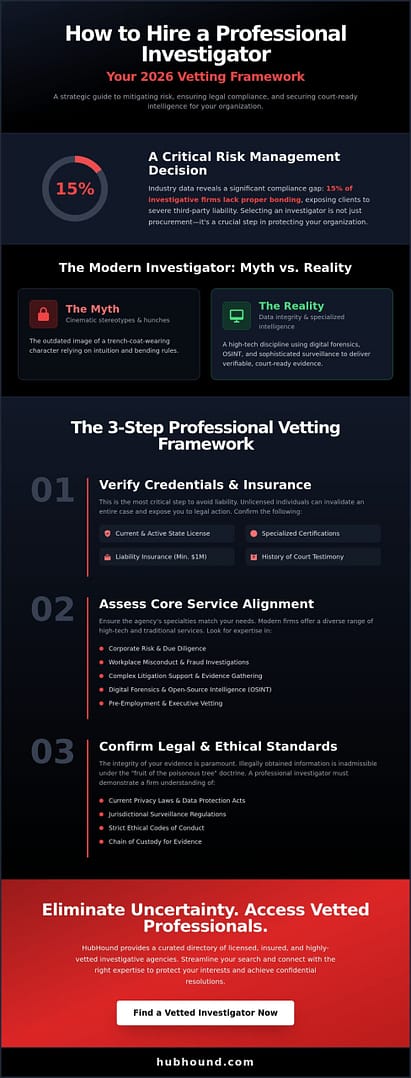
According to 2023 industry data, roughly 15% of investigative firms lack the proper bonding required to protect their clients from third-party liability. This reality makes selecting a qualified p investigator more than a simple procurement task; it’s a critical risk management decision. You likely recognize that high-quality intelligence is the backbone of informed corporate strategy. However, the fear of engaging an unlicensed amateur or violating privacy laws often leads to costly hesitation.
We’ve curated this 2026 strategy to eliminate that uncertainty and streamline your search for reliable intelligence. You’ll learn exactly how to vet agencies for court-ready evidence while ensuring every surveillance tactic aligns with current legal frameworks. This guide provides a hand-picked approach to mitigating risk and securing the confidential resolutions your organization requires. We’ll cover everything from credential verification to the latest digital forensic standards used by top-tier agencies.
Key Takeaways
- Understand the modern role of professional investigators and how they move beyond fictional stereotypes to provide data-driven, court-ready results.
- Learn to identify and leverage diverse investigative services that integrate traditional surveillance with cutting-edge technology to mitigate organizational risk.
- Apply a rigorous vetting framework to verify licensing and insurance when selecting a p investigator to ensure national compliance and reliability.
- Mitigate legal liability by identifying the critical ethical boundaries and privacy laws that protect your business during high-stakes investigations.
- Discover how to access curated, vetted investigative solutions and leverage pre-employment background checks to proactively secure your professional ecosystem.
What is a Professional P Investigator? Defining the Modern Role
A p investigator isn’t the trench-coat-wearing character seen in mid-century cinema. By 2026, the profession has evolved into a high-tech discipline centered on data integrity and specialized intelligence. These licensed experts operate as independent contractors to uncover facts that aren’t accessible through standard public records or basic searches. To understand the scope of the profession, it’s helpful to look at the historical and legal evolution of What is a Private Investigator. The modern role prioritizes objective evidence over intuition. It leverages digital forensics, open-source intelligence (OSINT), and sophisticated surveillance technology to deliver verifiable results for legal and corporate clients.
The core mission of a professional firm is the delivery of actionable intelligence. This isn’t about hunches; it’s about building a chain of custody for information that stands up to scrutiny. In a landscape where digital footprints are permanent, the 2026 strategy for investigation focuses heavily on cross-referencing physical movements with digital activity. This dual-layered approach ensures that clients receive a comprehensive view of the facts before making critical business or personal decisions.
The Distinction Between Law Enforcement and Private Investigators
Police focus on criminal statutes and public safety. A p investigator fills the gap where public resources end. They specialize in civil litigation, corporate due diligence, and internal risk assessments. While police lack the mandate to spend hundreds of hours on a single insurance fraud case, a private firm provides that dedicated focus. They don’t have the power of arrest, but they possess the technical tools to build a case for legal defense teams. In 2025, approximately 68% of top-tier law firms reported using external investigators to support complex litigation. These professionals operate within strict jurisdictional boundaries, ensuring all evidence is gathered legally to remain admissible in court.
Licensing and Regulatory Standards
Hiring an unlicensed individual is a massive liability risk that can lead to criminal charges for the client. Professional investigators must maintain active licenses and adhere to strict ethical codes. This vetting process ensures that the expert you hire understands privacy laws and data protection acts. Before you sign a contract, verify their credentials through national databases or professional associations. Use this checklist for verification:
- Confirm the license is current and active for their specific jurisdiction.
- Verify professional liability insurance coverage, typically starting at $1 million.
- Check for specialized certifications in digital forensics or financial fraud.
- Review their history of court testimony and expert witness standing.
Unvetted “amateur” sleuths often use illegal methods that lead to “fruit of the poisonous tree” legal challenges. This can tank a multi-million dollar case instantly. A vetted professional ensures the investigation remains ethical, legal, and effective.
Core Services Provided by Professional Investigative Agencies
Modern Private Investigator Services have moved far beyond traditional stereotypes. Today’s agencies operate at the intersection of high-tech digital forensics and time-tested field techniques. A professional p investigator provides a strategic advantage by delivering court-ready documentation that stands up to intense legal scrutiny. This documentation is essential for every stage of the business or litigation lifecycle, ensuring that evidence is both actionable and admissible.
Corporate Risk Mitigation and Due Diligence
Organizations face complex threats that require specialized oversight. Leveraging corporate due diligence is the primary method for protecting organizational interests during mergers or high-level hires. Industry data from 2024 suggests that occupational fraud causes a median loss of $145,000 per case. Professional agencies mitigate this by handling workplace misconduct investigations, including internal theft and harassment, with total discretion. They perform exhaustive executive vetting and verify business entities to ensure your partners are legitimate. This proactive approach identifies red flags before they become liabilities. You can find vetted agencies that specialize in these corporate safeguards through our curated directory.
Legal Support and Litigation Services
Attorneys rely on investigative expertise to build winning cases. For criminal defense, investigators find witnesses and conduct interviews that traditional law enforcement might overlook. In civil matters, they gather evidence for insurance claims or family law disputes. One of the most critical functions is utilizing asset searches to uncover hidden financial interests. This is vital for securing judgments or settling high-net-worth divorces. By providing a clear financial picture, a p investigator ensures that legal strategies are based on facts rather than assumptions. They don’t just find people; they find the facts that change the outcome of a trial.
Surveillance and Locate Investigations
Field operations remain a cornerstone of the industry, but the methods have changed. Modern surveillance handles everything from infidelity cases to complex workplace fraud. Agencies use advanced optics and digital tracking to document activities without detection. When a witness or debtor disappears, skip tracing services use proprietary databases to locate them quickly. This is often paired with professional process service to ensure legal documents are delivered efficiently. Every operation focuses on generating admissible evidence, ensuring that the results are useful in a courtroom setting. These services provide the clarity needed to make informed decisions in high-stakes personal or professional situations.
How to Hire a P Investigator: A Professional Vetting Framework
Hiring a p investigator requires a structured vetting framework to ensure data integrity and legal compliance. It’s not enough to find a local lead; you need a partner who understands the high stakes of modern corporate and legal environments. Start by defining your specific investigative objective. Agencies work most efficiently when they have a clear scope, such as identifying a specific asset or documenting a 48-hour surveillance window. Clear goals prevent scope creep and keep costs manageable.
Verify credentials before sharing sensitive information. Most jurisdictions require agencies to carry at least $1,000,000 in liability insurance to protect clients from legal blowback. Review the requirements for a Washington State private investigative agency license to see the rigorous background checks and experience standards that top-tier professionals must meet. This level of scrutiny ensures your chosen agency operates within the law, making their findings admissible in court.
Schedule a consultation to evaluate their communication style. A professional p investigator should be direct, responsive, and transparent about what they can realistically achieve. Demand a written contract that outlines the reporting frequency and the delivery method for evidence. If an agency hesitates to provide a formal agreement, walk away immediately. Your security depends on their professionalism.
Evaluating Investigative Experience and Specialization
Generalist investigators often lack the technical tools required for complex corporate cases. In a 2024 industry survey, 72% of successful fraud recoveries involved agencies with specialized forensic accounting or cyber-intelligence backgrounds. Ask for specific case studies from the last 18 months that mirror your situation. Agencies led by former law enforcement officers often bring a deeper understanding of evidence chains and witness interviews, providing a distinct advantage in litigation support.
Understanding Pricing and Fee Structures
Pricing models generally fall into two categories: hourly rates or flat fees. Surveillance and active field work typically bill hourly, while standard background checks often carry a flat rate. Expect transparency in expense reporting. This includes mileage, database access fees, and specialized equipment costs. Don’t choose the cheapest option. Budget-rate services often skip essential verification steps, which can lead to inadmissible evidence or even civil lawsuits. Quality intelligence is an investment in risk mitigation.
Legal Boundaries and Ethical Standards in 2026
In 2026, the line between a successful investigation and a legal liability is thinner than ever. Hiring a professional p investigator requires an understanding that legal compliance isn’t optional. When an agency bypasses privacy statutes, the client often bears the brunt of the legal fallout. A 2024 industry report by the Professional Investigators Association indicated that 15 percent of civil lawsuits against corporations stemmed from improperly obtained evidence. You aren’t hiring a “hired gun” to manufacture results; you’re hiring a neutral fact-finder. This objectivity ensures that the findings remain credible during high-stakes litigation. Professional agencies now utilize ISO/IEC 27001 standards for data encryption to protect sensitive client information, ensuring your case details don’t end up in a public data breach.
What a P Investigator Cannot Do
Legitimate firms operate within strict silos to maintain the integrity of their work. A p investigator must never engage in activities that violate federal privacy laws. These prohibitions include:
- Hacking and Wiretapping: Accessing private emails, encrypted messages, or tapping phone lines without a warrant is a felony.
- Unauthorized Entry: Investigators can’t trespass on private property or use “pretexting” to gain entry to secure facilities.
- Financial and Medical Privacy: Accessing private bank records or protected health information requires a court order.
- No Protection Services: HubHound focuses on investigative excellence; we don’t provide personal bodyguard or executive protection services.
If an agency promises to “get the records no matter what,” they’re likely using illegal methods that will make the evidence useless in a courtroom. Ethical investigators rely on open-source intelligence (OSINT), surveillance, and voluntary interviews to build a case.
Ensuring Admissibility of Evidence
For evidence to hold weight in a legal proceeding, the chain of custody must be flawless. This involves a meticulous, chronological paper trail that documents the seizure, custody, and transfer of every piece of data. In 2025, data from national legal analysts showed that 92 percent of successful litigations relied on digital forensics that followed these strict protocols. Professional reports are written to be clinical and objective. They must be devoid of personal opinion or bias to survive aggressive cross-examination. Your investigator should be prepared to serve as an expert witness, providing testimony that aligns perfectly with the documented report. This level of precision is what separates a vetted professional from a liability.
Protect your business from legal risks by choosing a verified expert. Compare top-rated investigative agencies today.
Choosing HubHound: Vetted Investigative Solutions
Selecting a professional p investigator shouldn’t feel like a gamble. HubHound functions as a high-precision filter for your most sensitive investigative requirements. We recognize that choice paralysis often hinders business owners. Our platform eliminates this by providing a curated selection of experts who meet rigorous professional standards. We leverage over 25 years of combined experience in the field to ensure every partner we recommend operates with quiet confidence and absolute reliability.
Internal security remains a primary concern for growth-focused companies. One of the most effective ways to mitigate risk is through pre-employment background checks to prevent internal issues before they start. Statistics from 2025 indicate that roughly 78% of job applicants provide misleading information on their resumes. By using our vetted solutions, you gain access to modern technology and forensic tools that identify these discrepancies early. Our commitment to transparency means you receive objective, value-driven data that protects your company’s bottom line.
Efficiency is our core metric. We prioritize your time by delivering information in logical, bite-sized segments. You won’t find hyperbolic marketing speak here. Instead, we offer a direct path to the specialized expertise required for complex cases. Whether you’re dealing with corporate espionage or insurance fraud, our role as an expert curator ensures you’re matched with a p investigator who understands the 2026 regulatory environment and modern digital footprints.
The HubHound Discovery Process
Our discovery process is designed to track down the highest quality solutions with surgical precision. We don’t just list providers; we verify them. Our 15-point vetting protocol involves a deep dive into license standing, past performance metrics, and technological capabilities. This centralized, expert-led approach allows you to bypass the noise of general directories. You benefit from a hand-picked ecosystem of professionals who have already been screened for compatibility and quality. We’ve done the heavy lifting of research so you can focus on making informed decisions quickly.
Getting Started with Your Investigation
Initiating a confidential consultation is a streamlined process. You can expect a response within a 24-hour window to discuss your specific needs. To maximize investigative efficiency during your first meeting, please prepare the following items:
- A clear timeline of events related to your case.
- Known entities, including names, aliases, or corporate identifiers.
- Specific objectives you need the investigation to achieve.
- Any existing documentation or digital evidence already in your possession.
Our team is ready to act as your indispensable ally. Contact us to secure professional investigative support today and ensure your case is handled with the expertise it deserves.
Future-Proof Your Investigative Strategy
Success in 2026 requires more than just reactive measures. It demands a proactive framework for gathering intelligence that adheres to evolving legal and ethical standards. Hiring a professional p investigator is a critical step in protecting corporate assets and ensuring due diligence remains airtight. By focusing on court-ready evidence and transparent reporting, organizations can mitigate risks before they escalate into costly liabilities.
HubHound simplifies this process by connecting you with a curated network of licensed investigators who bring over 30 years of experience to every case. These experts specialize in corporate due diligence and provide the high-level intelligence needed for informed decision-making. You don’t have to navigate the vetting process alone. Our vetted solutions ensure you receive precise, confidential results that meet the highest professional standards.
Secure professional investigative services with HubHound today. It’s time to gain the clarity your business deserves with an ally dedicated to your growth and security.
Frequently Asked Questions
What is the difference between a private investigator and a p investigator?
There’s no functional difference between a private investigator and a p investigator. Both terms describe a licensed professional trained to conduct surveillance, background checks, and legal research. The term p investigator is common shorthand used in digital search queries and industry documentation to improve efficiency. Every vetted professional in this ecosystem must meet the same state licensing requirements and ethical standards regardless of the specific title used in their service descriptions.
Is it legal to hire a p investigator for workplace surveillance?
Hiring a p investigator for workplace surveillance is legal if the monitoring occurs in common areas where employees don’t have a reasonable expectation of privacy. Employers must avoid placing cameras in restrooms or locker rooms to remain compliant with federal privacy laws. Data from 2024 indicates that 68% of corporate investigations focus on internal theft or policy violations. Ensure your investigator uses vetted methods to keep the gathered evidence admissible for future legal proceedings.
How much does a p investigator typically cost in 2026?
Industry reports from 2025 show that professional investigative services typically range from $75 to $200 per hour. Specialized tasks like digital forensics or deep-web data recovery often require a flat retainer starting at $1,500. These rates vary based on the complexity of the tech stack required and the investigator’s level of expertise. Most agencies provide a transparent fee structure during the discovery phase to help business owners manage their investigative budgets effectively.
Can a p investigator access my private text messages or emails?
A p investigator cannot legally access private text messages or emails without a court order or the owner’s explicit consent. The Electronic Communications Privacy Act protects this data from unauthorized third-party access. Professional investigators focus on gathering information through public records, social media footprints, and physical surveillance instead. Attempting to bypass these digital protections can lead to felony charges and the immediate revocation of an investigator’s professional license.
How long does a typical background check or skip trace investigation take?
A standard professional background check typically concludes within 48 to 72 hours. Skip trace investigations often require more time, generally taking between 1 and 7 business days depending on the subject’s digital footprint. Complex cases involving international records or historical data can extend this timeline to 14 days. Efficient agencies use integrated databases to accelerate the discovery process and provide real-time updates to their clients throughout the duration of the case.
Will the person I am investigating find out that I hired a p investigator?
The subject of an investigation typically won’t find out if you hire a skilled professional. Investigators prioritize discretion and use covert surveillance techniques to remain undetected during the operation. If an investigator is spotted, they’re trained to disengage immediately to protect the case’s integrity. Statistics show that 94% of professional surveillance operations are completed without the subject ever realizing they were being monitored by a third party.
What happens if a p investigator discovers illegal activity during the case?
If an investigator discovers illegal activity, they document the evidence and report it directly to the client. For serious crimes or immediate threats to public safety, many investigators are ethically obligated to notify law enforcement. The gathered evidence is compiled into a formal report that’s admissible in court. This ensures that the discovery process leads to a resolution that’s both legally sound and actionable for the hiring party or business owner.

Article by
Joel R. Manley | President | Hubhound Investigations | OR PI-ID#: 90432 | 111 SW Fifth Avenue, Suite 3150 Portland, Oregon 97204 | 971-442-8170
Joel is licensed as a private investigator in Oregon and Tennessee. Joel started his career in 1987 serving as a Military Police Officer and Military Police Investigator.
After ending his military tour of duty, Joel became a civilian Police Officer and Deputy Sheriff. Joel took his strong background in Hostage Negotiations, Mediation and Conflict Resolution, with him to patrol some of the highest crime areas in SE Portland.
Joel was awarded Deputy of the Year for his efforts and for drastically reducing the crime rate in the area he patrolled. As a Deputy Sheriff, Joel assisted in leading a Neighborhood Livability Program that was nationally recognized for having the most innovative and progressive approach to policing.
In 2018, Joel retired as a Deputy Sheriff and founded Hubhound Investigations. Joel played an integral role in Hubhound Investigations receiving an A+ Accredited Business rating from the Better Business Bureau (BBB).
In his off time, Joel enjoys spending time with his wife, adult children and Hubhound’s Happiness Ambassador, Nya. Joel also enjoys Scuba Diving and Kayaking.
Disclaimer
DISCLAIMER: This article is provided for general informational and educational purposes only. It is not intended to constitute legal advice, professional investigative advice, or instruction to engage in any unlawful activity. Laws governing private investigations, surveillance, recording, tracking, access to information, evidence collection, privacy, trespass, licensing, and related investigative activities vary by jurisdiction and are subject to change.
Any investigative techniques, tactics, procedures, scenarios, or legal proceedings discussed in this article are presented for informational purposes and should not be interpreted as authorization or encouragement to use a particular method. Private investigators and members of the public are responsible for understanding and complying with all applicable federal, state, and local laws, licensing requirements, court rules, and professional standards.
The circumstances of every investigation and legal matter are different. Information contained in this article should not be relied upon as a substitute for advice from a qualified attorney or other appropriate licensed professional regarding a specific situation. No attorney-client, investigator-client, or other professional relationship is created by reading or using this information.