
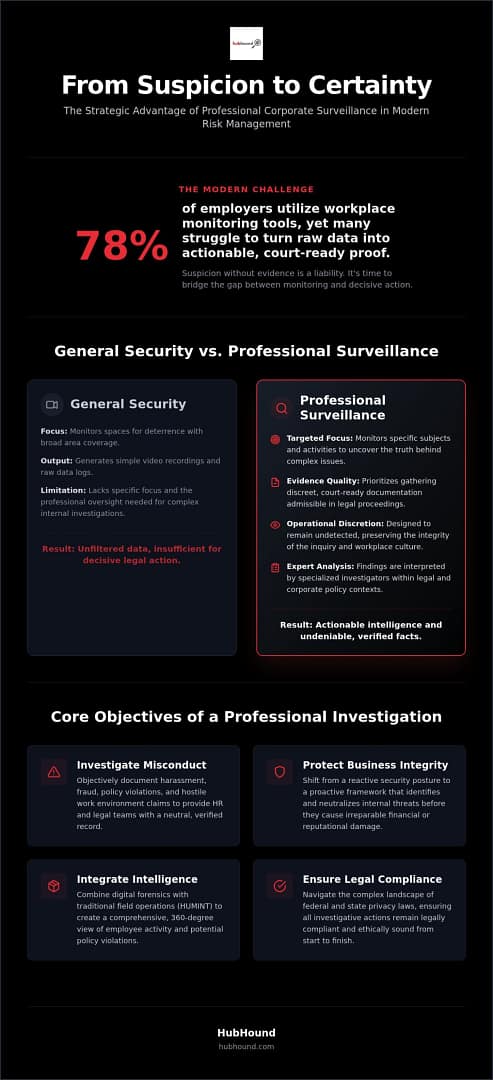
78% of employers are utilizing workplace monitoring tools in 2026, yet many still struggle to turn raw data into actionable results. You likely recognize that internal theft and employee misconduct represent more than just financial leaks. These issues are direct threats to your company’s reputation and legal standing. Managing these risks requires a shift from reactive monitoring to strategic corporate surveillance investigations. It’s frustrating to know something is wrong but lack the documented proof required to take decisive action. You need clarity, not just suspicion.
This guide will help you master the deployment of professional surveillance to secure court-ready evidence and mitigate organizational risk. We’ve done the heavy lifting to help you identify high-quality investigative methodologies that align with current privacy regulations. You’ll discover how to leverage AI-powered analytics and specialized expertise to expose misconduct while maintaining business integrity. We’ll explore the essential components of a modern investigation, from digital forensics to field operations. Learn to evaluate top-tier service partners and implement a selection process that saves time. This approach ensures your next move is backed by undeniable facts and professional precision.
Key Takeaways
- Shift from reactive security measures to a proactive framework that identifies internal threats before they cause irreparable reputational damage.
- Identify the specific methodologies used in corporate surveillance investigations to gather discreet, court-ready evidence of financial fraud or workplace misconduct.
- Integrate digital forensics with traditional field operations to create a comprehensive view of employee activity and potential policy violations.
- Navigate the complex landscape of federal and state privacy laws to ensure all investigative actions remain legally compliant and ethically sound.
- Leverage specialized investigative expertise to mitigate organizational risk and protect business integrity through rigorous, vetted discovery practices.
Understanding Corporate Surveillance in the Modern Business Landscape
Corporate surveillance has expanded significantly by 2026. It now encompasses a sophisticated blend of physical observation and digital activity tracking. Traditional security measures, like standard alarm systems or static entry logs, frequently fail to detect internal threats because they focus on external perimeter breaches rather than behavioral anomalies. Professional corporate surveillance investigations provide the specialized lens needed to identify misconduct occurring within the organization’s own ranks. This specialized approach ensures that businesses don’t just react to problems but actively maintain their integrity.
Understanding Corporate Surveillance in this modern context requires recognizing that threats are often hybrid. An employee might use legitimate access to facilitate illegitimate activities. Surveillance supports organizational integrity by providing objective, third-party verification of events across diverse industries, from financial services to logistics. It creates a transparent record that protects both the company and its honest employees.
The Shift Toward Proactive Risk Mitigation
Delayed investigations carry a heavy price tag. By the time a reactive measure catches a fraudster, the financial and reputational damage is often irreversible. Using surveillance as a tool for preventative due diligence allows leadership to identify high-risk behaviors before they escalate into legal liabilities. This proactive stance is essential for maintaining a stable corporate environment. Modern surveillance is a strategic business asset that transforms ambiguous suspicions into actionable intelligence for risk management. It allows executives to make informed decisions based on verified facts rather than hearsay. For organizations that require a holistic safety strategy, combining these insights with the professional protection services of Regal Security offers a complete solution for risk mitigation.
Surveillance vs. General Security: Key Differences
Standard CCTV systems are designed for deterrence and broad area coverage, but they are insufficient for targeted corporate surveillance investigations. These systems lack the focus and professional oversight required to document specific, court-ready evidence of complex internal schemes. Human intelligence (HUMINT) plays a critical role here. Licensed investigators apply specialized techniques to observe interactions and movements that cameras alone miss. Discretion is paramount in these operations. Professional Surveillance Operations allow for evidence gathering without disrupting workplace culture or alerting the subjects of the inquiry. Key differences include:
- Targeted Focus: General security monitors spaces; surveillance monitors specific activities and subjects.
- Evidence Quality: Professional investigations prioritize court-ready documentation over simple video recording.
- Operational Discretion: Surveillance is designed to remain undetected to protect the integrity of the inquiry.
- Expert Analysis: Specialized investigators interpret findings within the context of corporate policy and law.
You need more than just a recording. You need a curated investigative process that identifies the root cause of misconduct while shielding the organization from unnecessary exposure. This level of precision is what separates a professional investigation from basic facility security.
Core Objectives: Why Organizations Deploy Professional Investigators
Modern organizations deploy professional investigators to bridge the gap between suspicion and evidence. While generic security tools provide raw footage, professional corporate surveillance investigations offer the context and legal defensibility required for high-stakes decision-making. These operations protect the organization’s financial health while reinforcing its cultural standards. You can’t rely on automated alerts alone when the integrity of your leadership or the safety of your assets is on the line.
Investigating Workplace Misconduct and Internal Threats
Misconduct isn’t always overt; it often hides in the nuances of daily interactions and administrative loopholes. Professional corporate surveillance investigations document harassment or hostile work environment claims objectively. This provides a neutral record that HR departments can rely on during sensitive litigation. Investigators also identify “ghost employees” and sophisticated time-theft schemes that quietly drain payroll budgets. For a deeper look at these protocols, review our guide on workplace investigations. By securing clear evidence of activity, you can address misconduct before it escalates into a public reputational crisis.
Corporate Due Diligence and Fraud Detection
Fraud detection in 2026 requires integrating field surveillance with deep background research. During mergers and acquisitions, surveillance verifies the actual activity of business entities. This ensures that the physical assets and operations match what’s presented on paper. This process also uncovers hidden conflicts of interest among senior leadership that traditional audits often miss. Just as the SEC investigative process relies on rigorous evidence gathering to maintain market integrity, private organizations must use similar standards to protect their shareholders. Partnering with an experienced corporate investigation firm ensures these high-stakes inquiries are handled with the necessary discretion and expertise.
Beyond misconduct and M&A, surveillance is vital for verifying claims in workers’ compensation and FMLA cases. Fraudulent claims cost businesses billions annually in increased premiums and lost productivity. Investigators observe claimants in their daily environments to determine if their physical activities align with their stated medical restrictions. This objective evidence is essential for contesting unverified claims and mitigating organizational risk. Additionally, protecting intellectual property from unauthorized disclosure remains a top priority. Investigators track the movement of sensitive materials to identify potential leaks before trade secrets reach competitors. Securing your organization’s future starts with identifying these internal vulnerabilities. If you suspect activity that threatens your business integrity, evaluating specialized surveillance operations can provide the documented proof you need to act.
Surveillance Methodologies: How Evidence is Discreetly Gathered
Successful corporate surveillance investigations rely on a strategic selection between stationary and mobile observation models. Stationary surveillance involves monitoring a fixed location, such as a warehouse loading dock or a specific office entrance, to identify patterns in internal theft or unauthorized access. Mobile surveillance follows a subject’s movements across multiple locations. This approach is essential for verifying workers’ compensation claims or documenting undisclosed meetings between employees and competitors. Investigators must choose the methodology that maximizes evidence gathering while minimizing the risk of detection.
Discretion is the foundation of professional fieldwork. Investigators use specialized techniques to blend into diverse environments, ensuring their presence doesn’t alert the subject or disrupt the workplace. This involves utilizing plain vehicles, varying observation points, and maintaining a distance that allows for clear documentation without compromising anonymity. The goal is to provide a “fly on the wall” perspective that captures authentic behavior in real time.
Physical and Digital Hybrid Operations
Modern investigative success requires coordinating field surveillance with digital footprint analysis to build a complete picture of activity. By analyzing login patterns or public digital records alongside physical movements, investigators identify discrepancies that physical observation alone might miss. High-stakes corporate cases often require 24/7 monitoring to ensure no critical interaction is overlooked. For a deeper dive into these technical specifications, explore our guide on advanced surveillance techniques. This multi-layered approach ensures that the gathered intelligence is both comprehensive and legally defensible.
The Role of Technology in Court-Ready Documentation
Technology serves as the backbone of evidentiary integrity in 2026. High-definition video capture with synchronized timestamping is non-negotiable for court-ready documentation. These technical standards prevent claims of tampering and ensure the timeline of events is indisputable. Investigators also utilize several advanced tools to maintain a tactical advantage:
- Unmanned Surveillance: Remote systems allow for persistent observation in sensitive areas where a human presence might be easily detected.
- Long-Range Optics: High-powered lenses enable investigators to capture identifiable footage from significant distances.
- Covert Camera Systems: Miniature, disguised equipment allows for documentation in public spaces where traditional cameras would be conspicuous.
- GPS Tracking: When legally authorized, GPS provides a reliable log of vehicle movements to support physical tailing operations.
Advanced surveillance technology ensures objective reporting by providing a raw, unfiltered record of events that eliminates the risks associated with human memory or bias. This objective data is what allows decision-makers to act with confidence. By prioritizing high-quality hardware and rigorous documentation standards, professional investigators deliver evidence that stands up to the scrutiny of both the boardroom and the courtroom.
Legal Compliance and Ethical Standards in Nationwide Operations
Executing corporate surveillance investigations across state lines requires a rigorous, standardized approach to legal compliance. You cannot afford to ignore the patchwork of federal and state privacy laws that govern evidence gathering. Professional investigators operate under a code of ethics that prevents entrapment and harassment, ensuring your organization remains protected from counter-litigation. Hiring licensed and insured partners is the only way to guarantee that your findings will hold up under the scrutiny of a judge or arbitrator. Nationwide standards ensure that a multi-state operation receives consistent, high-quality results regardless of where the activity occurs.
Admissibility and the Chain of Custody
The chain of custody represents the chronological documentation of evidence from the moment of capture to its presentation in court. This paper trail is essential for both physical and digital evidence. You must avoid “self-help” surveillance conducted by HR or internal security teams. These well-meaning but untrained efforts often lead to procedural errors that render evidence inadmissible. Professional documentation standards for civil and criminal litigation require:
- Verified Time-Stamping: Digital records must have unalterable metadata showing the exact time and date of capture.
- Secure Transfer Logs: Every individual who handles the evidence must be recorded in a formal log to prevent claims of tampering.
- Original Media Preservation: Investigators must maintain the original files or physical assets in a secure, audited environment.
Privacy Rights in the Corporate Environment
The “Reasonable Expectation of Privacy” determines the legal boundaries of any inquiry. In an office environment, employees typically have a lower expectation of privacy in common areas like lobbies or open workspaces. However, private offices and restrooms remain strictly protected. Legal boundaries also extend to vehicle tracking and public space observation. Professional investigators ensure all acts comply with 2026 labor laws and federal mandates like the Electronic Communications Privacy Act (ECPA). Navigating these complexities is why professional corporate surveillance investigations are essential for maintaining legal defensibility. This specialized knowledge prevents your investigation from crossing into illegal surveillance territory, which could lead to significant liability.
Secure your business integrity with licensed investigative experts
Partnering with HubHound: Specialized Investigative Excellence
HubHound serves as the expert guide for organizations seeking clarity through professional corporate surveillance investigations. With over 30 years of industry experience, our team provides the specialized authority required to handle complex workplace misconduct and due diligence cases. We’ve already done the heavy lifting of vetting the most effective investigative methodologies to ensure your results are both accurate and actionable. Our nationwide reach allows us to maintain consistent quality assurance across diverse environments, eliminating the regional biases that often limit smaller, localized firms. We prioritize efficiency and transparency, functioning as an indispensable ally for growth-focused companies that value business integrity.
Our Process: From Discovery to Final Report
Efficiency is central to our operational model. We begin with a rigorous initial consultation and risk assessment to define the scope of the inquiry and align with your specific objectives. This phase ensures we identify the highest quality resources and investigative strategies before the first field operation begins. During the investigation, we maintain transparent communication protocols and provide real-time updates. This keeps your leadership team informed without creating unnecessary cognitive load or distracting from core business operations. Our final delivery consists of a comprehensive, court-ready investigative summary. We translate raw data and surveillance footage into a logical, documented narrative that supports decisive action. We focus on delivering bite-sized, scannable segments that move you seamlessly from a problem to a solution.
Why Legal Teams Trust Our Professional Curators
Legal and HR departments require evidence that withstands the highest levels of scrutiny in 2026. Navigating the complexities of corporate surveillance investigations requires a partner who understands the nuances of the technical landscape and the shifting regulatory environment. We minimize corporate liability by ensuring every step of our process complies with federal privacy regulations and current labor laws. Our team acts as a professional curator of facts, providing the objective documentation necessary for high-stakes civil litigation and internal disciplinary actions. If a case moves to a hearing, our investigators provide expert witness testimony to validate the chain of custody and the integrity of the findings.
This specialized support helps alleviate the choice paralysis often felt by business owners when selecting investigative partners. Our focus remains on quality assurance and rigorous validation, providing the reliable data points you need for growth-focused decision-making. We don’t just gather data; we provide the clarity required to protect your organization’s reputation and financial health. Trust our experience to handle your sensitive inquiries with the quiet confidence and precision your brand deserves.
Securing Your Corporate Future with Actionable Intelligence
Protecting your organization in 2026 requires more than simple monitoring; it demands a sophisticated framework for risk mitigation. By integrating advanced methodologies with rigorous legal standards, you ensure that every inquiry provides a clear path toward resolution. Professional corporate surveillance investigations allow you to address misconduct and fraud with the confidence of documented, court-ready evidence. This proactive approach saves time and prevents the reputational damage that often follows unverified claims.
HubHound provides licensed investigators with 30+ years of industry experience and comprehensive nationwide coverage. Our specialized workplace misconduct expertise ensures that your most sensitive inquiries are handled with precision and discretion. You don’t have to navigate these complex technical and legal landscapes alone. Partnering with a trusted curator of investigative facts allows you to focus on growth while we handle the discovery process.
Take the first step toward safeguarding your business integrity and securing your long-term organizational health today.
Frequently Asked Questions
Is corporate surveillance legal for investigating employees?
Yes, corporate surveillance is legal when conducted for legitimate business purposes and in compliance with federal and state privacy laws. The primary legal boundary is the “Reasonable Expectation of Privacy,” which generally permits observation in public areas and common workspaces. Federal laws like the Electronic Communications Privacy Act (ECPA) set baseline standards for monitoring. You should ensure all investigative actions are documented by licensed professionals to maintain legal defensibility and avoid liability.
How much do corporate surveillance investigations typically cost?
Costs vary depending on the complexity and duration of the inquiry. Industry standard rates in 2026 typically range from $85 to $150 per hour for standard operations, while more complex corporate surveillance investigations can reach $150 to $250 per hour. Specialized technical services or digital forensics often command higher rates. Most professional firms require an upfront retainer, which often ranges between $1,500 and $5,000 depending on the project scope.
What kind of evidence is admissible in a workplace misconduct case?
Admissible evidence includes high-definition video footage, time-stamped photographs, and detailed investigative reports that follow a strict chain of custody. Digital evidence, such as login logs or communication records, is also admissible if gathered legally. For evidence to hold up in court or during an HR hearing, it must be gathered by a neutral third party. Professional investigators also provide expert witness testimony to validate the integrity of the documented facts.
Can a private investigator use GPS tracking on company vehicles?
Yes, investigators can typically use GPS tracking on vehicles that are owned or leased by the company. Since the organization holds the title to the asset, there is a lower expectation of privacy for the driver during business hours. However, tracking personal vehicles without explicit consent or a court order is generally prohibited. You should verify that your corporate policy clearly states that company-owned equipment and vehicles are subject to monitoring at any time.
How long does a typical corporate surveillance operation take?
The duration of an operation depends entirely on the patterns of the subject’s activity and the specific goals of the case. Some corporate surveillance investigations yield results within a few days, while complex fraud or intellectual property cases may require several weeks of persistent observation. High-stakes inquiries often involve 24/7 monitoring to ensure no critical interactions are missed. We recommend a strategic assessment to determine the most efficient timeline for your specific needs.
Will my employees know they are being investigated?
Professional investigators prioritize absolute discretion to ensure the subject remains unaware of the inquiry. We use covert techniques, plain vehicles, and long-range optics to maintain a “fly on the wall” perspective. This prevents the subject from altering their behavior or destroying evidence. Maintaining anonymity is essential for gathering authentic data and protecting the workplace culture. You can receive real-time updates through secure communication channels while the investigation remains completely undetected on-site.
What is the difference between corporate surveillance and corporate due diligence?
Corporate surveillance focuses on the active, real-time observation of subjects to document specific behaviors or misconduct. In contrast, corporate due diligence is a broader investigative process that involves researching history, financial records, and background data. While surveillance catches an employee in the act of theft today, due diligence identifies a history of litigation or hidden conflicts of interest before you hire them or finalize a merger. Both are essential tools for managing organizational risk.
Does HubHound provide personal bodyguard services?
No, HubHound does not provide personal bodyguard services. Our agency specializes exclusively in high-level investigative solutions, such as workplace misconduct inquiries, corporate due diligence, and surveillance operations. We focus on providing the specialized authority and court-ready evidence needed to protect business integrity and mitigate financial risk. This hyper-focus on investigative excellence ensures that our clients receive the most rigorous and professional support for their complex corporate intelligence needs.

Article by
Joel R. Manley | President | Hubhound Investigations | OR PI-ID#: 90432 | 111 SW Fifth Avenue, Suite 3150 Portland, Oregon 97204 | 971-442-8170
Joel is licensed as a private investigator in Oregon and Tennessee. Joel started his career in 1987 serving as a Military Police Officer and Military Police Investigator.
After ending his military tour of duty, Joel became a civilian Police Officer and Deputy Sheriff. Joel took his strong background in Hostage Negotiations, Mediation and Conflict Resolution, with him to patrol some of the highest crime areas in SE Portland.
Joel was awarded Deputy of the Year for his efforts and for drastically reducing the crime rate in the area he patrolled. As a Deputy Sheriff, Joel assisted in leading a Neighborhood Livability Program that was nationally recognized for having the most innovative and progressive approach to policing.
In 2018, Joel retired as a Deputy Sheriff and founded Hubhound Investigations. Joel played an integral role in Hubhound Investigations receiving an A+ Accredited Business rating from the Better Business Bureau (BBB).
In his off time, Joel enjoys spending time with his wife, adult children and Hubhound’s Happiness Ambassador, Nya. Joel also enjoys Scuba Diving and Kayaking.
Disclaimer
DISCLAIMER: This article is provided for general informational and educational purposes only. It is not intended to constitute legal advice, professional investigative advice, or instruction to engage in any unlawful activity. Laws governing private investigations, surveillance, recording, tracking, access to information, evidence collection, privacy, trespass, licensing, and related investigative activities vary by jurisdiction and are subject to change.
Any investigative techniques, tactics, procedures, scenarios, or legal proceedings discussed in this article are presented for informational purposes and should not be interpreted as authorization or encouragement to use a particular method. Private investigators and members of the public are responsible for understanding and complying with all applicable federal, state, and local laws, licensing requirements, court rules, and professional standards.
The circumstances of every investigation and legal matter are different. Information contained in this article should not be relied upon as a substitute for advice from a qualified attorney or other appropriate licensed professional regarding a specific situation. No attorney-client, investigator-client, or other professional relationship is created by reading or using this information.