
Finding a private investigator number online takes about thirty seconds. Verifying that the person behind it is actually licensed, experienced, and legally authorized to work your case? That’s where most people get burned.
You already know the stakes are high. Whether you’re dealing with a suspected infidelity situation, a corporate due diligence concern, or a civil litigation matter, the last thing you need is to hand sensitive information to an unlicensed operator who can’t legally gather admissible evidence. The anxiety is real, and the confusion around state licensing requirements doesn’t make the search any easier.
This guide cuts through that noise. You’ll learn exactly how to locate a legitimate private investigator number, what credentials to verify before you share a single detail, and what to expect during your first consultation. We’ll also walk you through the key questions that separate a qualified professional agency from one that simply has a convincing website. By the end, you’ll have a clear, confident process for finding the right investigator quickly and without second-guessing yourself.
Key Takeaways
- A legitimate private investigator number connects you to a licensed professional agency — not a people-search database — and knowing the difference protects your case from the start.
- Verifying state licensing and a confirmed physical address before your first call are the two fastest ways to filter out unqualified operators.
- Professional investigative agencies offer a precise range of services — from surveillance operations and corporate due diligence to civil litigation support — that unlicensed alternatives simply cannot legally provide.
- Your initial consultation is a structured intake process, not a casual chat; understanding what to expect helps you arrive prepared and get faster, more accurate results.
- HubHound brings over 30 years of investigative experience to complex cases nationwide, offering a single, streamlined point of contact across a broad spectrum of professional services.
Understanding the Role of a Private Investigator Number
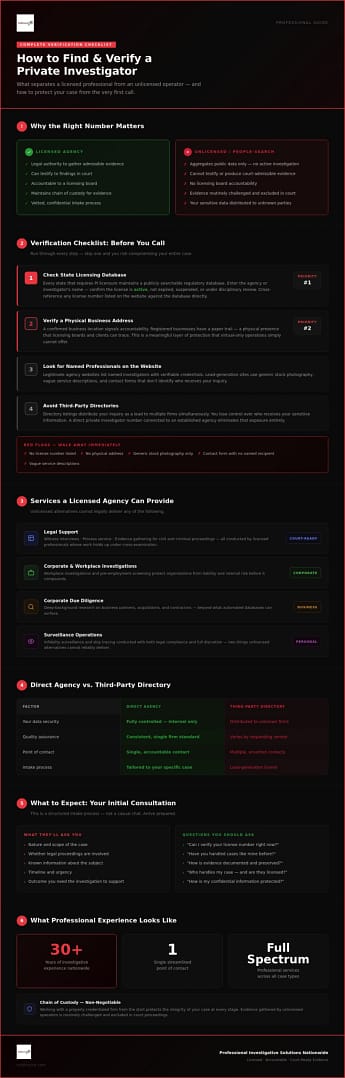
A private investigator number isn’t just a phone number. It’s a direct line to a licensed professional who carries legal authority to gather evidence, conduct surveillance, and support court proceedings. That distinction matters enormously, and most people don’t realize it until they’ve already wasted time on the wrong resource.
People-search websites look convincing. They return names, addresses, and associated records within seconds. But those platforms aggregate publicly available data through automated scraping. They don’t conduct active investigations, they can’t testify to findings, and they have no accountability to a licensing board. A licensed investigative agency operates under an entirely different framework, one where methods, documentation, and chain of custody can withstand legal scrutiny.
For legal and corporate matters specifically, this gap is critical. Evidence gathered by an unlicensed operator is routinely challenged and excluded. If your case ends up in court, or if a corporate dispute escalates to litigation, the source and method of every piece of evidence will be examined. Working with a properly credentialed firm from the start protects the integrity of your case at every stage.
Confidentiality is equally non-negotiable. High-stakes investigations require immediate, secure communication. When you contact a professional agency directly, your inquiry is handled internally by vetted staff. That’s not guaranteed when you submit a form through a third-party directory.
When to Call a Professional Investigator
The circumstances that warrant professional investigative services are more varied than most people expect:
- Legal support: Witness interviews, process service, and evidence gathering for civil or criminal proceedings require licensed professionals whose work holds up under cross-examination.
- Corporate needs: Workplace investigations and pre-employment screening protect organizations from liability and internal risk before it compounds.
- Personal matters: Skip tracing and infidelity surveillance operations demand both discretion and legal compliance, two things unlicensed alternatives can’t reliably deliver.
Direct Agency Numbers vs. Third-Party Directories
Generic directory listings carry a specific risk that most people overlook: your inquiry becomes a lead that gets distributed to multiple firms simultaneously. You lose control over who receives your sensitive information and how it’s handled. A direct private investigator number connected to an established agency eliminates that exposure entirely. You get consistent quality assurance, a single accountable point of contact, and an intake process designed around your case, not a lead-generation funnel.
Spotting the difference is straightforward. Legitimate agency websites include verifiable licensing information, a confirmed physical address, and named professionals. Lead-generation pages typically feature generic stock photography, vague service descriptions, and contact forms that don’t identify who’s actually receiving your submission.
How to Verify a Private Investigator Before You Call
Most people skip the verification step entirely. They find a private investigator number that looks credible, make the call, and assume the agency is legitimate because the website looks professional. That assumption is how cases get compromised before they even begin.
Verification takes less time than you’d expect, and the process is straightforward once you know exactly what to look for.
Start with the license. Every state that requires PI licensure maintains a publicly searchable regulatory database. Pull it up, enter the agency’s name or the individual investigator’s name, and confirm the license is active, not expired, suspended, or under disciplinary review. This single step filters out a significant number of unqualified operators. If the agency’s website lists a license number, cross-reference it directly against the database rather than taking the number at face value.
Next, verify the physical address. A confirmed business location tied to the private investigator number you’re calling signals accountability. Registered businesses have a paper trail, a physical presence that licensing boards and clients can trace. That’s a meaningful layer of protection that a mobile-only operation simply can’t offer.
Beyond the license, look for professional affiliations. Membership in organizations like the National Association of Legal Investigators or the Council of International Investigators indicates a commitment to ongoing professional standards. These aren’t vanity credentials; they require active participation and adherence to ethical codes that licensing alone doesn’t always enforce.
Experience specificity matters too. An agency with deep expertise in corporate due diligence may not be the right fit for a civil litigation support case. Ask directly whether they’ve handled cases that match your situation and request a general sense of their track record in that area.
Finally, read independent reviews on platforms the agency doesn’t control. Look for patterns in the feedback rather than isolated comments. A consistent record of professionalism, discretion, and accurate documentation tells you far more than a five-star average with no supporting detail.
License Verification Steps
Confirm active license status through your state’s regulatory database before any conversation goes further. Ask whether the specific investigator assigned to your case is covered under the agency’s insurance policy, not just the firm in general. “Licensed and bonded” isn’t a marketing phrase; it’s a baseline standard that protects you if something goes wrong during the investigation. Any agency that can’t confirm both immediately should be treated with caution.
Red Flags to Watch For
- Mobile-only contact: Agencies that provide only a cell number with no verifiable business office have no fixed accountability. That’s a structural problem, not a minor inconvenience.
- Untraceable payment requests: Demands for cash, wire transfers, or cryptocurrency before a formal contract is signed indicate an operation that doesn’t want a paper trail.
- Evasive answers about methods: A licensed investigator can explain their approach clearly and confirm it stays within legal boundaries. Vague or deflective responses to direct questions about methodology are a serious warning sign.
Agencies with genuine credentials welcome scrutiny. If the verification process feels like an inconvenience to the firm you’re evaluating, that reaction tells you everything you need to know. HubHound’s team of licensed investigators brings over 30 years of documented experience to every case, making the credential review process straightforward from the first point of contact.
Key Services Accessed Through a Professional Investigative Agency
Once you’ve verified a legitimate private investigator number and confirmed the agency’s credentials, the next step is understanding exactly what professional investigative services can do for your situation. The range is broader than most people expect, and matching the right service to your specific need is what separates a productive engagement from a wasted one.
Professional agencies don’t operate as generalists who dabble in everything. The strongest firms carry deep operational expertise across defined service categories, each with its own methodology, legal framework, and documentation standards. Here’s what those categories actually deliver.
Corporate and Workplace Investigations
Corporate due diligence goes well beyond pulling a credit report. Before an acquisition, partnership, or executive hire, organizations need verified information about financial history, undisclosed liabilities, and reputational risk. A professional investigative agency builds that picture through active research, not automated data pulls.
Pre-employment background checks and tenant screening serve a similar risk-mitigation function. They confirm that the person an organization is bringing in, whether as an employee or an occupant, is who they claim to be. Gaps in employment history, undisclosed criminal records, and falsified credentials are consistently identified through thorough screening that goes deeper than standard HR processes.
Internal investigations are where the stakes get particularly high. Workplace misconduct cases involving theft, harassment, or policy violations require a structured, documented approach. Findings need to withstand both internal review and potential legal scrutiny. Licensed investigators bring the procedural discipline that internal HR teams often can’t provide without compromising the integrity of the process.
Legal and Litigation Support
Civil and criminal defense cases depend on evidence that holds up in court. That means chain of custody, documented methodology, and investigators who can speak to their findings under cross-examination. Gathering court-ready evidence through advanced surveillance techniques requires both technical skill and strict legal compliance.
Witness location and interview services are equally critical. Tracking down individuals who’ve relocated, changed contact information, or are actively avoiding involvement in a case requires skip tracing capability combined with professional interview technique. Statements gathered correctly, documented thoroughly, and attributed accurately carry genuine evidentiary weight.
Process service rounds out the litigation support picture. Efficient, legally compliant delivery of court documents affects case timelines directly. Missed deadlines caused by improper service can derail proceedings entirely.
- Skip tracing and locate investigations: Used for missing persons, legal defendants, and individuals who’ve severed contact; combines database research with active field investigation.
- Surveillance operations: Applied to workplace misconduct and personal matters alike, with documented findings that meet evidentiary standards.
- Infidelity investigations: Conducted with legal compliance and documented discretion, producing findings that can support family law proceedings when needed.
When you contact a professional private investigator number connected to an established agency like HubHound, you’re accessing over 30 years of operational experience across all of these service categories, through a single, accountable point of contact.
What to Expect During Your Initial Consultation
Most people approach the first call with a professional investigative agency the way they’d approach any service inquiry: loosely, with a general sense of what they need and a vague hope that the conversation will sort itself out. That approach costs time and, in some cases, compromises the investigation before it starts. The initial consultation is a structured intake process with a defined sequence, and knowing that sequence puts you in control of it.
The call typically moves through five stages: case intake, conflict of interest screening, strategy development, fee structure discussion, and formal agreement. Each stage has a purpose. None of them are filler.
During intake, you’ll share the broad goals and constraints of your situation. The agency needs enough context to assess whether they can help and how. This isn’t the moment for complete disclosure of every detail; it’s the moment to establish the core facts, the parties involved, and the outcome you’re working toward. The investigator uses that information to run a conflict of interest check, confirming that the agency doesn’t have an existing relationship with any party in your case that would compromise their ability to represent you ethically.
Strategy development follows. A qualified investigator won’t hand you a generic service package. They’ll define the specific methods applicable to your situation, outline a realistic timeline, and identify any legal constraints that affect the approach. That last point matters: licensed professionals operate within defined legal boundaries, and a credible agency will tell you upfront if a requested method falls outside what they can legally execute.
Fee structure comes next. Investigative agencies typically work on hourly rates, flat-fee arrangements for defined-scope tasks, or retainer agreements for ongoing engagements. Get clarity on what triggers additional charges, what’s included in any quoted figure, and what documentation you’ll receive as work progresses. The consultation closes with a formal contract that defines scope, confidentiality obligations, and deliverables. Don’t proceed without it.
Preparing for the Call
Organize what you know before you dial a private investigator number. Gather relevant names, dates, locations, and any documents that establish the background of your situation. Be ready to explain not just what you need, but why, since the “why” shapes the investigative approach directly. Have a realistic budget range in mind; an experienced agency will structure a strategy around what’s achievable within your parameters rather than overpromising on scope.
Confidentiality and Ethics
Professional investigators protect your information from the first exchange. That means internal handling by vetted staff, no third-party lead distribution, and a formal confidentiality agreement before substantive case details are shared. Ethical investigators also know where their legal authority ends. They won’t conduct unauthorized access to private communications, trespass to gather evidence, or accept cases that require illegal methods to resolve. If an agency doesn’t raise these limits voluntarily, raise them yourself. The ones worth working with will welcome the question.
Connect with HubHound’s licensed investigators to begin your confidential case consultation today.
Contacting HubHound: Professional Investigative Solutions Nationwide
Every step in this guide has pointed toward one outcome: connecting with a licensed, experienced investigative agency that can actually deliver results. HubHound is that agency. With over 30 years of operational experience across corporate, legal, and private investigation sectors, the firm brings a depth of verified expertise that generic directories and unlicensed operators simply can’t match.
Transparent pricing and professional reporting standards define every engagement. Before any investigative work begins, clients receive a clear breakdown of fees, a defined scope of services, and documentation standards that meet legal and corporate requirements. There are no vague estimates and no surprise charges. That level of clarity isn’t a courtesy; it’s a structural commitment that protects your case and your budget from the first conversation forward.
The HubHound Difference
HubHound operates as a specialized curator of high-quality investigative resources, not a generalist firm that takes every case that comes through the door. That selectivity matters. It means the investigators assigned to your case carry specific expertise in the service category your situation requires, whether that’s civil litigation support, workplace misconduct investigation, or skip tracing. The team has built its reputation on action-oriented results and direct communication, two qualities that are easy to claim and genuinely difficult to consistently deliver.
- Corporate sector expertise: Pre-employment background checks, tenant screening, corporate due diligence, and workplace misconduct investigations handled with documented rigor.
- Legal and litigation support: Court-ready evidence gathering, witness interviews and statements, process service, and criminal defense investigations conducted by licensed professionals.
- Private investigation services: Surveillance operations, infidelity investigations, and locate investigations executed with legal compliance and strict confidentiality.
Finding a legitimate private investigator number that connects you directly to this caliber of professional is exactly what HubHound provides. One point of contact. One accountable team. No lead distribution to third parties.
Ready to Begin Your Investigation?
Bring your case details to a team that’s equipped to assess them accurately and move quickly. HubHound’s intake process is built for efficiency; you’ll leave the initial consultation with a clear strategy, a realistic timeline, and a formal agreement that defines every deliverable. That’s the standard a growth-focused investigative firm operates to, and it’s the standard your case deserves.
Don’t let an unverified private investigator number or an unlicensed operator compromise what’s at stake. Contact HubHound today for a professional consultation.
Your Next Step Toward a Verified, Trustworthy Investigation
The right private investigator number connects you to a licensed professional who can legally gather evidence, document findings, and support your case through every stage. The wrong one wastes your time and compromises your outcome before work even begins.
Three things determine whether your investigation succeeds: verified credentials, matched expertise, and a structured intake process that protects your information from the first exchange. Skip any one of them and the risk compounds quickly.
HubHound brings over 30 years of licensed investigative experience to corporate, legal, and private cases nationwide. From pre-employment background checks to civil litigation support and surveillance operations, the team carries the specialized depth your situation requires through a single, accountable point of contact.
Don’t leave something this important to an unverified source. You now have the framework to choose correctly.
The right professionals are ready when you are.
Frequently Asked Questions
How do I find a private investigator’s license number?
Start with your state’s regulatory agency, typically a department of public safety, consumer affairs, or professional licensing. Most states maintain a publicly searchable online database where you can look up an investigator or agency by name and retrieve their license number, current status, and any disciplinary history. The search takes minutes and costs nothing.
If an agency lists a license number on their website, don’t take it at face value. Cross-reference it directly against the official state database to confirm it’s active and assigned to the specific firm you’re evaluating. A number that doesn’t match the agency name in the database is an immediate disqualifier.
Is it legal for a private investigator to track a phone number?
Licensed investigators can legally gather information associated with a phone number through lawful means, including public records research, skip tracing databases, and documented field investigation. What they cannot legally do is intercept calls, access private communications without authorization, or install tracking software on a device without the owner’s consent. Those methods violate federal and state wiretapping statutes regardless of who performs them.
Any private investigator number you call should connect you to a professional who can explain their legal boundaries clearly and without hesitation. If an investigator implies they can access private communications or real-time location data through unauthorized methods, end the conversation and look elsewhere.
What happens if I call a private investigator number and they are unlicensed?
Engaging an unlicensed operator carries real consequences for your case. Evidence they gather can be challenged or excluded in court because it wasn’t collected by a legally authorized professional. You also have no recourse through a licensing board if the operator mishandles your information, breaches confidentiality, or delivers fraudulent findings. In some states, the unlicensed operator themselves may face criminal charges, which can pull your case into unwanted scrutiny.
Beyond the legal exposure, unlicensed operators typically lack the professional liability insurance that protects clients if something goes wrong during an investigation. Verifying licensure before sharing any case details isn’t optional; it’s the baseline protection your situation requires.
How much does it typically cost to hire a private investigator after the first call?
Investigative fees vary based on the complexity of the case, the methods required, and the estimated time involved. Agencies generally structure pricing as hourly rates, flat fees for defined-scope tasks like process service, or retainer agreements for ongoing engagements. The initial consultation should produce a clear fee breakdown tied to your specific situation rather than a generic quote.
Ask what triggers additional charges beyond the initial estimate and what documentation you’ll receive as billable work progresses. Reputable agencies provide written agreements that define scope and cost before any investigation begins. We don’t quote specific pricing here because rates vary significantly by case type and agency; get a formal proposal in writing before committing.
Can a private investigator find a person using only their phone number?
A phone number alone is a starting point, not a complete picture. Licensed investigators use skip tracing methods that combine multiple data sources, including carrier records accessible through legal channels, associated address histories, and field verification. A phone number can help narrow the search, but locating a person accurately typically requires corroborating information to confirm identity and current whereabouts.
Provide as much background as you have when initiating a locate investigation. Names, last known addresses, employment history, and associated contacts all improve the accuracy and efficiency of the search. The more context an investigator has at the outset, the faster they can produce verified results.
What questions should I ask a private investigator during the first consultation?
Lead with the essentials: Is your license current and does it cover this type of investigation? Are you insured, and does that coverage extend to the specific investigator assigned to my case? What methods will you use, and do they stay within legal boundaries? What does your documentation process look like, and will findings hold up under legal scrutiny if needed?
Also ask about their experience with cases similar to yours, their expected timeline, and what milestones or updates you’ll receive during the engagement. A qualified investigator answers these questions directly and without deflection. Vague or evasive responses to any of them are a reliable signal to keep looking.
How do I know if a private investigator number is legitimate?
A legitimate private investigator number connects to an agency with a verifiable physical address, an active state license, and named professionals you can independently look up. Check that the website includes specific licensing information rather than generic claims, and confirm the address is a registered business location rather than a residential or virtual office with no traceable presence.
Run the agency name through your state’s licensing database and look for independent reviews on platforms the firm doesn’t control. Legitimate agencies welcome that scrutiny. If the contact number routes to a generic voicemail with no agency identification, or if the website features only stock photography and vague service descriptions with no verifiable credentials, treat it as a red flag and move on.
Do private investigators offer free consultations over the phone?
Consultation policies vary by agency, and we don’t claim this on behalf of any specific firm. Some agencies offer an initial intake call at no charge to assess whether they can take your case; others apply a consultation fee that may be credited toward the engagement if you proceed. Ask directly before the call begins so there are no surprises.
Regardless of whether a consultation carries a fee, treat it as a structured professional exchange rather than a casual inquiry. Arrive with organized case details, a clear sense of your goals, and a realistic budget range. That preparation makes the conversation more productive and helps the investigator give you an accurate assessment from the start.

Article by
Joel R. Manley | President | Hubhound Investigations | OR PI-ID#: 90432 | 111 SW Fifth Avenue, Suite 3150 Portland, Oregon 97204 | 971-442-8170
Joel is licensed as a private investigator in Oregon and Tennessee. Joel started his career in 1987 serving as a Military Police Officer and Military Police Investigator.
After ending his military tour of duty, Joel became a civilian Police Officer and Deputy Sheriff. Joel took his strong background in Hostage Negotiations, Mediation and Conflict Resolution, with him to patrol some of the highest crime areas in SE Portland.
Joel was awarded Deputy of the Year for his efforts and for drastically reducing the crime rate in the area he patrolled. As a Deputy Sheriff, Joel assisted in leading a Neighborhood Livability Program that was nationally recognized for having the most innovative and progressive approach to policing.
In 2018, Joel retired as a Deputy Sheriff and founded Hubhound Investigations. Joel played an integral role in Hubhound Investigations receiving an A+ Accredited Business rating from the Better Business Bureau (BBB).
In his off time, Joel enjoys spending time with his wife, adult children and Hubhound’s Happiness Ambassador, Nya. Joel also enjoys Scuba Diving and Kayaking.
Disclaimer
DISCLAIMER: This article is provided for general informational and educational purposes only. It is not intended to constitute legal advice, professional investigative advice, or instruction to engage in any unlawful activity. Laws governing private investigations, surveillance, recording, tracking, access to information, evidence collection, privacy, trespass, licensing, and related investigative activities vary by jurisdiction and are subject to change.
Any investigative techniques, tactics, procedures, scenarios, or legal proceedings discussed in this article are presented for informational purposes and should not be interpreted as authorization or encouragement to use a particular method. Private investigators and members of the public are responsible for understanding and complying with all applicable federal, state, and local laws, licensing requirements, court rules, and professional standards.
The circumstances of every investigation and legal matter are different. Information contained in this article should not be relied upon as a substitute for advice from a qualified attorney or other appropriate licensed professional regarding a specific situation. No attorney-client, investigator-client, or other professional relationship is created by reading or using this information.