
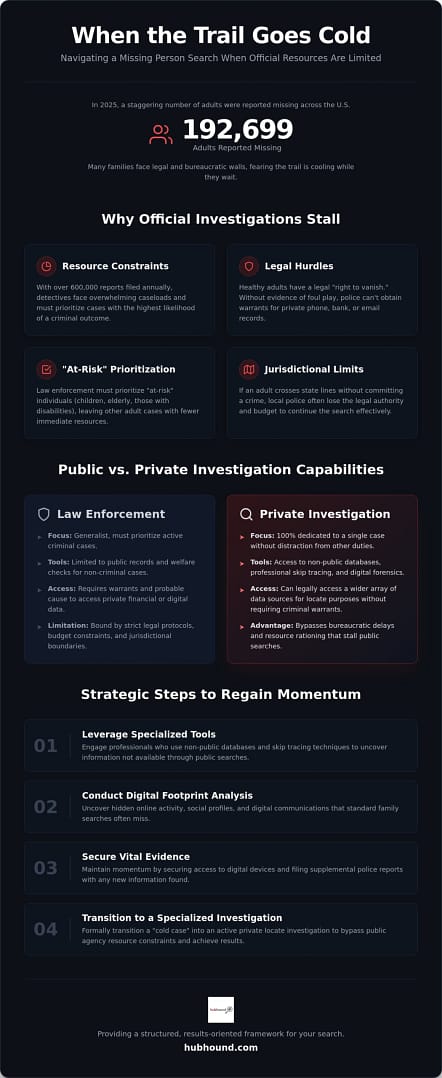
In 2025, official records showed that 192,699 adults were reported missing across the United States. Despite these high numbers, many families encounter a wall of legal red tape when they try to secure government resources for a search. You might feel dismissed by authorities because the missing person is an adult, leading to the fear that a trail is going cold while you wait for a breakthrough. Knowing what to do when police can’t help with a missing person is the first step toward regaining control of the situation.
We understand the urgency of your search and the need for actionable data over administrative delays. This guide outlines the specific investigative steps and professional resources available when law enforcement efforts reach their limit. You’ll learn how to evaluate the difference between public and private search capabilities and identify the legal avenues required to move a search forward. Use this professional framework to transition from frustration to a structured, results-oriented investigation. We’ve compiled the necessary tools to help you identify high-quality resources and evaluate specialized service partners effectively.
Key Takeaways
- Identify the specific legal thresholds, such as “at-risk” status, that dictate how law enforcement prioritizes missing person cases.
- Discover exactly what to do when police can’t help with a missing person by leveraging professional skip tracing and non-public databases.
- Evaluate the efficacy of digital footprint analysis to uncover hidden online activity that standard social media searches often miss.
- Learn how to secure vital evidence, including digital device access and supplemental police reports, to maintain momentum in a search.
- Understand the process of transitioning a cold case into a specialized locate investigation to bypass public agency resource constraints.
Understanding Why Law Enforcement May Hit a Wall
Law enforcement agencies operate under strict mandates that prioritize immediate physical danger. While a missing person report must be accepted in many jurisdictions, the depth of the subsequent investigation depends on the “endangered” status of the individual. Police typically prioritize children and the elderly because they’re legally considered vulnerable. Healthy adults, however, possess a legal right to disappear. If there’s no evidence of a crime, law enforcement often views a disappearance as a personal choice rather than a police matter. This “right to vanish” is a significant hurdle for families seeking official help.
Resource constraints further limit the scope of public searches. With over 600,000 missing person reports filed annually in the United States, detectives face overwhelming caseloads. They must allocate time based on the likelihood of a criminal outcome. Additionally, jurisdictional limits create significant friction. If an adult crosses state lines without committing a felony, local police often lose the legal authority or the budget to follow the trail. This gap in the system leaves families wondering what to do when police can’t help with a missing person, often requiring them to turn to private resources and professional outreach platforms like Calls-Are-Us to help mobilize community awareness and bridge the communication gap.
The ‘No Evidence of Foul Play’ Barrier
Search warrants and subpoenas require probable cause. Without a clear crime scene or evidence of an abduction, police can’t legally access private phone records, bank statements, or email accounts. This lack of evidence often leads to a case being labeled as low priority or “cold” within days. When the trail reaches a digital or financial wall that requires a warrant, public agencies often stop their active search because their hands are legally tied by the Fourth Amendment.
Public vs. Private Resource Allocation
Public agencies provide a vital service, but they’re generalists by necessity. A police “welfare check” is often limited to a single visit to a known address or a brief inquiry. In contrast, a private locate investigation focuses exclusively on your file without the burden of other active criminal cases. Specialized firms like HubHound use dedicated resources to track address history and utilities through non-public databases. Private investigators offer 100% focus on a single case, bypassing the bureaucratic delays and resource rationing that cause official investigations to stall. This allows for a deeper dive into skip tracing and digital forensics that police departments simply can’t afford for non-criminal cases.
The Legal Threshold: Missing vs. Endangered Adults
The legal distinction between “missing” and “endangered” determines the speed and scale of a law enforcement response. Police prioritize “at-risk” individuals, which typically includes minors, the elderly with cognitive decline, or adults with documented disabilities. If an individual doesn’t fit these criteria and there’s no immediate evidence of foul play, the case often lacks the urgency families expect. This specific legal threshold is why families often search for what to do when police can’t help with a missing person after the initial report is filed.
While agencies must accept reports, they aren’t always legally required to actively search for an adult who is capable of making their own decisions. The National Missing and Unidentified Persons System (NamUs) serves as a vital bridge in these instances, allowing families to enter data into a national database that law enforcement uses to cross-reference cases. As of June 19, 2024, this database contained 54,221 active cases, highlighting the high volume of individuals who remain in a legal limbo between being reported and being found.
When Disappearing is a Legal Choice
Adults have a constitutional right to leave their lives behind without notifying family, provided no crime has been committed. When an investigation reveals that a person has intentionally relocated, ethical boundaries prevent investigators from disclosing a specific location against the individual’s will. In these scenarios, professionals often provide “peace of mind” reports, confirming the individual is safe and alive without violating their privacy. This approach is critical in cases involving domestic disputes where safety and legal autonomy must be balanced carefully. If you need to verify a person’s status without violating legal boundaries, professional locate investigations offer a structured way to get answers.
Privacy Laws and Data Access
Privacy regulations like HIPAA and the Gramm-Leach-Bliley Act create significant barriers for public officials who lack a search warrant. Police cannot legally ping a cell phone or access bank statements unless they can prove imminent danger or criminal activity. Private investigators navigate these hurdles by using specialized skip tracing tools that identify utility connections, property records, and credit headers. Private investigators utilize the legal framework of “permissible purpose” to access non-public databases for skip tracing and locate investigations. These specialized tools allow for a level of data discovery that public agencies simply cannot pursue without a criminal conviction on the horizon.
Professional Investigative Tools Beyond Law Enforcement
Public agencies are bound by procedural law, but private investigative services operate using a different set of specialized tools. When you are determining what to do when police can’t help with a missing person, the shift from public records to proprietary data is essential. Professional investigators utilize skip tracing to bridge the gap left by standard police inquiries. This process involves cross-referencing non-public databases, credit headers, and utility records to establish a person’s current location. While law enforcement relies on a national information clearinghouse and resource center for forensic data, private investigators focus on the digital breadcrumbs of the living.
Advanced Skip Tracing Techniques
Professional skip tracing is not a simple internet search. It involves accessing proprietary credit and public record databases that are strictly unavailable to the general public. These systems track address history, cellular account registrations, and even recent IP logs from digital logins. By mapping these connections, an investigator can identify potential witnesses or associates who may have information about the missing person’s current whereabouts. These technical assets allow for a level of precision that public agencies often lack the time or resources to pursue.
A person’s digital footprint extends far beyond their public social media profiles. Professional investigators use Open Source Intelligence (OSINT) to identify hidden online activity, including forum posts, secondary email accounts, and app registrations. This analysis can reveal a person’s intent, travel plans, or recent communications that were previously invisible. By evaluating these digital markers, we can construct a timeline of movements that helps direct physical search efforts.
Surveillance and Field Investigations
Once data analysis identifies a likely location, physical surveillance becomes the primary tool for verification. Unlike a police welfare check, which is often brief and formal, discreet surveillance allows for long-term monitoring to ensure a person’s safety and well-being. This boots on the ground approach is vital for gathering court-ready evidence if the disappearance involves legal misconduct or financial disputes. Field investigations also include re-interviewing associates. People often speak more freely with a private investigator than they do with a uniformed officer, providing leads that were missed during the initial police report. If your case requires this level of dedicated field work, HubHound's surveillance operations provide the professional coverage needed to close the gap.
Strategic Steps to Take When the Case Goes Cold
When the initial flurry of police activity subsides without a resolution, you must pivot to a more granular, data-driven approach. Understanding what to do when police can’t help with a missing person requires you to become the lead curator of information. You’ll need to build a comprehensive investigative file that a private specialist can use to pick up the trail immediately. Follow these specific steps to maintain the momentum of your search:
- Step 1: Request the full police report. Do not settle for a summary. You need the supplemental notes and officer observations that aren’t always included in the public version.
- Step 2: Secure digital devices. If the missing person left behind a laptop or tablet, keep it powered down but accessible. Do not attempt to guess passwords, as too many failed attempts can trigger a permanent lockout.
- Step 3: Document the final 24 hours. List every detail, including their specific clothing, mood, and any unusual financial activity. Even a small coffee purchase can provide a location and timestamp.
- Step 4: Map the social circle. Include “outer ring” contacts like coworkers, distant relatives, or acquaintances from niche online communities.
- Step 5: Consult a professional. Engage a private investigative firm to conduct a dedicated locate search that utilizes non-public databases.
Preserving Evidence for a Private Search
Digital evidence is fragile and easily compromised. Avoid logging into the missing person’s social media or email accounts prematurely. These actions can trigger security alerts or overwrite login metadata that a professional investigator could use to track an IP address. Save the original files of any photos or messages sent just before the disappearance. These files contain embedded metadata, such as GPS coordinates or precise timestamps, that provide critical location data. Maintain a minute-by-minute timeline of events that goes far beyond the broad strokes found in a standard police report. If you’ve hit a wall with official channels, you can consult with HubHound for a professional locate search to restart the investigation.
Building a Comprehensive Associate Map
Public agencies often focus only on immediate family and known partners due to limited time. You should identify secondary contacts such as former colleagues, distant relatives, or friends from online forums. These individuals often possess pieces of the puzzle that the missing person didn’t share with their inner circle. Professional witness interviews are vital here because they uncover hidden motives or secret travel plans. Private investigators often secure more detailed statements because witnesses feel less interrogated and more comfortable sharing sensitive information than they do during official police questioning. This reduced pressure often leads to the disclosure of vital leads that were missed during the initial report.
Partnering with HubHound for Locate Investigations
Transitioning from a stagnant public file to an active private search is the most effective way to regain control of a missing person case. HubHound specializes in bridging the gap when official leads dry up. We utilize advanced skip tracing and surveillance operations to track individuals who have intentionally or unintentionally dropped off the grid. While police focus on criminal thresholds, we prioritize the discovery of actionable data. Knowing what to do when police can’t help with a missing person involves shifting your strategy from public reporting to private discovery. Our team moves your case into a specialized environment where your file is the singular priority.
The transition process begins with a thorough review of the existing police report and any supplemental notes you’ve secured. We identify exactly where the official search reached its limit and apply our technical tools to push past those barriers. Our investigators look for the nuances in witness statements and digital footprints that public agencies might have overlooked due to high caseloads. You can expect complete transparency and regular updates as we build a file of court-ready evidence. With decades of experience in complex locates, we provide the expertise necessary to find the ‘unfindable’ using methods that public agencies aren’t equipped to handle.
Why Professional Locate Investigations Work
Generic “people search” websites rely on outdated public records that often lead to dead ends. Professional investigative databases, however, offer access to real-time utility connections, credit headers, and property records. HubHound bypasses the resource limitations that public agencies face by dedicating focused investigative resources to a single file. Our skip tracing methods identify current address histories and associates that standard searches miss. Learn more about our skip tracing and locate investigations to see how we leverage specialized data to restart a stalled search.
Getting Started with Your Search
Preparation is the key to a successful transition. Before your initial consultation, organize the police report copies and the associate maps you’ve developed. Our investigators will help you define specific milestones and establish a clear scope of work tailored to your specific situation. Understanding these investigative milestones ensures you remain informed throughout the process. We provide transparency by documenting every lead pursued and every database queried. This structured approach helps alleviate the uncertainty often felt when a case goes cold. Contact HubHound today to restart your search for a missing loved one and leverage our specialized authority in locate investigations.
Take Decisive Action to Resume Your Search
The transition from a stagnant public report to a private investigation is a strategic move that bypasses administrative delays and legal roadblocks. By understanding the distinction between missing and endangered status, you can better navigate the limitations public agencies face. Utilizing advanced tools like skip tracing and digital footprint analysis allows for a level of discovery that standard police inquiries often miss. Knowing what to do when police can’t help with a missing person moves you from a state of waiting to one of active search, ensuring no lead is left unexamined.
HubHound provides the technical expertise and dedicated focus required to track down high quality solutions for your search. Our licensed investigators bring over three decades of experience to every file, specializing in high precision skip tracing and discreet surveillance. We maintain a comprehensive nationwide reach to handle complex locate cases, offering the specialized authority that broader directory sites lack. It’s possible to regain momentum and find clarity even when official trails have gone cold.
Start your professional locate investigation with HubHound today to leverage the specialized expertise your case deserves. You don’t have to navigate this process alone.
Frequently Asked Questions
Can a private investigator find someone who doesn’t want to be found?
Yes, professional investigators can locate individuals who’ve intentionally disappeared by tracking utility connections, credit headers, and digital breadcrumbs. If the person is a healthy adult who’s chosen to leave, the investigator may only confirm their safety to the family to maintain legal privacy standards. This process ensures a balance between the family’s need for closure and the individual’s right to privacy while providing verified results.
How long do I have to wait before hiring a private investigator for a missing person?
You don’t have to wait any amount of time before hiring a private investigator. In fact, starting a private search immediately is often the best course of action when you’re unsure what to do when police can’t help with a missing person. Early intervention allows investigators to secure digital metadata and witness statements before the trail grows cold or vital evidence is overwritten by the passage of time.
Will the police share their case file with a private investigator?
Law enforcement agencies typically don’t share active case files directly with private investigators due to privacy laws and internal policies. However, the family has a legal right to request a copy of the police report and any supplemental notes. By securing these documents yourself, you can provide your private investigator with the necessary foundation to resume the search where public agency efforts reached their limit.
What is the success rate of professional locate investigations?
Success rates for locate investigations depend on the quality of available data and the time elapsed since the disappearance. While no investigator can guarantee a specific outcome, utilizing professional skip tracing significantly increases the probability of a resolution compared to standard public searches. Programs like NamUs helped resolve over 45,807 cases by 2023, demonstrating the power of dedicated data cross-referencing in complex locate cases.
How much does it cost to hire a private investigator for a missing person search?
The cost of a missing person search varies based on the complexity of the case and the investigative tools required. Most professional firms utilize a combination of hourly rates and retainers to cover specialized database access and field surveillance operations. You should discuss specific fee structures and investigative milestones during your initial consultation to ensure the search parameters align with your budget and goals.
Is it legal for a private investigator to track a person’s cell phone?
Private investigators cannot legally “ping” a cell phone or access live GPS data without a warrant or the owner’s consent. Instead, they use forensic techniques to analyze IP logs, account registrations, and cellular billing records. These methods identify the digital breadcrumbs left behind during device usage, providing a reliable timeline of a person’s movements without violating federal privacy laws or data protection regulations.
What information should I have ready before calling an investigator?
Prepare a comprehensive file that includes the full police report, a recent high-resolution photograph, and a list of all known associates. Having access to the missing person’s digital devices or social media login information is also highly beneficial. This data allows your investigator to perform a deep-web search and identify what to do when police can’t help with a missing person more efficiently.
Can a private investigator search across state lines?
Yes, licensed private investigators can conduct searches across state lines by utilizing national databases and professional networks. Unlike local police departments, which are often restricted by jurisdictional boundaries and budget limits, private firms maintain a nationwide reach. This allows them to follow a trail across the entire country, which is essential when an individual intentionally relocates to a different region to avoid being found.

Article by
Joel R. Manley | President | Hubhound Investigations | OR PI-ID#: 90432 | 111 SW Fifth Avenue, Suite 3150 Portland, Oregon 97204 | 971-442-8170
Joel is licensed as a private investigator in Oregon and Tennessee. Joel started his career in 1987 serving as a Military Police Officer and Military Police Investigator.
After ending his military tour of duty, Joel became a civilian Police Officer and Deputy Sheriff. Joel took his strong background in Hostage Negotiations, Mediation and Conflict Resolution, with him to patrol some of the highest crime areas in SE Portland.
Joel was awarded Deputy of the Year for his efforts and for drastically reducing the crime rate in the area he patrolled. As a Deputy Sheriff, Joel assisted in leading a Neighborhood Livability Program that was nationally recognized for having the most innovative and progressive approach to policing.
In 2018, Joel retired as a Deputy Sheriff and founded Hubhound Investigations. Joel played an integral role in Hubhound Investigations receiving an A+ Accredited Business rating from the Better Business Bureau (BBB).
In his off time, Joel enjoys spending time with his wife, adult children and Hubhound’s Happiness Ambassador, Nya. Joel also enjoys Scuba Diving and Kayaking.
Disclaimer
DISCLAIMER: This article is provided for general informational and educational purposes only. It is not intended to constitute legal advice, professional investigative advice, or instruction to engage in any unlawful activity. Laws governing private investigations, surveillance, recording, tracking, access to information, evidence collection, privacy, trespass, licensing, and related investigative activities vary by jurisdiction and are subject to change.
Any investigative techniques, tactics, procedures, scenarios, or legal proceedings discussed in this article are presented for informational purposes and should not be interpreted as authorization or encouragement to use a particular method. Private investigators and members of the public are responsible for understanding and complying with all applicable federal, state, and local laws, licensing requirements, court rules, and professional standards.
The circumstances of every investigation and legal matter are different. Information contained in this article should not be relied upon as a substitute for advice from a qualified attorney or other appropriate licensed professional regarding a specific situation. No attorney-client, investigator-client, or other professional relationship is created by reading or using this information.