
What if an expert’s résumé looks strong but doesn’t show that their experience fits your dispute? Verifying credentials of an expert witness takes more than reviewing degrees and past roles. Confirm important claims through independent sources, then assess whether the expert’s knowledge, methods, and experience align with the issues in your case.
A structured review can help you identify gaps, prepare focused questions, and address credibility concerns early in case preparation. This guide covers how to check identity, education, licenses, experience, prior testimony, and other relevant background.
You’ll also learn how to assess an expert’s case fit and approach, and when to bring questions to counsel. If case-relevant information needs to be located or corroborated, counsel may consider investigative support as an adjacent resource, not a substitute for credential verification.
Key Takeaways
- Verifying credentials of an expert witness means corroborating key claims with independent sources, not relying on a polished résumé alone.
- Compare names, dates, institutions, qualifications, and specialty across available records, then document what you confirm.
- Assess whether the expert’s experience and methods address the questions your case requires.
- Classify discrepancies as clerical, material, or unresolved, and follow up before drawing conclusions.
- Use your findings to guide next steps with counsel and evaluate whether the expert’s proposed role fits the case.
Why verifying expert witness credentials takes more than reviewing a résumé
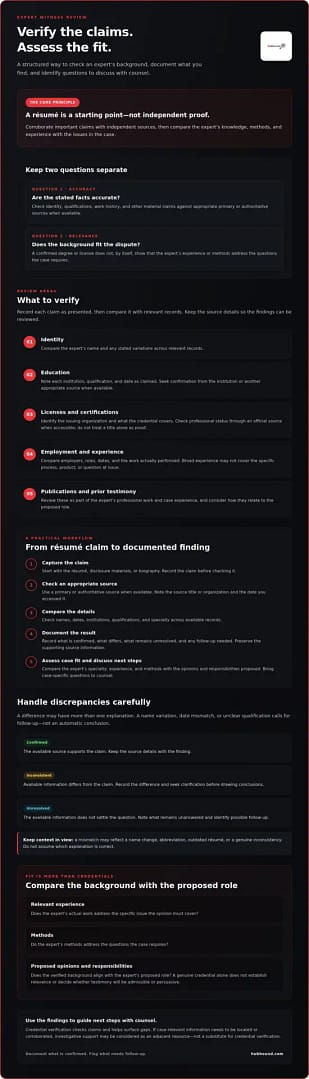
A résumé is a starting point, not independent proof. Verifying credentials of an expert witness means checking the person’s identity, qualifications, work history, experience, and other claims relevant to the proposed role. A biography may omit dates, use broad titles, or list credentials without enough context to assess their relevance.
Separate two questions: Are the stated facts accurate, and does the expert’s background fit the dispute? A confirmed degree or professional license supports a factual claim. It doesn’t, by itself, establish that the expert has relevant experience, uses appropriate methods, or can explain an opinion clearly. The Expert witness overview provides general context on the role. Confirm case-specific requirements with counsel.
What does expert witness credential verification establish?
Expert witness credential verification is the process of checking an expert’s identity and corroborating material claims about their education, professional credentials, employment, publications, and case experience. Review each category separately. Education confirms academic history; licenses and certifications relate to professional standing; employment and case experience show practice history; publications provide another record of professional work. Verification checks claims. It does not determine whether testimony will be admissible or persuasive.
A credential can be genuine but unrelated to the issue at hand. A verified employment history may still leave questions about the work the expert actually performed. Build an accurate, documented picture, then compare it with the expert’s proposed opinions and responsibilities.
Why a credible résumé can still leave unanswered questions
Credentials can change, titles can mean different things in different settings, and a résumé may summarize rather than fully describe work history. A date mismatch might reflect an outdated document or a clerical error. An unexplained gap or unclear qualification calls for follow-up, not an automatic conclusion of misconduct. Record what is confirmed, what differs, and what remains unresolved.
Relevance matters as much as prestige or length of experience. An expert may have extensive experience in a broad field but limited work with the specific process, product, or question central to the dispute. Compare the expert’s specialty and actual work with the issues their opinion must address. Ask counsel which qualifications and supporting records matter for the expert’s proposed role and which case requirements apply.
How to verify an expert witness’s identity, education, and professional credentials
Use a claim-by-claim process. Start with the expert’s résumé, disclosure materials, or biography, then check each important statement against an appropriate primary or authoritative source when available. The goal of verifying credentials of an expert witness is not to collect the longest list of documents. It is to establish what is confirmed, what differs, and what still needs an answer.
Build a claim-by-claim verification checklist
Record each claim as presented before checking it. For each item, note the source, the date you accessed it, the result, and any follow-up needed. Include source details, such as the record’s title or the organization that provided it, so counsel can review how you reached each conclusion.
- Identity: Note the expert’s name and any stated variations, then compare them across relevant records.
- Education: Record each institution, qualification, and date as claimed. Seek confirmation from the institution or another appropriate source when available.
- Licenses: Identify the issuing organization and check professional status through its official source, if accessible.
- Certifications: Record the exact credential and issuer. Confirm what the credential represents rather than treating the title alone as proof.
- Employment: Note employers, roles, and dates. Compare available records or seek clarification if details don’t align.
Compare names, dates, institutions, qualifications, and specialty across records. A difference may reflect a name change, abbreviation, outdated résumé, or genuine inconsistency. Don’t assume which explanation is correct. Mark the item as confirmed, inconsistent, or unresolved, and preserve the supporting source information.
Check professional status and specialized qualifications
For each claimed license or certification, identify who issued it and what it covers. Use an official or primary source where available, and note any limits on what the source can establish. Membership in a professional organization, completion of a course, or use of a job title doesn’t by itself establish licensure. If you can’t access a record, document that limitation and ask the expert or counsel what alternative confirmation is appropriate.
Credential checks establish facts, but they don’t decide whether an expert’s methods or opinions fit the dispute. For context on how reliability and relevance may be assessed in federal cases, review Cornell Law School’s Daubert Standard overview. Ask counsel which case-specific requirements apply and how to handle any unresolved claim.
If counsel needs help locating or corroborating other case-relevant information, investigative support may be a separate consideration. HubHound provides civil litigation support; this is not a standalone expert-credential verification service.
How to assess an expert’s case experience, methods, and potential credibility concerns
A verified résumé doesn’t automatically make an expert suitable for a particular dispute. Credential checks establish whether background claims are accurate. Case-fit review asks whether the expert’s experience and approach address the questions that need an opinion. Keep those assessments separate. An impressive title or long career may matter less than directly relevant work and a clear explanation of how the expert reached a conclusion.
Match expertise to the disputed issues
List the technical or professional questions the expert may be asked to address. Then compare each question with the expert’s training, practical experience, and demonstrated specialty. For example, broad experience in a field may not establish familiarity with the specific process or issue at the center of a dispute. Flag that gap for clarification rather than assuming the expert is unqualified.
Use a simple evidence map to keep the review objective:
- Verified evidence: Information supported by a source you reviewed, such as a confirmed role, publication, or qualification relevant to the proposed opinion.
- Self-reported claims: Statements in a résumé, biography, or interview that you haven’t independently corroborated.
- Questions for counsel: Unclear links between the expert’s experience and the disputed issue, or questions about the scope of the proposed opinions.
This format shows counsel what the record supports and where follow-up may help. It also prevents an unverified claim from being treated as established fact.
Review prior testimony, publications, and disclosed limitations
Ask counsel which prior testimony, disclosure materials, publications, or other work are relevant and obtainable. Compare descriptions of the expert’s methods in those materials with the approach proposed for this case. Differences, such as a method described differently or a stated limitation that may affect the opinion, may need explanation. A difference is a prompt for inquiry, not automatic proof of unreliability.
Consider how the expert explains the basis for an opinion: What information did they rely on? What steps did they take? Can they identify limits or uncertainty? These questions help you assess whether the proposed analysis is transparent and connected to the case facts, without treating a credential review as a decision about admissibility.
Prior challenges, exclusions, or criticism may warrant careful review, but context matters. Ask counsel to assess the underlying decisions or records and determine whether they relate to the current opinions. Legal standards and procedural requirements can vary by case, so direct admissibility questions to counsel. Use verifying credentials of an expert witness as one part of a broader assessment of experience, methods, and fit.
A practical expert witness verification workflow for resolving discrepancies
A consistent process makes findings easier to review and helps prevent an unexplained difference from being treated as proof of a problem. Focus on relevant claims, use appropriate sources, and consult counsel before pursuing information that may raise confidentiality or case-strategy concerns.
- 1. Capture the claim. Record the exact résumé, biography, or disclosure statement, including the qualification, role, or date being checked.
- 2. Identify a suitable source. Look for a primary or authoritative source that can confirm the specific claim. Note if the source is unavailable or lacks enough detail.
- 3. Compare the records. Check names, dates, institutions, titles, and other relevant details. Keep the source material and context together.
- 4. Classify the result. Mark the claim as confirmed, self-reported, conflicting, or unavailable. Distinguish a clerical mismatch, such as a formatting difference, from a material inconsistency that could affect the expert’s stated qualifications or experience.
- 5. Follow up and document. Give the expert or an appropriate representative a fair opportunity to clarify a discrepancy. Record the response and supporting information without presenting an unresolved question as a proven fact.
Document findings without overstating what they prove
Maintain a source log with the records reviewed, access dates, verification status, and follow-up needed. Use neutral descriptions: “date differs from résumé” is more precise than “false credential.” Preserve the original wording and relevant context so counsel can assess whether the difference is clerical, material, or unresolved. Verification establishes what the available evidence supports; it doesn’t, by itself, determine credibility or admissibility.
Decide when to seek legal or investigative support
Refer questions about disclosure, admissibility, research boundaries, and case strategy to the attorney responsible. Counsel can assess whether further research is relevant and appropriate, especially where records may involve confidential or sensitive information. If locating records or corroborating case-related facts requires additional work, investigative support may be considered as an adjacent resource. HubHound provides civil litigation support, but does not offer expert-witness credential verification as a standalone service.
Use this workflow to organize your findings, then let counsel determine what they mean for the case. Explore civil litigation support
Next steps after verifying an expert witness’s credentials
Use your findings to guide the next decision, not to reach a legal conclusion on your own. Verified qualifications show which background claims are supported. Case-fit review helps determine whether the expert’s experience and proposed methods relate to the disputed issues. Unresolved questions identify what still needs clarification before the legal team decides how to proceed.
Turn verification results into focused questions
Prepare a short list of questions tied to specific evidence. For example, ask about a date that differs between records, a specialty claim that lacks supporting detail, or a qualification whose scope is unclear. Share source details and unresolved items with counsel, along with the expert’s proposed role. This gives counsel a clear basis for deciding what follow-up is relevant.
Keep your language neutral. A mismatch may have a straightforward explanation, and an inaccessible record doesn’t establish that a claim is false. Avoid drawing legal conclusions from either. Ask counsel to assess the significance of each issue, determine whether clarification is appropriate, and align follow-up with case requirements and the opinions the expert may offer.
Use litigation support only where it fits the need
Credential review and case investigation address different needs. If counsel identifies related facts that need to be located or corroborated, investigative support may help with that fact-finding. HubHound offers civil litigation support and witness interviews and statements. These are adjacent litigation-support services, not a standalone service for auditing or verifying expert-witness credentials.
Before involving investigative support, confirm with counsel what information is relevant and what methods are appropriate. That keeps the work focused and connected to the legal team’s plan. Your verification record can help counsel identify a remaining fact-finding need, but the decision about the expert’s role belongs with the legal team.
Explore civil litigation support and witness interviews through HubHound’s homepage.
Make your next decision with a clear verification record
Verifying credentials of an expert witness means checking more than résumé claims. Confirm material qualifications through reliable sources, assess whether the expert’s experience and methods fit the disputed issues, and document unresolved questions without treating a discrepancy as proof of misconduct.
Use your findings to prepare focused follow-up for counsel. The legal team can determine which issues matter to the expert’s proposed role and what next steps fit the case. If related fact-finding or witness interviews are needed, consider litigation support as a separate resource, not a substitute for credential verification.
HubHound provides legal and litigation support, including witness interviews. Its agency is operated by licensed investigators with over three decades of industry experience.
A careful, documented review gives counsel a stronger foundation for the next decision. Take each question in turn, and move forward with clarity.
Frequently Asked Questions
How do you verify an expert witness’s credentials?
Use a claim-by-claim process: record what the expert states, then compare material claims with appropriate primary or authoritative sources. Check identity, education, licenses or certifications, employment, publications, and relevant case experience. Keep a log of sources reviewed, access dates, results, and open questions. Verifying credentials of an expert witness can confirm factual claims where evidence is available; it doesn’t decide whether the expert’s opinions fit the case.
What credentials should an expert witness have?
There isn’t one credential checklist for every dispute. Relevant background depends on the questions the expert may address and the requirements that apply to the case. Review education, professional licenses, certifications, training, work history, and practical experience in the claimed specialty. Focus on whether those qualifications relate to the proposed opinions, not simply on institutional prestige or résumé length. Ask counsel about case-specific requirements.
Can you check an expert witness’s license or certification online?
You may be able to confirm a license or certification through the issuing organization, if it provides an accessible source. Search using the expert’s stated name and credential, then compare details such as status, dates, and the credential’s scope. Availability and the information shown can vary. If you can’t locate a reliable record, document the limitation and ask the expert or counsel what other confirmation is appropriate.
How do you verify an expert witness’s education and work history?
Compare the expert’s stated institutions, qualifications, employers, roles, and dates with records from appropriate sources, when available. For education, seek confirmation from the institution or another primary source. For work history, check relevant employer records or supporting materials and ask about unclear dates or titles. Keep the original claim and source details in your notes. A missing public record doesn’t prove a claim is false, so record what remains unconfirmed.
What happens if an expert witness’s credentials cannot be confirmed?
Record which claim you checked, what sources you tried, and why confirmation wasn’t possible. Distinguish unavailable information from conflicting information. Ask the expert or an appropriate representative for clarification or supporting material, then share the result with counsel. The importance of an unconfirmed item depends on the claim and the expert’s proposed role. Don’t treat an access limitation or discrepancy alone as proof of misconduct or unreliability.
Can an expert witness’s prior testimony help assess credibility?
Prior testimony and related materials may help counsel examine the expert’s experience, explanations, and consistency, when relevant records are available. Review them in context: the subject, opinions, and role in another matter may differ from the current case. A prior challenge or criticism is a reason to understand the surrounding facts, not automatic proof that the expert lacks credibility. Ask counsel which materials are relevant and appropriate to review.
Does a verified credential mean an expert witness is qualified for a case?
No. Confirming a degree, license, certification, or work history establishes only that a particular claim is supported. Case fit also depends on the connection between the expert’s knowledge and experience, the disputed issues, and the proposed opinions and methods. Verification alone doesn’t guarantee that testimony will be admissible or persuasive. Share confirmed facts and unresolved questions with counsel, who can assess the expert’s suitability for the case and proposed role.

Article by
Joel R. Manley | President | Hubhound Investigations | OR PI-ID#: 90432 | 111 SW Fifth Avenue, Suite 3150 Portland, Oregon 97204 | 971-442-8170
Joel is licensed as a private investigator in Oregon and Tennessee. Joel started his career in 1987 serving as a Military Police Officer and Military Police Investigator.
After ending his military tour of duty, Joel became a civilian Police Officer and Deputy Sheriff. Joel took his strong background in Hostage Negotiations, Mediation and Conflict Resolution, with him to patrol some of the highest crime areas in SE Portland.
Joel was awarded Deputy of the Year for his efforts and for drastically reducing the crime rate in the area he patrolled. As a Deputy Sheriff, Joel assisted in leading a Neighborhood Livability Program that was nationally recognized for having the most innovative and progressive approach to policing.
In 2018, Joel retired as a Deputy Sheriff and founded Hubhound Investigations. Joel played an integral role in Hubhound Investigations receiving an A+ Accredited Business rating from the Better Business Bureau (BBB).
In his off time, Joel enjoys spending time with his wife, adult children and Hubhound’s Happiness Ambassador, Nya. Joel also enjoys Scuba Diving and Kayaking.
Disclaimer
DISCLAIMER: This article is provided for general informational and educational purposes only. It is not intended to constitute legal advice, professional investigative advice, or instruction to engage in any unlawful activity. Laws governing private investigations, surveillance, recording, tracking, access to information, evidence collection, privacy, trespass, licensing, and related investigative activities vary by jurisdiction and are subject to change.
Any investigative techniques, tactics, procedures, scenarios, or legal proceedings discussed in this article are presented for informational purposes and should not be interpreted as authorization or encouragement to use a particular method. Private investigators and members of the public are responsible for understanding and complying with all applicable federal, state, and local laws, licensing requirements, court rules, and professional standards.
The circumstances of every investigation and legal matter are different. Information contained in this article should not be relied upon as a substitute for advice from a qualified attorney or other appropriate licensed professional regarding a specific situation. No attorney-client, investigator-client, or other professional relationship is created by reading or using this information.