
A convincing promise to “find every bug” isn’t proof of a capable TSCM provider. If you’re concerned about unauthorized monitoring, the harder task is distinguishing technical expertise from confident marketing and understanding what an assessment can actually establish.
It’s reasonable to want clear answers before allowing a provider to inspect sensitive spaces or systems. A TSCM bug sweep may involve physical inspection or analysis of signals and communications, but the scope depends on the engagement. Ask how the work will be conducted, what areas or systems are included, how privacy will be protected, and what the report will cover. Those details matter more than sweeping assurances.
This guide explains what a TSCM assessment may involve and how to compare providers using verifiable criteria, including experience, process, reporting, and follow-up. You’ll also find practical questions to ask before authorizing work. If your concern involves employee conduct rather than suspected technical monitoring, workplace investigations address a different need. Clarify which type of support fits the situation before proceeding.
Key Takeaways
- Understand TSCM as a technical assessment, not a guarantee that every monitoring device will be found.
- Compare providers by relevant experience, transparent methods, clear limitations, and a written scope of work.
- Match the engagement to your concern, then clarify what areas will be assessed and what deliverables to expect.
- Use focused questions about access, privacy, reporting, and follow-up before authorizing an investigation.
- Workplace investigation services address employee conduct concerns, a different need from technical counter-surveillance; verify that any provider actually offers TSCM.
What TSCM bug sweep services are designed to assess
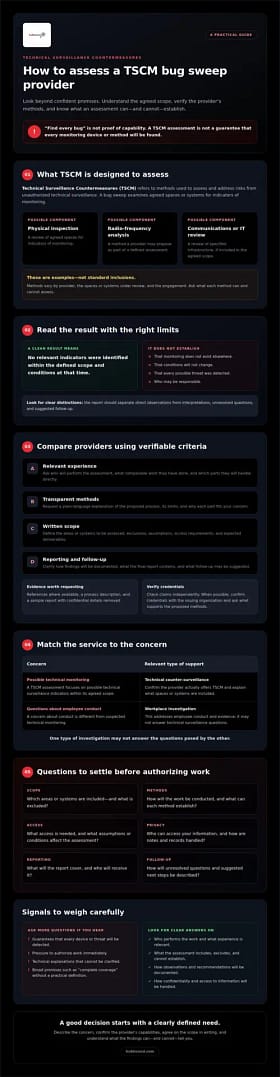
Technical Surveillance Countermeasures (TSCM) refers to methods used to assess and address risks from unauthorized technical surveillance. A bug sweep is one type of assessment: it examines agreed spaces or systems for indicators of monitoring. It isn’t a guarantee that every device or surveillance method will be found. The term is explained in this overview of Technical Surveillance Counter-measures (TSCM).
Organizations may consider an assessment before sensitive meetings, when confidential work takes place in a particular space, or after a specific security concern arises. Start by describing the concern and the locations or systems involved. A defined reason helps a provider propose a relevant scope without treating suspicion as proof that monitoring is occurring.
Keep technical counter-surveillance separate from a workplace misconduct investigation. A TSCM assessment focuses on possible technical surveillance indicators within its agreed scope. A misconduct investigation addresses questions about employee conduct and evidence. One may not answer the questions posed by the other. HubHound’s confirmed offerings include workplace misconduct investigations, but TSCM bug sweeps aren’t among its listed services.
What may a technical surveillance assessment include?
Possible components can vary. A proposed scope might mention a physical inspection, radio-frequency analysis, or a review of communications or IT infrastructure. These are examples to verify with a qualified TSCM provider, not standard inclusions or recommendations for every situation. Ask the provider to explain each method in plain language and state what it can and can’t assess.
Scope and methods depend on the provider, the location or systems under review, and the agreed engagement. Request a written description of what will be examined, what’s excluded, what access is needed, and how observations will be documented. Don’t assume that a “bug sweep” label means providers use the same process.
What a bug sweep cannot promise
A clean result means no relevant indicators were identified within the defined scope and conditions at that time. It doesn’t establish that no monitoring exists elsewhere, that conditions won’t change, or that every possible threat was detected. Nor does an assessment alone identify who may be responsible.
Read the report carefully. It should distinguish direct observations from interpretations, unresolved questions, and recommended follow-up. If the concern is employee behavior rather than suspected technical monitoring, consider whether workplace investigation services are the more relevant category of support. Keep allegations, confirmed facts, and next steps clearly separated.
How to evaluate TSCM bug sweep providers before hiring
Choose a provider based on evidence of relevant capability, not polished language alone. Ask who will perform the assessment, what experience they have with comparable engagements, and which parts of the work they’ll handle directly. Request references where available, along with a process description or sample report with confidential details removed. Verify professional claims independently; a title or credential label, by itself, doesn’t establish expertise.
Pay attention to how the provider explains uncertainty. Claims that an assessment guarantees detection, pressure to authorize work immediately, or technical explanations you can’t get clarified deserve follow-up questions. A credible provider should be able to describe the proposed process in plain language, state its limits, and explain why each part fits your concern.
Which qualifications and experience should you verify?
Ask for examples of relevant experience, who will be assigned, and how findings are documented. References may help you assess communication and professionalism, while a redacted report can show whether observations and recommendations are clearly separated. Confirm any credentials directly with the issuing organization when possible, and ask what training or experience supports the specific methods proposed.
How to compare scope, reporting, and confidentiality
Get the scope in writing before authorizing an assessment. It should name the areas or systems to be assessed, exclusions, assumptions, access requirements, and expected deliverables. If a proposal uses broad phrases such as “complete coverage,” ask what they mean in practice. A clear scope gives both sides a shared reference point if the concern or access conditions change.
Clarify what the final report will contain: observations, supporting documentation, limitations, and any suggested follow-up. Ask who can access your information, how notes and records are stored, and who will receive the report. Discuss any sensitive rooms, devices, or business information that may be encountered. Don’t assume confidentiality practices; have the provider explain them before sharing details.
Workplace misconduct inquiries require a different process from technical counter-surveillance work. For employers managing an internal concern, Ogletree Deakins outlines issues to consider when conducting workplace investigations, including the careful handling of electronic evidence. Keep the purpose of each engagement clear so the right expertise is assessed for the question at hand.
If the underlying issue concerns employee conduct, you can review HubHound’s confirmed workplace misconduct investigation services. HubHound’s listed offerings don’t include TSCM bug sweeps, so verify any prospective provider’s technical capabilities directly.
TSCM bug sweep comparisons: match the engagement to your concern
Compare proposed engagements by what they’re meant to address, what work is included, and what you’ll receive. The labels below are comparison categories, not standard service packages. Ask each provider to define its own terms and fill gaps in writing. For background on the terminology, see this overview of Technical Surveillance Counter-Measures.
| Engagement type | Purpose and proposed scope | Personnel and documentation | Privacy and limitations to clarify |
|---|---|---|---|
| One-time assessment | Address a defined concern in specified areas or systems. Ask exactly what’s included and excluded. | Who will conduct the work? What observations and supporting documentation will be provided? | Who can access information, and what can’t the assessment determine? |
| Targeted follow-up | Revisit a specific unresolved question or area. Confirm what new information would shape the follow-up. | Will the same personnel return? How will new observations be distinguished from earlier findings? | What records will be reviewed or created, and what remains outside scope? |
| Broader security consultation | Discuss wider organizational concerns and whether multiple types of expertise may be needed. Define each workstream separately. | Which specialists are assigned to each task, and what deliverable corresponds to each? | How will information be shared across workstreams, and where does each specialist’s role end? |
Match the work to the question
A focused, clearly defined technical concern may call for a scoped assessment from a qualified TSCM provider. Broader organizational concerns can raise separate technical and investigative questions. Don’t treat a workplace investigation or surveillance as a substitute for TSCM expertise, or assume a technical assessment can establish employee conduct.
If the concern is possible misconduct, workplace investigation services address a different question: what happened, and what evidence can be gathered about conduct? HubHound’s confirmed offerings include workplace misconduct investigations, not TSCM bug sweeps. Readers assessing internal concerns can review its workplace investigations information. Confirm a provider’s TSCM capabilities directly before considering it for technical work.
Use the comparison to identify unanswered questions, not to infer quality from a package name. Before authorizing work, get the proposed scope, assigned personnel, documentation, privacy practices, and stated limitations in writing. If a provider can’t explain an item clearly, pause and ask for clarification.
Questions to ask before authorizing a TSCM bug sweep
A focused consultation helps establish whether the proposed work fits your concern. Prepare what you know, separate observed facts from assumptions, and ask the provider to explain what the assessment can and can’t address. You don’t need to prove that monitoring occurred before asking questions.
Prepare for the consultation
Before the discussion, note the concern, relevant dates, affected spaces or systems, and what decisions the assessment is meant to inform. Identify who can arrange access and coordinate with the provider. Ask what information they need in advance, how they’ll use it, and what details should be kept confidential.
Use this consultation checklist
- 1. Concern: What information would help you understand the issue? How will you distinguish reported suspicions from confirmed observations?
- 2. Scope: Which spaces or systems are proposed for assessment? What’s excluded, and what assumptions does the scope rely on?
- 3. Access: What access, preparation, or coordination is required? Who needs to be present or available?
- 4. Reporting: What will the final report document? How will it separate observations, interpretations, uncertainties, and recommendations?
- 5. Privacy: Who can access the information and records collected during the engagement? How will report distribution be handled?
- 6. Limitations: How will the provider document limits on the assessment and communicate inconclusive results?
- 7. Follow-up: What next steps are possible if the findings don’t resolve the concern? Is follow-up included, offered separately, or outside the proposed scope?
Listen for direct answers. If a provider can’t explain what an inconclusive result means or how out-of-scope observations will be handled, request clarification before authorizing work. Ask for any revised scope or commitments in writing so you can review them against your original concern.
If the issue is suspected employee misconduct rather than possible technical monitoring, consider whether a workplace investigation is the relevant form of support. These are distinct needs, and one shouldn’t be treated as a substitute for the other. HubHound lists workplace misconduct investigations among its services, but TSCM bug sweeps aren’t a confirmed offering.
Choose a provider whose confirmed capabilities match your need
Make the decision based on fit, not the service label. Before proceeding with a TSCM bug sweep, confirm that the provider actually offers this work and can substantiate relevant expertise. Review the written scope, assigned personnel, expected deliverables, privacy practices, and stated limitations. If any of these remain unclear, pause and request specific answers before authorizing an assessment.
When HubHound’s confirmed investigative services may be relevant
HubHound lists workplace misconduct investigations for concerns about workplace conduct. Its confirmed offerings also include surveillance operations and corporate due diligence, which may relate to separate investigative needs. These services aren’t substitutes for a technical counter-surveillance assessment. TSCM bug sweeps aren’t listed among HubHound’s confirmed services, so ask directly about availability before treating the company as a potential TSCM provider.
Start by identifying the question you need answered. A concern about employee behavior calls for an investigative approach suited to conduct. Suspected technical monitoring calls for a provider with verified TSCM capabilities. If both issues are present, keep the workstreams distinct and clarify what each provider is responsible for establishing.
A final provider-selection checklist
- Relevant experience: Can the provider explain experience that directly matches the proposed work?
- Assigned personnel: Do you know who will conduct the work and what their role will be?
- Written scope: Does the agreement identify areas assessed, exclusions, assumptions, and access requirements?
- Deliverables: Is it clear what documentation or report you’ll receive and how findings will be presented?
- Privacy handling: Has the provider explained who can access sensitive information and how records and reports will be handled?
- Limitations: Does the provider explain uncertainty and scope limits without promising a particular result?
Choose the provider whose documented capabilities match your concern and the engagement you’ve agreed to. A well-defined process should make clear what the work can assess, what it can’t establish, and what options exist if questions remain. Don’t rely on broad assurances when you can verify the provider’s role and commitments directly.
For employee conduct concerns, review HubHound’s confirmed investigative services and ask whether they fit your needs. For suspected technical monitoring, verify TSCM availability with a provider before moving forward.
Choose with clarity, then move forward
A sound TSCM decision starts with a defined concern and a provider whose relevant expertise can be verified. Before authorizing work, confirm the scope, assigned personnel, privacy practices, reporting, and limitations in writing. Treat a sweep as an assessment of specific areas and conditions, not a promise to identify every possible threat. If the concern is employee conduct, choose investigative support suited to that question.
HubHound’s confirmed offerings include workplace misconduct investigations, not TSCM bug sweeps. For workplace conduct concerns, HubHound is privately owned and operated by licensed investigators, was founded in 2018, and its ownership notes report more than three decades of industry experience. Verify any provider’s capabilities directly and select the service that matches your need.
With clear questions and verified scope, you can choose the next step with greater confidence.
Frequently Asked Questions
What are TSCM bug sweep services?
TSCM bug sweep services assess a defined environment for possible technical surveillance concerns. The provider and agreed scope determine which areas and risks are considered, so ask for those details before authorizing work. A sweep is an assessment, not a guarantee that every device or monitoring method will be detected. Interpret any findings in light of the stated scope, conditions, and limitations.
How do I choose a TSCM bug sweep provider?
Choose a provider whose relevant experience and process you can verify. Ask who will conduct the work, how the scope is defined, what the report will contain, and how sensitive information will be handled. Clarify exclusions, limitations, and follow-up before you authorize an engagement. Compare documented practices rather than dramatic claims, and independently confirm that the provider actually offers TSCM services before sharing sensitive information.
What happens during a TSCM bug sweep?
The process depends on the provider and the agreed scope. Before work begins, confirm which spaces or systems will be assessed, what access is needed, and what the final report will include. Ask how observations, uncertainties, and limitations will be documented. Providers may use different methods and deliverables, so don’t assume a service label describes a standard package. Request a plain-language explanation of the proposed process.
Can a bug sweep guarantee that no listening devices are present?
No assessment should be treated as a guarantee that every listening device or monitoring method will be found. Results reflect the defined scope, conditions, and assessment process. Ask the provider to explain what a clear or inconclusive result means and how limitations will appear in the report. Treat absolute assurances as a reason to request precise, written explanations before proceeding, rather than as proof that all risks have been ruled out.
How much do TSCM bug sweep services cost?
The cost depends on the provider’s proposed scope and the specific engagement. Request a written proposal that identifies the work, reporting, travel, and follow-up included or excluded. Compare proposals only after confirming they cover comparable areas and deliverables. Generic estimates may not reflect the work you need, and this guide doesn’t provide prices or typical cost ranges. Ask providers to explain any differences between their proposed scopes.
When should a business consider a TSCM assessment?
Consider consulting a qualified provider when a specific concern involves possible technical surveillance in a sensitive environment. First document what prompted the concern and what decision an assessment should inform. Keep suspected surveillance distinct from workplace misconduct or general information-security issues; each may call for different expertise. If concerns overlap, clarify whether separate technical and investigative workstreams are appropriate instead of expecting one assessment to answer every question.
Does HubHound provide TSCM bug sweep services?
HubHound’s confirmed service information does not list TSCM bug sweeps. It lists workplace misconduct investigations, surveillance operations, corporate due diligence, and other investigative services. Don’t assume that broader investigative experience includes technical counter-surveillance work. If you’re considering HubHound for a workplace conduct concern, ask about its confirmed investigative services. For a suspected technical monitoring issue, verify directly that any provider you consider offers TSCM and can explain its scope.

Article by
Joel R. Manley | President | Hubhound Investigations | OR PI-ID#: 90432 | 111 SW Fifth Avenue, Suite 3150 Portland, Oregon 97204 | 971-442-8170
Joel is licensed as a private investigator in Oregon and Tennessee. Joel started his career in 1987 serving as a Military Police Officer and Military Police Investigator.
After ending his military tour of duty, Joel became a civilian Police Officer and Deputy Sheriff. Joel took his strong background in Hostage Negotiations, Mediation and Conflict Resolution, with him to patrol some of the highest crime areas in SE Portland.
Joel was awarded Deputy of the Year for his efforts and for drastically reducing the crime rate in the area he patrolled. As a Deputy Sheriff, Joel assisted in leading a Neighborhood Livability Program that was nationally recognized for having the most innovative and progressive approach to policing.
In 2018, Joel retired as a Deputy Sheriff and founded Hubhound Investigations. Joel played an integral role in Hubhound Investigations receiving an A+ Accredited Business rating from the Better Business Bureau (BBB).
In his off time, Joel enjoys spending time with his wife, adult children and Hubhound’s Happiness Ambassador, Nya. Joel also enjoys Scuba Diving and Kayaking.
Disclaimer
DISCLAIMER: This article is provided for general informational and educational purposes only. It is not intended to constitute legal advice, professional investigative advice, or instruction to engage in any unlawful activity. Laws governing private investigations, surveillance, recording, tracking, access to information, evidence collection, privacy, trespass, licensing, and related investigative activities vary by jurisdiction and are subject to change.
Any investigative techniques, tactics, procedures, scenarios, or legal proceedings discussed in this article are presented for informational purposes and should not be interpreted as authorization or encouragement to use a particular method. Private investigators and members of the public are responsible for understanding and complying with all applicable federal, state, and local laws, licensing requirements, court rules, and professional standards.
The circumstances of every investigation and legal matter are different. Information contained in this article should not be relied upon as a substitute for advice from a qualified attorney or other appropriate licensed professional regarding a specific situation. No attorney-client, investigator-client, or other professional relationship is created by reading or using this information.