
What if the evidence you spent weeks collecting is the very thing that destroys your legal standing in court? It’s natural to want immediate answers when you suspect a partner of betrayal. You likely feel that taking matters into your own hands is the fastest way to regain control. However, the limitations of DIY infidelity investigations often lead to inadmissible evidence, potential harassment charges, or total emotional burnout.
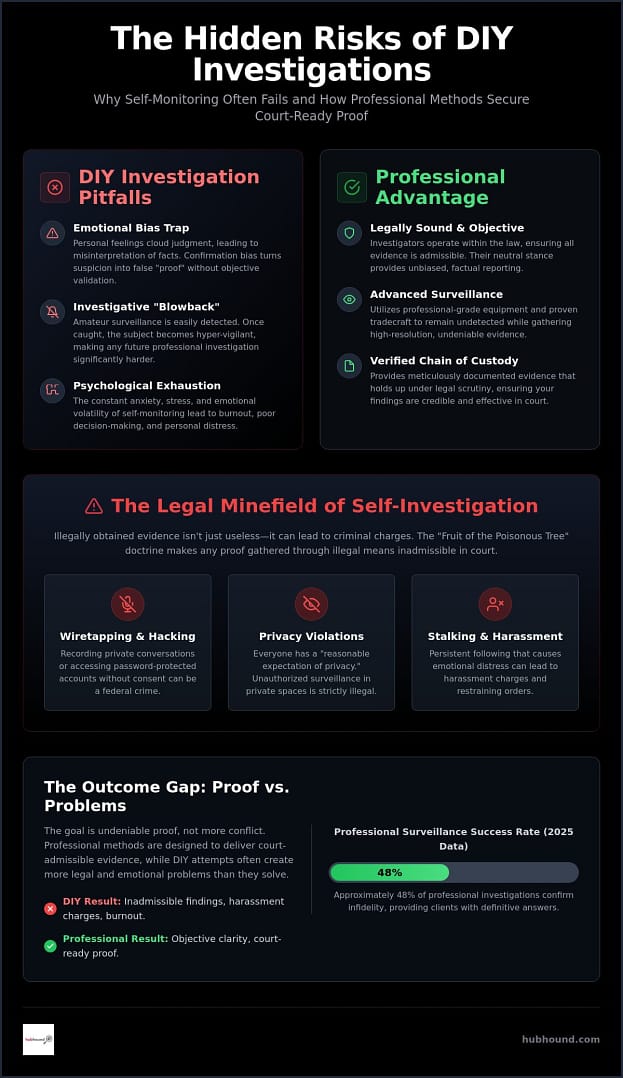
Data from 2025 indicates that while professional surveillance confirms infidelity in approximately 48% of cases, amateur attempts frequently fail due to a lack of technical precision and legal knowledge. You deserve undeniable proof without the risk of legal blowback or unnecessary anxiety. This guide examines the critical risks of self-monitoring and explains how professional investigators maintain a clear chain of custody to ensure your findings hold up under rigorous legal assessment.
Key Takeaways
- Recognize how emotional bias compromises evidence objectivity and clarity.
- Understand the legal limitations of DIY infidelity investigations to avoid inadmissible findings or harassment charges.
- Assess the physical safety risks and psychological exhaustion associated with self-monitoring.
- Compare the effectiveness of consumer-grade tracking apps against professional-grade surveillance optics.
- Secure court-ready results through professional documentation and a verified chain of custody.
The Hidden Risks of DIY Infidelity Investigations
A DIY infidelity investigation is defined as the attempt by an untrained individual to gather proof of a partner’s cheating without professional oversight. While the motivation to seek the truth is understandable, the execution often creates more problems than it solves. One of the primary limitations of DIY infidelity investigations is the absolute absence of objective distance. When you’re emotionally invested in the outcome, you lose the ability to view facts clearly and impartially.
You’re essentially falling into the “Emotional Bias Trap.” This occurs when personal feelings cloud objective evidence collection. You might see a late-night text as definitive proof of an affair when it’s actually a mundane work notification. This lack of objectivity makes your findings virtually useless in a professional or legal setting. Without a neutral perspective, you risk making accusations that damage your relationship further without having the facts to back them up.
Amateur attempts frequently lead to investigative “blowback.” This happens when your partner notices they’re being watched. They don’t just stop their behavior; they become hyper-vigilant. They change passwords, use burner phones, or alter their daily routes. This makes it significantly harder for a professional to step in later. One of the most significant limitations of DIY infidelity investigations is that you usually only get one chance to catch a suspect off guard before they move their activities further underground.
Why Suspicion Does Not Equal Evidence
Suspicion is a feeling, but evidence is a verifiable fact. DIYers often jump to conclusions based on incomplete or circumstantial data. You might find a restaurant receipt and assume it was for a romantic date, but that isn’t proof of infidelity. Confirmation bias in domestic investigations is the psychological tendency to interpret new information as verification of one’s existing suspicions while ignoring any contradictory facts. Professionals avoid this by focusing on building a documented timeline that can withstand a legal challenge rather than chasing emotional hunches.
The High Probability of Getting Caught
Amateurs lack the tradecraft required for successful surveillance. Common mistakes include following too closely in traffic, using a recognizable vehicle, or checking a spouse’s phone while they sleep. These actions “burn” the investigation. When you get caught, the relationship often ends abruptly without the closure of undeniable proof. Comparing Professional Surveillance vs. DIY methods reveals that experts use specialized equipment and tactical positioning to remain undetected. They gather high-resolution evidence that remains admissible in court, ensuring your efforts lead to a resolution rather than a confrontation.
Legal Limitations and the Danger of Inadmissible Evidence
Many individuals believe that a marriage license grants them total access to their partner’s private life. This is a dangerous legal misconception. The justice system protects a “reasonable expectation of privacy” even within a domestic partnership. One of the most severe limitations of DIY infidelity investigations is the high risk of violating federal and state privacy laws. If you gather evidence through illegal means, you face more than just a failed investigation; you face potential criminal prosecution.
A central concept in legal proceedings is the “Fruit of the Poisonous Tree” doctrine. This rule dictates that any evidence obtained through illegal search or seizure is inadmissible in court. If you trespass on private property or hack into a password-protected device to find proof of an affair, a judge will likely exclude those findings from your case. This effectively renders your weeks of self-monitoring useless during divorce or custody hearings. To ensure your evidence is gathered within the bounds of the law, it is often safer to rely on professional Surveillance Operations that utilize legal tradecraft.
Wiretapping and Privacy Statutes
Recording private conversations without consent is a violation of wiretapping laws in many jurisdictions. Accessing a partner’s password-protected social media or email accounts without authorization can lead to felony charges under the Computer Fraud and Abuse Act. DIYers often use consumer-grade spyware or hidden microphones, unaware that these tools can trigger federal investigations. Privacy expectations are highest in “private zones” like bathrooms, bedrooms, or personal vehicles, where unauthorized recording is strictly prohibited.
Stalking and Harassment Charges
The line between “following” a spouse and criminal stalking is thinner than most people realize. Persistent surveillance can be legally classified as harassment if it causes the subject emotional distress or a fear for their safety. If your partner discovers your DIY efforts, they may file for a restraining order. This creates a permanent legal record that can be devastating during child custody battles. Judges often view amateur surveillance as a sign of instability or obsession, which can negatively influence their decisions regarding parental fitness and asset division. Understanding the limitations of DIY infidelity investigations is the only way to protect your future standing in a court of law.
Physical Safety and the High Cost of Emotional Volatility
Investigating a spouse personally removes a critical safety barrier known as the “Investigative Buffer.” When you’re the one behind the camera, you’re susceptible to intense emotional spikes that a professional investigator simply doesn’t experience. One of the most overlooked limitations of DIY infidelity investigations is the high probability of a physical altercation. If you track a partner to a location and witness betrayal firsthand, your biological “fight or flight” response takes over. This often leads to spontaneous confrontations that can escalate into violence or result in immediate police intervention.
Adrenaline overrides logic during these high-stress moments. You might feel compelled to “crash” a meeting or event based on amateur GPS tracking, but these actions often lead to charges of trespassing or disorderly conduct. You risk being labeled the aggressor in a domestic dispute, even if you’re the victim of betrayal. Utilizing professional Surveillance Operations provides a necessary distance. Experts document facts from a safe, legal range, ensuring you receive the truth without the risk of a permanent criminal record or physical harm.
The Risk of Volatile Confrontations
Discovering infidelity in real-time creates a volatile environment for you, your partner, and any third party involved. Confrontations in public spaces often lead to embarrassing scenes that can be recorded by bystanders, further damaging your reputation. Protecting yourself from accusations of assault or domestic violence is difficult when you’ve intentionally followed someone to a private location. A professional third party acts as a witness to the facts rather than a participant in the drama, keeping the focus on evidence rather than conflict.
The Psychological Impact of Self-Investigation
The psychological toll of 24/7 self-monitoring is immense. You stop living your own life and start “living the investigation.” This constant state of hyper-vigilance leads to chronic sleep deprivation and severely impaired judgment. You might begin seeing patterns where none exist, further fueling a cycle of trauma and anxiety. Maintaining a normal routine is impossible when you’re obsessively checking location pips or social media timestamps. Relying on an expert allows you to preserve your mental health during an already difficult period. Emotional distance is essential for clear decision-making; without it, you’re likely to make impulsive choices that jeopardize your long-term legal and personal goals. Understanding the limitations of DIY infidelity investigations means recognizing when your own mental well-being is at stake.
Professional Surveillance vs. DIY: A Strategic Comparison
The gap between amateur efforts and professional tradecraft is wide. While a smartphone might seem like a sufficient tool, it’s often the first point of failure in a domestic investigation. One of the core limitations of DIY infidelity investigations is the reliance on consumer-grade technology that lacks the stabilization and low-light capabilities required for discreet surveillance. Professional investigators leverage specialized optics and 4K resolution cameras designed for high-resolution capture from extreme distances. This ensures that the subject remains unaware of the observation while every movement is documented with clarity.
Consider the reporting process. An amateur usually keeps a frantic journal of emotional notes and fuzzy screenshots. These documents rarely meet the rigorous standards of a courtroom. In contrast, a licensed firm provides structured investigative reports that follow a strict chain of custody. This transition from emotional recording to objective documentation is what separates a failed personal mission from a successful legal strategy. You might think you’re saving money by doing it yourself, but the cost of legal fees to fight a harassment charge or the loss of a favorable divorce settlement far outweighs the initial investment in professional help.
Technology and Tradecraft
Smartphones fail in low light and lack the optical zoom necessary to remain at a safe distance. Professionals utilize GPS tracking technology and long-range optics that capture identifiable features from hundreds of yards away. They also employ “blending” techniques, using varied vehicles and attire to match the environment. Furthermore, experts have access to restricted databases and skip tracing tools that allow them to identify “third parties” and verify addresses that aren’t available to the general public. Learn how professional surveillance techniques deliver results by combining these advanced tools with decades of field experience.
Admissibility and Expert Witness Status
A licensed investigator’s report carries significant weight in family court because they’re considered a neutral third party. When you present your own evidence, it’s often viewed as biased or potentially tampered with. A PI can testify as an expert witness, providing an objective account of the facts that a judge is more likely to accept. These technical limitations of DIY infidelity investigations often result in the total exclusion of amateur evidence during critical hearings. To protect your interests, it’s vital to secure a professional partner for your Infidelity Investigations before the situation escalates. Expert testimony provides the finality and authority that personal accusations simply cannot achieve.
Securing Resolution with Professional Infidelity Investigations
The pivot from personal suspicion to professional fact-finding is a strategic move. It replaces the inherent limitations of DIY infidelity investigations with a structured, legally sound methodology. A professional firm operates with a level of discretion that individuals simply cannot maintain. They guarantee confidentiality, ensuring that your privacy and the integrity of the investigation remain intact from start to finish. This professional distance prevents the emotional volatility that often ruins amateur attempts.
When you hire experts for Infidelity Investigations, you receive a comprehensive package of deliverables. These typically include high-definition surveillance footage, time-stamped activity logs, and a finalized investigative report. This documentation isn’t just for your personal closure; it’s a professional asset that serves as an objective record of events. Having the truth backed by verifiable facts provides a level of peace of mind that amateur tracking can never offer. It removes the “he said, she said” dynamic and replaces it with undeniable proof.
What to Look for in a Professional Firm
Verify that the agency holds valid licensing and comprehensive insurance. These credentials are non-negotiable for ensuring the evidence gathered is admissible in a legal setting. It’s also vital to consult with a professional investigative agency through secure channels. Use a private device and a non-shared email address to schedule your initial meeting. This prevents the suspect from becoming hyper-vigilant and protects the “element of surprise” necessary for successful surveillance operations.
Moving Forward with Clarity
Investigative results empower you to make informed decisions about your future. Whether you’re considering reconciliation or moving toward a divorce, having the full picture is essential. These findings play a critical role in protecting your assets and parental rights during litigation. They provide your legal counsel with the leverage needed to negotiate from a position of strength. By acknowledging the limitations of DIY infidelity investigations and choosing a professional path, you secure a resolution that is both ethical and effective. Contact HubHound for a discreet evaluation of your situation to begin your journey toward clarity.
Secure Your Future with Evidence-Based Clarity
The risks associated with self-monitoring are far too significant to ignore. While the urge to find answers personally is understandable, the limitations of DIY infidelity investigations often lead to inadmissible evidence and legal complications that can haunt you for years. Choosing a professional path ensures that your discovery process remains ethical, legal, and focused on your long-term stability. You deserve a solution that protects your assets and parental rights rather than jeopardizing them through amateur mistakes.
HubHound provides the expertise needed to navigate these high-stakes situations. Our team consists of licensed investigators with over three decades of industry experience. We conduct discreet surveillance operations designed to gather court-ready evidence while strictly adhering to complex privacy and surveillance laws. You don’t have to manage this emotional weight on your own. Protect your legal rights and get the truth with HubHound. Taking the first step toward professional assistance is the most effective way to regain control and move forward with confidence.
Frequently Asked Questions
Is it illegal to put a GPS tracker on my spouse’s car?
Placing a GPS tracker on a vehicle without the owner’s consent is illegal in many jurisdictions and can lead to criminal stalking charges. Even if you share ownership of the vehicle, using tracking technology to monitor a spouse’s movements often violates reasonable privacy expectations. This is one of the major legal limitations of DIY infidelity investigations that can result in criminal prosecution or the issuance of a restraining order.
Can I use a recording device to catch my partner cheating?
Recording private conversations without the consent of at least one party is a violation of federal and state wiretapping laws. You cannot legally hide a recording device in a bedroom, bathroom, or a personal vehicle to capture audio. Evidence obtained through these methods is inadmissible in court and exposes you to potential felony charges under privacy statutes.
Will evidence I found myself be useful in a divorce court?
Evidence you gather yourself is rarely useful in a divorce court because it lacks a verified chain of custody and often violates privacy laws. Judges frequently exclude amateur recordings, hacked digital data, or illegally obtained photos under the “fruit of the poisonous tree” doctrine. Professional documentation is required to ensure that findings are considered credible and objective during legal proceedings.
How much does a professional infidelity investigation cost compared to DIY?
While DIY attempts appear to have no upfront cost, they often become more expensive due to legal fees from harassment charges or lost assets in a divorce settlement. Professional investigations involve billable hours for expert surveillance and structured reporting. This investment provides court-ready results that protect your financial interests, whereas amateur failures can be devastatingly expensive in a legal context.
What happens if I get caught following my partner?
Getting caught following your partner often leads to immediate harassment or stalking charges. It also alerts the suspect, causing them to hide their activities more effectively or change their communication habits. This investigative “blowback” makes it significantly harder for a professional to step in later and gather the proof you need to resolve the situation.
Can a private investigator access my partner’s text messages legally?
No, a private investigator cannot legally hack into a phone or access private text messages without a court order or the owner’s consent. Accessing password-protected accounts without authorization violates the Computer Fraud and Abuse Act. Professionals rely on legal surveillance, public record searches, and witness interviews to build their cases instead of illegal digital intrusion.
What is the difference between a licensed investigator and a private citizen doing surveillance?
Licensed investigators have the legal authority to conduct surveillance and are trained to operate within strict privacy boundaries. Private citizens lack the insurance, specialized equipment, and expert witness status necessary for court-ready results. A professional’s report is viewed as neutral third-party testimony, while a citizen’s findings are often dismissed as biased or illegally obtained.
How long does a professional infidelity investigation usually take?
A professional infidelity investigation typically takes between several days and a few weeks to establish a clear pattern of behavior. The duration depends on the subject’s schedule and the frequency of their suspicious activities. Most agencies recommend multiple surveillance sessions to ensure the evidence gathered is comprehensive and provides a definitive resolution for the client.

Article by
Joel R. Manley | President | Hubhound Investigations | OR PI-ID#: 90432 | 111 SW Fifth Avenue, Suite 3150 Portland, Oregon 97204 | 971-442-8170
Joel is licensed as a private investigator in Oregon and Tennessee. Joel started his career in 1987 serving as a Military Police Officer and Military Police Investigator.
After ending his military tour of duty, Joel became a civilian Police Officer and Deputy Sheriff. Joel took his strong background in Hostage Negotiations, Mediation and Conflict Resolution, with him to patrol some of the highest crime areas in SE Portland.
Joel was awarded Deputy of the Year for his efforts and for drastically reducing the crime rate in the area he patrolled. As a Deputy Sheriff, Joel assisted in leading a Neighborhood Livability Program that was nationally recognized for having the most innovative and progressive approach to policing.
In 2018, Joel retired as a Deputy Sheriff and founded Hubhound Investigations. Joel played an integral role in Hubhound Investigations receiving an A+ Accredited Business rating from the Better Business Bureau (BBB).
In his off time, Joel enjoys spending time with his wife, adult children and Hubhound’s Happiness Ambassador, Nya. Joel also enjoys Scuba Diving and Kayaking.
Disclaimer
DISCLAIMER: This article is provided for general informational and educational purposes only. It is not intended to constitute legal advice, professional investigative advice, or instruction to engage in any unlawful activity. Laws governing private investigations, surveillance, recording, tracking, access to information, evidence collection, privacy, trespass, licensing, and related investigative activities vary by jurisdiction and are subject to change.
Any investigative techniques, tactics, procedures, scenarios, or legal proceedings discussed in this article are presented for informational purposes and should not be interpreted as authorization or encouragement to use a particular method. Private investigators and members of the public are responsible for understanding and complying with all applicable federal, state, and local laws, licensing requirements, court rules, and professional standards.
The circumstances of every investigation and legal matter are different. Information contained in this article should not be relied upon as a substitute for advice from a qualified attorney or other appropriate licensed professional regarding a specific situation. No attorney-client, investigator-client, or other professional relationship is created by reading or using this information.