
What if the most significant threat to your startup’s survival isn’t a competitor or a market shift, but the person sitting at the next desk? Organizations now face an average annual cost of $19.5 million related to insider risks, a figure that has climbed significantly as technical roles become more complex. For a small team, a single bad hire isn’t just a budget line item; it’s a direct threat to your entire code base. Effective screening for tech startup employees is no longer a simple HR task; it’s a critical component of corporate due diligence.
You likely already know that a traditional resume review doesn’t reveal a candidate’s history of workplace misconduct or their actual ability to handle root access. You need a reliable framework to verify high-level technical experience without falling victim to AI-generated credentials or remote hiring fraud. This guide provides a comprehensive, investigative-grade checklist designed to help you mitigate risk and protect your innovation. We will examine the mandatory federal standards for 2026, the specific steps for vetting executive talent, and how to integrate zero-trust principles into your hiring workflow.
Key Takeaways
- Recognize why startups are high-value targets for IP theft and how it’s possible for a bad hire to cost over 200% of an annual salary.
- Establish a rigorous baseline for identity and criminal history verification that exceeds standard automated software results.
- Implement specialized screening for tech startup employees Portland to verify high-level technical experience and past workplace conduct.
- Use investigator-led witness interviews to identify non-compete conflicts and verify credentials that automated tools often miss.
- Adopt a tiered screening framework that adjusts depth based on the sensitivity of the role and level of system access.
The High Stakes of Tech Startup Hiring in 2026
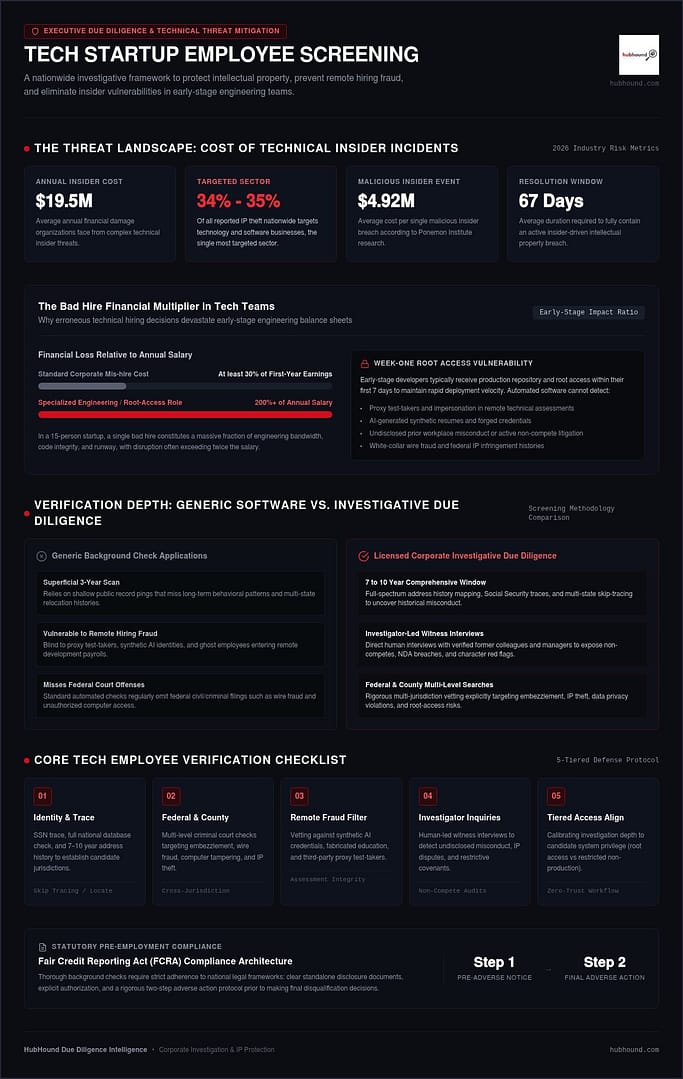
Technology and software businesses currently account for 34% to 35% of all reported intellectual property theft incidents. This makes startups the single most targeted industry sector nationwide. While a large enterprise can survive a localized data leak, a 15-person startup faces a devastating multiplier effect. A single bad hire represents a massive fraction of your engineering capacity and payroll budget. It’s not just about the immediate salary loss. Erroneous hiring decisions cost at least 30% of first-year earnings, but for specialized roles, the disruption often reaches 200%. Effective screening for tech startup employees requires shifting from a compliance mindset to one of active defense.
The Vulnerability of Early-Stage Teams
Early-stage engineers frequently receive root access to sensitive code repositories and production environments within their first week. This level of privilege is necessary for rapid development, but it creates an immense security vacuum. Ponemon Institute research indicates that malicious insiders cost organizations an average of $4.92 million per incident. It takes an average of 67 days to contain an insider-driven IP incident. Investigative due diligence acts as a critical defense mechanism. It identifies behavioral risks before a bad actor can compromise your entire codebase or jeopardize future venture capital funding rounds.
Moving Beyond Automated HR Software
Generic background check apps often provide a false sense of security. These tools rely on automated pings that miss nuanced red flags like undisclosed disciplinary actions or AI-generated credentials. A standard pre-employment background screening process might verify a degree, but it won’t uncover the “proxy test-taker” fraud currently surging in remote technical assessments. Human-led investigation is essential for critical hires. It involves a selective filtering process that identifies high-quality resources while respecting the professional’s time.
Relying on a specialized Corporate Investigation Firm ensures that your vetting process is as sophisticated as the software you build. Automated filters can’t replace the rigorous validation provided by licensed investigators with decades of experience. By prioritizing professional screening for tech startup employees, you protect your company’s long-term assets and ensure that your innovation remains yours alone.
Core Identity and Criminal History Verification Checklist
Establishing a baseline for every candidate begins with a rigorous identity verification process. You can’t rely on a resume alone when remote hiring fraud and AI-generated personas are on the rise. Effective screening for tech startup employees starts with a Social Security number trace and a comprehensive address history. This data doesn’t just confirm who they are; it identifies the specific jurisdictions where you need to search for criminal records. A professional approach ensures you aren’t missing gaps in a candidate’s timeline where misconduct might have occurred.
Establishing a Verified Identity
Discrepancies in address history or identity often require advanced techniques to resolve. If an applicant’s records don’t align, professional investigators use skip tracing / locate investigations to uncover the individual’s true history. It’s essential to validate right-to-work status through national databases and look back at least seven to ten years. This window is critical for identifying long-term patterns of behavior that a standard three-year check might miss. Rigorous identity validation prevents ghost employees from entering your payroll and protects your internal systems from unauthorized access.
Navigating Criminal Records Nationally
Criminal searches must span multiple levels to be effective. A national criminal database search is a good starting point, but it’s not exhaustive. You must conduct searches at the county and federal levels to find specific white-collar offenses like embezzlement, wire fraud, or intellectual property theft. These offenses are often filed in federal court and won’t appear in a standard county-level search. Look for red flags that indicate a risk to your technical environment, such as unauthorized computer access or data privacy violations. Identifying these patterns early is the most effective way to prevent future insider threats.
Compliance is just as important as the search itself. The Fair Credit Reporting Act (FCRA) sets strict standards for how you use this information. For example, you must provide a standalone disclosure and follow a two-step adverse action process if you decide not to hire based on the report. Many jurisdictions now enforce fair-chance hiring frameworks that prohibit employers from asking about criminal history on initial applications. These nationwide regulations require a partner who understands how to maintain compliance while delivering high-quality data. By following a structured pre-employment background check protocol, you protect your company from both bad actors and expensive litigation.
Protecting Intellectual Property through Rigorous Due Diligence
Intellectual property is the lifeblood of any technology venture, yet standard background checks frequently ignore the specific risks associated with trade secret theft and code contamination. When you perform screening for tech startup employees Portland, you must look beyond criminal records to identify potential legal entanglements. A candidate who brings proprietary code from a former employer doesn’t just create a technical headache; they create a liability that can bankrupt a young company. You need a process that analyzes the candidate’s professional history for non-compete agreements and IP conflicts that could jeopardize your patent filings or future acquisitions.
Rigorous due diligence involves analyzing public records for civil litigation involving past employers. If a candidate has a history of being sued for breach of contract or trade secret misappropriation, that’s a critical red flag. Professional investigators go a step further by conducting witness interviews with past supervisors. These conversations often reveal integrity issues that automated systems miss, such as a pattern of taking proprietary tools to new roles. Safeguarding your assets requires an active defense that treats every high-level hire as a significant corporate transaction.
Employment and Credential Verification
Resume inflation is a pervasive issue in the tech sector, where candidates often exaggerate their role in successful projects or claim unearned certifications. You should confirm degrees and technical certifications directly with the issuing institutions to ensure the candidate possesses the skills they claim. Verifying exact job titles and dates of employment is vital to detecting gaps hidden by creative resume formatting. By applying a high level of investigative rigor to the verification process, you ensure that your team is built on a foundation of genuine expertise rather than fabricated credentials.
Assessing Corporate Conflict of Interest
Undisclosed business affiliations present a unique threat to startup resources. A developer who owns a side entity in the same niche creates an immediate conflict of interest and a high risk of “moonlighting” that drains your company’s time and innovation. Specialized investigative techniques can uncover these hidden affiliations by searching corporate filings and domain registrations. These steps align with best practices found in CISA’s Insider Threat Mitigation Guide, which emphasizes the need for behavioral risk indicators during the vetting process. Ensuring that a new hire’s professional interests are fully aligned with your startup’s goals is essential for long-term organizational integrity.
Using a professional Corporate Due Diligence service allows you to identify these complexities before they become legal crises. It’s a proactive step that moves your hiring process from simple compliance to a strategic defense of your most valuable innovations.
Behavioral Assessment and Workplace Integrity Screening
Technical proficiency is only one part of a successful hire. A single toxic individual can dismantle a startup’s culture and drive away top talent faster than a market downturn. This is why screening for tech startup employees Portland must include a deep dive into behavioral history and workplace integrity. You aren’t just looking for a coder; you’re looking for a reliable partner who won’t compromise your team’s cohesion or reputation. Identifying these patterns early is the only way to maintain a high-performance environment.
Uncovering Hidden Misconduct
Standard HR software has a significant blind spot: it only sees what has been officially reported to a database. It misses the nuances of past workplace misconduct investigations or internal disciplinary actions that were settled quietly. Professional investigators bridge this gap by conducting discreet, third-party inquiries that uncover the truth about a candidate’s past behavior. This neutral approach provides an objective layer of protection that automated pings cannot replicate. For founders, this level of due diligence is essential to prevent bringing a known liability into a small, agile environment. Review our Workplace Investigations guide to understand how to handle these findings with organizational integrity.
Digital footprints also offer a window into a candidate’s professional conduct. Evaluating public social media profiles and forum activity helps identify reputational risks before they become your company’s problem. Look for patterns of unprofessionalism or a lack of discretion regarding proprietary information. A candidate who shares sensitive details about a previous employer’s projects is likely to do the same to yours. Professional reference checks should be handled as interviews with past supervisors to gauge integrity rather than just confirming dates of employment.
The Role of Professional Surveillance
High-stakes executive hires often require a level of vetting that goes beyond interviews and public records. In these specialized cases, discreet surveillance operations can provide critical data about a candidate’s associations and lifestyle choices that might conflict with your startup’s interests. This isn’t about intrusion; it’s about verifying the high-level integrity required for roles with significant financial or operational control. It’s a selective filtering process that identifies risks before they manifest as corporate crises. It’s important to note that our focus remains strictly on providing investigative data and intelligence. We don’t offer personal bodyguard services, as our expertise lies in the rigorous assessment of facts and behavioral patterns.
Implementing a Scalable Screening Strategy
Growth phases require a screening strategy that expands alongside your engineering capacity without sacrificing the depth of your due diligence. A one-size-fits-all approach fails because different roles carry different levels of risk. You must establish a tiered screening framework that allocates resources based on seniority and system access. While a basic check is sufficient for entry-level roles, executive talent and core developers require a deep dive to protect your codebase and intellectual property. Integrating these protocols directly into your onboarding workflow ensures security checks are completed before system privileges are granted.
Regularly auditing your screening protocols is necessary to maintain compliance with shifting national standards. Federal regulations under the FCRA change, and using outdated disclosure forms creates immediate statutory liability. A proactive stance on corporate security means reviewing your vetting process every twelve months to ensure alignment with current legal safe harbors. This systematic approach ensures that screening for tech startup employees Portland or across distributed national teams remains both legally defensible and operationally efficient.
Building a Trusted Partner Network
Partnering with a professional investigative agency allows founders to delegate complex checks to experienced specialists. You should evaluate service partners based on their real-world investigative experience rather than their software interface. Automated tools frequently miss cross-jurisdictional red flags that a human investigator will uncover through direct courthouse searches. Taking a proactive stance on corporate security ensures that your hiring process remains a barrier against insider threats. To secure your high-stakes hires with investigator-led due diligence, visit HubHound for professional screening support.
Maintaining Efficiency in High-Growth Phases
Startups often face intense pressure to issue rapid job offers to top technical talent. You must balance this need for speed with the necessity of thoroughness to avoid the high cost of an erroneous hiring decision. Utilizing scannable, segmented workflows helps your leadership team make quick, informed decisions without bypassing critical verification steps. This structured curation of candidate data ensures that you don’t compromise your standards during rapid hiring surges. By relying on expert guidance, you streamline the discovery of top-tier talent while maintaining a secure organization.
Securing the Future of Your Technical Innovation
Building a resilient engineering team requires moving beyond simple database checks to a model of investigator-led due diligence. By implementing a tiered strategy that prioritizes behavioral integrity and intellectual property protection, you safeguard your innovation from the human element of risk. The high stakes of the current landscape demand that you verify every technical credential and investigate every potential conflict of interest before granting system access. It’s about ensuring that your most valuable assets remain protected during rapid growth phases.
Whether you’re refining your screening for tech startup employees Portland or scaling a distributed workforce across the country, professional oversight is your best defense. HubHound provides the specialized expertise needed to navigate complex national regulations and uncover hidden risks. We bring over 30 years of investigative experience to every case. Our licensed professional investigators offer nationwide service coverage that automated HR software simply can’t match.
Take the guesswork out of your hiring process and focus on building the next generation of technology with confidence.
Frequently Asked Questions
Why is standard HR software insufficient for tech startup screening?
Standard HR software relies on automated database pings that often overlook non-public records or settled disputes. It lacks the human intuition required to detect AI-generated credentials or sophisticated persona fraud. HubHound provides an investigator-led alternative that uncovers these nuances through direct courthouse searches and witness interviews. This approach ensures your screening for tech startup employees Portland or anywhere else in the country identifies risks that algorithms simply can’t process.
What are the most common red flags when screening remote engineers?
Red flags include inconsistent employment dates that suggest resume inflation and address histories that don’t align with technical project timelines. Watch for candidates who provide proxy test-takers for coding assessments or use deepfake personas during video interviews. Undisclosed business affiliations are another significant risk, as they often lead to moonlighting or intellectual property contamination. Professional investigators verify these details to ensure the hire aligns with your startup’s organizational integrity.
How long does a professional investigative background check typically take?
A comprehensive professional check generally takes between one and five business days to complete. While instant database results are available within an hour, manual county courthouse searches typically require one to seven business days depending on local access methods. Employment and degree verifications usually take three to five business days. HubHound prioritizes accuracy over raw speed, ensuring that high-stakes technical hires are vetted thoroughly without causing excessive delays in your onboarding timeline.
Can a startup legally check for past workplace misconduct?
Startups can legally investigate past misconduct provided they adhere to the Fair Credit Reporting Act and local fair-chance hiring laws. You should utilize professional workplace misconduct investigations to uncover disciplinary actions that aren’t part of public criminal records. These inquiries must be handled discreetly to maintain legal compliance. It’s essential to follow the mandatory federal two-step adverse action process if any findings lead to a decision not to hire the candidate.
What is the difference between a basic background check and corporate due diligence?
A basic check establishes a baseline by searching national criminal databases and sex offender registries. Corporate due diligence is a much deeper investigative process that verifies business entities, analyzes civil litigation history, and uncovers potential intellectual property conflicts. It involves witness interviews and statements from past supervisors to gauge a candidate’s integrity. For technical roles with root access, due diligence is the necessary standard for protecting your company’s long-term assets.
How does screening help protect a startup’s intellectual property?
Screening protects intellectual property by identifying candidates with active non-compete agreements or a history of trade secret litigation. Professional investigators analyze public records for civil suits involving past employers to detect behavioral patterns related to data theft. This process helps prevent code contamination, where a new hire inadvertently introduces proprietary tools from a former company. Rigorous screening for tech startup employees Portland ensures your patent filings and trade secrets remain legally secure.
What should a startup do if a background check reveals a discrepancy?
If a discrepancy appears, you must follow the federal two-step adverse action requirements. First, send a Pre-Adverse Action Notice along with a copy of the background report and the CFPB Summary of Rights. You must then provide a reasonable waiting period, typically five business days, to allow the candidate to dispute inaccurate records. If the disqualification stands after this period, you may issue a formal Adverse Action Notice to finalize the decision legally.
Are there specific national regulations for screening remote employees?
Screening remote employees requires compliance with the FCRA and the nationwide patchwork of Ban-the-Box regulations, which currently cover 37 states. You must use the updated model form for the Summary of Your Rights published by the CFPB. Employers are also strictly liable for any disparate impact caused by AI screening software under EEOC guidance. A national investigative agency like HubHound ensures your screening protocols meet these evolving standards across all jurisdictions where your team operates.

Article by
Joel R. Manley | President | Hubhound Investigations | OR PI-ID#: 90432 | 111 SW Fifth Avenue, Suite 3150 Portland, Oregon 97204 | 971-442-8170
Joel is licensed as a private investigator in Oregon and Tennessee. Joel started his career in 1987 serving as a Military Police Officer and Military Police Investigator.
After ending his military tour of duty, Joel became a civilian Police Officer and Deputy Sheriff. Joel took his strong background in Hostage Negotiations, Mediation and Conflict Resolution, with him to patrol some of the highest crime areas in SE Portland.
Joel was awarded Deputy of the Year for his efforts and for drastically reducing the crime rate in the area he patrolled. As a Deputy Sheriff, Joel assisted in leading a Neighborhood Livability Program that was nationally recognized for having the most innovative and progressive approach to policing.
In 2018, Joel retired as a Deputy Sheriff and founded Hubhound Investigations. Joel played an integral role in Hubhound Investigations receiving an A+ Accredited Business rating from the Better Business Bureau (BBB).
In his off time, Joel enjoys spending time with his wife, adult children and Hubhound’s Happiness Ambassador, Nya. Joel also enjoys Scuba Diving and Kayaking.
Disclaimer
DISCLAIMER: This article is provided for general informational and educational purposes only. It is not intended to constitute legal advice, professional investigative advice, or instruction to engage in any unlawful activity. Laws governing private investigations, surveillance, recording, tracking, access to information, evidence collection, privacy, trespass, licensing, and related investigative activities vary by jurisdiction and are subject to change.
Any investigative techniques, tactics, procedures, scenarios, or legal proceedings discussed in this article are presented for informational purposes and should not be interpreted as authorization or encouragement to use a particular method. Private investigators and members of the public are responsible for understanding and complying with all applicable federal, state, and local laws, licensing requirements, court rules, and professional standards.
The circumstances of every investigation and legal matter are different. Information contained in this article should not be relied upon as a substitute for advice from a qualified attorney or other appropriate licensed professional regarding a specific situation. No attorney-client, investigator-client, or other professional relationship is created by reading or using this information.