
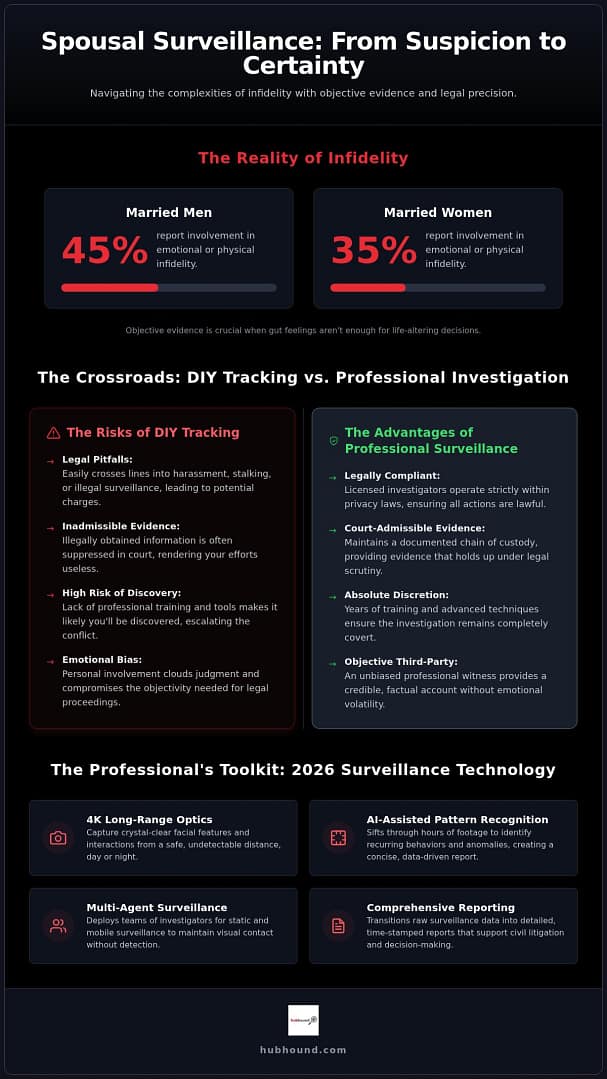
Nearly 45% of married men and 35% of married women report involvement in emotional or physical infidelity. If you suspect your partner is being unfaithful, the emotional distress is often compounded by a fear of being discovered while trying to find the truth yourself. You need more than just a gut feeling to make informed decisions about your future. Professional spousal surveillance services provide a strategic path to clarity by replacing doubt with objective, undeniable evidence. These investigations are designed to operate within strict legal boundaries, ensuring that any findings remain admissible in court.
You deserve peace of mind and a clear understanding of your legal standing. This guide details how specialized agencies utilize 2026 technology, such as AI-assisted pattern recognition, to document activity with absolute discretion. You’ll learn how to secure a detailed report for your legal counsel and navigate the complexities of modern privacy laws. We’ll walk you through the process of obtaining high-quality video and photo evidence, giving you the tools to move forward with quiet confidence and factual certainty.
Key Takeaways
- Differentiate between emotional suspicion and court-admissible evidence to ensure your findings hold up during legal proceedings.
- Leverage 2026 surveillance technology, including high-definition optics and AI-assisted pattern recognition, for discreet and effective documentation.
- Avoid the legal pitfalls of DIY tracking, such as harassment charges or evidence suppression, by utilizing professional spousal surveillance services.
- Verify agency credentials and domestic expertise through national databases to ensure your investigation is handled by licensed professionals.
- Learn how to transition raw surveillance data into comprehensive reports that support civil litigation and future decision-making.
Understanding the Scope of Professional Spousal Surveillance Services
Professional spousal surveillance services involve the discreet observation of a partner to document their interactions and movements. It’s a tactical shift from personal suspicion to the collection of objective, undeniable proof. While emotional distress often drives the initial inquiry, the primary goal is to secure evidence that survives legal scrutiny. Unlike informal digital tracking, which often relies on unauthorized access to private data, professional surveillance focuses on observable behavior in public environments.
A private investigator serves as an essential third-party witness. Their involvement removes the emotional volatility associated with a spouse conducting their own investigation. This objectivity is vital. If a case moves toward civil litigation, a detailed report from a licensed professional carries significantly more weight than a spouse’s personal account or unverified digital screenshots.
When to Consider Professional Intervention
Identifying behavioral shifts is usually the first step in the discovery process. Intuition often signals that something is wrong before physical proof exists. You might notice unexplained financial withdrawals, sudden changes in work schedules, or an increased need for digital privacy. Once these red flags become consistent, it’s time to move from emotional discovery to strategic documentation. Professional intervention ensures that you don’t compromise your legal standing by attempting to gather evidence through illegal means.
The Legal Framework of Modern Surveillance
Modern surveillance operates within a complex web of privacy laws. In most jurisdictions, individuals have a reduced expectation of privacy when they are in public spaces. Licensed investigators are trained to operate within these boundaries, capturing video and photo evidence that is legally obtained. This is a critical distinction. Civilians often cross legal lines into stalking or harassment when attempting DIY surveillance.
Licensed professionals maintain the integrity of the evidence through a documented chain of custody. This ensures the material is admissible for legal counsel. By hiring a qualified agency, you ensure that the search for truth doesn’t result in legal repercussions for yourself. This professional oversight provides the clarity needed for future decision-making without the risks associated with amateur tracking.
Advanced Techniques Used in Modern Marital Investigations
Professional spousal surveillance services rely on a sophisticated combination of high-end hardware and tactical expertise. Agencies now utilize long-range optics with 4K resolution to capture clear facial features and interactions from significant distances. This ensures investigators remain undetected while securing high-fidelity daytime and nighttime imagery. High-quality gear for such precise observation is often sourced from specialized outdoor retailers like Vse za Lov in Prosti Čas, which provides professional-grade optical equipment. Beyond raw footage, modern investigators use AI-assisted pattern recognition to filter through hours of observation. This technology identifies recurring behaviors and anomalies, allowing the agency to deliver a concise, data-driven report rather than a mountain of irrelevant video.
Strategic planning determines whether to use static or mobile surveillance. Static observation is ideal for monitoring a specific location, such as a residence or workplace. Mobile surveillance is required for subjects with active lifestyles or those who frequently travel for business. Integrating GPS technology within legal parameters allows for efficient vehicle tracking, reducing the risk of losing a subject in heavy traffic. If you’re looking for a professional assessment of your situation, you can evaluate specialized investigative resources to find the right tactical fit for your needs.
Physical Surveillance and Covert Observation
Execution of a covert “tail” requires years of training to avoid detection across diverse environments. In high-traffic urban areas, agencies often deploy multiple investigators to maintain visual contact. This team-based approach prevents a single vehicle from becoming recognizable to the subject. Investigators focus on documenting third-party interactions, identifying unknown associates, and noting specific locations visited. This level of detail provides the context necessary to distinguish between routine business meetings and illicit interactions. Every movement is logged with time-stamped precision, creating a chronological narrative that is difficult to dispute in a legal setting.
Digital and Technical Evidence Gathering
Modern investigations extend beyond physical tails into the digital landscape. Social media forensics allow investigators to cross-reference physical sightings with online activity, often revealing hidden connections or planned meetings. Supplemental services, such as asset searches and financial discovery, help identify unexplained expenditures that may indicate an affair. By analyzing these data points, investigators can uncover hidden patterns that physical observation alone might miss. This hybrid approach ensures a comprehensive picture of the subject’s activities, providing undeniable proof for legal or personal use. Using these technical filters saves time and focuses the investigation on the most relevant activities.
The Risks of DIY Tracking vs. Professional Surveillance
Attempting to investigate a partner independently often leads to severe legal and tactical repercussions. While the urge to find immediate answers is understandable, amateur attempts frequently result in stalking or harassment charges. These legal complications can shift the focus from the partner’s actions to your own conduct. It’s a risk that can damage your standing in future civil proceedings and create unnecessary liability for yourself. Professional surveillance removes this risk by ensuring all activities are conducted within the bounds of the law.
Evidence gathered by a spouse is often subject to suppression in court. If video or audio is obtained through illegal means or lacks a verified chain of custody, it becomes inadmissible. High-quality spousal surveillance services mitigate this risk by following established legal protocols. A professional investigator acts as a neutral party, ensuring the data collection process remains objective and legally sound. This separation is vital for maintaining the integrity of the investigation.
There is also a high risk of “burning” the investigation. If a subject detects they are being followed or monitored, they immediately move their activities further underground. This makes it nearly impossible for a professional to gather evidence later. This loss of strategic opportunity can be permanent, leaving you with no clear path to the truth. Relying on an expert prevents these tactical errors and preserves the chance to gather undeniable proof.
Legal Pitfalls of Unlicensed Tracking
Unlicensed individuals often overlook complex regulations like federal wiretapping statutes. Recording private conversations without consent is a felony in many jurisdictions. Deploying GPS tracking devices without specific legal authorization can also lead to criminal penalties. The “fruit of the poisonous tree” doctrine means that any evidence derived from an initial illegal act is likely to be discarded by a judge. Professionals ensure all techniques comply with current 2026 privacy standards to protect the integrity of your case.
The Value of Professional Objectivity
An investigator provides a documented chain of custody for every piece of evidence. This meticulous record-keeping is essential for establishing the authenticity of photos or video during depositions. Unlike an emotionally involved spouse, a licensed investigator serves as a credible, third-party witness whose testimony carries weight in a trial. They provide a dispassionate account of the facts, which is far more persuasive to a judge or jury than hearsay from an aggrieved partner. This objectivity preserves your legal options and provides the clarity needed for long-term planning.
How to Evaluate an Investigative Agency for Domestic Cases
Selecting a partner for spousal surveillance services requires a rigorous filtering process. Start by verifying the agency’s professional licensing and insurance through relevant national databases. This isn’t just a formality. Licensed investigators must adhere to strict ethical and legal standards that protect the admissibility of your evidence. Uninsured agencies leave you vulnerable to liability if an accident occurs during the operation. Always request proof of current credentials before sharing sensitive information about your case.
Evaluate the agency’s specific experience with domestic investigations versus corporate surveillance. While the hardware is often similar, the tactics differ significantly. Domestic cases require a higher degree of emotional intelligence and a more nuanced approach to public observation. Ask for samples of their investigative reports to assess their level of detail. A high-quality report should be objective, chronological, and supported by time-stamped visual evidence. This documentation is what your legal counsel will use to build your case.
Understand the fee structure before signing a contract. Most reputable agencies operate on a retainer basis, drawing from that fund as they bill for hourly surveillance and equipment costs. Ensure you receive a transparent breakdown of how hours are logged and what constitutes a billable expense. This clarity prevents budget overruns and ensures the investigation remains focused on your desired outcomes. Use these evaluative steps to identify a service partner that values efficiency and transparency.
Essential Questions for Your Initial Consultation
Identify high-quality resources by asking direct questions about their operational success. Inquire about their success rate in documenting third-party interactions in various environments. Ask how they handle surveillance in high-security areas or gated communities without compromising their position. You also need to know the specific process for delivering evidence to your legal representative. A professional agency will have a streamlined protocol for transferring files securely while maintaining the chain of custody.
Red Flags in the Investigative Industry
Avoid agencies that promise “guaranteed” results. Surveillance is inherently unpredictable; a professional can only guarantee their effort and the quality of their documentation, not the subject’s behavior. Be wary of any provider offering “hacking” services or unauthorized access to private digital accounts. These activities are illegal and will result in evidence suppression or criminal charges against you. A lack of a clear, written contract or a confidentiality agreement is a major warning sign. Always demand a detailed breakdown of investigative hours to ensure you aren’t being overcharged for unproductive time.
Strategic Evidence Collection with HubHound
HubHound approaches domestic investigations as a tactical legal asset. By applying specialized surveillance techniques, we transform personal suspicions into verified data points. Our investigators utilize the same high-standard protocols found in corporate due diligence to ensure every piece of evidence is objective and indisputable. This professional rigor is what distinguishes our spousal surveillance services from amateur attempts. We don’t just watch; we document with the intent to support your legal interests in a court of law.
A comprehensive investigation often requires looking beyond physical activities. We integrate asset searches to identify hidden financial interests or unexplained expenditures. This dual-track approach provides a complete picture of marital conduct and financial transparency. If your case moves toward a courtroom, our team provides seamless civil litigation support to ensure your representation has the strongest possible foundation.
From Surveillance to Legal Resolution
High-quality investigative reports provide essential leverage during divorce or custody negotiations. When faced with undeniable video or photographic proof, opposing parties are often more inclined to settle favorably. Our documentation is designed to simplify the workload for your legal team by providing organized, time-stamped, and verified evidence. We stand behind our work. Our investigators are prepared to provide expert testimony to authenticate the findings and explain the methodology used during the operation. This level of accountability ensures that the truth remains the central focus of your legal strategy.
Taking the First Step Toward Clarity
Confidentiality is the cornerstone of our domestic inquiry process. We maintain strict privacy protocols from the moment of initial contact to ensure your investigation remains discreet. Every case is unique, so we customize our investigative plans to align with your specific goals and budgetary requirements. Whether you need a single afternoon of observation or a multi-week deep dive, we provide a clear roadmap for the discovery process. Stop living with uncertainty and start gathering the facts you need to make informed decisions about your future.
Securing Your Future with Factual Certainty
Moving past marital doubt requires a shift from emotional reaction to strategic observation. Professional spousal surveillance services offer more than just confirmation; they provide a foundation of court-admissible evidence that safeguards your legal interests. By prioritizing licensed investigators over DIY methods, you eliminate the risks of evidence suppression and personal liability. Objective documentation remains your most powerful tool for achieving a favorable resolution in civil proceedings.
HubHound brings over three decades of industry experience to every investigation. Our licensed and insured nationwide investigators utilize advanced 2026 technology to deliver detailed reporting and high-definition video evidence. We handle the heavy lifting of research and field operations so you can focus on your next steps with clarity and confidence.
Take control of your situation by choosing a partner that values transparency and efficiency. You don’t have to face uncertainty alone when undeniable proof is within reach.
Frequently Asked Questions
Is spousal surveillance legal if I am still married to the person?
Hiring a licensed investigator for spousal surveillance services is legal regardless of your marital status. Professionals operate in public spaces where there is no reasonable expectation of privacy, ensuring the collection of evidence remains within the law. You must avoid DIY methods like planting hidden cameras in private rooms or using unauthorized tracking software. These actions can lead to criminal charges or harassment claims that jeopardize your legal standing.
How much do professional spousal surveillance services typically cost?
Costs for professional investigations depend on the complexity of the case, the number of investigators required, and the duration of the operation. Most firms utilize an hourly rate structure and require an initial retainer to cover operational expenses. Factors like travel requirements and specialized equipment also influence the final investment. Contact a professional agency directly for a customized quote based on your specific investigative goals and schedule.
Will the video evidence be admissible in a divorce or custody hearing?
Video evidence is generally admissible in divorce or custody hearings if it was obtained legally by a licensed professional. Investigators maintain a strict chain of custody and provide time-stamped documentation to verify the authenticity of the footage. This objectivity is critical for legal counsel when building a case. Evidence gathered through illegal means, such as unauthorized digital access or trespassing, is typically suppressed by the court.
How long does a typical infidelity investigation take to complete?
A typical infidelity investigation can take anywhere from a few days to several weeks to complete. The timeline depends on the subject’s schedule and the frequency of the suspected activity. Some cases yield results during the first surveillance window, while others require longer periods of observation to establish a consistent pattern of behavior. Professional agencies work with you to determine the most strategic times for surveillance to maximize efficiency.
Can a private investigator track my spouse’s cell phone or social media?
Private investigators monitor public social media activity and perform forensic data analysis on shared accounts. However, hacking into a spouse’s private cell phone or accessing encrypted messaging apps without consent is illegal. Professional agencies focus on legal methods, such as physical surveillance and open-source intelligence. These techniques provide high-quality evidence without violating federal wiretapping laws, ensuring your findings remain useful for legal purposes and civil litigation.
What happens if the investigator is spotted by my spouse?
Licensed investigators use specific “burn” protocols to minimize the risk of being spotted. If an investigator suspects they’ve been identified, they’ll immediately break off contact to protect the integrity of the case. This discretion prevents the subject from becoming more secretive or confrontational. Professional teams often rotate vehicles and personnel to maintain a low profile, a level of tactical expertise that DIY investigators simply cannot replicate in the field.
Do I need to tell my lawyer before hiring a private investigator?
While you aren’t legally required to inform your lawyer, consulting them before hiring an investigator is highly recommended. Your attorney can provide specific guidance on what types of evidence will be most beneficial for your case. They also ensure that the investigative plan aligns with your broader legal strategy for divorce or custody. Coordinating with legal counsel ensures the final report is formatted correctly for immediate use in court proceedings.
What kind of report will I receive at the end of the investigation?
You’ll receive a comprehensive, chronological report that details every significant activity observed during the investigation. This document includes time-stamped logs, high-resolution photographs, and edited video segments that highlight relevant interactions. The report is designed to be a professional exhibit for legal counsel, providing an objective narrative of the facts. This level of detail removes ambiguity and provides the factual certainty needed for future decision-making and legal resolution.

Article by
Joel R. Manley | President | Hubhound Investigations | OR PI-ID#: 90432 | 111 SW Fifth Avenue, Suite 3150 Portland, Oregon 97204 | 971-442-8170
Joel is licensed as a private investigator in Oregon and Tennessee. Joel started his career in 1987 serving as a Military Police Officer and Military Police Investigator.
After ending his military tour of duty, Joel became a civilian Police Officer and Deputy Sheriff. Joel took his strong background in Hostage Negotiations, Mediation and Conflict Resolution, with him to patrol some of the highest crime areas in SE Portland.
Joel was awarded Deputy of the Year for his efforts and for drastically reducing the crime rate in the area he patrolled. As a Deputy Sheriff, Joel assisted in leading a Neighborhood Livability Program that was nationally recognized for having the most innovative and progressive approach to policing.
In 2018, Joel retired as a Deputy Sheriff and founded Hubhound Investigations. Joel played an integral role in Hubhound Investigations receiving an A+ Accredited Business rating from the Better Business Bureau (BBB).
In his off time, Joel enjoys spending time with his wife, adult children and Hubhound’s Happiness Ambassador, Nya. Joel also enjoys Scuba Diving and Kayaking.
Disclaimer
DISCLAIMER: This article is provided for general informational and educational purposes only. It is not intended to constitute legal advice, professional investigative advice, or instruction to engage in any unlawful activity. Laws governing private investigations, surveillance, recording, tracking, access to information, evidence collection, privacy, trespass, licensing, and related investigative activities vary by jurisdiction and are subject to change.
Any investigative techniques, tactics, procedures, scenarios, or legal proceedings discussed in this article are presented for informational purposes and should not be interpreted as authorization or encouragement to use a particular method. Private investigators and members of the public are responsible for understanding and complying with all applicable federal, state, and local laws, licensing requirements, court rules, and professional standards.
The circumstances of every investigation and legal matter are different. Information contained in this article should not be relied upon as a substitute for advice from a qualified attorney or other appropriate licensed professional regarding a specific situation. No attorney-client, investigator-client, or other professional relationship is created by reading or using this information.