
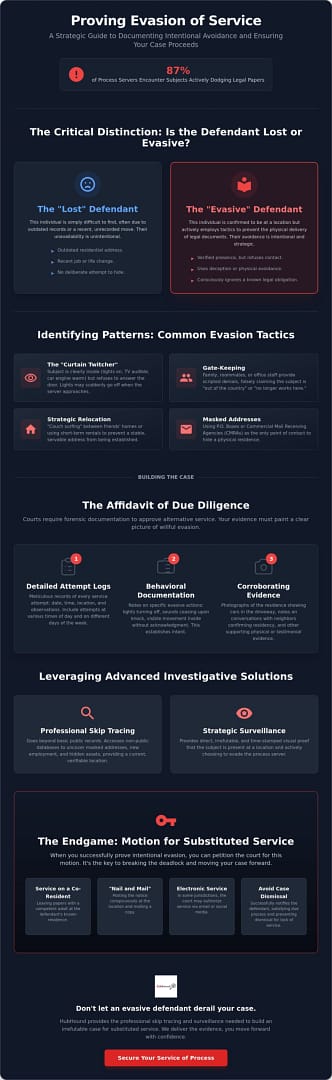
According to the National Association of Professional Process Servers, 87% of its members have encountered subjects who are actively dodging legal papers. If you’re facing a defendant who refuses to answer the door or suddenly disappears when a server arrives, you’re dealing with a strategic hurdle that can derail your entire case. Understanding how to prove someone is avoiding service of process is the only way to move past this stalemate. It requires shifting your strategy toward forensic documentation and behavioral analysis. Precision is your best tool here.
You likely feel the pressure of mounting legal costs and the stress of a timeline that refuses to budge. We understand that the uncertainty of court requirements often causes choice paralysis when you’re trying to move a case forward. This guide explains exactly what evidence courts require to prove a defendant is intentionally hiding and how professional investigative tactics can break the deadlock. You’ll learn how to document patterns of evasion and use skip tracing data to secure a Motion for Substituted Service. This approach ensures you successfully notify the defendant and ensures the case isn’t dismissed for lack of service.
Key Takeaways
- Distinguish between a missing defendant and an evasive one to select the most efficient investigative path for your legal strategy.
- Identify specific behavioral patterns like gate-keeping or signs of occupancy that demonstrate intentional unresponsiveness to a legal notice.
- Master the rigorous documentation standards needed for your affidavit, including how to prove someone is avoiding service of process through detailed physical descriptions and attempt logs.
- Evaluate the utility of professional-grade skip tracing and surveillance over basic public records to locate subjects who have masked their digital footprint.
- Leverage precise evidence to obtain a Motion for Substituted Service, allowing you to move forward with alternative delivery methods and avoid case dismissal.
What Constitutes Intentional Avoidance of Service?
Service of process is a fundamental legal requirement rooted in the constitutional right to due process. It ensures every defendant receives formal notification of legal action against them. However, a significant gap exists between a defendant who is simply difficult to find and one who is actively hiding. Distinguishing between these two scenarios is the first step in learning how to prove someone is avoiding service of process.
A “lost” defendant is often the result of outdated records or a recent move. They aren’t hiding; they’re just not where you thought they were. An “evasive” defendant is verified to be at a specific location but employs tactics to prevent physical delivery of documents. Courts across the country use the “reasonable diligence” standard to evaluate service attempts. This isn’t a fixed number of tries. Instead, it’s a qualitative assessment of whether the server made a genuine, exhaustive effort to reach the subject at various times of day and at all known residential or business addresses.
The Legal Definition of Evasion
Evasive service is the deliberate attempt to thwart judicial notification through deception or physical avoidance. Courts interpret “willful” avoidance as a conscious choice to ignore a known or suspected legal obligation. This behavior doesn’t stop the clock. In many jurisdictions, proven evasion allows the court to toll the statute of limitations, preventing a defendant from waiting out a claim. It transforms a simple administrative task into a documented pattern of non-compliance that judges take seriously.
Why Establishing Intent Matters
You must establish intent to secure a motion for substituted service. Without proof of a subject’s deliberate actions, a judge likely won’t authorize alternative delivery methods. Establishing this intent also safeguards your case against future challenges. If you can show the defendant knew about the service and actively dodged it, they can’t later claim a lack of notice to vacate a judgment. The process server’s testimony and detailed logs serve as the primary evidence for this pattern of behavior.
When you successfully prove evasion, the legal landscape shifts in your favor. Consider these common outcomes:
- The court grants orders for substituted service, such as leaving papers with a co-resident.
- The defendant may be held liable for the increased costs of specialized surveillance operations.
- The court may authorize “Nail and Mail” procedures or service via electronic means.
- Judges often view evasive behavior as a lack of good faith, which can influence early procedural rulings.
Proving evasion requires a shift in perspective. You aren’t just trying to deliver a package; you’re building a case for the court to bypass traditional rules. Document every interaction with neighbors, every car in the driveway, and every light turned off when the server knocks. These details form the foundation of your argument.
Identifying Patterns: Common Evasion Tactics
Evasion is rarely a single event. It’s a series of calculated behaviors designed to exploit the limitations of standard process servers. To build a compelling case for the court, you must document these patterns with forensic detail. This documentation is the cornerstone of how to prove someone is avoiding service of process effectively. When a defendant realizes they are being tracked, their tactics often shift from passive avoidance to active concealment.
The “Curtain Twitcher” is a classic example of passive evasion. This occurs when a subject is clearly inside the residence but refuses to acknowledge the door. Signs of occupancy are critical here. If the server notes a warm vehicle engine, audible television noise, or lights that vanish upon a knock, these are not coincidences. They are indicators of presence. Similarly, many defendants rely on gate-keepers. Family members, roommates, or office receptionists may provide scripted denials, claiming the subject is “out of the country” or “no longer works here” despite evidence to the contrary.
More sophisticated subjects use intentional relocation or “couch surfing” to stay mobile. By moving between short-term rentals or friends’ homes, they prevent a stable service address from being established. Some even use PO boxes or Commercial Mail Receiving Agencies (CMRA) as their only listed contact point. These services provide a professional appearance while masking the subject’s actual physical residence. Identifying these “ghost” addresses is a primary step in optimizing your investigative strategy.
Residential Evasion Strategies
Modern technology has simplified evasion for the savvy defendant. Ring doorbells and high-definition security cameras allow subjects to screen visitors from their smartphones without ever approaching the door. If a subject consistently ignores the door only when a server is present but answers for delivery drivers, a pattern emerges. Documenting these signs of life is critical:
- Vehicles registered to the subject parked in the driveway.
- Lights on timers or television noise audible from the street.
- Mail accumulation in the box followed by its sudden removal.
- Security camera movement or “curtain twitching” during service attempts.
Professional investigators often conduct neighbor interviews or utility checks to confirm the subject hasn’t actually moved. This data is essential for securing substituted service when personal contact fails.
Workplace and Digital Evasion
The rise of remote work provides defendants with a convenient shield. They may claim to be “field-based” or “permanently remote” to avoid workplace service. Digital footprints are also being scrubbed. Subjects often deactivate social media profiles or switch them to private to hide their current location or employer. Another common tactic is the “alias” maneuver. By using a middle name or a nickname in professional settings, a defendant can claim the person named in the legal documents is someone else. Documenting these discrepancies is vital for your affidavit.
The Evidence Required: Proving Intentional Evasion to the Court
Proving evasion isn’t about intuition; it’s about building a data-driven narrative that leaves no room for doubt. Courts require a specific evidentiary threshold to bypass standard service rules. Understanding how to prove someone is avoiding service of process involves collecting granular details that demonstrate a subject’s willful refusal to be served. Generally, three failed attempts at different times of day is the industry minimum for demonstrating due diligence to a judge.
Every attempt must be documented with the ‘Who, What, Where, and When’ in mind. If an individual at the residence refuses to identify themselves, record a detailed physical description instead. Note their approximate height, weight, hair color, and any distinguishing features. This level of detail proves you encountered a specific person, even if they were uncooperative. Recording statements from third parties is also vital. If a roommate says, “He isn’t here,” while the subject’s car is idling in the driveway, that discrepancy is powerful evidence of deception.
Photographic evidence provides the visual confirmation courts often demand. Capture images of the subject’s vehicle, packages addressed to them on the porch, or even the defendant seen through a window. These photos anchor your claims in reality. They transform a process server’s notes into a verifiable record of residency and presence.
The Affidavit of Due Diligence
The affidavit is your primary tool for communicating with the court. It must be a comprehensive log of every action taken. Include precise dates, times, and specific locations for each attempt. Don’t just list the results; describe the environment. Mention if you utilized a skip trace to verify the address was current and correct. If you conducted surveillance, incorporate your ‘stakeout’ notes to show a pattern of the subject entering and exiting the premises. Following the Rules of Civil Procedure ensures your documentation meets the necessary legal standards for admissibility.
Corroborating Evidence from Third Parties
External validation strengthens your case by removing the “he said, she said” element. Conduct witness interviews with neighbors or landlords to confirm the subject’s residency status. Neighbors often have the most current information regarding a subject’s daily habits and vehicle use. You can also leverage verification from the USPS or utility companies to prove active service at the address. If necessary, obtain employment verification logs. Showing the defendant was on the clock during service attempts at their workplace provides undeniable proof of their availability and subsequent evasion.
Advanced Investigative Solutions: Skip Tracing and Surveillance
When routine attempts fail, advanced investigative solutions become necessary. Standard process servers typically rely on the addresses provided in legal filings. If those addresses are stale or compromised, the case stalls. Professional skip tracing goes deeper by identifying secondary locations like vacation rentals, corporate housing, or hidden business offices. This forensic approach is vital when learning how to prove someone is avoiding service of process because it demonstrates that the defendant has intentionally abandoned their primary residence to stay mobile.
There is a significant gap between public records and professional-grade investigative databases. While anyone can search a social media profile, investigators analyze credit headers, utility connection records, and motor vehicle registrations to find real-time movement. They may use digital tracking or social media “honey-pots” to identify current locations through active engagement. In some cases, legal and ethical pretexting is used to confirm a subject’s location before an attempt is made. These tools cross-reference known associates and family members to identify potential safe houses where a defendant might be hiding.
Professional Skip Tracing Methodology
Effective skip tracing is a process of elimination and validation. It involves scrubbing digital footprints to see if a subject has recently updated their records. Investigators utilize several data sources that are unavailable to the general public:
- Credit headers and recent loan applications.
- Utility connection records and billing addresses.
- Motor vehicle registrations and lien information.
- Cross-referenced data from known associates.
By tracking these updates, investigators pinpoint where a subject is likely to be at specific hours. This level of detail is exactly what you need to provide the court with evidence of a subject’s current whereabouts versus their claimed absence.
Surveillance for Evasive Defendants
Sometimes, the only way to break a deadlock is to catch a defendant “in the wild.” Using advanced surveillance techniques allows investigators to document the subject’s daily routine. This might include early morning spot checks to confirm residency or following a subject from their workplace to an undisclosed home. Video evidence is the gold standard here. It proves the person seen is indeed the defendant, even if they later attempt to deny their identity.
High-quality surveillance provides the undeniable proof required for how to prove someone is avoiding service of process in complex cases. If you need to identify a subject’s current location with surgical precision, evaluate professional skip tracing and surveillance services to ensure your case moves forward without further delay.
Resolving the Deadlock: Substituted Service and Alternative Methods
Once you have documented a clear pattern of evasion, the focus shifts from physical delivery to legal resolution. You don’t need to stay trapped in an endless loop of failed attempts. Instead, use your gathered evidence to request alternative methods from the court. Understanding how to prove someone is avoiding service of process is the prerequisite for these high-level maneuvers. When personal service is impossible, several specialized delivery methods can keep your case on track.
Substituted service is often the most efficient next step. This involves leaving the legal documents with a competent adult member of the subject’s household or a person in charge at their workplace. If the subject lives in a gated community or a secured building where this is impossible, the court may authorize the “Nail and Mail” method. This requires the server to physically attach the documents to the subject’s front door and simultaneously send a copy via certified mail. For defendants who have completely vanished or are hiding with extreme sophistication, service by publication serves as the “last resort.” This involves placing a notice in a newspaper of general circulation, though it’s usually reserved for cases where all other leads are dead.
Modern litigation is also embracing digital frontiers. In certain jurisdictions, judges now grant orders for service via email or social media messaging. This requires proof that the subject actively monitors the digital account and that this method is reasonably calculated to provide actual notice. This approach is particularly effective against tech-savvy defendants who have scrubbed their physical presence but remain active online.
How to File a Motion for Substituted Service
Securing a court order for alternative service is a procedural exercise in transparency. Follow these steps to ensure your motion is granted:
- Compile the record: Gather every Affidavit of Due Diligence, surveillance log, and skip trace report generated during the investigation.
- Exhaust all leads: Demonstrate to the judge that you attempted service at all known residential, business, and secondary addresses identified through professional databases.
- Calculate the notice: Propose a delivery method that has a high probability of reaching the defendant, such as a known business email or a verified relative’s residence.
The Role of Civil Litigation Support
Professional investigators do more than just knock on doors; they provide the specialized Civil Litigation Support necessary to satisfy a judge’s scrutiny. An “expert declaration” from a licensed investigator carries significant weight. It provides a technical breakdown of the search methodology used to locate the subject and the specific behaviors that indicate evasion. This documentation ensures every attempt complies with national civil procedure rules, protecting your case from future motions to vacate. Once the court accepts the alternative service, your investigator finalizes the Proof of Service, allowing you to move seamlessly into the discovery or judgment phase.
Secure Your Litigation with Forensic Documentation
Securing your legal rights shouldn’t be stalled by a defendant’s refusal to cooperate. You now understand that evasion is a documented pattern of behavior, not just a series of missed connections. By compiling a rigorous Affidavit of Due Diligence and leveraging third-party verification, you create the legal leverage needed for alternative service methods. This forensic approach ensures your case moves toward a resolution rather than a dismissal for lack of service.
Mastering how to prove someone is avoiding service of process requires a transition from standard delivery to advanced investigation. Professional surveillance and skip tracing provide the expert declaration that judges respect during a motion for substituted service. If you’re stuck with an evasive defendant, contact HubHound for professional skip tracing and process service support. We bring decades of experience in locate investigations and specialized expertise in criminal defense investigations. Our comprehensive surveillance capabilities document intentional evasion with the precision your case demands. Take the next step to break the deadlock and move your litigation forward with absolute confidence.
Frequently Asked Questions
How many times does a process server have to try before I can prove evasion?
Most courts require at least three separate attempts at different times of the day to demonstrate due diligence. These attempts should occur when the subject is reasonably expected to be home, such as early morning, midday, and evening. Documentation of these specific windows is a core part of how to prove someone is avoiding service of process. A single failed visit isn’t enough to secure a motion for substituted service.
Can someone be served if they refuse to open the door?
Yes, refusal to open the door does not automatically stop the legal process. If the server identifies the subject through a window or by voice, they can sometimes perform service by leaving the papers at the door while announcing the contents. The server must document the subject’s presence and their refusal to cooperate. This documentation forms the basis for an affidavit of service that judges will accept as valid notification of the lawsuit.
What happens if a defendant moves to another state to avoid service?
Moving across state lines complicates the process but does not end the litigation. You must utilize skip tracing to locate the new residence and then hire a process server authorized to operate in that jurisdiction. Most states have reciprocal agreements that allow for out of state service. If they continue to hide, you can use the documented history of interstate movement to request alternative service methods from the court.
Is it a crime to avoid being served court papers?
Avoiding service is generally not a criminal offense, but it carries significant civil consequences. A defendant who dodges papers may face increased legal fees, court sanctions, or a default judgment if the court authorizes substituted service. While they won’t go to jail for hiding, their evasive behavior often damages their credibility with the judge. It effectively removes their opportunity to present a defense before a ruling is made.
Can I serve someone via social media if they are hiding?
Service via social media is possible only with a specific court order. You must first prove that traditional personal service is impossible and demonstrate that the defendant actively uses the social media account in question. This usually requires showing recent posts or direct interactions. Once the court is satisfied that this method is reasonably calculated to provide actual notice, they may authorize delivery through a private message or a public post.
What is an Affidavit of Due Diligence and why do I need one?
An Affidavit of Due Diligence is a sworn statement from the process server detailing every attempt made to find the defendant. It includes dates, times, and descriptions of the environment, such as cars in the driveway or lights being turned off. You need this document to prove to the court that you’ve exhausted all reasonable options. It is the essential evidence required to move for alternative service methods like publication.
Can a private investigator serve papers differently than a sheriff?
Private investigators often provide more flexible and persistent service than a sheriff’s department. While a sheriff may only make a few attempts during standard business hours, an investigator can use surveillance to identify the subject’s actual routine. They use professional databases to perform deep skip tracing, which is a critical step in how to prove someone is avoiding service of process. Their specialized focus often leads to faster results in evasive cases.
What is the ‘drop service’ method and is it legal?
Drop service is a legal method where the server leaves the papers in the subject’s immediate vicinity after they have been identified. This is commonly used when a defendant refuses to physically touch the documents or retreats behind a locked door. As long as the server clearly announces that the person is being served and identifies the nature of the papers, the court generally considers the service valid and complete under current civil rules.

Article by
Joel R. Manley | President | Hubhound Investigations | OR PI-ID#: 90432 | 111 SW Fifth Avenue, Suite 3150 Portland, Oregon 97204 | 971-442-8170
Joel is licensed as a private investigator in Oregon and Tennessee. Joel started his career in 1987 serving as a Military Police Officer and Military Police Investigator.
After ending his military tour of duty, Joel became a civilian Police Officer and Deputy Sheriff. Joel took his strong background in Hostage Negotiations, Mediation and Conflict Resolution, with him to patrol some of the highest crime areas in SE Portland.
Joel was awarded Deputy of the Year for his efforts and for drastically reducing the crime rate in the area he patrolled. As a Deputy Sheriff, Joel assisted in leading a Neighborhood Livability Program that was nationally recognized for having the most innovative and progressive approach to policing.
In 2018, Joel retired as a Deputy Sheriff and founded Hubhound Investigations. Joel played an integral role in Hubhound Investigations receiving an A+ Accredited Business rating from the Better Business Bureau (BBB).
In his off time, Joel enjoys spending time with his wife, adult children and Hubhound’s Happiness Ambassador, Nya. Joel also enjoys Scuba Diving and Kayaking.
Disclaimer
DISCLAIMER: This article is provided for general informational and educational purposes only. It is not intended to constitute legal advice, professional investigative advice, or instruction to engage in any unlawful activity. Laws governing private investigations, surveillance, recording, tracking, access to information, evidence collection, privacy, trespass, licensing, and related investigative activities vary by jurisdiction and are subject to change.
Any investigative techniques, tactics, procedures, scenarios, or legal proceedings discussed in this article are presented for informational purposes and should not be interpreted as authorization or encouragement to use a particular method. Private investigators and members of the public are responsible for understanding and complying with all applicable federal, state, and local laws, licensing requirements, court rules, and professional standards.
The circumstances of every investigation and legal matter are different. Information contained in this article should not be relied upon as a substitute for advice from a qualified attorney or other appropriate licensed professional regarding a specific situation. No attorney-client, investigator-client, or other professional relationship is created by reading or using this information.