
Taking matters into your own hands to uncover infidelity often destroys the very case you’re trying to build. While the instinct to investigate a partner’s behavior is natural, DIY surveillance can lead to criminal liability or the immediate dismissal of evidence. You need to understand how to legally gather evidence of a cheating spouse without violating privacy laws or compromising your standing in potential litigation. It’s a high-stakes environment where one wrong move with a tracking device or a hacked password can invalidate months of documentation.
The emotional distress of suspected infidelity is overwhelming, and you deserve a clear path toward the truth. This professional guide details the precise legal boundaries and professional methods used to document infidelity in 2026. You’ll discover which digital records are court-admissible, how to avoid the pitfalls of illegal ‘snooping’, and the specific steps required to transition from suspicion to verified, actionable proof. We deliver the technical clarity needed to evaluate professional surveillance operations and ensure your next steps are both strategic and legally sound.
Key Takeaways
- Identify the critical differences between admissible proof and illegal digital privacy violations to protect your legal standing.
- Discover how to legally gather evidence of a cheating spouse by utilizing behavioral logs and public social media footprints.
- Evaluate the risks of DIY surveillance and why professional surveillance operations are necessary for maintaining ECPA compliance.
- Learn how third-party, unbiased testimony from licensed investigators provides the evidentiary weight needed for successful civil litigation.
- Master the process of presenting documented findings to legal counsel to influence mediation and out-of-court settlements effectively.
The Legal Framework of Infidelity Evidence in 2026
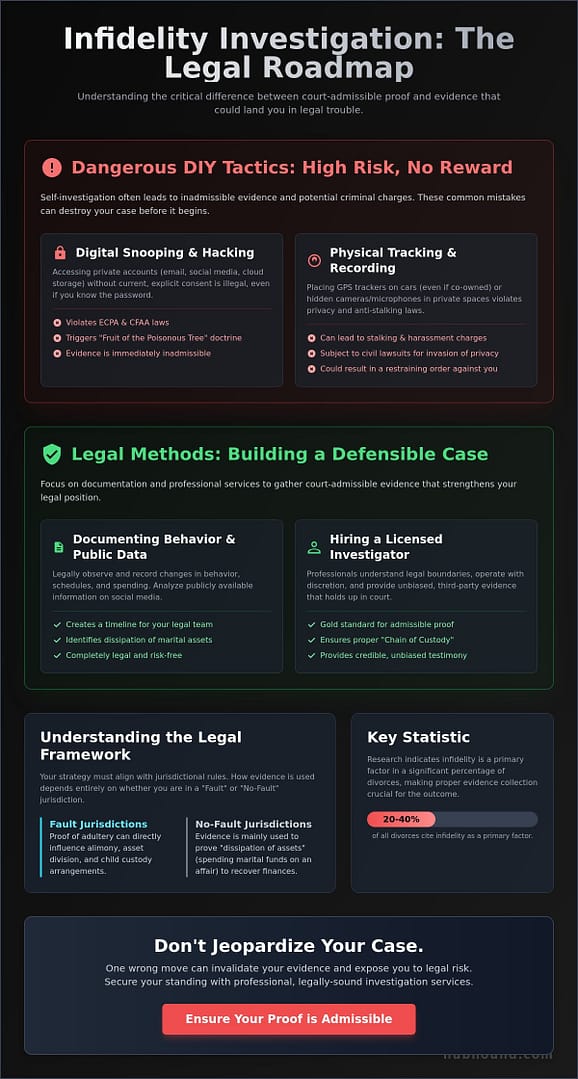
Establishing proof of a spouse’s infidelity requires a shift in perspective from emotional validation to legal strategy. In domestic relations and civil litigation, evidence must be both relevant and legally obtained to be considered by a judge. This distinction is where many individuals fail; they focus on ‘peace of mind’ rather than ‘court-ready’ documentation. To succeed, you must understand how to legally gather evidence of a cheating spouse through methods that respect privacy statutes and digital boundaries. Research from 2026 indicates that while infidelity is a primary factor in 20% to 40% of all divorces, the method of discovery often determines the financial outcome of the case.
Admissibility and the Chain of Custody
The chain of custody is a chronological log that records the sequence of custody, control, and transfer of evidence. It’s the backbone of any professional investigation. If you handle the evidence yourself, defense attorneys will likely challenge its authenticity by arguing that data was tampered with or fabricated. In 2026, courts have moved beyond simple screenshots of text messages. Judges now prioritize methods that preserve metadata to verify the exact time, location, and origin of digital communications. Self-collected evidence frequently lacks this technical validation, leading to its immediate dismissal. Understanding The Legal Framework of Infidelity involves recognizing that how you obtain information is just as important as what the information contains.
Fault vs. No-Fault Jurisdictions
Jurisdictions across the country generally divide into fault-based and no-fault categories, and your investigative strategy must align with these local rules. In fault-based jurisdictions, proving adultery can directly influence alimony awards or result in a more favorable share of marital assets. Conversely, in no-fault jurisdictions, infidelity is often legally irrelevant to the divorce itself unless it involves the ‘dissipation of assets.’ This occurs when a spouse uses marital funds for gifts, travel, or hotel stays for a paramour. In these scenarios, knowing how to legally gather evidence of a cheating spouse becomes a tool for financial recovery. Professional documentation allows your attorney to argue for a ‘reconstitution’ of the marital estate, ensuring you aren’t penalized for your partner’s unauthorized spending. Furthermore, evidence of a partner’s lifestyle choices may influence custody decisions if the third party involved poses a documented risk to the children’s environment.
Dangerous DIY Tactics: Avoiding Inadmissible Evidence
Many individuals believe they’ve found a shortcut by installing tracking apps or hidden cameras. This is a significant tactical error. Attempting to figure out how to legally gather evidence of a cheating spouse through illegal means often invokes the ‘Fruit of the Poisonous Tree’ doctrine. In civil litigation, this means that even if you find undeniable proof of an affair, the court may bar it because the collection method was unlawful. Beyond losing your evidence, you could face criminal charges for wiretapping, computer fraud, or stalking. Evidence obtained through a crime is rarely, if ever, useful in a courtroom.
The Pitfalls of Digital Snooping
The 2026 interpretation of the Computer Fraud and Abuse Act (CFAA) is exceptionally strict regarding unauthorized access. You might have your spouse’s password from a shared account, but that doesn’t constitute ‘authorized access’ in a legal sense today. Logging into private cloud storage, social media, or encrypted email without explicit, current consent is a violation of the ECPA. Using spyware or keyloggers is even more hazardous. These tools are frequently flagged by modern security software, creating a digital trail that leads directly back to you. If you require verified documentation, opting for Professional Surveillance is the only way to ensure the data remains untainted for court.
Physical Surveillance and Stalking Laws
A common myth suggests you can legally place a GPS tracker on a vehicle as long as your name is on the title. In 2026, many jurisdictions view this as a violation of privacy or even stalking if the other spouse is the primary driver. Similarly, hidden cameras in private spaces like bedrooms or bathrooms are criminal violations of privacy laws. DIY surveillance often crosses the line into harassment. When a spouse realizes they’re being followed, they can file for a restraining order. This doesn’t just halt your investigation; it can devastate your position in a custody battle. Judges rarely favor a parent who has a documented history of ‘stalking’ behavior, regardless of the underlying infidelity. To protect your future, you should identify high-quality resources that prioritize legal compliance over risky shortcuts.
Using illegal tactics also creates a massive liability during the discovery phase of a divorce. If your attorney is forced to disclose that evidence was gathered through ‘snooping’ or unauthorized access, the opposing counsel will use it to paint you as unstable or controlling. This can shift the focus from the spouse’s infidelity to your own misconduct, potentially impacting asset division and child visitation rights. Understanding how to legally gather evidence of a cheating spouse means knowing when to step back and let professionals handle the technical and physical surveillance requirements.
Legitimate Ways to Document Suspicions Individually
Maintaining a meticulous behavioral log is the first step in building a foundation for your case. This timeline should document unexplained absences, changes in routine, and inconsistent stories. It serves as a roadmap for your legal team, allowing them to identify specific windows for more intensive investigation. Observing behaviors in plain view within shared spaces is generally legal, provided you aren’t using intrusive technology to bypass a reasonable expectation of privacy. Improperly documenting private moments can trigger invasion of privacy lawsuits, which effectively flip the legal script against you. When you’re learning how to legally gather evidence of a cheating spouse, focus on the information that is already available to you as a co-owner or joint account holder.
Financial Discovery and Paper Trails
Financial records are often the most objective pieces of evidence in a divorce proceeding. Reviewing joint bank statements and credit card bills allows you to identify ‘dissipation of assets.’ This term refers to the use of marital funds for non-marital purposes, such as gifts, luxury dinners, or travel for a third party. When determining how to legally gather evidence of a cheating spouse, these paper trails are among the most effective tools for financial recovery. Documenting unexplained cash withdrawals or the existence of hidden credit cards provides circumstantial evidence that often necessitates further inquiry. These paper trails are powerful because they’re difficult to dispute in court. The process of legally gathering evidence through financial discovery ensures that your claims of misconduct are backed by verifiable data rather than just suspicion.
Social Media and Public Domain Research
Modern investigations rely heavily on Open-Source Intelligence (OSINT). This involves documenting information that is voluntarily placed in the public domain. Publicly accessible social media posts, check-ins, and tagged photos can provide a wealth of information regarding a spouse’s whereabouts and associations. However, you must be cautious. Creating fake profiles to ‘friend’ a spouse or engaging in ‘catfishing’ is legally precarious and can be viewed as harassment or a violation of platform terms of service. Stick to information that is truly public. If a profile is set to private, attempting to circumvent those settings through deceptive means may render the evidence inadmissible. Instead, focus on preserving high-quality records of public interactions that contradict your spouse’s claims about their activities or travel.
Professional Surveillance: The Gold Standard for Admissible Proof
Individual documentation and financial discovery provide a necessary foundation, but they rarely satisfy the rigorous standards of a contested divorce. Professional intervention is required to transform suspicion into court-ready documentation. Licensed investigators are the only entities qualified to execute surveillance techniques that withstand aggressive legal scrutiny. They operate within a strict framework of ‘plain view’ doctrine and public privacy laws, ensuring that every captured image or video is obtained without violating the subject’s rights. This objective approach is the definitive answer for anyone wondering how to legally gather evidence of a cheating spouse while protecting their own reputation.
The Investigator’s Method
Professional surveillance is a disciplined process involving both stationary and mobile operations. Stationary surveillance involves monitoring a specific location, such as a residence or workplace, to document departures and arrivals. Mobile surveillance requires following a subject through public spaces, requiring high levels of technical skill to remain undetected. Investigators focus on establishing ‘inclination and opportunity.’ This legal standard doesn’t require proof of the intimate act itself but rather evidence that the spouse had the desire to commit adultery and the chance to do so in private. High-grade equipment with low-light sensors and stabilized lenses ensures that the identity of all parties is unmistakable. The final investigative report serves as a ‘Chain of Evidence’ log, providing a verified timeline that your attorney can use as a primary exhibit.
Why Third-Party Evidence Wins
Courts are inherently skeptical of evidence presented by an emotionally involved spouse. A licensed investigator serves as an unbiased third-party witness, providing testimony that carries significantly more weight than ‘he-said, she-said’ accusations. This professional documentation is a core component of comprehensive civil litigation support, as it provides the factual basis for legal arguments regarding marital misconduct. Beyond the courtroom, the psychological impact of professional evidence is profound. When a spouse is presented with undeniable, high-grade video evidence, they’re often more inclined to negotiate a settlement rather than risk a public trial. Understanding how to legally gather evidence of a cheating spouse through professional channels protects your interests during every phase of the divorce. If you’re ready to secure the proof you need, you can evaluate top-tier surveillance operations to find the right partner for your case.
Turning Evidence into Action: Legal and Investigative Next Steps
Acquiring high-quality proof is a critical milestone, but the value of that data depends entirely on its strategic application. Once the surveillance phase concludes, you must transition from discovery to asset protection and legal maneuvering. Knowing how to legally gather evidence of a cheating spouse provides you with a significant advantage during the early stages of a divorce. This evidence serves as a catalyst for more favorable settlement terms, particularly when documented misconduct contradicts a spouse’s claims of financial or parental fitness. Your focus should now shift toward secure storage and professional consultation to ensure your findings remain admissible and impactful.
Consulting with Legal Counsel
Presenting your investigative report to a family law attorney is the most vital step in your strategy. A professional report, complete with a verified chain of custody and high-resolution documentation, allows your lawyer to build a case based on facts rather than hearsay. In fault-based jurisdictions, this evidence can be used to leverage better terms for alimony or the division of marital property. When complex financial structures or family-owned businesses are involved, investigators often apply corporate investigation firm standards to trace the movement of marital funds. This ensures that any ‘dissipation of assets’ is fully documented for the court, preventing a spouse from hiding or spending down the marital estate during the litigation process.
Finalizing the Investigation
Determining when to stop surveillance is a tactical decision that should be made in coordination with your legal team. Continuing an investigation after you’ve already secured sufficient, court-admissible proof can be viewed as harassment or unnecessary escalation. Once you’ve established ‘inclination and opportunity’ through professional channels, the focus must move to securing your digital footprints. Ensure that all investigative reports, video files, and communications with your investigator are stored in a secure, password-protected environment that your spouse cannot access. Maintaining this level of confidentiality protects the integrity of the evidence and shields you from accusations of bad-faith snooping during the discovery phase of your case.
The transition from suspicion to legal action is often the most emotionally taxing period of the process. Having professional documentation reduces the ‘he-said, she-said’ friction that often stalls mediation or leads to prolonged court battles. When the evidence is undeniable, opposing counsel is frequently more willing to accept reasonable settlement terms to avoid a public trial. This efficiency saves time, reduces legal fees, and allows you to move forward with clarity and financial security. If you’re ready to move from suspicion to verified proof, you should consult with a professional investigator to discuss your case and identify the most effective path forward.
Securing Your Future with Admissible Proof
Navigating the complexities of marital misconduct requires a transition from emotional suspicion to disciplined legal strategy. You’ve learned that ‘snooping’ often creates more liability than clarity, potentially ruining your standing in family court. By focusing on financial discovery and professional surveillance, you protect your rights while establishing a verified timeline of events. Understanding how to legally gather evidence of a cheating spouse is often the difference between a stalled mediation and a successful settlement that protects your financial interests.
Success in these high-stakes cases depends on documentation that meets forensic standards. HubHound provides the niche expertise required to document infidelity without compromising privacy laws. Our licensed investigators bring 30+ years of experience to every operation, delivering court-admissible reporting and discreet, nationwide surveillance operations. We’ll help you move beyond uncertainty with the technical precision your legal counsel requires. Secure the evidence you need with HubHound’s professional infidelity investigations. You deserve the clarity and peace of mind that comes from having the facts on your side.
Frequently Asked Questions
Is it legal to put a GPS tracker on my spouse’s car?
It is generally illegal to install GPS tracking devices on a spouse’s personal property without their explicit consent. While some believe co-ownership of a vehicle grants this right, modern privacy laws often prioritize the primary driver’s expectation of privacy. Using these devices without authorization can lead to criminal stalking charges and the immediate dismissal of any data collected. Consult with a professional to ensure your tracking methods don’t violate local statutes.
Can I use text messages I found on a shared iPad as evidence?
Text messages found on shared devices are generally admissible if there was no reasonable expectation of privacy. If the iPad is used by both parties without individual passwords, the court often views the content as accessible. However, you must ensure the evidence is properly authenticated with metadata rather than simple screenshots to meet 2026 court standards. Avoid hacking into private, password-protected accounts, as this violates federal privacy laws.
Do I need ‘proof’ of physical intimacy to prove infidelity in court?
Courts do not typically require direct evidence of physical intimacy to establish adultery. The legal standard usually relies on proving ‘inclination and opportunity.’ This means documenting that the spouse had a romantic interest in a third party and the opportunity to act on it in a private setting. This is a core part of how to legally gather evidence of a cheating spouse. Professional surveillance reports are designed to establish these two elements clearly.
Is it illegal to hire a private investigator for a cheating spouse?
Hiring a licensed private investigator is a perfectly legal and professional way to document marital misconduct. Investigators are trained to operate within the bounds of the law, ensuring that the evidence they gather is court-admissible. This third-party documentation removes the ‘he-said, she-said’ element from legal proceedings and provides an objective record for your attorney. Verify the credentials of any firm you hire to ensure they follow rigorous reporting standards.
What is the ‘expectation of privacy’ and how does it affect my case?
The expectation of privacy is a legal concept that determines where a person has a right to be free from observation. Public spaces, like parks or restaurants, have a low expectation of privacy; this makes surveillance legal. Conversely, private spaces like a locked bedroom or a personal smartphone have a high expectation of privacy. Respect these boundaries to avoid having your evidence barred from court. One wrong move in a private space can turn you from a victim into a defendant.
How much does a professional infidelity investigation typically cost?
The total investment for an investigation varies based on the complexity of the case and the duration of surveillance required. Factors like the number of agents and the technical equipment used influence the final fee. Most professional firms require an upfront retainer before beginning surveillance operations or background checks. Consult with individual providers to evaluate specific fee structures and contract terms. This ensures you understand the financial commitment before the investigation begins.
Can evidence of cheating affect child custody arrangements?
Infidelity typically only affects child custody if the behavior directly impacts the child’s well-being or safety. If a spouse introduces a child to a paramour who has a criminal history or if the affair leads to parental neglect, the court may intervene. Documenting these specific circumstances is a vital part of how to legally gather evidence of a cheating spouse when children are involved. Focus on how the partner’s choices create an unstable or dangerous environment for the child.
Will my spouse find out if I hire a private investigator?
Professional surveillance is designed to be completely discreet and undetected. Licensed investigators use specialized vehicles and long-range equipment to maintain a significant distance from the subject. While no operation is without risk, the likelihood of discovery is minimal when compared to DIY ‘snooping’ attempts. Professionals prioritize stealth to ensure the investigation remains secure until the final report is delivered to your legal counsel. Trust the process and avoid discussing the investigation with anyone who might alert your spouse.

Article by
Joel R. Manley | President | Hubhound Investigations | OR PI-ID#: 90432 | 111 SW Fifth Avenue, Suite 3150 Portland, Oregon 97204 | 971-442-8170
Joel is licensed as a private investigator in Oregon and Tennessee. Joel started his career in 1987 serving as a Military Police Officer and Military Police Investigator.
After ending his military tour of duty, Joel became a civilian Police Officer and Deputy Sheriff. Joel took his strong background in Hostage Negotiations, Mediation and Conflict Resolution, with him to patrol some of the highest crime areas in SE Portland.
Joel was awarded Deputy of the Year for his efforts and for drastically reducing the crime rate in the area he patrolled. As a Deputy Sheriff, Joel assisted in leading a Neighborhood Livability Program that was nationally recognized for having the most innovative and progressive approach to policing.
In 2018, Joel retired as a Deputy Sheriff and founded Hubhound Investigations. Joel played an integral role in Hubhound Investigations receiving an A+ Accredited Business rating from the Better Business Bureau (BBB).
In his off time, Joel enjoys spending time with his wife, adult children and Hubhound’s Happiness Ambassador, Nya. Joel also enjoys Scuba Diving and Kayaking.
Disclaimer
DISCLAIMER: This article is provided for general informational and educational purposes only. It is not intended to constitute legal advice, professional investigative advice, or instruction to engage in any unlawful activity. Laws governing private investigations, surveillance, recording, tracking, access to information, evidence collection, privacy, trespass, licensing, and related investigative activities vary by jurisdiction and are subject to change.
Any investigative techniques, tactics, procedures, scenarios, or legal proceedings discussed in this article are presented for informational purposes and should not be interpreted as authorization or encouragement to use a particular method. Private investigators and members of the public are responsible for understanding and complying with all applicable federal, state, and local laws, licensing requirements, court rules, and professional standards.
The circumstances of every investigation and legal matter are different. Information contained in this article should not be relied upon as a substitute for advice from a qualified attorney or other appropriate licensed professional regarding a specific situation. No attorney-client, investigator-client, or other professional relationship is created by reading or using this information.