
An unknown number can point you toward an identity, but it can’t reveal someone’s real-time location. Learning how to find a person with only a phone number usually starts with a free reverse search and a broader web search; a paid people-search report may add records when free results fall short. A lookup may show a name, city and state, line type, or carrier, if available.
It’s natural to want a quick answer before returning a call. Keep in mind that records can be outdated, numbers can be reassigned, and a match doesn’t prove you’ve identified the right person. Results depend on what information is publicly available.
This guide compares free and paid options and explains what each may reveal. Some paid reports include additional contact details, relatives, work information, or court records. You’ll also learn how to assess accuracy and privacy, understand the limits of a phone search, and choose what to do if an online lookup doesn’t provide enough clarity.
Key Takeaways
- Start with free searches to see whether the number appears in public listings or search results.
- Use exact-number searches and vary the formatting to uncover pages that may list the caller’s details.
- People-search reports draw on multiple data sources, so treat matches as clues rather than proof of identity.
- Ask a mutual connection for context when appropriate, and avoid sharing more personal information than necessary.
- Choose a paid directory when you need a broader report, and review its privacy practices before using it.
Possible lookup results, including name, address, and carrier
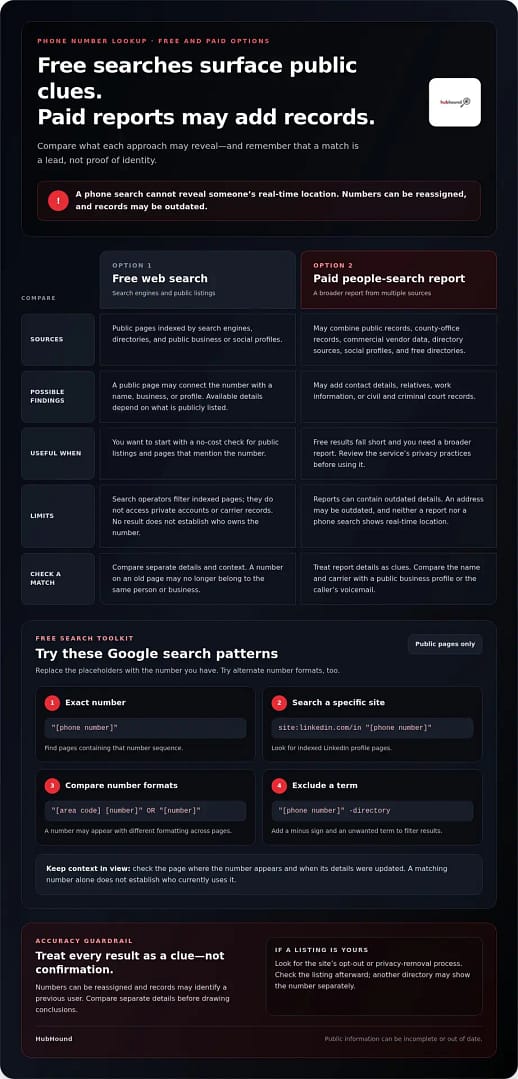
A reverse phone lookup may return a name, city and state, line type, and carrier when those details are available. A people-search report may add contact information, relatives, work details, or civil and criminal court records. Treat every result as a lead, not a verified identity. Numbers can be reassigned, and records may still identify a previous user.
Take particular care with addresses. People-search services may infer them from historical, public, or leaked data, so an address could be outdated. These reports generally don’t provide real-time location information. A phone number search may help identify a caller, but it can’t show where that person is now.
In the United States, searching public directories differs from obtaining carrier-held location data. Mobile operators may provide device location with the subscriber’s consent or through lawful process, such as a court order or emergency-services request. The Federal Communications Commission regulates telecommunications services between states and internationally.
Choose a lookup tool that suits the number and the information you need. Cell numbers may have fewer public directory listings than landlines, and unlisted numbers may not appear in ordinary directories. Try a reverse lookup that covers the relevant line type, then compare its result with a general web search or another source. No match doesn’t establish who owns the number.
Assess a match by checking whether separate details agree. For example, compare the reported name and carrier with a public business profile or the caller’s voicemail. If the number was reassigned, an older record may identify someone else. User reviews can reveal recurring complaints about outdated matches, incomplete reports, or difficulty accessing results. They can help you assess a service, but they can’t verify a specific record.
A lookup can’t reliably confirm whether caller ID was spoofed. Treat an unexpected call requesting payment, passwords, or personal details as suspicious, and don’t call back using the displayed number. Find the organization’s contact details independently and reach it through a known channel. For practical guidance on identifying fraud and avoiding scam calls, resources from Digital Safety Hub can help you safeguard your personal data. A people-search report may also flag a number for telemarketing, spam, or prank calls.
To remove your number, find the people-search site’s opt-out or privacy-removal process and follow its instructions. Many sites offer opt-outs, though the process can be inconvenient. Check the listing afterward and repeat the request if the number appears in another directory.
Google search operators for finding contact details
Google can surface public pages linking a phone number with a name, business, or profile. First, search the full number in quotation marks, including the country code if available. Then try it without spaces, dashes, or parentheses. A business may publish the same number in different formats across its website, directories, and social profiles.
Use search operators to narrow the results rather than scanning broad listings. Try these examples, replacing the placeholder with the number you have:
- Exact match: Search
"[phone number]"to find pages containing that sequence. - Site search: Enter
site:linkedin.com/in "[phone number]"to look for indexed LinkedIn profile pages. - Alternative formats: Search
"[area code] [number]" OR "[number]"to compare common formatting variations. - Exclude noise: Add a minus sign and an unwanted term, such as
"[phone number]" -directory.
These operators filter Google’s indexed pages; they don’t access private accounts or carrier records. If a company appears in the results, open its official website and compare the number with its contact page. If a personal profile appears, compare the name and other public details before drawing conclusions. A matching number alone doesn’t establish who currently uses it.
For professional numbers, search LinkedIn using the person’s name, employer, and role alongside the number. A query such as site:linkedin.com/in "Jordan Lee" "phone number" may find a public profile or indexed contact details. LinkedIn profiles don’t always display phone numbers, so use a result to check professional context, not to assume the person owns the number.
Social media can offer another trail of public information. Search the number in Google alongside terms such as “contact,” “appointment,” or a business name. Then check public Facebook or Instagram pages for matching business details. Platform search features and privacy settings limit what appears, and most apps restrict searches by phone number. Don’t try to bypass those settings.
Keep your search focused. Note the exact page, displayed name, and context where the number appears. For example, a number on a company’s booking page suggests a business contact, while an old forum post may be out of date. If Google returns nothing, try another number format and a relevant site operator before moving to a directory or people-search tool.
How people-search sites obtain phone data
People-search sites build databases by combining public records, county-office records, commercial vendor data, and directory sources. Social profiles and free directories can add other publicly available details.
Social Media Profile Searches
Some people-search services match phone data with information from public social media profiles. A profile may show a name, business, or other contact detail that helps explain a number’s possible connection. Results depend on what the site can access and match, not on private account content.
To assess a match, compare the profile name and context with the number’s listing. For example, a number on a public business page may be a workplace contact, not a personal line. Check when the profile was updated and whether its details align with other public records. A matching profile is a clue, not proof of current ownership.
Free People-Search Directories
Free people-search directories can provide a starting point by gathering phone listings from public records, county offices, commercial vendors, and other directory sources. Search the full number, then try common formatting variations. Compare the name and listed location with the source page instead of relying on a summary alone.
Free access may reveal only part of a report, while some services charge for fuller results or cell-phone lookups. Before using a directory, read its privacy policy and user reviews. Look for comments about access, incomplete records, and outdated matches. Because numbers can be reassigned, an old database entry may link the number to a previous user.
Information From Phone Carriers
A carrier’s account records aren’t the same as a public directory entry. Mobile network operators may provide device-location information with the subscriber’s consent or through lawful process, such as a court order or emergency-services request. A public reverse search doesn’t grant access to information held by a carrier.
For an ordinary identity search, use public records and directory listings rather than expecting a carrier to disclose private subscriber details. If the number relates to an emergency, emergency services can obtain rapid location information for emergency calls, including through E911 or Advanced Mobile Location. For a legal investigation, appropriate legal process is needed for a carrier or law enforcement to request location records. Keep the purpose clear: identifying a public listing is different from seeking private account or location data.
Asking mutual connections
A mutual connection can provide context a database can’t. Start with someone who knows both you and the person you think may be linked to the number, such as a former colleague or shared friend. Explain why you’re trying to identify the caller. A brief, specific request is easier to answer than asking someone to investigate. For example: “I received a call from this number. Do you recognize it?”
Choose the connection carefully. If the number seems linked to a workplace, ask someone familiar with that organization rather than contacting several unrelated people. If a friend introduced you to the person, start with that friend. This keeps the inquiry focused and limits unnecessary sharing of the number or your own records.
Give your contact enough information to recognize the situation without exposing private details. Include the caller’s name, if known, the date of the call, or a brief description of the message. Avoid forwarding screenshots that show unrelated contacts or account information. You could write: “I’m checking whether Jordan from the project team called me. Does that name match anyone you know?”
Distinguish recognition from verification. A friend may recognize a name or explain why someone called, but that doesn’t prove the displayed number belongs to that person. Compare the explanation with details you can confirm independently, such as a business’s published contact page or a message you expected. Don’t share passwords, payment details, or account codes during follow-up.
Keep the conversation private. Don’t post the number in a group chat or on social media to crowdsource an identity. Ask one relevant person directly, then stop if they don’t know. If that person offers to make an introduction, let them ask the caller whether they’re comfortable being contacted. This lets the caller decide whether to share their contact details.
For a work-related call, use a professional channel. Ask a colleague whether the number appears in an existing contact record or company directory. Treat internal records as a reference, not proof, especially if someone recently changed roles or contact details. For a personal call, a trusted mutual friend can pass along your name and invite the caller to contact you.
Before reaching out, decide what you need to know. If you only want to confirm whether a call was expected, ask that directly. If the caller claims to represent an organization, contact it through a known channel instead of relying on a mutual connection’s guess. Keep your request narrow, respectful, and easy to decline.
Online directories
Online directories let you search a phone number for related contact details. Reverse lookup services may return a name, line type, carrier, or spam complaint when available. Start with a free search to see whether the number appears in public listings. Then decide whether a broader report could provide information you need.
Choose a directory based on the number and your goal. Some sites charge for fuller reports or cell-phone lookups, while free results may show limited details. Traditional white pages typically required a person’s name to find their number. Reverse lookup lets you enter the number to search for a possible caller identity. Paper phone books are used less often, and many apps restrict phone-number searches.
Use this sequence to keep the lookup focused:
- Enter the full number. Include the country code if you have it, then try another common number format if the first search returns nothing.
- Review the report categories. Look for a name, line type, carrier, or flags for telemarketing, spam, or prank calls.
- Separate free results from paid access. Identify which details the site displays without payment before deciding whether additional records matter.
- Record the source and result. Note the directory name and the specific detail it provides, such as a business label or spam flag.
Consider what the directory is designed to do. A service focused on caller complaints may help assess repeated unwanted calls, while a people-search report may combine contact details with other records. Don’t assume every directory searches the same database or returns the same information. Read its description and privacy policy before entering a number or creating an account.
Check user reviews for practical details, not just star ratings. Look for repeated comments about hidden report information, difficult access, or unclear billing. Review the service’s opt-out process, too. People-search websites generally offer a way to request removal, though the steps can be inconvenient. Save your confirmation or request details so you can follow up if the listing remains visible.
Protect your search history. Some reverse-lookup services have sold users’ search histories, potentially resulting in spam calls. Review what information the directory collects and how it says it may be used. Avoid sharing extra personal details when a number-only search is sufficient. Treat an online listing as a research lead, not an official identity record, and use the result for a legitimate purpose.
HubHound: Pre-Employment Background Checks
If a phone lookup isn’t enough for a hiring decision, HubHound provides Pre-Employment Background Checks. A reverse search may offer a lead, but it doesn’t replace a background check designed for employment screening. Use the appropriate screening process to assess a candidate rather than relying on a phone-number match or online profile alone.
For personal matters, HubHound also conducts Infidelity Investigations and Criminal Defense Investigations. These services address needs beyond identifying an unknown caller, so choose according to the question you need answered. For employment screening, explore HubHound’s background check service and share the relevant context.
Choose the Right Next Step
Before acting on a phone lookup, define the decision you need to make. Identifying a caller and assessing someone for a formal purpose are different tasks. A name from an online search may guide your next step, but it shouldn’t carry more weight than the evidence supports. Learning how to find a person with only a phone number is just the start; let the purpose of your search shape what you do next.
HubHound provides Pre-Employment Background Checks, Landlord/Tenant screening, and Infidelity Investigations. These services address specific investigative needs, rather than simply identifying an unknown caller. Choose the relevant service for your situation and share the context behind your request.
Choose your next step based on what you need to establish. A clear purpose helps you take a careful, appropriate approach.
Frequently Asked Questions
Free vs Paid: Which Method Should You Choose?
Start with a free search if you need only an initial clue, such as whether a number belongs to a business. Consider paying only if the free search leaves a specific gap, such as whether a report includes a particular record category. Before purchasing, review the sample report and billing terms. Don’t pay for a broad report when simple caller identification is enough.
What is a reverse phone listing?
A reverse phone listing is a directory entry searched by phone number instead of a person’s name. It may connect a number with a person or business and related public details. For example, a listing could link a number to a company’s published contact information. It reflects information held by that directory, so its presence alone doesn’t verify current ownership.
How can you identify a caller using a reverse phone lookup?
Enter the number into a reverse lookup, then assess the result in light of the call. If the caller claims to represent a bank, compare the name with the institution’s official contact information before responding. Don’t provide account credentials or verification codes to an unverified caller. When learning how to find a person with only a phone number, treat a lookup as an initial lead, not a final identification.
Which reverse phone lookup services are reputable in the United States?
Choose a service with a clear privacy policy, transparent billing terms, and an accessible process for managing or removing your data. Review recent user feedback for specific issues, such as reports that won’t load or unclear subscription cancellation. Avoid tools that promise private account data or real-time tracking from a number alone. No directory can ensure every record is current or complete.
Are free phone number lookup services accurate, and what do they reveal?
Free lookups can offer useful clues, but accuracy depends on the source and how recently its records were updated. A result might identify a public business listing or a number flagged for unwanted calls. Before acting, compare a match with an independent source, especially if the caller requests money or sensitive information. A blank result doesn’t prove that the number is private or harmless.
How much do paid reverse phone lookup services cost?
Paid lookup services set their own charges based on what a report or access plan includes. Some charge for fuller reports or cell-number searches. Before entering payment details, check whether the offer covers a single report or recurring access, and read the cancellation and renewal terms. Compare the included information with your specific need instead of paying for categories you won’t use.
How can you search a phone number on search engines and social media?
Search the complete number in quotation marks, then try a version without punctuation. Add a person’s name, employer, or the word “contact” to narrow the results. On LinkedIn or public business profiles, check whether the number appears alongside relevant professional details. Search results may omit private or unindexed pages, so don’t treat no results as evidence about who called.

Article by
Joel R. Manley | President | Hubhound Investigations | OR PI-ID#: 90432 | 111 SW Fifth Avenue, Suite 3150 Portland, Oregon 97204 | 971-442-8170
Joel is licensed as a private investigator in Oregon and Tennessee. Joel started his career in 1987 serving as a Military Police Officer and Military Police Investigator.
After ending his military tour of duty, Joel became a civilian Police Officer and Deputy Sheriff. Joel took his strong background in Hostage Negotiations, Mediation and Conflict Resolution, with him to patrol some of the highest crime areas in SE Portland.
Joel was awarded Deputy of the Year for his efforts and for drastically reducing the crime rate in the area he patrolled. As a Deputy Sheriff, Joel assisted in leading a Neighborhood Livability Program that was nationally recognized for having the most innovative and progressive approach to policing.
In 2018, Joel retired as a Deputy Sheriff and founded Hubhound Investigations. Joel played an integral role in Hubhound Investigations receiving an A+ Accredited Business rating from the Better Business Bureau (BBB).
In his off time, Joel enjoys spending time with his wife, adult children and Hubhound’s Happiness Ambassador, Nya. Joel also enjoys Scuba Diving and Kayaking.
Disclaimer
DISCLAIMER: This article is provided for general informational and educational purposes only. It is not intended to constitute legal advice, professional investigative advice, or instruction to engage in any unlawful activity. Laws governing private investigations, surveillance, recording, tracking, access to information, evidence collection, privacy, trespass, licensing, and related investigative activities vary by jurisdiction and are subject to change.
Any investigative techniques, tactics, procedures, scenarios, or legal proceedings discussed in this article are presented for informational purposes and should not be interpreted as authorization or encouragement to use a particular method. Private investigators and members of the public are responsible for understanding and complying with all applicable federal, state, and local laws, licensing requirements, court rules, and professional standards.
The circumstances of every investigation and legal matter are different. Information contained in this article should not be relied upon as a substitute for advice from a qualified attorney or other appropriate licensed professional regarding a specific situation. No attorney-client, investigator-client, or other professional relationship is created by reading or using this information.