
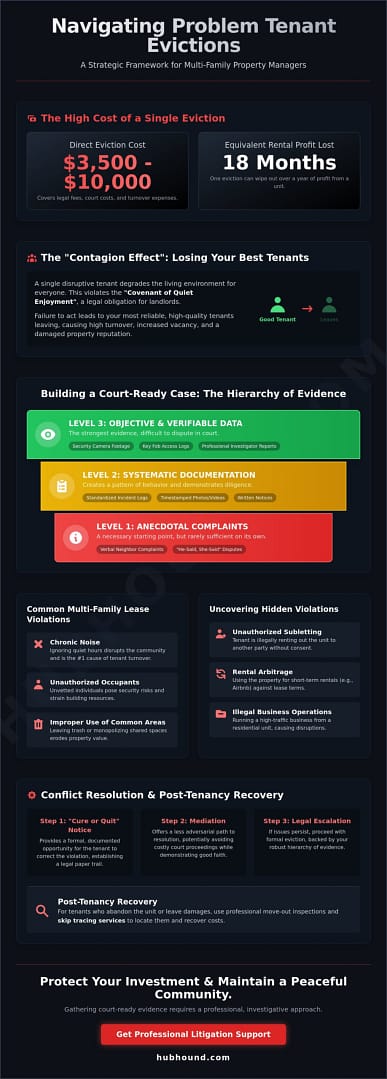
Did you know that a single eviction in 2026 can cost between $3,500 and $10,000, effectively wiping out up to 18 months of rental profit? For multi-family property managers, the financial risk is only half the battle. The true cost often lies in the high turnover of your best tenants who leave because of one disruptive neighbor. You likely understand the frustration of suspecting unauthorized occupants or lease violations but lacking the technical proof to take action. Successfully gathering evidence to evict a problem tenant requires moving beyond simple observations and adopting a rigorous, investigative mindset.
We’ve curated this professional guide to help you master the strategic framework for identifying, documenting, and legally proving lease violations. You’ll learn how to bridge the evidence gap using professional surveillance and documentation techniques that respect privacy rights while building a court-ready case. We’ll explore the specific methods used to verify non-obvious breaches and reduce the risk of retaliatory claims. This approach ensures you can protect your investment, maintain a quiet environment for your residents, and navigate the legal landscape with total confidence.
Key Takeaways
- Understand why high-density multi-family environments require a rigorous enforcement of “quiet enjoyment” clauses to prevent high turnover among your best residents.
- Master the hierarchy of evidence by transitioning from anecdotal complaints to timestamped, third-party documentation when gathering evidence to evict a problem tenant.
- Identify advanced investigative tactics to uncover hidden lease violations, including unauthorized subletting, rental arbitrage, and illegal business operations.
- Implement “Cure or Quit” notices and mediation techniques to provide a clear path for behavioral correction or establish a solid foundation for legal escalation.
- Protect your property’s profitability by conducting professional move-out inspections and utilizing skip tracing to recover costs from tenants who abandon the premises.
The Unique Challenges of Problematic Tenants in Multi-Family Units
High-density living amplifies every friction point. In a multi-family property, a single problematic tenant doesn’t just affect your bottom line; they impact the quality of life for every resident sharing a wall, floor, or ceiling. This creates a “contagion effect” where your most reliable, rent-paying tenants begin to migrate toward quieter properties, leaving you with high vacancy rates and a damaged reputation. Effectively gathering evidence to evict a problem tenant starts with recognizing how these behaviors disrupt the ecosystem of your building. It’s about protecting the collective community while mitigating your personal financial risk.
Unlike single-family rentals, multi-family units require stricter enforcement of lease terms to maintain order. You must distinguish between minor daily annoyances, like the sound of footsteps during the day, and actionable violations that breach the lease agreement. The Eviction process is often triggered not by a single event, but by a pattern of behavior that makes the property untenable for others. Failing to address these issues promptly sends a message that lease violations are tolerated, which can lead to a general decline in property standards.
Identifying Common Multi-Family Lease Violations
Chronic noise is the most frequent catalyst for tenant turnover. When one unit consistently ignores quiet hours, it signals to other residents that management has lost control. This leads to a cycle of complaints and eventual move-outs. Unauthorized occupants also present a significant risk. These individuals aren’t vetted through a professional Landlord/Tenant screening process, which compromises building security and places an uncalculated strain on shared utilities. Improper use of common areas, such as leaving trash in hallways or monopolizing the lobby, further erodes the community’s value and creates additional maintenance costs.
The Legal Doctrine of Quiet Enjoyment
Every lease includes an implied covenant of quiet enjoyment. This isn’t just a courtesy; it’s a legal obligation. You must provide a peaceful environment where residents can live without significant interference. If you fail to act against a disruptive tenant, you risk lawsuits from other residents who claim you’ve breached their right to quiet enjoyment. Balancing the rights of the accused with the rights of the community is a delicate task. You must remain objective and rely on verifiable facts. Successfully gathering evidence to evict a problem tenant ensures that your actions are based on documented breaches rather than subjective complaints, protecting you from retaliatory legal claims and maintaining a professional property environment.
Documentation and Evidence: Building a Court-Ready Case
Success in housing court depends entirely on the quality of your paper trail. Verbal complaints from neighbors are a necessary starting point, but they rarely survive judicial scrutiny on their own. When gathering evidence to evict a problem tenant, you must establish a hierarchy of proof that moves from subjective claims to timestamped, objective data. Judges often dismiss “he-said, she-said” disputes because they lack independent verification. To avoid this, property managers should integrate digital records into their investigative strategy. Security camera footage, key fob access logs, and archived communication through tenant portals provide an unalterable timeline of events that is difficult to dispute.
Establishing a standardized incident log is a critical step for your onsite team. Every maintenance worker or leasing agent who witnesses a violation or receives a complaint should record the date, time, location, and specific behavior observed. This internal log creates a consistent narrative that makes the legal eviction process for landlords significantly smoother. If you find your internal records are insufficient or disorganized, utilizing professional Civil Litigation Support can help you validate and organize your findings before they reach a courtroom.
The Power of Professional Witness Interviews
Objective statements from neighboring tenants are powerful, but they must be handled with care. You need statements that are signed, dated, and formatted to meet local court requirements. Professional investigators can conduct these interviews to ensure neutrality. This prevents the accused tenant from claiming harassment or bias by management. A third-party statement carries more weight because it lacks the emotional charge often found in direct neighbor-to-neighbor disputes. It turns a personal grievance into a documented fact.
Utilizing Professional Legal and Litigation Support
High-stakes evictions require evidence that meets rigorous judicial standards. Professional support services help identify critical gaps in your documentation before you file. They ensure that every piece of evidence, from surveillance footage to witness statements, is legally admissible. This proactive approach reduces the risk of the case being thrown out due to technicalities. By coordinating with legal counsel and investigative experts, you ensure your case is built on a foundation of verified facts rather than assumptions. This level of preparation is essential for maintaining a profitable, well-managed property.
Advanced Tactics for Uncovering Hidden Lease Violations
Hidden lease violations often cause the most long-term damage to a property’s stability. Unlike loud parties or unpaid rent, issues like unauthorized subletting or short-term rental arbitrage can go unnoticed for months while degrading the security of your building. Detecting these requires a shift from passive management to active observation. Look for patterns of high-frequency arrivals with luggage or the use of lockboxes on nearby railings. These behaviors often indicate that your unit is being used as a commercial hotel, which violates standard residential lease agreements and increases liability risks.
Proving the presence of unauthorized long-term guests is equally complex. You must document behavioral patterns over an extended period to distinguish a visitor from a resident. This involves tracking vehicle presence, the regular use of key fobs during early morning hours, and the delivery of mail to unnamed individuals. When gathering evidence to evict a problem tenant for residency violations, consistency is your strongest asset. A single photo of a guest is anecdotal; a log showing a guest entering the building 20 nights in a row is actionable evidence.
Detecting illegal business operations or criminal activity requires a more specialized approach. Watch for unusual traffic patterns where visitors stay for very short durations or arrive at odd hours. Specific smells or excessive utility usage can also signal that a residential unit is being used for industrial or illicit purposes. Documenting these anomalies provides the necessary foundation for local law enforcement involvement or immediate lease termination based on safety violations.
Strategic Landlord and Tenant Screening
Prevention is the most efficient form of management. While some competitors suggest that screening is only for the application phase, recurring Landlord/Tenant screening is vital for maintaining multi-family stability. Identifying red flags early, such as frequent address changes or gaps in employment history, helps you predict future behavioral issues. Verifying current income and employment status ensures that the tenant has the financial stability to remain compliant. If a tenant’s circumstances change significantly, their risk profile changes too, making ongoing assessment a necessary part of professional property oversight.
Surveillance Operations in Residential Environments
Professional Surveillance Operations can bridge the gap between suspicion and proof. However, you must operate within strict legal boundaries to avoid invasion of privacy claims. Documenting patterns of behavior in common areas, such as hallways or parking lots, is generally permissible and highly effective for proving lease non-compliance. Tenants have a legal expectation of privacy within their individual units, but shared hallways and common areas generally do not carry the same legal protection. Focus your efforts on these shared spaces to capture clear evidence of unauthorized pets or illegal business operations. This strategic focus ensures that gathering evidence to evict a problem tenant remains a legal and professional process.
Conflict Resolution and Legal Escalation Strategies
Effective property management requires knowing exactly when to stop negotiating and start the legal countdown. While some advocacy groups suggest mediation is the primary solution for all disputes, this approach is often naive when dealing with professional “squatter” types or serious lease offenders. These individuals frequently use informal mediation as a stall tactic to extend their stay without correcting their behavior. To mitigate risk, you must transition from informal warnings to formal legal notices as soon as a pattern of non-compliance is established. This shift protects your property’s “quiet enjoyment” standards and establishes a clear timeline for the court.
The “Cure or Quit” notice serves as your most powerful tool for behavioral correction. It provides the tenant with a specific timeframe to fix the violation or vacate the premises. If the tenant fails to comply, this notice becomes the cornerstone of your legal filing. During this phase, gathering evidence to evict a problem tenant moves from observation to active verification. You aren’t just looking for a violation; you’re documenting the tenant’s failure to remedy a previously identified issue. This proactive documentation is essential for defeating the common “retaliatory eviction” defense often raised in contested hearings.
Mediation remains useful only for minor disputes between co-tenants where management shouldn’t be the primary arbiter. For example, disagreements over shared kitchen cleanliness or guest frequency can often be resolved through a neutral third party, reducing your management burden. However, once a violation threatens building security or physical property, formal escalation is the only reliable path to resolution. Secure your legal standing by utilizing professional Civil Litigation Support to ensure your case is airtight before reaching a judge.
Professional Process Service and Legal Delivery
Delivery of legal notices is a critical failure point for many landlords. If a notice isn’t served in strict accordance with local and national laws, your entire case can be dismissed on a technicality. This leads to months of lost rent and additional legal fees. Using professional Process Service eliminates this risk. Professionals provide a verified affidavit of service that stands up in court, preventing the tenant from claiming they never received the warning. This level of precision is vital for maintaining the momentum of your legal strategy.
Preparing for a Contested Eviction Hearing
A contested hearing is won or lost based on the organization of your evidence binder. You must present a logical, chronological narrative that leaves no room for ambiguity. Include all communication logs, timestamped photos, and signed witness statements. In high-stakes cases, having an investigator serve as an expert witness can provide the objective, third-party testimony needed to tip the scale. This investigative presence reinforces that your decision to evict is based on rigorous fact-finding rather than personal bias. By organizing your evidence for maximum judicial impact, you demonstrate a level of professionalism that judges respect and rely upon when making their final ruling.
Post-Tenancy Recovery: Dealing with Damages and Vanishing Tenants
Eviction doesn’t end when the tenant leaves the premises. Often, the most challenging work starts when you discover property damage or realize the tenant vanished overnight. These “midnight moves” are common in multi-family environments. They leave owners with thousands in unpaid rent and significant repair costs. You’ve spent weeks gathering evidence to evict a problem tenant. That same documentation now forms the basis for your financial recovery claim. Conduct a professional move-out inspection immediately. Document every wall scuff, broken fixture, and abandoned item with high-resolution photos. This creates a concrete link between the tenant’s residency and the unit’s physical state.
Recovering unpaid rent and repair costs requires a shift from property management to debt recovery. Most housing courts provide a judgment for possession, but they don’t automatically collect the money owed to you. You must take proactive legal steps to secure a money judgment. This involves filing additional claims and proving the exact dollar amount of the damages. Without a professional inspection report and the evidence you collected during the eviction, these claims often fail. Treat the move-out process with the same investigative rigor you applied to the initial lease violations.
Skip Tracing and Locate Investigations
Finding a former tenant is the first step toward debt collection. Many tenants believe that leaving the property ends their financial obligation. You need to prove them wrong. Using professional skip tracing allows you to track down individuals who’ve moved without providing a forwarding address. This process involves verifying new residential addresses and identifying current employment. This information is vital for wage garnishment or serving a summons for a small claims case. Act quickly. The trail goes cold fast as people change phone numbers or move again. Professional locate investigations ensure your legal documents reach the right person at the right time.
Maintaining Organizational Integrity
Every difficult eviction is a learning opportunity. Use these cases to refine your workplace investigations and tenant policies. If a tenant successfully hid violations for months, your inspection protocols need an update. Partnering with a specialized corporate investigation firm helps you protect property assets through more rigorous vetting and surveillance standards. Use this final checklist to restore your unit and select a high-quality resident:
- Complete a line-item damage assessment with cost estimates.
- File a police report if criminal damage or theft occurred.
- Initiate skip tracing for any outstanding balance over $1,000.
- Update lease language to address discovered loopholes or behavioral issues.
- Re-evaluate your screening criteria to prioritize long-term stability.
Securing Your Property’s Future Through Rigorous Documentation
Transitioning from a passive management style to an investigative mindset is the most effective way to protect your multi-family assets. By establishing a clear hierarchy of proof and utilizing professional surveillance, you move beyond simple disputes to build a defensible legal case. It’s about precision. Successfully gathering evidence to evict a problem tenant requires a structured approach, especially when navigating the complexities of housing court and post-tenancy debt recovery. Relying on verified data ensures your property remains both quiet and profitable.
Protect your property and resolve tenant disputes with HubHound’s professional investigative services. Our licensed investigators leverage over 30 years of experience to deliver specialized background screening, skip tracing, and litigation support. We ensure your legal notices are delivered correctly through professional process service, minimizing the risk of court delays. Take the first step toward a more stable property environment today. You have the tools to restore order and protect your investment for the long term.
Frequently Asked Questions
What constitutes a “problematic tenant” in a multi-family unit?
A problematic tenant is someone whose recurring behavior violates the specific terms of a lease agreement or disrupts the “quiet enjoyment” of other residents. Common examples include chronic noise violations, unauthorized occupants, or illegal business operations. In high-density environments, these actions create a contagion effect that drives away reliable neighbors and increases vacancy rates. Identifying these behaviors early is essential for maintaining building stability.
Can I use private investigators for tenant disputes?
Yes, hiring licensed private investigators is a standard professional practice for verifying lease violations that aren’t easily observable by management. Investigators provide objective, third-party testimony and surveillance data that hold up in housing court. This approach is particularly effective when gathering evidence to evict a problem tenant in cases involving unauthorized subletting or suspected criminal activity within the residential unit.
How do I legally document noise complaints from other tenants?
You should require complaining tenants to submit written, timestamped logs that detail the date, duration, and nature of each disturbance. Supplement these personal logs with decibel meter readings or audio recordings from common areas when possible. Professional witness interviews also provide signed, dated statements that transform subjective grievances into legally formatted evidence suitable for a judicial hearing.
What is the most effective way to prove unauthorized subletting?
The most effective method involves documenting a consistent pattern of unknown individuals entering the unit with luggage or using external lockboxes. Cross-referencing key fob access logs with online short-term rental listings provides a digital paper trail. Professional surveillance operations can further verify that the leaseholder is no longer residing on the premises, establishing a clear breach of the residency clause.
Is it legal to perform surveillance on a tenant in a shared building?
Surveillance is legal as long as it’s conducted in common areas where there is no reasonable expectation of privacy. This includes shared hallways, parking lots, and lobby areas. You must never install cameras that view the interior of a private unit. Professional investigators ensure all surveillance adheres to local privacy laws while gathering evidence to evict a problem tenant.
What should I do if a problematic tenant moves out but owes money for damages?
You should immediately conduct a professional move-out inspection and then utilize skip tracing to locate the former resident. Once you’ve verified their new address or place of employment, you can file a claim for a money judgment in small claims court. Acting quickly prevents the trail from going cold and allows for the eventual garnishment of wages to recover your losses.
How can I avoid hiring a problematic tenant in the first place?
Implement a rigorous multi-stage screening process that includes criminal background checks, credit assessments, and employment verification. Don’t rely solely on automated reports; conduct thorough reference checks with previous landlords to identify past behavioral patterns. Consistent screening is the most effective preventative measure for maintaining property stability and reducing the need for future legal action.
When does a tenant’s behavior become a legal liability for the landlord?
Behavior becomes a liability when it threatens the safety of other residents or breaches the implied covenant of quiet enjoyment. If you’re aware of criminal activity or harassment and fail to act, other tenants may have grounds to sue you for negligence. Promptly documenting violations and initiating the eviction process mitigates this risk and protects your professional reputation and property assets.

Article by
Joel R. Manley | President | Hubhound Investigations | OR PI-ID#: 90432 | 111 SW Fifth Avenue, Suite 3150 Portland, Oregon 97204 | 971-442-8170
Joel is licensed as a private investigator in Oregon and Tennessee. Joel started his career in 1987 serving as a Military Police Officer and Military Police Investigator.
After ending his military tour of duty, Joel became a civilian Police Officer and Deputy Sheriff. Joel took his strong background in Hostage Negotiations, Mediation and Conflict Resolution, with him to patrol some of the highest crime areas in SE Portland.
Joel was awarded Deputy of the Year for his efforts and for drastically reducing the crime rate in the area he patrolled. As a Deputy Sheriff, Joel assisted in leading a Neighborhood Livability Program that was nationally recognized for having the most innovative and progressive approach to policing.
In 2018, Joel retired as a Deputy Sheriff and founded Hubhound Investigations. Joel played an integral role in Hubhound Investigations receiving an A+ Accredited Business rating from the Better Business Bureau (BBB).
In his off time, Joel enjoys spending time with his wife, adult children and Hubhound’s Happiness Ambassador, Nya. Joel also enjoys Scuba Diving and Kayaking.
Disclaimer
DISCLAIMER: This article is provided for general informational and educational purposes only. It is not intended to constitute legal advice, professional investigative advice, or instruction to engage in any unlawful activity. Laws governing private investigations, surveillance, recording, tracking, access to information, evidence collection, privacy, trespass, licensing, and related investigative activities vary by jurisdiction and are subject to change.
Any investigative techniques, tactics, procedures, scenarios, or legal proceedings discussed in this article are presented for informational purposes and should not be interpreted as authorization or encouragement to use a particular method. Private investigators and members of the public are responsible for understanding and complying with all applicable federal, state, and local laws, licensing requirements, court rules, and professional standards.
The circumstances of every investigation and legal matter are different. Information contained in this article should not be relied upon as a substitute for advice from a qualified attorney or other appropriate licensed professional regarding a specific situation. No attorney-client, investigator-client, or other professional relationship is created by reading or using this information.