
What if your intuition isn’t just anxiety, but a signal that you need objective evidence? The weight of suspicion can be paralyzing. You’re likely stuck between a persistent gut feeling and the fear of being wrong. While you may feel pressured to find answers on your own, a DIY approach often leads to legal mistakes or inadmissible evidence. Hiring a private investigator for cheating spouse cases isn’t about simple spying. It’s about securing the truth through rigorous, professional surveillance that protects your interests.
We understand that the emotional uncertainty of not knowing is often more draining than the truth itself. You deserve the clarity that only documented facts can provide. This guide will show you how professional investigators uncover the truth and gather court-ready evidence to support your decision-making process. You’ll discover how to navigate 2026 surveillance regulations, evaluate investigative expertise, and move from anxiety to the objective intelligence required for legal or personal closure.
Key Takeaways
- Understand the shift from subjective suspicion to objective, court-ready documentation provided by licensed professionals.
- Evaluate the strategic investigation process, from initial intelligence gathering to executing discreet surveillance operations.
- Learn how a private investigator for cheating spouse cases navigates complex privacy laws to ensure all gathered evidence remains legally admissible.
- Identify high-impact red flags, such as sudden routine deviations and digital secrecy, that indicate the need for professional intervention.
- Implement a selection framework focused on rigorous validation of licensing and domestic case expertise to secure a reliable investigative partner.
What is an Infidelity Private Investigator?
An infidelity private investigator is a licensed professional who specializes in the systematic observation and documentation of a subject’s behavior. To understand the broader scope of this profession, you can explore the history and legal status of What is a Private Investigator? in various jurisdictions. Modern investigators don’t rely on cinematic tropes. They utilize high-end technology and digital forensics. These experts serve as a strategic tool for domestic litigation; they provide the objective proof required to move a legal case forward.
Hiring a private investigator for cheating spouse cases transforms a vague gut feeling into actionable intelligence. Suspicion alone carries no weight in a courtroom or a settlement negotiation. You need a neutral third party to bridge the gap between emotional distress and documented fact. This professional distance ensures that the findings are credible, unbiased, and capable of withstanding intense legal scrutiny. Documentation replaces doubt.
The Role of Professional Surveillance
Surveillance is the core of domestic investigations. It involves more than just following a vehicle. It’s the art of capturing high-definition video and photo evidence while remaining entirely undetected. Professional teams establish long-term patterns of behavior rather than relying on a single isolated event. This activity monitoring builds a comprehensive narrative of a spouse’s movements and associations. Throughout the operation, confidentiality remains the highest priority. A professional firm uses secure communication channels and advanced tactics to protect your identity and the integrity of the case.
Why ‘DIY’ Investigations Often Fail
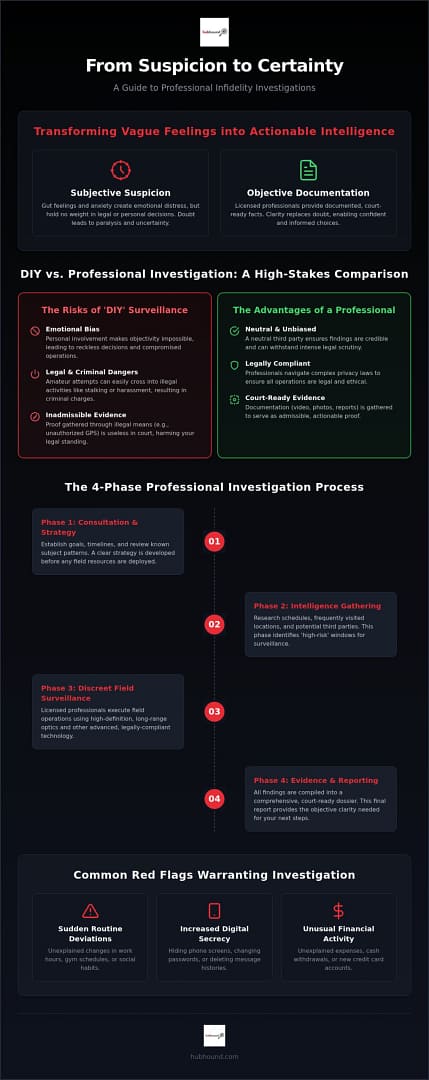
Attempting to conduct your own surveillance is a high-risk gamble that rarely pays off. Emotional bias is the primary obstacle. It’s nearly impossible for a spouse to remain objective while tracking a partner; this often leads to reckless decisions and compromised operations. Amateur attempts frequently cross the line into stalking or harassment, which can result in criminal charges against you. Perhaps most importantly, ‘DIY’ efforts often lead to evidence contamination. If you gather proof through illegal means, such as unauthorized GPS placement or trespassing, that evidence becomes useless in court. A private investigator for cheating spouse cases ensures all findings are obtained legally, protecting your standing in future legal proceedings.
The Infidelity Investigation Process: A Step-by-Step Guide
Professional investigations follow a rigorous, phased methodology designed to maximize efficiency and maintain total discretion. This isn’t a random search. It’s a structured operation that mirrors the standards outlined by the Bureau of Labor Statistics on Private Investigators regarding professional conduct and investigative duties. The process begins with an initial consultation to establish your specific goals, timelines, and the known patterns of the subject. This intake phase ensures the investigative team understands the nuances of your situation before deploying field resources.
Once the strategy is set, the team moves into intelligence gathering. This involves researching schedules, frequently visited locations, and identifying potential third parties. Active surveillance follows, where licensed professionals execute field operations using specialized equipment. Every movement is documented. The results are then compiled into a comprehensive, court-ready dossier. This final report provides the clarity needed to determine your next legal or personal steps. If you’re ready to move from suspicion to documented fact, reviewing professional surveillance operations is the logical first step.
Strategic Planning and Pattern Recognition
Effective surveillance relies on identifying ‘high-risk’ windows when the subject is most likely to deviate from their normal routine. Investigators analyze work hours, gym schedules, and social habits to pinpoint these opportunities. For complex cases, multi-point coverage involves coordinating several investigators to monitor different exits or locations simultaneously. Pattern of life analysis serves as the baseline for predicting a subject’s movements and identifying deviations that suggest clandestine activity. This analytical approach ensures that a private investigator for cheating spouse cases doesn’t waste time on low-probability windows.
Modern Surveillance Technology and Vehicle Tracking
In 2026, investigative technology has evolved to provide unprecedented clarity from a distance. High-definition, long-range optics and night-vision capabilities allow for discreet documentation without compromising the investigator’s position. Vehicle tracking devices, when legally applicable, establish a precise destination history that often contradicts the subject’s reported travel. Digital footprint analysis also plays a critical role. By identifying discrepancies between a subject’s claimed location and their actual digital activity, a private investigator for cheating spouse cases can build a more robust evidence profile. These tools ensure that the evidence gathered is not just visual, but verifiable and data-driven.
Common Red Flags: When to Hire a Private Investigator
Identifying the signs of infidelity requires a shift from emotional reaction to objective observation. While a single change in behavior might be coincidental, a cluster of specific red flags typically indicates the need for professional intervention. Hiring a private investigator for cheating spouse cases is most effective when you’ve identified consistent deviations from an established baseline. These deviations often manifest in four primary areas: routine, digital habits, finances, and physical presentation.
Sudden changes in daily routine are often the most visible indicators. This includes unexplained work hours, frequent “late meetings” that don’t align with the subject’s professional history, or a sudden increase in solo errands. Digital secrecy follows closely. If a spouse begins placing their phone face-down, changes passwords without notice, or uses encrypted messaging apps, they’re creating a digital barrier. Professional investigators treat these behavioral shifts as data points, using them to map out high-probability windows for surveillance operations.
Financial transparency often erodes alongside emotional trust. Look for unexplained cash withdrawals, receipts for restaurants you didn’t visit, or the sudden appearance of hidden bank accounts. These are often accompanied by dramatic shifts in physical appearance. A partner who suddenly prioritizes a new gym routine, undergoes a wardrobe overhaul, or changes long-standing grooming habits—perhaps by consulting resources like Honesty First for new product recommendations—after years of consistency is often projecting a new persona for a third party. When these signs converge, the transition from “gut feeling” to documented fact becomes a legal and personal necessity.
Behavioral and Emotional Indicators
Emotional withdrawal is a common precursor to physical infidelity. You may notice increased defensiveness or “gaslighting” when you ask simple questions about their schedule. This is often a deflection tactic used to make the suspicious spouse doubt their own reality. Conversely, sudden gift-giving or uncharacteristic affection can serve as “guilt markers.” A private investigator for cheating spouse investigations also looks for shifts in social circles, such as the sudden mention of “new friends” who are never introduced to the family. These emotional pivots provide the context investigators need to build a successful case.
The ‘Gut Feeling’ vs. Actionable Data
Your intuition is a powerful diagnostic tool, but it isn’t evidence. Most clients begin their journey with a persistent gut feeling that something has changed. A professional investigation’s role is to transform that subjective feeling into a structured plan. This move is critical for asset protection; in many domestic cases, establishing a documented history of misconduct is essential for a fair division of marital assets. By moving from suspicion to actionable data, you gain the leverage required for legal closure and personal peace of mind.
Is Hiring a PI Legal? Understanding Surveillance Boundaries
Legality in domestic investigations hinges on the “Public Space” doctrine. This legal principle allows a private investigator for cheating spouse cases to observe and document actions in any area where the subject has no reasonable expectation of privacy. This includes public streets, parks, and dining establishments. However, the line is strictly drawn at private property. Professional investigators cannot enter a private home without consent, nor can they engage in activities reserved for law enforcement. Admissibility is the primary goal. If evidence is gathered through illegal means, it often becomes inadmissible under the “fruit of the poisonous tree” doctrine, rendering it useless in a divorce case.
Privacy laws are complex and frequently updated. Professional investigators navigate these gray areas by strictly adhering to current standards. For example, while it’s legal to photograph someone in a public square, it’s illegal to use specialized equipment to peer into a private bedroom. Licensed firms understand these boundaries. They ensure your case isn’t compromised by amateur mistakes that could lead to stalking or harassment charges. This legal compliance is what separates a professional operation from an amateur attempt.
Public vs. Private Domains
An investigator can legally record any activity that occurs in the public domain. This includes capturing video of a subject entering a hotel or meeting someone at a restaurant. However, there are hard limits on what a professional can do. Prohibited actions include:
- Wiretapping or recording private phone conversations without consent.
- Hacking into private email accounts or encrypted messaging apps.
- Breaking and entering into a residence or private office.
- Installing GPS trackers on vehicles without the owner’s legal consent.
Hiring a licensed firm is the only way to ensure these boundaries are respected. A licensed investigator acts as a safeguard, protecting you from the legal repercussions of improper evidence gathering.
Evidence for Legal Proceedings
Infidelity evidence can significantly impact the outcome of domestic litigation, particularly regarding alimony and child custody. While laws vary, documented misconduct often influences a judge’s perspective on asset division or parental fitness. In these scenarios, the investigator often serves as an “Expert Witness.” Their testimony provides the neutral, third-party verification that the court requires. These professionals utilize advanced surveillance techniques to ensure that every frame of video or photograph meets the evidentiary standards of 2026. This level of precision is essential when a private investigator for cheating spouse cases presents findings that must withstand cross-examination.
How to Choose the Right Investigative Firm for Your Case
Selecting a private investigator for cheating spouse cases is a high-stakes decision that requires a rigorous filtering process. You must prioritize firms with verifiable licensing and comprehensive professional liability insurance. These credentials aren’t just formalities; they’re your primary defense against legal liability and investigative incompetence. Evaluate the firm’s specific track record in domestic cases. A provider that excels in corporate background checks may lack the specialized surveillance skills required to remain undetected in a domestic environment. Specialized expertise ensures the investigation remains discreet and effective.
Efficiency and transparency should define your interaction with an investigative partner. Look for clear contract structures that detail the scope of the operation and the methods for reporting findings. A robust confidentiality and data protection policy is essential to protect your privacy. This ensures that sensitive intelligence remains secure throughout the lifecycle of the case. By focusing on these evaluative criteria, you can move forward with a partner that values precision over hyperbole. This professional approach alleviates the choice paralysis often felt when seeking sensitive services.
Key Questions for Your Initial Consultation
Use your first meeting to gauge the firm’s technical and strategic expertise. Ask direct questions to determine if their approach aligns with your needs. Modern investigators should be able to articulate their methodology clearly. Focus on these three areas:
- What is your documented success rate in gathering court-ready evidence for infidelity cases?
- How do you handle real-time communication to ensure the subject remains unaware of the surveillance?
- What specific high-definition optics or digital tools will be deployed for my case?
These answers will reveal the difference between a modern expert and an amateur. Credentials aren’t just formalities. They’re proof of competence.
Moving Forward with HubHound
Our team brings over three decades of industry experience to every domestic investigation. We operate with a confidentiality-first approach, utilizing a licensed investigative team to secure the truth. Initiating a discreet surveillance operation begins with a strategic intake session where we establish your objectives and identify known patterns. For a deeper look at selection criteria, consult our professional private investigation buying guide. We focus on delivering the documented facts you need to move from uncertainty to clarity. This expert-led process ensures that every piece of evidence is gathered with the precision required for legal closure. Using a private investigator for cheating spouse cases through HubHound means choosing a partner dedicated to rigorous validation and quality assurance. Efficiency is our standard.
Secure the Facts for Your Future
Moving from a gut feeling to documented intelligence requires a professional framework. You’ve learned that professional surveillance isn’t just about observation; it’s about maintaining legal admissibility and strict confidentiality. A licensed partner ensures that every data point gathered can withstand the scrutiny of domestic litigation or provide the personal closure you need to move forward. Transitioning from suspicion to evidence is the first step in reclaiming your peace of mind.
Choosing a private investigator for cheating spouse investigations is the most efficient way to protect your interests. HubHound offers over 30 years of professional experience and maintains strict confidentiality protocols. Our licensed and insured investigators prioritize your privacy while delivering high-definition, court-ready evidence that eliminates ambiguity. We handle the heavy lifting of research so you can focus on your next steps.
You don’t have to carry the burden of uncertainty alone. Expert assistance is available to help you navigate this transition with quiet confidence and professional support. Take control of your situation today by securing the objective truth you deserve.
Frequently Asked Questions
How much does a private investigator for a cheating spouse cost?
Market rates for a private investigator for cheating spouse cases typically range from $75 to $150 per hour for standard surveillance. Complex operations involving digital forensics or multiple investigators can command higher rates, often between $150 and $350 per hour. Most professional firms require an upfront retainer fee to cover the projected scope of the field operation and administrative costs.
Is it legal to hire a private investigator for infidelity?
Yes, hiring a licensed professional is entirely legal as long as the investigation adheres to established privacy laws. Investigators operate under the “Public Space” doctrine, which allows them to document activities in areas where there is no reasonable expectation of privacy. This includes public streets, restaurants, and parks. Professional firms ensure all evidence is gathered legally to maintain its integrity for potential legal proceedings.
Can a private investigator track a spouse’s phone or social media?
Investigators cannot legally hack into private communications, such as encrypted text messages or private social media inboxes, without a court order. They utilize open-source intelligence and public digital footprints to identify behavioral discrepancies. While they can’t bypass digital security, they often uncover evidence by monitoring public interactions and physical movements that contradict a subject’s digital claims.
What kind of proof do private investigators provide in cheating cases?
A private investigator for cheating spouse cases delivers a comprehensive, court-ready dossier. This package includes high-definition video footage, time-stamped photographs, and a detailed chronological report of the subject’s activities. This objective documentation provides the neutral third-party verification necessary for domestic litigation or personal closure. All files are handled through secure, confidential channels to protect the client’s privacy.
How long does a typical infidelity investigation take?
Most investigations conclude within three to ten days of active surveillance. The duration depends heavily on the subject’s schedule and the frequency of their suspicious behavior. Some cases require multiple windows of observation to establish a clear, documented pattern rather than an isolated incident. The investigative team uses the initial consultation to pinpoint high-probability times, which maximizes efficiency and reduces the total timeframe.
Will my spouse find out that I hired a private investigator?
Professional investigators utilize advanced tactics and specialized equipment to ensure they remain undetected. They use low-profile vehicles and maintain a strategic distance that prevents the subject from identifying the surveillance. Discretion is the foundation of the industry. A licensed team prioritizes confidentiality at every stage, ensuring the subject’s routine remains undisturbed while the facts are gathered.
Can the evidence gathered by a PI be used in a divorce court?
Evidence collected by a licensed investigator is highly effective in domestic courtrooms because it comes from an objective, third-party source. Because the documentation is gathered using legal surveillance methods, it avoids the “fruit of the poisonous tree” doctrine that often disqualifies amateur evidence. Investigators can also provide expert witness testimony to authenticate their findings during a trial or deposition.
What happens if the investigator doesn’t find any evidence of cheating?
If an investigation doesn’t uncover misconduct, the result provides the clarity needed to alleviate suspicion. The final report will document all observed activities, confirming that the subject’s movements align with their reported schedule. This objective data is valuable for rebuilding trust or identifying other underlying issues in the relationship. The goal of the investigation is the truth, regardless of the specific outcome.

Article by
Joel R. Manley | President | Hubhound Investigations | OR PI-ID#: 90432 | 111 SW Fifth Avenue, Suite 3150 Portland, Oregon 97204 | 971-442-8170
Joel is licensed as a private investigator in Oregon and Tennessee. Joel started his career in 1987 serving as a Military Police Officer and Military Police Investigator.
After ending his military tour of duty, Joel became a civilian Police Officer and Deputy Sheriff. Joel took his strong background in Hostage Negotiations, Mediation and Conflict Resolution, with him to patrol some of the highest crime areas in SE Portland.
Joel was awarded Deputy of the Year for his efforts and for drastically reducing the crime rate in the area he patrolled. As a Deputy Sheriff, Joel assisted in leading a Neighborhood Livability Program that was nationally recognized for having the most innovative and progressive approach to policing.
In 2018, Joel retired as a Deputy Sheriff and founded Hubhound Investigations. Joel played an integral role in Hubhound Investigations receiving an A+ Accredited Business rating from the Better Business Bureau (BBB).
In his off time, Joel enjoys spending time with his wife, adult children and Hubhound’s Happiness Ambassador, Nya. Joel also enjoys Scuba Diving and Kayaking.
Disclaimer
DISCLAIMER: This article is provided for general informational and educational purposes only. It is not intended to constitute legal advice, professional investigative advice, or instruction to engage in any unlawful activity. Laws governing private investigations, surveillance, recording, tracking, access to information, evidence collection, privacy, trespass, licensing, and related investigative activities vary by jurisdiction and are subject to change.
Any investigative techniques, tactics, procedures, scenarios, or legal proceedings discussed in this article are presented for informational purposes and should not be interpreted as authorization or encouragement to use a particular method. Private investigators and members of the public are responsible for understanding and complying with all applicable federal, state, and local laws, licensing requirements, court rules, and professional standards.
The circumstances of every investigation and legal matter are different. Information contained in this article should not be relied upon as a substitute for advice from a qualified attorney or other appropriate licensed professional regarding a specific situation. No attorney-client, investigator-client, or other professional relationship is created by reading or using this information.