
Could a brief trip to the store be treated as proof that you can work full time? That concern is understandable: activity checks for a long-term disability claim may capture a single moment without showing what happened before or after it. An observation can raise questions, but it does not explain your symptoms, recovery time, or overall functional limits on its own.
Understanding what an activity check may document can help you respond calmly and keep the record accurate. This article explains common observation methods, how insurers may compare observations with reported limitations and medical evidence, and why context matters when interpreting a short video or photograph.
You will also find practical ways to preserve relevant details, such as keeping consistent activity records and sharing accurate information with your healthcare providers and claims administrator. The goal is not to change your routine to avoid being observed. It is to understand what observations can and cannot establish, and how they fit into the policy-specific review of a long-term disability claim.
Key Takeaways
- Activity checks can involve different forms of documentation. Their scope may depend on the insurer, claims administrator, policy, and circumstances.
- Observations, your reports, medical records, and policy terms each contribute different information to a claim review.
- If activity checks for a long-term disability claim are raised, review the evidence and note specific factual inaccuracies before responding.
- Keep accurate records of symptoms, treatment, limitations, and activity context to clarify what a snapshot may leave out.
- Professional investigators can document observations and distinguish recorded facts from interpretation, but their findings do not determine medical status or benefit eligibility.
What Are Activity Checks for a Long-Term Disability Claim?
Activity checks for a long-term disability claim are efforts to observe or document a claimant’s activities. Insurers or claims administrators may consider the information alongside the claimant’s statements, medical records, and policy terms. The process is not identical in every case. Methods and scope can vary with the policy, the assignment, and the circumstances.
An observation records a particular moment, not a complete picture of someone’s health or day-to-day capacity. Carrying a bag once, for example, does not by itself establish that a person can repeat the task throughout a workday or sustain full-time employment. Disability insurance provides benefits under the terms of a particular policy, as outlined in this general overview of Disability Insurance. A claim decision depends on more than a single observed action.
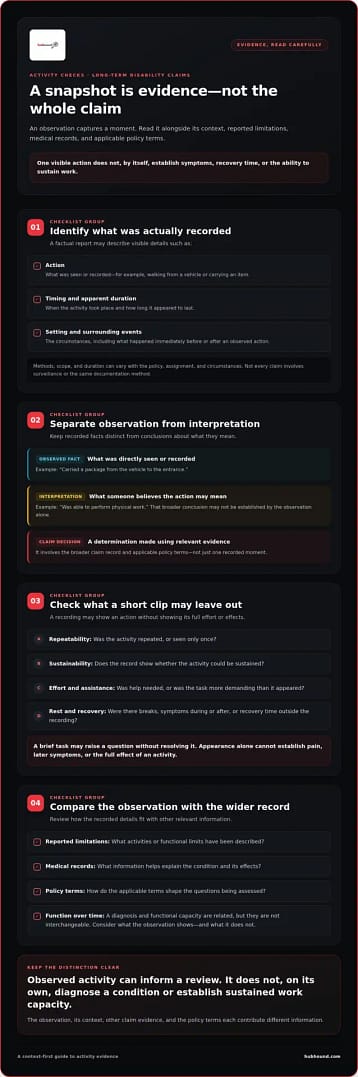
Observation: What was directly seen or recorded, including an action, time, duration, and setting.
Interpretation: What someone believes the observation may mean about function or consistency with reported limits.
Claim decision: A determination made after considering relevant evidence and applicable policy terms.
What might an activity check document?
A factual record may describe visible actions and the circumstances in which they occurred. It might note that someone walked from a vehicle to a building, carried an item, or sat in one place for a period of time. It may also record when the activity took place, how long it appeared to last, and the setting. These details help separate what was observed from conclusions drawn later.
A recording may show someone lifting an object, but appearance alone cannot establish whether the action caused pain, what symptoms followed, or whether the person needed recovery time. An activity check does not diagnose a condition or reveal the full effects of an illness. Those questions require other evidence and context.
- Direct observation: An action or event that was seen or recorded.
- Context: Timing, apparent duration, and circumstances surrounding the activity.
- Inference: A conclusion about symptoms or capacity that the observation alone may not prove.
Not every claim involves surveillance or the same documentation method. Whether information is gathered, and how, depends on the circumstances of the claim.
Why might activity evidence be considered?
Claim reviewers may compare relevant observations with reported limitations and other information in the claim file. They may consider whether the evidence appears consistent or raises questions that need clarification. The policy language and full claim record shape how information is assessed. A general observation does not answer every policy-specific question.
A diagnosis and functional capacity are related, but they are not interchangeable. A diagnosis identifies a health condition; functional capacity concerns how that condition affects activities. One brief task may be a piece of evidence, but it does not establish someone’s sustained abilities across different tasks or over time. Consider what the record shows, what it leaves out, and how it fits with the broader evidence.
How Activity Checks Gather and Record Information
There is no fixed process for activity checks for a long-term disability claim. If an insurer or claims administrator assigns an investigation, it may involve defining the assignment, gathering observations, recording details as events occur, and preparing a report. The method, scope, and duration depend on the assignment and circumstances. No single schedule or approach applies to every claim.
Clear documentation separates what an investigator directly observed from any interpretation of what it might mean. That distinction helps readers assess the evidence without treating a recorded moment as proof of broader work capacity. An investigator can report visible actions; the report alone cannot establish a diagnosis, symptoms, or the full effect of an activity.
What does an investigator’s report typically describe?
A report may describe an observed action, its approximate timing and duration, and relevant context, such as the setting or what happened immediately before or after it. Precise notes are more useful than broad labels like “active” because they let a reviewer see which details were recorded and which conclusions would require further assessment.
Reports should distinguish direct observations from interpretation or information provided by someone else. For example, “carried a package from the vehicle to the entrance” describes an action. “Was able to perform physical work” is a broader conclusion that the observation alone may not support.
Why can context change how an observation is understood?
A brief recording may not show whether an action was repeated, how much effort it required, or whether it was sustainable. Assistance, rest breaks, symptoms during or after the activity, and recovery time may not be visible. A clip can raise a question without resolving it, so an observed activity does not necessarily contradict a claimant’s stated limitations.
Review the sequence, not just the most striking moment. Someone may complete a task once and then need to rest, or manage an activity only with help. Those details matter when observations are compared with reported functional limits and the wider claim record.
Privacy and surveillance rules can depend on the jurisdiction and circumstances. A general description of investigative methods does not determine what is legally permitted in a specific case; that requires current, jurisdiction-specific verification. The Social Security Administration’s disability fraud guidance concerns its own programs and does not set procedures for private long-term disability claims.
For legal and corporate matters where observations need clear, factual documentation, HubHound provides investigative support. Its role is to organize evidence, not decide benefit eligibility.
How Activity Evidence Compares With Medical Records and Claim Terms
Activity checks for a long-term disability claim are one source of information, not a medical examination or complete assessment of disability. Compare each item with the question it can answer and the limits of what it shows. A brief observation, a claimant’s account, clinical records, and policy language serve different roles. None should substitute for the others.
| Evidence type | What it may help clarify | What it cannot establish alone |
|---|---|---|
| Observations | Visible actions at a particular time and in a particular setting. | Diagnosis, pain level, symptoms outside the observation, or sustained capacity. |
| Claimant reports | Described symptoms, limitations, and how activities affect daily life. | Medical findings or policy eligibility without consideration of other evidence. |
| Medical records | Clinical findings, treatment history, and a provider’s assessment. | Every activity or limitation experienced outside appointments. |
| Policy language | The plan’s definitions and criteria for evaluating the claim. | Whether those criteria are met without applying them to the full record. |
Review the evidence together. If a report describes an activity that appears different from a stated limitation, compare the exact action, timing, and circumstances with the claimant’s account and relevant medical information. The difference may call for context or clarification, but it does not by itself predict the insurer’s conclusion.
What can observations show that medical records may not?
Observations can capture visible actions in a specific setting that may not appear in clinical notes, such as how someone manages a task outside an appointment. But a recording cannot reveal pain level, hidden symptoms, or the after-effects of exertion simply by showing that an action occurred. The absence of visible difficulty is not proof that symptoms were absent.
How do policy definitions affect interpretation?
Start with the specific policy governing the claim. Some policies define disability in relation to a person’s own occupation; others may use different work-related criteria or policy-specific review standards. Do not assume a general description fits your plan. The wording, relevant definitions, and individual claim record shape how evidence is assessed.
For example, an observation of someone completing a household task documents that particular action. Whether it bears on a policy’s functional criteria depends on the task’s demands, reported limitations, medical evidence, and policy language. It does not automatically establish capacity for the duties, pace, or consistency required in a job.
Keep the questions distinct: What was observed? What did the claimant report? What do the medical records indicate? What does the policy require? This evidence map helps identify where information aligns, where it differs, and what context may be needed, without treating activity evidence as a definitive disability assessment.
What to Do if Activity Checks Are Raised in Your Claim
Stay factual and work through the information in order. If an insurer or claims administrator raises activity evidence, first understand what it shows and what response is requested. Follow the instructions provided for your claim, and keep your response accurate.
- Review the notice. Identify what the insurer says it observed, the dates or materials referenced, and whether it requests a specific step by a stated deadline.
- Identify the evidence. Use the claim instructions to understand what information is being discussed and how it relates to the review. If something is unclear, note the specific question instead of guessing.
- Check for factual inaccuracies. Compare the description with reliable records and your recollection. Note precisely what appears inaccurate and what information supports your understanding.
- Preserve relevant context. Keep a clear record of symptoms, limitations, treatment, and activities. Follow applicable claim instructions and seek qualified advice if you need help with a claim-specific decision.
This measured approach is useful if activity checks for a long-term disability claim become part of the review. It creates a clearer account without overstating what any one piece of information proves. Similarly, for military veterans dealing with the complexities of disability documentation and securing the benefits they earned, advocacy organizations such as militaryveteransolutions.org offer guidance tailored to service-connected claims.
How can claimants preserve useful context?
When possible, make notes close to the time an activity occurs. Record what you did, how long it lasted, symptoms during or afterward, rest breaks, assistance, and recovery. Keep the details concrete. “Needed to rest after preparing a meal” is more informative than a general label such as “limited activity.”
Organize relevant appointment records and communications in their original form. Do not alter documents. If you need to correct a factual point, write a separate note identifying the source and date of the information. Distinguish what you remember from what a record confirms. If you are unsure, say so rather than filling in gaps.
Which responses can create avoidable complications?
Avoid guessing about what an investigator saw or making unsupported accusations. If you disagree with a description, identify the specific detail and explain the basis for your correction. Do not conceal activities, change truthful statements, or obstruct an investigation. Consistent, accurate information is more useful than trying to anticipate what an insurer may conclude.
Do not post explanations that could create a misleading impression, and do not delete relevant records. If a notice raises a difficult question about your obligations or response, consult the policy and consider getting advice from qualified counsel familiar with your claim. The applicable policy and individual circumstances matter, so general guidance cannot determine the right response in every case.
For legal or corporate matters that require objective investigative documentation, explore HubHound’s professional investigative support.
How Professional Investigative Support Can Clarify Activity Evidence
Professional investigators can help turn observations into an organized factual record. In matters involving activity checks for a long-term disability claim, that means documenting what was observed, when it occurred, and the surrounding circumstances, while keeping conclusions separate from direct observations. Clear records give legal and corporate clients information to review alongside other evidence.
Investigative findings have a defined role. They can describe observed activity and preserve relevant details, but they do not diagnose a condition, assess medical capacity, interpret policy eligibility, or determine benefits. Those questions belong to the appropriate medical and claims review processes. Treat investigative documentation as one source of information, not a ruling on a claim.
What makes investigative documentation useful?
Useful documentation is specific and traceable. A clear timeline can help readers understand the sequence of events, while precise descriptions make it easier to distinguish what an investigator saw from what someone later inferred. Broad characterizations can blur that line; neutral, factual language keeps it clear.
Careful evidence handling also matters. Sensitive information should be managed discreetly and professionally, with records organized so the intended reviewer can understand their source and context. Investigators can document observations and present them clearly without claiming to know a person’s symptoms, diagnosis, or experience beyond what the evidence supports.
No documentation can promise a particular result, establish that evidence will be admissible, or predict how it may affect benefits. Its value is in providing a clear account for review, with limitations and context intact.
When might investigative support fit into a claim matter?
Legal or corporate clients may need factual activity documentation when reviewing a matter in which observed conduct is relevant. The investigator’s assignment is to gather and organize information within its scope, not to decide whether a medical condition exists or whether a policy’s eligibility criteria are met.
HubHound conducts surveillance operations and supports legal and corporate clients with evidence gathering. A careful investigative process can keep the record focused on verifiable observations rather than assumptions about what an activity means. That distinction is useful when a short observation may be weighed alongside broader claim materials.
Explore HubHound’s professional investigative support when objective activity documentation is relevant to a legal or corporate matter.
Keep Your Next Step Grounded in the Record
When activity checks for a long-term disability claim raise questions, focus on what the available information can actually establish. Keep your records accurate, follow claim instructions, and make decisions based on the policy and specific evidence, not assumptions about what an observation means.
For legal or corporate matters where objective activity documentation is relevant, HubHound provides nationwide investigative support, including surveillance operations. Its licensed investigators bring more than three decades of industry experience. Investigative findings can help organize factual information for review, while medical and benefit determinations remain separate.
A clear record can make a complex situation easier to assess. Contact HubHound to discuss investigative support for a legal or corporate matter requiring objective activity documentation.
Frequently Asked Questions
What do activity checks for a long-term disability claim look for?
They look for observable activities that may relate to limitations described in the claim. For example, if a claim discusses difficulty with prolonged standing, a reviewer may consider an observation involving standing while also examining what the record does and does not show. The purpose is not to diagnose a condition. An observed action may prompt follow-up questions, but its relevance depends on the claimed limitation and the rest of the evidence.
Can an activity check alone end long-term disability benefits?
An activity check does not automatically end benefits. The insurer’s decision depends on the policy and the evidence considered in the claim review. If you receive a notice about a decision or a request for information, read it carefully and note any response instructions or deadlines. Keep a copy of what you submit. For guidance on how the policy applies to your circumstances, consider speaking with qualified counsel, such as the team at szlaw.ca.
Is it legal for an insurer to conduct surveillance during a disability claim?
Whether a particular surveillance method is lawful depends on applicable law and the circumstances. There is no blanket answer for every investigation or method. If you are concerned about how information was obtained, write down the specific facts and raise them with qualified counsel familiar with the relevant jurisdiction. Do not rely on general online descriptions to decide whether a specific action was permitted.
What happens if an activity check shows me doing something I reported I cannot do?
The insurer may compare the observation with your statement and other claim information, then ask for clarification or consider it during its review. Be precise about what you meant by “cannot do”: whether you meant never, repeatedly, without assistance, or without worsening symptoms may matter. Do not guess about the recording. Review the exact description, explain any factual difference honestly, and follow the claim’s response instructions.
Can ordinary activities contradict a long-term disability claim?
An ordinary activity can raise a question, but it does not automatically contradict a claim. Completing a household task once, for instance, does not show whether you could perform it repeatedly, maintain a work pace, or manage symptoms afterward. Be accurate about your abilities and limitations rather than avoiding normal activities out of fear. If an activity is later discussed, explain its circumstances truthfully and consistently with your claim records.
How should I respond if an insurer questions my activities?
Respond calmly and use the claim’s instructions to guide your next steps. Identify the specific activity or statement being questioned, then check relevant records before replying. Separate what you remember from what documents establish, and correct errors with clear, factual details. Do not delete records, make unsupported accusations, or change a truthful account. If the issue could affect your claim or requires interpretation of policy terms, seek qualified advice.

Article by
Joel R. Manley | President | Hubhound Investigations | OR PI-ID#: 90432 | 111 SW Fifth Avenue, Suite 3150 Portland, Oregon 97204 | 971-442-8170
Joel is licensed as a private investigator in Oregon and Tennessee. Joel started his career in 1987 serving as a Military Police Officer and Military Police Investigator.
After ending his military tour of duty, Joel became a civilian Police Officer and Deputy Sheriff. Joel took his strong background in Hostage Negotiations, Mediation and Conflict Resolution, with him to patrol some of the highest crime areas in SE Portland.
Joel was awarded Deputy of the Year for his efforts and for drastically reducing the crime rate in the area he patrolled. As a Deputy Sheriff, Joel assisted in leading a Neighborhood Livability Program that was nationally recognized for having the most innovative and progressive approach to policing.
In 2018, Joel retired as a Deputy Sheriff and founded Hubhound Investigations. Joel played an integral role in Hubhound Investigations receiving an A+ Accredited Business rating from the Better Business Bureau (BBB).
In his off time, Joel enjoys spending time with his wife, adult children and Hubhound’s Happiness Ambassador, Nya. Joel also enjoys Scuba Diving and Kayaking.
Disclaimer
DISCLAIMER: This article is provided for general informational and educational purposes only. It is not intended to constitute legal advice, professional investigative advice, or instruction to engage in any unlawful activity. Laws governing private investigations, surveillance, recording, tracking, access to information, evidence collection, privacy, trespass, licensing, and related investigative activities vary by jurisdiction and are subject to change.
Any investigative techniques, tactics, procedures, scenarios, or legal proceedings discussed in this article are presented for informational purposes and should not be interpreted as authorization or encouragement to use a particular method. Private investigators and members of the public are responsible for understanding and complying with all applicable federal, state, and local laws, licensing requirements, court rules, and professional standards.
The circumstances of every investigation and legal matter are different. Information contained in this article should not be relied upon as a substitute for advice from a qualified attorney or other appropriate licensed professional regarding a specific situation. No attorney-client, investigator-client, or other professional relationship is created by reading or using this information.