
A single procedural error in legal document delivery can stall an entire eviction case for months, costing property owners significant time and lost revenue. Serving eviction papers in Multnomah County requires more than just a knock on a door; it demands a tactical approach to skip tracing and precise adherence to statutory requirements. It’s a high-stakes environment where a minor technicality can lead to an immediate dismissal, forcing you to restart the entire process from scratch.
We recognize the frustration caused by tenants who evade service or the slow response times often associated with local authorities. This guide provides the expert framework you need to master the logistics of professional delivery and ensure your eviction process remains legally compliant. You’ll learn how to utilize advanced skip tracing to locate tenants who have moved and discover the best practices for securing court-validated service that minimizes your overall time-to-court.
Key Takeaways
- Align your document delivery with rigorous legal standards to eliminate the risk of technical dismissals during court proceedings.
- Master the tactical nuances of serving eviction papers in Multnomah County by utilizing investigative methods that outperform standard civil servant delivery.
- Deploy professional skip tracing to locate tenants who are actively hiding, ensuring that your case moves forward without unnecessary delays.
- Identify high-quality service partners who prioritize speed and efficiency to help you meet the tight deadlines typical of urban jurisdictions.
- Transition to an investigative model of process service to handle hard-to-serve cases and secure court-validated results more reliably.
Understanding the Legal Standards for Serving Eviction Papers
Process service acts as the procedural backbone of the legal system. It’s the formal delivery of legal notice that satisfies the constitutional requirement of due process. Without verified delivery, a court cannot exercise jurisdiction over a tenant. When Understanding the Legal Standards for Serving Eviction Papers, you must recognize that strict adherence to statutory rules is not optional. Any deviation from these protocols can lead to an immediate case dismissal.
Serving eviction papers in Multnomah County requires a high level of precision. Courts demand definitive proof that the tenant received the documents according to specific timelines and methods. This proof is formalized in an Affidavit of Service. This document is your primary evidence of compliance. It details the date, time, and location of delivery, along with a description of the recipient. If this document is incomplete or contains errors, your legal timeline effectively resets, costing you both time and rental income.
The Role of Due Diligence in Process Service
Courts evaluate “due diligence” based on whether a process server made a reasonable effort to locate the defendant. This isn’t a simple task. Professional standards usually dictate multiple attempts at various times of the day to account for different work schedules. Establishing diligence is critical when a tenant is evasive. If personal service fails after repeated, documented attempts, the court may allow substituted service or posting. You can’t skip straight to these alternatives without demonstrating that you’ve exhausted all reasonable paths to direct delivery. Documenting these efforts transforms a standard delivery into a court-validated investigative record.
Common Legal Pitfalls in Document Delivery
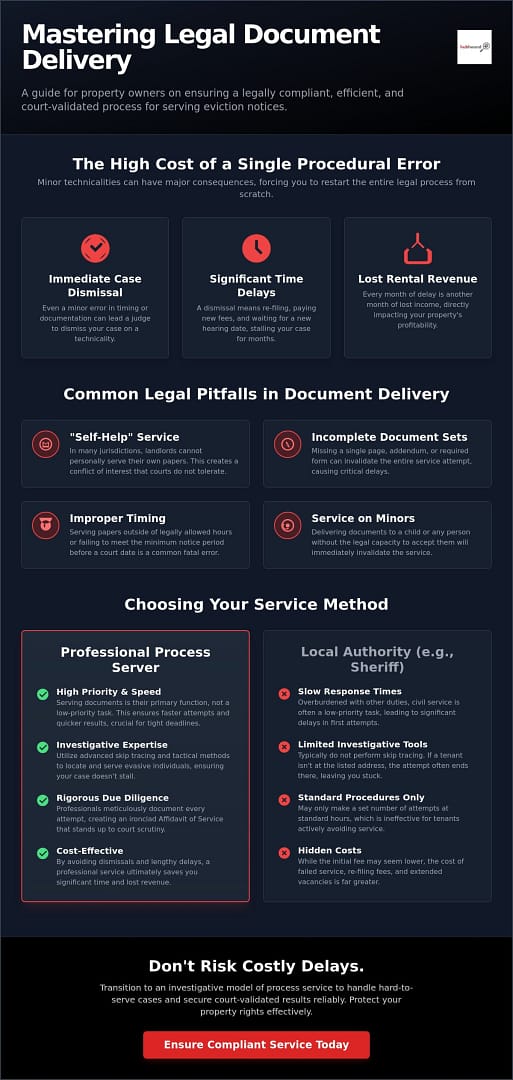
One of the most frequent mistakes is “self-help” service. In many jurisdictions, a landlord cannot personally serve their own eviction papers. Using an interested party creates a conflict of interest that judges rarely tolerate. Other pitfalls include:
- Improper Timing: Serving papers outside of allowed hours or failing to meet the minimum notice period before a court date.
- Incomplete Document Sets: Missing a single page of the summons or complaint can invalidate the entire service.
- Service on Minors: Delivering papers to a child or someone without the legal capacity to accept them.
A single procedural error doesn’t just delay the case. It often forces you to pay new filing fees and wait for a new hearing date. Efficiency in this phase is the only way to protect your property rights effectively. When you’re serving eviction papers in Multnomah County, hiring a neutral third party ensures that the process meets every technical requirement the first time.
The Step-by-Step Process for Serving Eviction Papers in Multnomah County
Speed is the primary driver of success in any urban eviction proceeding. Most major jurisdictions operate on fast-moving court calendars where a delay of even 24 hours can push your hearing date back by weeks. Effective delivery is a coordinated effort between the landlord and the server. It transitions the case from a theoretical legal filing to an active judicial matter. To maintain momentum, you must treat the delivery phase as a tactical operation that requires immediate action and precise documentation.
Preparing Your Legal Document Packet
Precision begins before the server ever leaves their office. You must organize a complete packet containing the summons, the complaint, and all required supplemental forms. Accuracy is non-negotiable. Ensure that the recipient’s name is spelled exactly as it appears on the lease agreement. Even a minor typo in an address can provide a tenant’s attorney with the grounds needed for a dismissal. Verify that every copy is identical and properly timestamped by the clerk. This level of preparation prevents the server from being turned away at the door due to a clerical oversight.
Executing the Delivery Protocol
Serving eviction papers in Multnomah County requires a disciplined approach to field operations. The server must first confirm the identity of the individual before handing over the documents. Hostile interactions are a common reality in high-stakes housing disputes. Professional servers are trained to remain neutral and de-escalate these situations while ensuring the legal requirements for delivery are met. Every detail matters during the encounter. The server must record the exact time, date, and a detailed physical description of the person who accepted the papers. When evaluating your options for Professional Process Service vs. Local Authority Delivery, consider how an investigative approach provides a more robust record for the court.
Filing the Proof of Service
The process isn’t complete until the court receives the Affidavit of Service. This document serves as the official testimony that the tenant was properly notified. You must complete this certificate with granular detail, reflecting the data gathered during the execution phase. Missing a filing deadline with the clerk can result in the court striking your case from the docket. Maintain a digital record of all attempts, including those that were unsuccessful. This data trail is vital if a tenant later claims they were never served. For landlords who need to ensure these technicalities are handled without error, choosing a specialized partner for process service is a strategic move that protects your timeline.
Skip Tracing: Locating Tenants Who Are Evading Service
Standard delivery methods often fail when a tenant actively hides to avoid legal consequences. This evasion creates a significant bottleneck in the judicial process. Skip tracing serves as a critical investigative tool that identifies a target’s current location through data-driven analysis. It moves the process from passive delivery to active recovery. When serving eviction papers in Multnomah County, relying on outdated address data is a recipe for dismissal. You need precise, real-time intelligence to ensure the papers reach the correct hands. This investigative layer is what separates professional process service from basic courier tasks.
A failed service attempt doesn’t just stall your timeline; it alerts the tenant that you’re looking for them. This often leads to even more aggressive evasion tactics. Investigative skip tracing minimizes this risk by confirming the target’s location before the first knock. Professionals look for digital breadcrumbs that go beyond what’s available to the general public. This ensures that every field attempt is backed by a high degree of certainty, preventing the wasted effort of visiting vacant properties or outdated workplaces.
Advanced Techniques for Locating Evasive Parties
Investigators utilize specialized, non-public databases that track utility records, professional licenses, and credit headers. These sources provide a more accurate picture than standard search engines or social media alone. Professional skip tracing within a modern legal support framework also analyzes social media footprints and professional networks to pinpoint a tenant’s daily movements. By cross-referencing these data points, professionals verify an address before any field attempts occur. This saves time and prevents the “burn” of a location where the target no longer resides. It’s about finding where they are now, not where they were six months ago.
Surveillance as a Tool for Guaranteed Service
Confirming a target’s location is only half the battle. Surveillance allows a server to establish the target’s daily routine. This identifies the optimal window for service, especially when dealing with secure access buildings or protective gatekeepers like front-desk staff or roommates. Discreet observation ensures the target is actually on-site before an attempt is made. This investigative approach is essential when serving eviction papers in Multnomah County to individuals who have successfully dodged previous attempts. It transforms a game of chance into a calculated, high-probability operation.
Using these tactics ensures that even the most evasive tenants receive legal notice, keeping your case on the court’s schedule. Surveillance provides the visual confirmation that a database cannot, closing the gap between a lead and a successful service. When a tenant knows they’re being sought, they change their patterns. A professional investigator adapts to those changes in real-time, ensuring the delivery is executed legally and promptly.
Professional Process Service vs. Local Authority Delivery
Choosing between a local official and a private agency represents a choice between a routine administrative task and a tactical objective. While local authorities are a common option, their approach is often reactive. They follow a standard checklist that may not account for the complexities of an evasive tenant. Serving eviction papers in Multnomah County requires a proactive stance. If you rely on a civil servant who only attempts service during standard business hours, you risk missing the narrow window when a tenant is actually home. This delay can have a cascading effect on your entire legal timeline.
Most local government offices operate with strict attempt quotas. If a deputy fails to make contact after a predetermined number of tries, they return the papers as unserved. This failure forces you to restart the process, pay additional filing fees, and wait for a new hearing date. Private agencies don’t just check boxes. They use investigative data to determine the best time to strike, significantly increasing the likelihood of a first-attempt success. This efficiency is vital when you’re managing high-value property assets.
Efficiency and Success Rates
Private servers provide the flexibility that high-stakes legal proceedings demand. They aren’t restricted to a 9-to-5 schedule. They operate early in the morning, late at night, and on weekends to catch tenants off-guard. This agility is crucial for navigating difficult-to-reach locations like gated communities or luxury high-rises where security protocols can stop a standard delivery attempt. An investigative server understands how to manage these gatekeepers legally to reach the target, ensuring that serving eviction papers in Multnomah County remains a streamlined process rather than a logistical nightmare.
Communication and Reporting Standards
Modern legal support requires modern communication. You shouldn’t have to wait weeks for a paper return to arrive in the mail to know if your tenant was served. Private agencies utilize digital platforms to provide instant updates after every field attempt. This level of transparency allows you to adjust your legal strategy in real-time. You gain direct access to the investigator handling your file, ensuring that any specific nuances of the case are documented correctly for courtroom scrutiny. High-quality documentation is your best defense against a tenant’s claim of improper notice.
The cost-to-value ratio heavily favors the investigative approach when you factor in the financial impact of a delayed eviction. A single month of lost rent often far exceeds the professional fee for a guaranteed service. To secure your property rights and ensure your court date remains on schedule, hire a professional process service partner today.
Why Investigative Expertise is Critical for Legal Support
Mastering the logistics of legal document delivery requires more than just a map and a summons. When you’re serving eviction papers in Multnomah County to a tenant who has successfully evaded previous attempts, you need a partner who views the task through an investigative lens. Standard delivery services often lack the resources to handle hard-to-serve cases where the target is actively hostile or deeply concealed. Professional investigators bridge this gap by applying high-standard protocols that are applicable across any jurisdiction, ensuring your case remains on solid legal footing.
Hiring licensed professionals for litigation support isn’t just about getting papers into hands. It’s about risk mitigation. An investigator ensures that every action taken is compliant with national privacy laws and local judicial rules. This level of specialization transforms process service from a simple administrative chore into a robust investigative operation. When the stakes involve serving eviction papers in Multnomah County, you can’t afford a service failure. By utilizing a professional solution, landlords and legal professionals can focus on the merits of their case rather than the frustrations of field work.
The HubHound Advantage in Civil Litigation
Efficiency in legal support comes from a unified workflow. We merge surveillance, skip tracing, and delivery into a single, cohesive strategy. This integration significantly reduces the cognitive load on legal teams. You don’t have to manage multiple vendors or cross-reference conflicting reports. Instead, you receive a verified, court-ready record that meets rigorous validation standards. Every attempt is documented with precision, ensuring that your actions stand up to the highest levels of courtroom scrutiny while remaining compliant with national privacy and legal standards.
Ensuring Your Case Moves Forward
The primary goal of professional service is to maintain the momentum of your eviction timeline. A no-excuses approach to service means that obstacles like gated access, evasive behavior, or outdated information are addressed immediately through investigative tactics. This prevents the costly delays that occur when a case is dismissed due to improper notice. You gain the peace of mind that comes from knowing your property rights are being protected by experts who have already done the heavy lifting of research and field validation. Don’t let a procedural technicality stall your progress. Contact HubHound for professional process service and skip tracing to ensure your legal documents are delivered with investigative precision.
Streamline Your Path to Court Validation
Success in property recovery depends on more than just filing paperwork; it requires tactical execution and technical precision. By prioritizing rigorous due diligence and utilizing investigative tools like skip tracing, you eliminate the procedural vulnerabilities that often lead to case dismissals. Professional delivery ensures that your documentation is court-ready and your timeline remains intact. It’s the most reliable way to protect your investment from unnecessary legal delays.
Serving eviction papers in Multnomah County demands a level of specialized expertise that standard delivery methods simply don’t provide. HubHound offers comprehensive civil litigation support backed by licensed investigators with over 30 years of experience. As specialists in skip tracing and evasive service, we ensure your legal notice is delivered correctly the first time. Secure your legal proceedings with HubHound’s professional process service today. You can move forward with the confidence that your case is built on a foundation of expert validation.
Frequently Asked Questions
How long does it typically take to serve eviction papers?
Professional process servers typically complete delivery within 24 to 72 hours after receiving the legal documents. This timeline depends heavily on the accuracy of the address provided and the tenant’s daily routine. If a tenant is actively evading service, the process may take longer as investigative techniques like surveillance are deployed to identify a successful service window. Speed is essential to keep your court date on schedule.
What happens if the tenant refuses to open the door or hides?
If a tenant refuses to open the door, investigators use surveillance and skip tracing to verify their presence on the property. Once presence is confirmed, servers can often utilize drop service or seek court approval for substituted service or posting, depending on local statutory requirements. Serving eviction papers in Multnomah County often requires these investigative adjustments to overcome active evasion and ensure the case moves forward.
Can I serve eviction papers to a tenant myself?
No, landlords are generally prohibited from serving their own legal documents in most jurisdictions. The law requires a neutral third party, such as a professional process server or a sheriff, to ensure the delivery is impartial and legally valid. You don’t want to risk a conflict of interest. Attempting self-service often leads to immediate case dismissal and potential claims of harassment from the tenant.
What is skip tracing, and when is it necessary for an eviction?
Skip tracing is a specialized investigative process used to locate individuals who haven’t provided a current address or are intentionally hiding. It’s necessary when a tenant has abandoned the property without notice or is avoiding standard delivery attempts. Using non-public databases, investigators track utility records and credit headers to find a target’s physical location. It’s a critical tool for maintaining the integrity of your legal timeline.
What information should I provide to a process server to speed up the process?
Provide the server with a full name, a recent photograph, and a detailed physical description of the tenant. Including information about their vehicle, place of employment, and typical daily schedule significantly increases the likelihood of a first-attempt success. You don’t want the server to waste time on preliminary research. The more data you provide, the more efficiently the investigator can execute the delivery.
Is an affidavit of service required for every eviction case?
Yes, the court requires a signed and often notarized affidavit of service to proceed with any eviction hearing. This document acts as the official testimony from the server that the tenant received the legal notice according to the law. It’s the only proof a judge will accept to establish jurisdiction. Without this verified proof, the court cannot rule on your case, regardless of the tenant’s conduct.
What is the difference between a process server and a private investigator?
While both can deliver papers, a private investigator has access to advanced investigative tools and surveillance techniques that a standard server lacks. This expertise is critical for hard-to-serve cases where the tenant is actively evasive. Serving eviction papers in Multnomah County through an investigator ensures that even the most difficult targets are located and served legally. It’s a more proactive approach than standard administrative delivery.
Can papers be served on weekends or holidays in most jurisdictions?
Yes, service is generally permitted on weekends and holidays unless specific local statutes prohibit it. Professional servers often prioritize these times because tenants are more likely to be at home and less guarded than during standard business hours. It’s a strategic window for successful delivery. Utilizing these timeframes is a key tactic for ensuring your legal proceedings aren’t stalled by a tenant’s work schedule.

Article by
Joel R. Manley | President | Hubhound Investigations | OR PI-ID#: 90432 | 111 SW Fifth Avenue, Suite 3150 Portland, Oregon 97204 | 971-442-8170
Joel is licensed as a private investigator in Oregon and Tennessee. Joel started his career in 1987 serving as a Military Police Officer and Military Police Investigator.
After ending his military tour of duty, Joel became a civilian Police Officer and Deputy Sheriff. Joel took his strong background in Hostage Negotiations, Mediation and Conflict Resolution, with him to patrol some of the highest crime areas in SE Portland.
Joel was awarded Deputy of the Year for his efforts and for drastically reducing the crime rate in the area he patrolled. As a Deputy Sheriff, Joel assisted in leading a Neighborhood Livability Program that was nationally recognized for having the most innovative and progressive approach to policing.
In 2018, Joel retired as a Deputy Sheriff and founded Hubhound Investigations. Joel played an integral role in Hubhound Investigations receiving an A+ Accredited Business rating from the Better Business Bureau (BBB).
In his off time, Joel enjoys spending time with his wife, adult children and Hubhound’s Happiness Ambassador, Nya. Joel also enjoys Scuba Diving and Kayaking.
Disclaimer
DISCLAIMER: This article is provided for general informational and educational purposes only. It is not intended to constitute legal advice, professional investigative advice, or instruction to engage in any unlawful activity. Laws governing private investigations, surveillance, recording, tracking, access to information, evidence collection, privacy, trespass, licensing, and related investigative activities vary by jurisdiction and are subject to change.
Any investigative techniques, tactics, procedures, scenarios, or legal proceedings discussed in this article are presented for informational purposes and should not be interpreted as authorization or encouragement to use a particular method. Private investigators and members of the public are responsible for understanding and complying with all applicable federal, state, and local laws, licensing requirements, court rules, and professional standards.
The circumstances of every investigation and legal matter are different. Information contained in this article should not be relied upon as a substitute for advice from a qualified attorney or other appropriate licensed professional regarding a specific situation. No attorney-client, investigator-client, or other professional relationship is created by reading or using this information.