
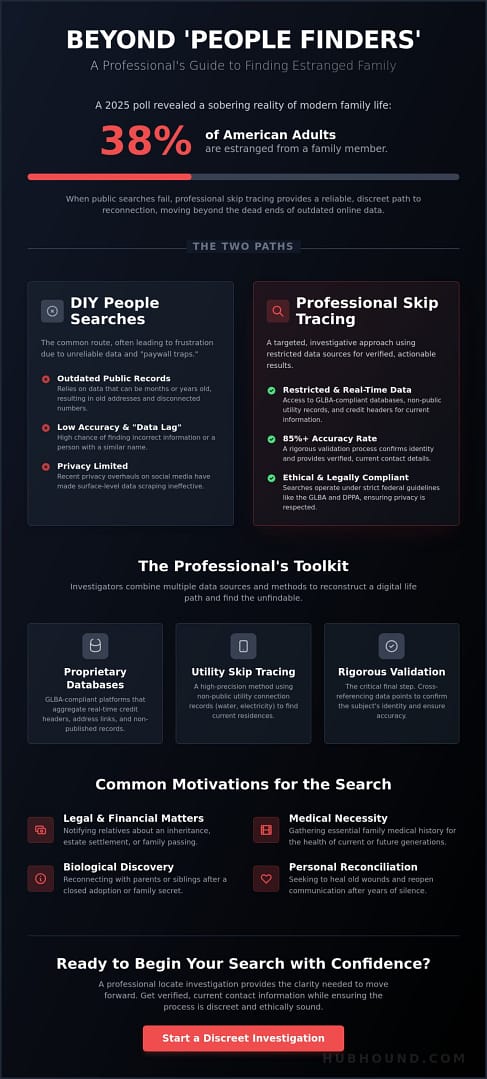
A 2025 YouGov poll found that 38% of American adults are currently estranged from a family member. If you’re part of this group, you likely know the frustration of hitting a wall with public search sites or wasting money on outdated data subscriptions. It’s common to feel stuck when “people finder” tools provide nothing but old addresses and disconnected phone numbers. You need more than a generic search engine to bridge this gap; you need a professional strategy to skip trace to find estranged family members that prioritizes accuracy and discretion.
This guide explores how professional skip tracing leverages restricted data and investigative expertise to locate long-lost relatives effectively. We’ll cover the best practices for navigating complex family dynamics and the technical methods used to verify current contact information. You’ll discover how expert curators use proprietary databases to move past outdated records and provide the clarity you need to move forward with confidence. We’ll also examine the legal frameworks like the GLBA and DPPA that ensure these searches remain compliant and ethical.
Key Takeaways
- Identify why professional investigative databases provide more reliable results than standard consumer “people finder” subscriptions.
- Learn how to skip trace to find estranged family members by leveraging non-public utility records and GLBA-compliant data sources.
- Determine the essential data requirements, from last known addresses to fragmented leads, required to initiate a successful search.
- Compare the efficiency of professional locate investigations against the common “paywall traps” found on public search sites.
- Discover the importance of a rigorous validation process to ensure you receive verified, current contact information.
What is Skip Tracing for Family Reunification?
Skip tracing is the professional practice of “tracing” an individual who has “skipped” their last known location or disappeared from their usual social circles. While the industry often focuses on debt collection or legal service, using a skip trace to find estranged family members requires a more nuanced, human-centric approach. It isn’t just about finding a coordinate on a map. It’s about reconstructing a life path using data that exists outside the public eye. Understanding What is Skip Tracing in this context helps bridge the gap between a simple internet search and a successful locate investigation.
There is a clear distinction between a missing persons case and a professional locate investigation. Law enforcement agencies prioritize missing persons when there’s an immediate threat to life or evidence of a crime. However, if a relative has simply drifted away or intentionally cut ties, police resources are rarely available. This is where professional investigators step in. They conduct searches that respect privacy laws while providing the verified contact details needed to reopen communication. These professionals operate under strict federal guidelines, ensuring every search is compliant with the Fair Credit Reporting Act and the Gramm-Leach-Bliley Act.
The Evolution of Locate Investigations in 2026
The methodology for finding people has changed rapidly over the last year. By June 2026, AI-driven data cross-referencing has significantly improved hit rates for cases that have been cold for decades. We’ve moved away from physical paper trails toward sophisticated digital footprint reconstruction. This shift is necessary because traditional “people search” websites are increasingly outdated. Privacy overhauls implemented by major social platforms in mid-2025 have made surface-level data scraping nearly impossible. Professionals now use restricted investigative databases to find current residences that DIY tools simply can’t access.
Common Reasons for Seeking Estranged Family
Identifying the motive for a search helps investigators tailor their strategy. Most clients seek to skip trace to find estranged family members for one of the following reasons:
- Legal and Financial Obligations: Notifying a long-lost relative about an inheritance, a pending estate settlement, or a family passing.
- Medical Necessity: Gathering essential family medical history that could impact the health of current or future generations.
- Biological Discovery: Reconnecting with biological parents or siblings following a closed adoption or a late-discovery family secret.
- Personal Reconciliation: Attempting to heal old wounds after years of silence caused by misunderstandings or past conflicts.
The Professional Toolkit: How Investigators Find the Unfindable
Locating a relative who has moved frequently or intentionally distanced themselves requires access to data silos that remain invisible to the average consumer. To skip trace to find estranged family members effectively, professionals utilize restricted investigative databases. These platforms are Gramm-Leach-Bliley Act (GLBA) compliant and require specific licensing to access. Unlike the aggregated results from “people finder” websites, these databases pull from credit headers, non-published phone records, and historical address links that aren’t available through a standard search engine.
Utility skip tracing serves as a high-precision method for identifying current residences. This involves querying non-public utility records, such as electricity or water connections, which often provide the most recent physical address for an individual. When combined with public records like voter registration, property deeds, and professional licenses, a clear picture of the subject’s current life begins to emerge. Social media forensics also plays a critical role, focusing on lifestyle markers and digital fingerprints that survive even after the privacy overhauls of mid-2025. These technical methods allow for a reconstruction of a life path that public search sites simply cannot replicate.
Proprietary Databases vs. Public Records
The primary weakness of DIY searches is the “data lag” inherent in public records. Most free or low-cost sites rely on government data that may only update annually. A professional search aggregates real-time data, bypassing the dead ends caused by outdated information. Data validation is the most important step here. It ensures the person identified isn’t just a namesake, but the specific relative you’re seeking. Premium investigative tools often yield an 85%+ accuracy rate, which is a significant jump from the 50-65% accuracy typical of lower-cost consumer options.
Advanced Surveillance and Fieldwork
Digital trails sometimes go cold. In these instances, physical surveillance operations become necessary to verify a “live” location. This fieldwork allows investigators to confirm residency through visual observation without alerting the subject. Discreetly interviewing former associates or neighbors can uncover leads that databases miss. If you’ve hit a wall with digital tools, professional locate investigations provide the boots-on-the-ground presence needed to verify an address before you initiate contact.
Professional Skip Tracing vs. DIY People Searches
Many people start their search with a $20 “people finder” subscription, hoping for a quick fix. These platforms often lead to the “paywall trap” where users pay for data that is already available for free through public social media or government portals. When you skip trace to find estranged family members, relying on these amateur tools creates a high risk of “tipping off” the subject. Inadvertent contact through automated notifications or social media pings can cause an estranged relative to retreat further. Professional investigators operate with a level of discretion that DIY sites cannot provide. They utilize a legal “permissible purpose” under federal laws like the Gramm-Leach-Bliley Act to access restricted information that remains hidden from the general public. This ensures the search remains invisible to the subject until you are ready to reach out.
The Problem with “Instant” Results
Instant reports are rarely current. They rely on cached, outdated web scrapes that might be five to ten years old. This leads to “false positives,” where you might spend weeks chasing an address that hasn’t been valid since 2018. Professional analysis filters out the “noise” generated by common names or shared family addresses. By cross-referencing multiple data points, an investigator ensures the person you’re looking for isn’t just a namesake. This rigorous validation process identifies the specific individual you need to reach, saving you from the emotional roller coaster of pursuing the wrong leads. Key filtering steps include:
- Cross-referencing historical address links with current utility connections.
- Verifying active phone lines and non-published numbers.
- Analyzing credit headers to confirm recent financial activity.
- Filtering out namesakes based on precise date-of-birth matching.
Cost-Benefit Analysis of Hiring a PI
Think of professional skip tracing as an investment in accuracy. While a DIY search might seem cheaper, the emotional energy wasted on dead ends is significant. Outsourcing the search to a specialized expert saves hours of manual research and prevents the frustration of outdated data. A verified result provides a clear path forward, whereas a “maybe” result from a consumer site only adds to the choice paralysis. You gain a current, validated address or phone number, allowing you to initiate contact on your terms with total confidence in the data’s integrity. Professionals provide a level of certainty that automated algorithms simply cannot match, turning a fragmented search into a concrete solution.
Preparing for the Search: Data Requirements and Ethical Steps
Success in a locate investigation depends heavily on the quality of initial data. Before you skip trace to find estranged family members, gather every piece of identifying information available. While a full name and date of birth are standard, even fragmented data can serve as a critical lead. A former employer, a specific hobby, or the name of an old friend can help an investigator distinguish between multiple individuals with similar names. These small details often act as the anchor points for reconstructing a digital footprint that has gone cold. Don’t assume a lead is too small. A professional curator can often turn a single professional license or a niche membership into a current physical address.
Ethical considerations are paramount when re-entering someone’s life. Professionals recognize the “Right to be Found,” but they also respect the subject’s right to privacy. If a relative has intentionally sought estrangement, a direct approach might backfire or lead to legal complications. Skilled investigators often serve as intermediaries. They can deliver a letter or a discreet message, providing a “soft landing” that allows the subject to process the contact without feeling cornered. This intermediary role protects both parties and increases the likelihood of a positive response. It ensures that your first point of contact is handled with a level of professionalism that minimizes emotional friction.
The Seeker Checklist: What to Gather Before Calling
A structured approach saves time and improves accuracy. Compile these essential identifiers before initiating your search:
- Full Legal Name: Include middle names and any known maiden names or aliases.
- Approximate Age: Even a birth year helps narrow the field significantly in proprietary databases.
- Ancillary Leads: Names of children, former spouses, or close business associates who might be linked to the subject.
- Last Known Contact: The specific date and location where you last had verified contact with the individual.
Managing Expectations and Emotional Readiness
Emotional preparation is just as vital as data collection. A search can lead to various outcomes. The subject may have passed away, or they might clarify that they do not wish to reconnect at this time. In some cases, a “wellness check” is the most appropriate first step to ensure the individual is safe without forcing a reunion. Using a professional skip trace to find estranged family members ensures that you are acting on verified data rather than hope. HubHound maintains a rigorous validation process to ensure the search remains discreet. This protects your privacy and the subject’s peace of mind during the discovery phase. If you are ready to begin, you can start your locate investigation with a team that prioritizes both results and ethics.
Partnering with HubHound for Discreet Locate Investigations
Finding a long-lost relative requires more than just access to a database. It demands a partner who understands the high stakes and emotional complexity of family reunification. HubHound positions itself as a specialized expert in this field, offering the technical precision and human intuition needed to skip trace to find estranged family members safely. With over 30 years of investigative experience, the agency has refined a rigorous validation process that eliminates the guesswork and choice paralysis often found in amateur searches. This methodology combines real-time, restricted database access with the traditional investigative grit required to verify a subject’s current status. Every search is handled with the quiet confidence and helpfulness that tech-savvy decision-makers expect from a top-tier service partner.
The agency operates as a trusted curator of information, doing the heavy lifting of research so you don’t have to. Instead of sifting through thousands of irrelevant records, you receive a filtered, high-quality result that’s been vetted for accuracy. This commitment to transparency and niche expertise ensures that the data you receive is actionable and reliable. By prioritizing efficiency and professional standards, the team moves you seamlessly from the problem of estrangement to a concrete solution. We invite you to a confidential consultation to discuss your specific family situation and the best path forward for your skip tracing and locate investigations.
Why National Expertise Matters
People move frequently in our modern economy. Leads often cross state lines, requiring a search strategy that isn’t tethered to a single region. HubHound operates with a nationwide scope, ensuring that your investigation remains seamless regardless of where the subject has relocated. This national reach allows for a consistent, professional standard of private investigation that follows the trail wherever it leads across the country. By leveraging a broad network of data sources and field contacts, the agency maintains a high level of rhythmic efficiency that local-only services simply can’t match. You gain the benefit of an insider who knows the nuances of the technical landscape on a national scale.
Taking the First Step Toward Reunification
The process of initiating a case is designed to be as streamlined as the digital tools we promote. It begins with a confidential intake where you provide the identifiers discussed in previous sections. From there, the team moves into the discovery phase, filtering through proprietary data to reconstruct the subject’s current digital and physical footprint. Every case concludes with a comprehensive “Locate Report.” This document provides a current, verified address, active phone numbers, and a status update on the individual. It’s the final piece of the puzzle you need to move forward with clarity. Contact HubHound today to begin your search and partner with a specialist who has already done the research for you.
Reconnecting Through Professional Discovery
Choosing to skip trace to find estranged family members is a significant step toward closure or reconciliation. You’ve learned that professional locate investigations go far beyond the surface-level data of consumer search sites. By leveraging restricted, non-public databases and applying 30+ years of investigative experience, licensed professionals provide the verified accuracy that DIY methods lack. This process ensures the search remains discreet, protecting both your privacy and the subject’s peace of mind through a validated and ethical approach.
Whether you’re seeking medical history, resolving an estate, or attempting a personal reunion, having a current and verified address is the essential starting point. HubHound acts as your expert guide, specializing in complex and discreet missing adults cases. You don’t have to navigate this path alone or settle for outdated information that leads to dead ends. Our methodology ensures that every search is conducted with the technical precision and investigative grit required for a successful outcome.
Start your family search with a professional HubHound skip trace investigation. Our team provides the clarity and results you need to bridge the gap of estrangement with confidence.
Frequently Asked Questions
Is it legal to hire a private investigator to find an estranged family member?
Yes, it’s entirely legal to hire a licensed private investigator to skip trace to find estranged family members. Professionals operate under federal regulations such as the Gramm-Leach-Bliley Act, which governs how personal data is accessed and handled. Unlike unauthorized data scraping, a licensed investigator uses legitimate investigative purposes to locate individuals; this ensures the process remains compliant with privacy laws and ethical standards.
How much does professional skip tracing cost for a family search?
Professional skip tracing costs vary depending on the depth of the investigation and the quality of the starting data. While basic database searches are more affordable, cases requiring extensive fieldwork or surveillance will require a larger investment. You should evaluate the cost based on the accuracy and verification provided, as professional results eliminate the wasted expense and paywall traps common with low-quality consumer search sites.
How long does it take for a PI to locate a missing relative?
Most digital locate investigations are finalized within three to five business days. If the search requires physical verification, such as surveillance or neighborhood interviews, the timeline may extend to a week or more. The speed of the search often depends on the accuracy of the initial identifiers you provide; details like a full name and a last known location significantly streamline the filtering process.
What happens if the person I am looking for does not want to be found?
If a subject wishes to remain estranged, a professional investigator acts as a neutral intermediary to protect both parties. While the investigator can provide you with the verified contact information, they often recommend a soft landing approach, such as delivering a letter. This respect for the right to be found ensures that the initial contact is handled ethically and reduces the risk of legal complications or further withdrawal.
Can a PI find someone with only a name and no other information?
A private investigator can attempt a search with only a name, but the risk of false positives increases without additional identifiers. To successfully skip trace to find estranged family members, providing a middle name, approximate age, or a former employer is highly recommended. These data points allow the investigator to filter out namesakes and ensure the final report identifies the correct individual with a high degree of certainty.
What is the difference between a missing person report and skip tracing?
A missing person report involves law enforcement and is reserved for situations involving immediate danger or suspected foul play. Skip tracing is a private locate investigation used when a relative has simply drifted away or intentionally cut contact. While police resources are limited for non-criminal disappearances, a private investigator has the specialized tools and time to focus on long-term estrangement cases that don’t meet police criteria.
Will the person know that I am looking for them?
The subject will not know they are being searched for unless you choose to make contact. Professional investigators use restricted databases that don’t trigger notifications or pings to the subject, unlike some social media searches or amateur tools. This discretion is vital for maintaining your privacy and ensuring that you can decide when and how to initiate a conversation once the location is verified.
Can skip tracing find family members who have moved out of the country?
International searches are possible but involve greater complexity due to varying global privacy laws and data availability. Many professional firms maintain networks with international investigators to follow leads that move across borders. While the process may take longer than a domestic search, the same principles of data cross-referencing and validation apply to ensure you receive current contact information regardless of the subject’s geographic location.

Article by
Joel R. Manley | President | Hubhound Investigations | OR PI-ID#: 90432 | 111 SW Fifth Avenue, Suite 3150 Portland, Oregon 97204 | 971-442-8170
Joel is licensed as a private investigator in Oregon and Tennessee. Joel started his career in 1987 serving as a Military Police Officer and Military Police Investigator.
After ending his military tour of duty, Joel became a civilian Police Officer and Deputy Sheriff. Joel took his strong background in Hostage Negotiations, Mediation and Conflict Resolution, with him to patrol some of the highest crime areas in SE Portland.
Joel was awarded Deputy of the Year for his efforts and for drastically reducing the crime rate in the area he patrolled. As a Deputy Sheriff, Joel assisted in leading a Neighborhood Livability Program that was nationally recognized for having the most innovative and progressive approach to policing.
In 2018, Joel retired as a Deputy Sheriff and founded Hubhound Investigations. Joel played an integral role in Hubhound Investigations receiving an A+ Accredited Business rating from the Better Business Bureau (BBB).
In his off time, Joel enjoys spending time with his wife, adult children and Hubhound’s Happiness Ambassador, Nya. Joel also enjoys Scuba Diving and Kayaking.
Disclaimer
DISCLAIMER: This article is provided for general informational and educational purposes only. It is not intended to constitute legal advice, professional investigative advice, or instruction to engage in any unlawful activity. Laws governing private investigations, surveillance, recording, tracking, access to information, evidence collection, privacy, trespass, licensing, and related investigative activities vary by jurisdiction and are subject to change.
Any investigative techniques, tactics, procedures, scenarios, or legal proceedings discussed in this article are presented for informational purposes and should not be interpreted as authorization or encouragement to use a particular method. Private investigators and members of the public are responsible for understanding and complying with all applicable federal, state, and local laws, licensing requirements, court rules, and professional standards.
The circumstances of every investigation and legal matter are different. Information contained in this article should not be relied upon as a substitute for advice from a qualified attorney or other appropriate licensed professional regarding a specific situation. No attorney-client, investigator-client, or other professional relationship is created by reading or using this information.