
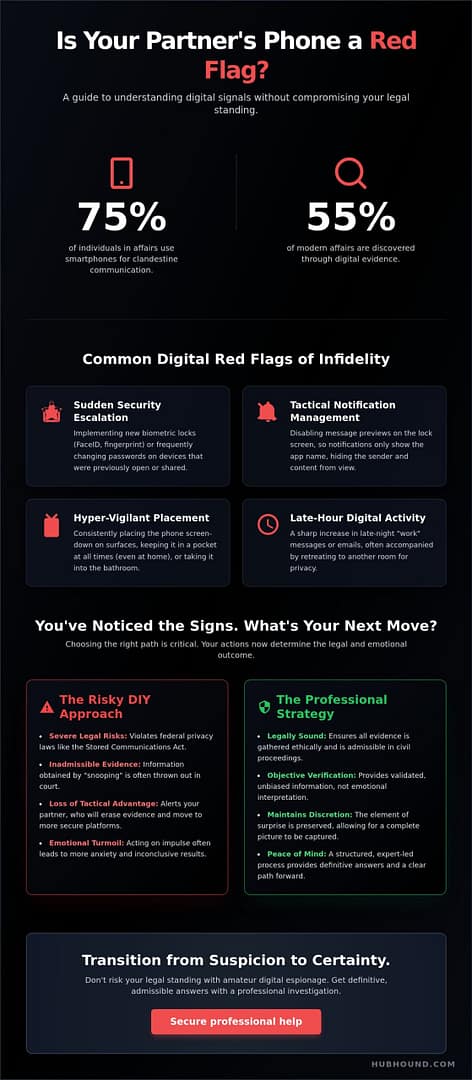
Recent data indicates that 55% of modern affairs are discovered through digital evidence; 75% of individuals involved in infidelity use their smartphones to communicate with partners. If you feel like my husband is acting suspicious with his phone, you aren’t just overreacting to a gut feeling. You’re noticing a documented diagnostic signal that requires professional assessment. The anxiety of uncertainty often leads to a desire for immediate answers, yet amateur digital espionage can lead to significant legal complications under evolving privacy regulations. It’s vital to prioritize objective verification over emotional impulse.
We recognize the constant anxiety and the fear of being perceived as “crazy” for questioning sudden changes in device habits. This guide helps you transition from suspicion to objective evidence without compromising your legal standing or privacy rights. You’ll learn to identify professional red flags, understand the implications of 2026 data privacy laws, and develop a strategic plan to gather high-quality information that holds up during civil litigation or divorce proceedings. Professional peace of mind starts with a structured, expert-led approach to discovery.
Key Takeaways
- Identify specific technical red flags, such as sudden biometric updates and hyper-vigilant device placement, to distinguish between standard privacy and diagnostic signals of infidelity.
- Understand the legal risks of unauthorized device access to ensure any gathered information remains admissible in future civil litigation or divorce proceedings.
- Establish a professional framework for documenting incidents when my husband is acting suspicious with his phone by maintaining a secure, objective log of behavioral deviations.
- Evaluate the strategic advantages of licensed surveillance operations over the legal and security risks associated with installing third-party digital tracking apps.
- Learn the essential criteria for vetting a professional investigative firm to ensure your case receives the rigorous validation and niche expertise required for definitive answers.
Common Red Flags: When Phone Secrecy Indicates Potential Infidelity
Identifying digital infidelity requires a shift from emotional reaction to objective observation. When you conclude that my husband is acting suspicious with his phone, you are likely responding to a deviation from an established behavioral baseline. Statistics from 2026 reveal that 75% of individuals involved in affairs use their smartphones as their primary communication tool. Identifying these patterns early is essential for anyone seeking a deeper understanding of infidelity and its digital evolution.
High-risk indicators often manifest through specific technical adjustments designed to create layers of digital insulation. Monitor for these specific red flags:
- Sudden Security Escalation: Implementation of biometric locks (FaceID or fingerprints) or frequent password updates on devices that were previously accessible.
- Tactical Notification Management: Disabling message previews on the lock screen so that incoming texts show only the app name rather than the sender or content.
- Hyper-Vigilant Placement: Consistently placing the phone screen-down on surfaces or keeping the device in a pocket even while at home.
- Late-Hour Digital Activity: A sharp increase in “work-related” emails or messages during unusual hours, often accompanied by a physical retreat to another room.
Behavioral Shifts vs. Technical Changes
Differentiating between a genuine interest in data privacy and active concealment is vital. A new focus on cybersecurity is often consistent across all accounts, whereas infidelity-driven secrecy is localized to specific apps. The “bathroom phone” habit, while a classic indicator, is often misunderstood. It only becomes a high-risk signal when paired with defensive reactions. If simple inquiries about device usage result in aggressive “gaslighting” responses, the behavior has transitioned from a privacy preference to a concealment tactic. These psychological defense mechanisms are designed to make you doubt your observations rather than address the underlying shift in transparency.
The Role of Encrypted Messaging Apps
The presence of specific software is often more diagnostic than the content of the messages themselves. Apps like Signal, Telegram, and WhatsApp are frequently utilized for their end-to-end encryption and disappearing message features. In 2026, 55% of affairs are discovered through digital evidence, yet these “privacy-first” tools make recovery difficult for untrained users. Finding these applications on a device where they serve no professional purpose is a significant indicator of clandestine communication. If you find yourself thinking my husband is acting suspicious with his phone, document the presence of these apps and the frequency of their use before attempting to confront the behavior directly.
The Legal and Emotional Risks of Unauthorized Phone Access
The impulse to bypass a partner’s passcode is a common reaction when my husband is acting suspicious with his phone. However, amateur digital forensics often results in severe legal and tactical setbacks. Accessing a password-protected device without explicit consent can violate federal statutes, including the Stored Communications Act. These violations don’t just carry the risk of civil penalties; they can fundamentally compromise your standing in future legal proceedings.
Beyond the legal framework, unauthorized access often alerts the subject to your suspicions. Once a partner realizes their digital activity is being monitored, they will likely migrate to more secure platforms or scrub their existing digital footprint. This makes it significantly harder for a professional investigator to recover deleted data or establish a pattern of behavior. Maintaining the element of surprise is a critical component of any successful investigation. If you tip your hand too early, you lose the opportunity to capture a complete picture of the activity.
Privacy Laws and Admissible Evidence
Courts maintain strict standards for the “chain of custody” regarding electronic evidence. If you obtain data through “snooping,” that information is frequently ruled inadmissible in civil litigation. DIY methods lack the rigorous validation required for civil litigation support. Professional investigators use specialized tools and methodologies to ensure that every piece of data is gathered legally and preserved correctly. This professional distance protects you from accusations of privacy invasion while securing evidence that actually holds weight in a courtroom.
The Consequences of Confrontation Without Proof
Confronting a partner based on “gut feelings” or incomplete digital snippets often leads to a cycle of denial and refined concealment. Without objective evidence, the conversation often devolves into arguments about your “paranoia” rather than their behavior. This psychological toll is significant. It creates a state of constant hyper-vigilance that is unsustainable for long-term mental health. Shifting the burden of proof to an objective third party provides the clarity needed to break this cycle. Professional surveillance offers the definitive answers that internal monitoring cannot provide, allowing you to move forward with confidence rather than doubt.
A Professional Framework for Documenting Suspicious Behavior
Systematic documentation transforms vague anxiety into actionable intelligence. When my husband is acting suspicious with his phone, the objective isn’t to confront him immediately. Instead, you must identify deviations from an established behavioral baseline. Begin by defining “normal” parameters for your household. Note the typical frequency of device usage, usual work hours, and standard financial patterns. Once this baseline exists, any deviation becomes a diagnostic data point rather than a mere suspicion.
Maintain a discreet, secure log that tracks specific incidents. Include dates, times, and the exact nature of the suspicious action. Crucially, do not store this log on shared devices, cloud accounts, or any platform accessible via a family password. A physical notebook stored in a secure, off-site location or a dedicated, password-protected offline file is preferable. This prevents the subject from discovering your observations and scrubbing their digital footprint before a professional can intervene.
Creating an Observation Log
Focus on “digital absences” where your partner is physically present but mentally disengaged due to device preoccupation. Record physical cues such as sudden changes in grooming habits, the acquisition of a new wardrobe, or unexplained shifts in daily routines. This log must remain strictly confidential. Its purpose is to provide a clear, chronological narrative of behavioral shifts that can be reviewed during a professional consultation. High-quality documentation allows an investigator to deploy resources more efficiently, saving you time and effort during the discovery phase.
Corroborating Phone Use with Reality
Verify digital claims against physical evidence. If late-night phone activity is attributed to “urgent work emails,” cross-reference this with known company standards or project timelines. Analyze external factors like unexplained mileage on the vehicle or credit card statements showing transactions in unfamiliar areas. When digital behavior consistently contradicts physical reality, it’s time to transition from self-observation to professional Surveillance Operations. This transition ensures that evidence is gathered through licensed, objective methods rather than subjective DIY tracking. Professional investigators can bridge the gap between suspicious phone habits and verified physical locations.
Professional Surveillance vs. Digital Tracking Apps
The transition from digital suspicion to physical proof requires a strategic choice between software solutions and human intelligence. Many individuals, noticing that my husband is acting suspicious with his phone, turn to third-party “spy” apps advertised on social media. This is a high-risk gamble. Modern mobile operating systems now feature aggressive security protocols that alert users to background tracking or unauthorized data transmission. Installing these apps often triggers a system notification, immediately alerting the subject and allowing them to scrub all relevant evidence.
Professional surveillance operations offer a level of context that digital logs simply cannot match. While a text message might suggest an intent, high-definition video evidence captures “inclination and opportunity” in the physical world. This objective proof is essential for any serious investigation. Human-based investigation eliminates the technical footprint left by malware and ensures that the discovery process remains entirely covert. You gain a complete narrative of events rather than fragmented digital snippets.
The Limitations of Digital Evidence
Digital logs are often circumstantial. A suspicious message confirms communication but does not prove physical infidelity or the nature of a meeting. Professional surveillance techniques fill these critical gaps by documenting real-world behavior in real-time. While GPS tracking provides location data, it is subject to strict legal limits and cannot show who the subject is with or what they are doing. Licensed investigators navigate these legal complexities to ensure that the evidence gathered remains admissible in civil proceedings.
Why Human Intelligence Wins
Licensed investigators provide a unique advantage: the ability to testify in court. A software log cannot take the stand to verify the authenticity of a document or describe the atmosphere of an interaction. Professional surveillance captures real-world nuances, such as body language and physical intimacy, that a phone screen never reveals. This method ensures the subject remains unaware of the investigation, preserving the integrity of the results. If you need definitive answers that hold up under legal scrutiny, consider the value of professional Infidelity Investigations to secure your future.
Securing Definitive Answers Through Professional Investigation
Moving from the observation phase to a formal case requires selecting a partner with specialized expertise. If you have concluded that my husband is acting suspicious with his phone, vetting a firm based on their experience with domestic surveillance is the next logical step. Verify that the firm is licensed and carries appropriate liability insurance. Avoid providers who make unrealistic guarantees or lack a transparent reporting process. A professional investigation provides the objective clarity needed to make informed decisions about your future without the risks of DIY snooping.
Prepare for the initial consultation by bringing the behavioral log established in the previous stages of your discovery process. An investigator will review these patterns to determine the most efficient deployment of surveillance assets. This meeting is also the time to establish strict communication protocols. Ensuring that the subject remains unaware of the investigation is paramount for maintaining the integrity of the evidence. Professional firms prioritize this discretion to protect your interests and your safety throughout the engagement.
The HubHound Approach to Infidelity
The HubHound approach focuses on rigorous validation and quality assurance. We utilize decades of experience to navigate complex domestic situations, providing comprehensive civil litigation support for divorce cases. Our methodology ensures that every finding is documented with precision and adheres to the highest standards of evidence collection. This level of specialized authority transforms suspicion into a verified record. This process offers the peace of mind that comes from knowing the truth, regardless of the eventual outcome of the investigation.
Next Steps for the Concerned Spouse
Before initiating a case, secure your own digital privacy. Ensure that your communications with an investigative firm are conducted through a secure, private device that your partner cannot access. It’s vital to prepare yourself emotionally for the results. Professional discovery is a tool for resolution, whether it leads to marital reconciliation or a legal separation. Don’t allow the cycle of suspicion to continue indefinitely. Contact a professional for a discreet, confidential evaluation to begin the process of reclaiming your certainty and protecting your legal standing.
Reclaiming Certainty Through Professional Discovery
Navigating the complexities of digital infidelity requires a shift from emotional hyper-vigilance to structured, professional discovery. You’ve learned that systematic documentation must replace immediate confrontation to preserve the integrity of future evidence. Maintaining legal boundaries by avoiding unauthorized device access ensures that any findings remain admissible in civil proceedings. If you find that my husband is acting suspicious with his phone, prioritize your long-term security by relying on objective, licensed methodologies rather than unstable third-party software.
Professional investigators offer a level of specialized authority that DIY methods cannot replicate. Our team leverages over 30 years of experience to provide strictly confidential surveillance operations and court-admissible evidence gathering. This expertise provides the rigorous validation required to move from suspicion to a definitive resolution. Don’t let uncertainty dictate your future when high-quality resources are available to provide the clarity you deserve.
Consult with a Licensed Professional Investigator for a Discreet Evaluation and take the first step toward professional peace of mind. You have the right to know the truth; we’re here to help you find it with absolute discretion.
Frequently Asked Questions
Is it illegal to look through my husband’s phone if I suspect him of cheating?
Accessing a password-protected device without explicit consent often violates federal privacy laws, including the Stored Communications Act. While you may share a household, individual digital privacy rights still apply to personal devices. Unauthorized access can lead to civil penalties and render any discovered evidence inadmissible in court. It’s safer to rely on professional methods that adhere to legal standards rather than risking your legal standing through amateur digital forensics.
What are the most common apps used for hiding an affair?
Encrypted messaging platforms such as Signal, Telegram, and WhatsApp are the most frequent tools for clandestine communication due to their disappearing message features. Additionally, “vault” apps designed to look like calculators or utility folders are used to hide photos and contact logs. Identifying these applications on a device where they serve no clear professional purpose is a significant diagnostic signal that requires further investigation and professional validation.
Can a private investigator recover deleted text messages or photos?
Licensed investigators can often recover deleted digital artifacts through specialized forensic software, provided the data hasn’t been overwritten by new system activity. This process involves creating a bit-by-bit image of the device to extract hidden fragments of messages, images, and call logs. Success rates vary based on the device model and how much time has passed since the deletion. Professional extraction ensures the data remains untampered and court-ready.
How much does an infidelity investigation typically cost?
The total investment for an infidelity investigation depends on the complexity of the case and the duration of surveillance required. Industry data from 2026 suggests that standard operations often involve a preliminary consultation and several days of field observation. While costs vary based on the specific resources deployed, professional firms typically require an upfront retainer to initiate the discovery process. You should request a detailed breakdown of potential expenses during your initial evaluation.
What is the best way to track a spouse’s location legally?
The most reliable and legal method to track a spouse’s movements is through licensed surveillance operations. While some individuals use GPS devices on vehicles they jointly own, legal boundaries regarding electronic tracking are increasingly strict under 2026 privacy regulations. Professional investigators provide a verified record of physical locations and interactions that holds up in court, which consumer-grade tracking apps or devices often fail to provide during litigation.
How do I know if my husband has a second phone?
Identifying a secondary device involves looking for physical inconsistencies, such as unexplained chargers, unfamiliar Bluetooth connections in a vehicle, or receipts for prepaid cellular services. If my husband is acting suspicious with his phone, monitor for “burner” devices hidden in vehicles or office spaces. A professional background check or financial audit can also reveal hidden accounts or recurring payments to mobile service providers that you don’t recognize in your standard household budget.
Should I confront him as soon as I see a suspicious notification?
Avoid immediate confrontation when you observe a suspicious notification. Prematurely addressing a single incident allows a subject to refine their concealment tactics and scrub their digital footprint. Instead, document the occurrence in your secure log and continue your observation to establish a pattern. Gathering a comprehensive body of evidence ensures that when the conversation does happen, it’s based on objective facts rather than easily denied snippets that lack context.
Can phone records be used as evidence in a divorce case?
Legally obtained phone records and digital evidence are frequently used as critical components in civil litigation and divorce proceedings. These records can establish patterns of behavior, verify physical locations, and corroborate claims of misconduct. However, the evidence must be gathered through licensed channels to ensure it meets the standards of admissibility. This is why professional verification is essential when my husband is acting suspicious with his phone and legal resolution is the ultimate goal.

Article by
Joel R. Manley | President | Hubhound Investigations | OR PI-ID#: 90432 | 111 SW Fifth Avenue, Suite 3150 Portland, Oregon 97204 | 971-442-8170
Joel is licensed as a private investigator in Oregon and Tennessee. Joel started his career in 1987 serving as a Military Police Officer and Military Police Investigator.
After ending his military tour of duty, Joel became a civilian Police Officer and Deputy Sheriff. Joel took his strong background in Hostage Negotiations, Mediation and Conflict Resolution, with him to patrol some of the highest crime areas in SE Portland.
Joel was awarded Deputy of the Year for his efforts and for drastically reducing the crime rate in the area he patrolled. As a Deputy Sheriff, Joel assisted in leading a Neighborhood Livability Program that was nationally recognized for having the most innovative and progressive approach to policing.
In 2018, Joel retired as a Deputy Sheriff and founded Hubhound Investigations. Joel played an integral role in Hubhound Investigations receiving an A+ Accredited Business rating from the Better Business Bureau (BBB).
In his off time, Joel enjoys spending time with his wife, adult children and Hubhound’s Happiness Ambassador, Nya. Joel also enjoys Scuba Diving and Kayaking.
Disclaimer
DISCLAIMER: This article is provided for general informational and educational purposes only. It is not intended to constitute legal advice, professional investigative advice, or instruction to engage in any unlawful activity. Laws governing private investigations, surveillance, recording, tracking, access to information, evidence collection, privacy, trespass, licensing, and related investigative activities vary by jurisdiction and are subject to change.
Any investigative techniques, tactics, procedures, scenarios, or legal proceedings discussed in this article are presented for informational purposes and should not be interpreted as authorization or encouragement to use a particular method. Private investigators and members of the public are responsible for understanding and complying with all applicable federal, state, and local laws, licensing requirements, court rules, and professional standards.
The circumstances of every investigation and legal matter are different. Information contained in this article should not be relied upon as a substitute for advice from a qualified attorney or other appropriate licensed professional regarding a specific situation. No attorney-client, investigator-client, or other professional relationship is created by reading or using this information.