
A police report is not a definitive record of truth; it’s a narrative that requires rigorous, independent validation. In high-stakes criminal litigation, relying solely on the prosecution’s discovery is a dangerous gamble. You likely recognize that initial reports often contain biases, and key witnesses frequently disappear before a professional criminal defense investigator can secure their testimony. This creates a significant gap between the official story and the actual facts of the case.
This guide demonstrates how a criminal defense investigator uncovers exculpatory evidence and validates witness statements to provide the factual foundation necessary for a robust legal defense. You’ll learn how specialized professionals use AI-powered analysis and skip tracing to locate reluctant witnesses and debunk inaccuracies in police documentation. We’ll preview the essential tools for 2026, from digital forensics to predictive analytics, ensuring your defense strategy is built on verified data rather than assumptions. By the end of this article, you’ll understand how to leverage expert curation to strengthen your case and protect your client’s future.
Key Takeaways
- Understand why a criminal defense investigator acts as an essential independent auditor to challenge the biases often found in initial police reports.
- Learn how advanced skip tracing and surveillance operations locate missing witnesses and verify the accuracy of prosecution evidence.
- Identify the specific investigative services, including crime scene re-evaluation, that provide the factual foundation for a robust legal defense strategy.
- Discover the critical timing for integrating professional investigators into your legal team to ensure maximum synergy between legal theory and factual verification.
- Recognize how filtering for high-quality, court-ready evidence saves legal teams time and strengthens overall litigation outcomes.
What is a Criminal Defense Investigator and Why Are They Essential?
A criminal defense investigator is a specialized professional tasked with the independent verification of facts within a criminal case. Their role is to conduct a parallel inquiry that ensures the legal system functions as intended, providing the discovery balance necessary for a fair trial. While a general Private investigator may handle various civil matters, the defense specialist focuses exclusively on the mechanics of the criminal justice system and the protection of constitutional rights.
Think of this role as an independent audit of the prosecution’s case. Law enforcement agencies often operate under intense pressure to clear cases quickly, which can lead to tunnel vision. While organizations like Blue Line Relief provide essential financial assistance and disaster relief to officers facing these professional and personal pressures, the role of the defense is to ensure the investigation remains objective. A criminal defense investigator ensures that police reports aren’t the final word by re-examining every claim, lead, and piece of physical evidence from a neutral perspective.
The Difference Between Private and Public Investigators
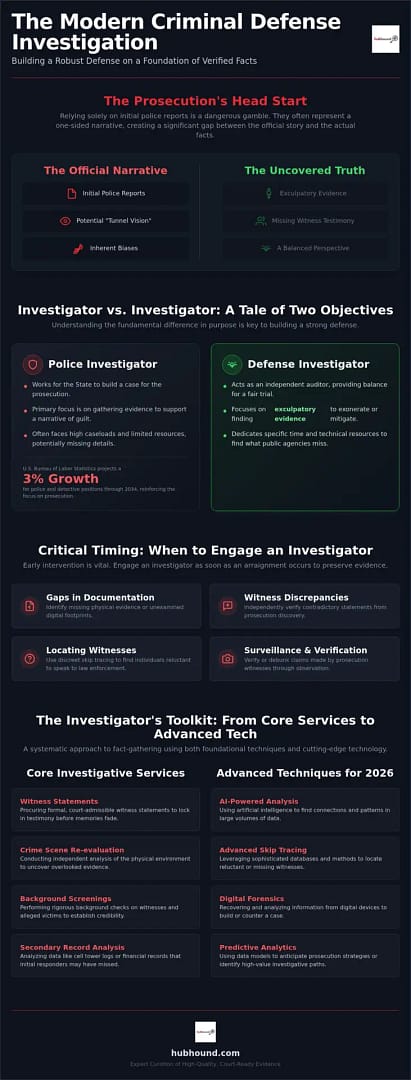
Police investigators work for the state. Their primary objective is to build a case for the prosecution. In contrast, a defense-led investigation focuses on exculpatory evidence; facts that might exonerate the defendant or mitigate their involvement. This distinction is critical because the U.S. Bureau of Labor Statistics projects a 3% growth for police and detective positions through 2034, yet the focus of public agencies remains on building a narrative of guilt.
Resource allocation is another major factor. Public agencies often face overwhelming caseloads and limited budgets, leading them to miss nuanced details or overlook secondary witnesses. National agencies like HubHound leverage over 30 years of experience to dedicate the specific time and technical resources required to find what public agencies might miss. They act as expert curators, filtering through large volumes of data to find the high-quality evidence that changes case outcomes.
When to Hire a Defense Investigator
Early intervention is vital for a successful legal strategy. You should engage an investigator as soon as an arraignment occurs to preserve evidence that may otherwise disappear. For those navigating the justice system in South Florida, securing release through bail bonds Miami is often the first step toward preparing a proper defense. Key triggers for hiring include:
- Gaps in Documentation: Identifying missing physical evidence or unexamined digital footprints in the initial police report.
- Witness Discrepancies: Contradictory statements in the prosecution’s discovery that require independent verification.
- Locate Needs: Situations requiring discreet skip tracing to find witnesses who are reluctant to speak with law enforcement.
- Verification: Cases involving complex surveillance needs to verify or debunk claims made by prosecution witnesses.
By integrating an investigator early, the defense team gains a factual foundation that allows them to challenge the prosecution’s narrative with confidence. This synergy between legal theory and factual verification is what ultimately secures a fair trial.
Core Investigative Services for Legal Defense Teams
Effective legal defense relies on more than just courtroom advocacy; it requires a systematic approach to fact-gathering. A professional criminal defense investigator provides the tactical support needed to challenge the prosecution’s narrative through technical precision and exhaustive research. These services aren’t just administrative tasks. They’re strategic interventions designed to uncover overlooked variables in a case.
The primary investigative services utilized by top-tier legal teams include:
- Procuring formal, court-admissible witness statements.
- Conducting independent crime scene re-evaluations.
- Performing rigorous background screenings on witnesses and alleged victims to establish credibility.
- Analyzing secondary records, such as cell tower data or financial logs, that initial responders might have bypassed.
Mastering Witness Interviews and Statements
Witnesses are often the most volatile element of any trial. An investigator must build rapport with individuals who may be reluctant or even hostile toward the legal process. This requires a sophisticated understanding of human behavior and interview mechanics, similar to the standards established by the Federal Law Enforcement Training Centers. Securing a formal statement early is critical; it locks in testimony before memories fade or outside influences alter a person’s story. By identifying inconsistencies between a current statement and the initial police report, the investigator provides the attorney with powerful impeachment material for cross-examination.
Evidence Review and Fact Verification
Evidence review extends far beyond reading reports. It involves a granular analysis of police body cam footage, forensic data, and chain-of-custody documentation to identify procedural errors. For example, if a timeline provided by the prosecution doesn’t align with digital metadata or GPS logs, the entire case theory may collapse. This level of verification is also essential for civil litigation support, particularly when criminal charges overlap with personal injury or corporate misconduct cases.
Success in these areas requires an investigator who understands both the legal requirements and the technical nuances of modern evidence. You can evaluate specialized investigative support to ensure every detail of your case is independently verified. This rigorous filtering process saves legal teams hundreds of hours and ensures the defense is built on a foundation of objective truth.
Advanced Techniques: Skip Tracing and Surveillance in Defense
Beyond the initial discovery file lies a landscape of unverified data and missing persons. A skilled criminal defense investigator uses advanced skip tracing and surveillance to bridge the gap between the police narrative and the objective facts. These techniques aren’t merely supplemental; they’re often the deciding factor in high-stakes litigation. By utilizing these tools, defense teams move from a reactive posture to a proactive search for the truth.
Locate Investigations: Finding the Unfindable
Effective defense requires access to every relevant witness. However, witnesses often relocate or hide to avoid involvement in criminal proceedings. Skip tracing identifies these individuals by analyzing digital footprints across specialized national databases. While advanced software provides a starting point, the expert investigator knows that manual field research is what ultimately secures a court-ready statement. The National Defender Investigator Association sets the industry standard for these operations, highlighting how a single located witness can dismantle a prosecution’s theory. Don’t settle for a “witness not found” report when a more rigorous, nationwide search could uncover exculpatory testimony.
Strategic Surveillance for Factual Verification
Surveillance is a direct way to debunk false claims or verify alibis. If a prosecution witness alleges physical limitations or denies specific associations, discreet observation provides the visual proof needed for trial impeachment. This is particularly relevant in cases involving alleged workplace misconduct or instances where a witness’s daily activities contradict their formal statements. Every surveillance operation must prioritize confidentiality and strict legal compliance to ensure the gathered evidence is admissible. HubHound applies over three decades of industry experience to ensure these operations are both discreet and highly effective. For a deeper look at these specialized methods, review our professional guide on Advanced Surveillance Techniques.
These advanced methods transform a defense strategy. They provide the empirical data needed to challenge assumptions and ensure that the jury sees a complete, fact-based picture of the case. By filtering for high-quality evidence through surveillance and locate investigations, you save time and strengthen your legal position.
Integrating an Investigator into Your Legal Strategy
Effective legal defense is a collaborative effort that begins long before the trial date. To maximize the impact of a criminal defense investigator, integration must occur at the moment of arraignment. This early involvement ensures that the investigator can preserve evidence that might otherwise be lost or overwritten, such as volatile surveillance footage or digital logs. The relationship between an attorney and an investigator is one of tactical synergy; while the attorney constructs the legal theory, the investigator provides the empirical data required to support it.
Managing the flow of information during the discovery phase is a high-stakes task. Investigators don’t just gather new facts; they analyze the prosecution’s evidence for technical inconsistencies. This includes preparing exhibits and testifying at trial as an expert fact witness, ensuring that the jury understands the context of the verified evidence. This level of factual verification is what differentiates a reactive defense from a proactive, data-driven strategy.
The Discovery Phase: A Collaborative Approach
During the discovery phase, the prosecution often provides massive volumes of data. An investigator helps the defense team parse through this information efficiently, identifying specific data points that contradict the official narrative. They’re particularly adept at identifying “missing” discovery items that the prosecution failed to provide. If specific forensic reports or witness contact information are omitted, the investigator’s audit highlights these gaps for legal challenge. This process allows the team to build a counter-narrative based on verified, independent findings.
Process Service and Legal Support
A successful defense strategy also relies on the precise execution of procedural tasks. Professional process service ensures that subpoenas are served correctly and efficiently, guaranteeing that critical witnesses are present for trial. Delays in service can disrupt case timelines and weaken the defense’s position. By managing the flow of information and ensuring all legal documents are handled with professional rigor, the investigator acts as an indispensable ally. This level of support is equally vital for businesses facing legal challenges, and you can learn more about these protections in our guide to a Corporate Investigation Firm.
Why HubHound is the Trusted Choice for Defense Support
HubHound functions as a specialized curator in a field where volume often obscures value. When a legal team hires a criminal defense investigator, they aren’t just looking for someone to knock on doors. They need an ally who understands the technical nuances of complex criminal matters and can provide court-ready evidence that withstands intense scrutiny. With over 30 years of industry experience, we’ve developed a national reach that allows us to conduct locate investigations and skip tracing across state lines with professional rigor. Our focus remains on rigorous validation and quality assurance, ensuring that every piece of information we provide is modern, reliable, and fact-based.
We don’t believe in a one-size-fits-all approach. Instead, we prioritize high-quality evidence that serves as a factual foundation for your legal strategy. By filtering out the noise and focusing on the variables that actually impact case outcomes, we help defense teams move from a reactive stance to a proactive search for the truth. This commitment to transparency and niche expertise is why we remain a trusted partner for high-stakes litigation support across the country.
A Specialized Expert Curator for Your Case
Attorneys often face choice paralysis when selecting investigative partners from a sea of generalists. HubHound alleviates this by acting as the expert guide that has already done the heavy lifting of research. We save your team time by delivering precise, evaluative findings that move cases forward without the cognitive load of irrelevant data. Our team doesn’t just collect information; we analyze it for quality and compatibility with your specific legal theory.
This niche expertise allows us to handle the most sensitive aspects of a case, from witness statement procurement to digital footprint verification. We use objective, value-driven communication to ensure you have the facts you need when you need them. Our role is to be an indispensable ally for growth-focused legal practices that value efficiency and results over hyperbolic marketing claims.
Get Started with Professional Investigative Support
Choosing the right investigative partner is a critical step in building a robust defense. We prioritize efficiency and transparency in every operation, ensuring that our process is as streamlined as the digital tools we use to track down leads. Evaluate your current investigative needs and identify where a specialized partner can add the most value to your upcoming cases. Our licensed investigators are ready to provide the professional support required to strengthen your overall defense strategy.
Strengthening the Factual Foundation of Your Case
A successful defense requires more than legal theory; it demands an objective verification of every fact. Engaging a professional criminal defense investigator ensures that discovery gaps are identified and prosecution witnesses are properly vetted before trial. By utilizing advanced skip tracing and strategic surveillance, legal teams can uncover exculpatory evidence that initial responders often miss. This proactive approach transforms a reactive defense into a data-driven strategy that protects the integrity of the justice system and ensures fairness.
HubHound brings over 30 years of licensed investigative experience to every case. We specialize in complex witness locates and skip tracing, providing the court-ready reporting and testimony needed for high-stakes litigation. Our national reach ensures your defense has support, regardless of where evidence leads. We act as your expert curator, filtering data to find the specific details that strengthen your case theory. It’s the most efficient way to build a robust defense without the cognitive load of unverified information.
Take the next step toward a more resilient legal strategy by partnering with investigators who value efficiency and precision. You can protect your client’s future by ensuring no lead goes unvetted and no witness remains unlocated.
Frequently Asked Questions
Is evidence gathered by a private investigator admissible in court?
Evidence gathered by a licensed investigator is admissible in court as long as the professional adheres to legal standards and maintains a strict chain of custody. A criminal defense investigator often serves as a fact witness, testifying about the methods used to procure statements or physical evidence. This ensures the information is reliable for the jury. Courts value independent verification, especially when it challenges or clarifies the narrative presented in initial police reports.
How much does a criminal defense investigator typically cost?
Costs for investigative services vary based on the complexity of the case, the experience of the firm, and the specific techniques required, such as surveillance or skip tracing. While industry surveys in 2026 show a wide range of hourly rates across the country, most professional firms operate on a retainer basis. You should evaluate service partners based on their track record and ability to provide court-ready evidence rather than selecting based on price alone.
Can an investigator find a witness who doesn’t want to be found?
Yes, investigators utilize advanced skip tracing techniques and national database access to locate individuals who are avoiding contact. Locating a witness who doesn’t want to be found requires a combination of digital footprint analysis and manual field research. HubHound leverages over 30 years of experience to track down these reluctant individuals, ensuring that your defense team has access to every relevant testimony needed to build a comprehensive case narrative.
What is the difference between a police detective and a private criminal investigator?
The primary difference lies in their objective and employer. Police detectives gather evidence to support the prosecution’s case and work for the state. A private criminal defense investigator works for the defense team to identify exculpatory evidence and verify the accuracy of the state’s claims. This independent audit is essential for a fair trial, as it addresses potential biases and identifies gaps that public agencies might overlook due to high caseloads.
How early should I hire an investigator for my criminal case?
You should engage an investigator as early as possible, ideally immediately following an arraignment or when you first anticipate charges. Early intervention is critical for preserving volatile evidence like surveillance footage or digital logs that may be overwritten within days. Prompt action also allows your team to secure witness statements while memories are fresh, providing a stronger factual foundation for your attorney to develop an effective legal theory.
Does a criminal defense investigator provide personal bodyguard services?
No, a professional criminal defense investigator does not provide personal bodyguard or protection services. HubHound focuses exclusively on investigative tasks such as skip tracing, witness interviews, and surveillance for factual verification. If you require physical protection, you should seek a firm that specializes in executive protection or security. Our expertise remains rooted in the technical and analytical aspects of legal and corporate litigation support to ensure case success.
What happens if an investigator uncovers evidence that is harmful to the defendant?
Any evidence uncovered during an investigation is typically protected under the attorney-client privilege or the work-product doctrine. This means the investigator reports findings directly to the defense attorney, who then determines the best strategic use of that information. Uncovering harmful evidence early is actually a benefit; it prevents the defense from being blindsided at trial and allows the legal team to adjust their strategy or seek a more favorable plea agreement.
Can an investigator help with civil litigation support as well?
Yes, investigative firms often provide comprehensive civil litigation support alongside their criminal defense work. HubHound assists clients with corporate due diligence, workplace misconduct investigations, and landlord/tenant screening. Because criminal and civil matters frequently overlap, having a specialized investigator who understands both environments is a significant advantage. This cross-disciplinary expertise ensures that all factual variables are identified, whether the case involves personal injury, corporate fraud, or complex criminal charges.

Article by
Joel R. Manley | President | Hubhound Investigations | OR PI-ID#: 90432 | 111 SW Fifth Avenue, Suite 3150 Portland, Oregon 97204 | 971-442-8170
Joel is licensed as a private investigator in Oregon and Tennessee. Joel started his career in 1987 serving as a Military Police Officer and Military Police Investigator.
After ending his military tour of duty, Joel became a civilian Police Officer and Deputy Sheriff. Joel took his strong background in Hostage Negotiations, Mediation and Conflict Resolution, with him to patrol some of the highest crime areas in SE Portland.
Joel was awarded Deputy of the Year for his efforts and for drastically reducing the crime rate in the area he patrolled. As a Deputy Sheriff, Joel assisted in leading a Neighborhood Livability Program that was nationally recognized for having the most innovative and progressive approach to policing.
In 2018, Joel retired as a Deputy Sheriff and founded Hubhound Investigations. Joel played an integral role in Hubhound Investigations receiving an A+ Accredited Business rating from the Better Business Bureau (BBB).
In his off time, Joel enjoys spending time with his wife, adult children and Hubhound’s Happiness Ambassador, Nya. Joel also enjoys Scuba Diving and Kayaking.
Disclaimer
DISCLAIMER: This article is provided for general informational and educational purposes only. It is not intended to constitute legal advice, professional investigative advice, or instruction to engage in any unlawful activity. Laws governing private investigations, surveillance, recording, tracking, access to information, evidence collection, privacy, trespass, licensing, and related investigative activities vary by jurisdiction and are subject to change.
Any investigative techniques, tactics, procedures, scenarios, or legal proceedings discussed in this article are presented for informational purposes and should not be interpreted as authorization or encouragement to use a particular method. Private investigators and members of the public are responsible for understanding and complying with all applicable federal, state, and local laws, licensing requirements, court rules, and professional standards.
The circumstances of every investigation and legal matter are different. Information contained in this article should not be relied upon as a substitute for advice from a qualified attorney or other appropriate licensed professional regarding a specific situation. No attorney-client, investigator-client, or other professional relationship is created by reading or using this information.