
What if a single missed delivery could dismantle months of legal preparation? A court deadline doesn’t care how well a subject hides; it only cares if the clock runs out. When you’re facing a fast-approaching hearing, the last thing you need is a courier who stops answering the phone or a subject who treats their front door like a fortress. Securing a reliable rush process service for time-sensitive documents is often the difference between moving forward with litigation and facing a frustrating dismissal. Speed is useless without investigative depth.
We understand the high stakes of civil litigation and the stress of potential case dismissals due to improper service. This strategy guide provides the framework you need to master the logistics of expedited legal delivery. Learn how investigative skip tracing ensures your documents reach their destination before the legal deadline, even when subjects are actively avoiding service. Evaluate the essential standards for real-time updates and court-admissible affidavits to protect your professional interests. Use this guide to identify top-tier service partners who safeguard your reputation and ensure your documents arrive on time.
Key Takeaways
- Define rush process service as prioritized delivery within 24 to 48 hours to fulfill constitutional due process requirements.
- Identify high-priority legal triggers like Temporary Restraining Orders and trial subpoenas that necessitate an immediate response.
- Secure your legal deadlines by utilizing rush process service for time-sensitive documents that incorporates skip tracing to find evasive subjects.
- Optimize document transmission by providing high-quality digital PDFs to field agents to eliminate the delays of physical mailing.
- Select investigative partners over standard couriers to benefit from decades of experience in managing complex, high-stakes serves.
Understanding Rush Process Service for Time-Sensitive Documents
Rush process service is a specialized category of legal delivery designed to ensure court papers reach their destination within a narrow 24 to 48 hour window. This isn’t merely a matter of convenience; it’s a critical component of safeguarding constitutional rights. The legal doctrine of Service of process establishes that all parties in a legal action must receive proper notice to satisfy the requirements of due process. When litigation deadlines are imminent, legal professionals depend on a high-tier rush process service for time-sensitive documents to maintain the validity of their filings. Unlike standard couriers who focus on simple package delivery, a professional process server understands the procedural requirements for a court-admissible affidavit that proves the subject was notified according to the law.
The Legal Stakes of Delayed Service
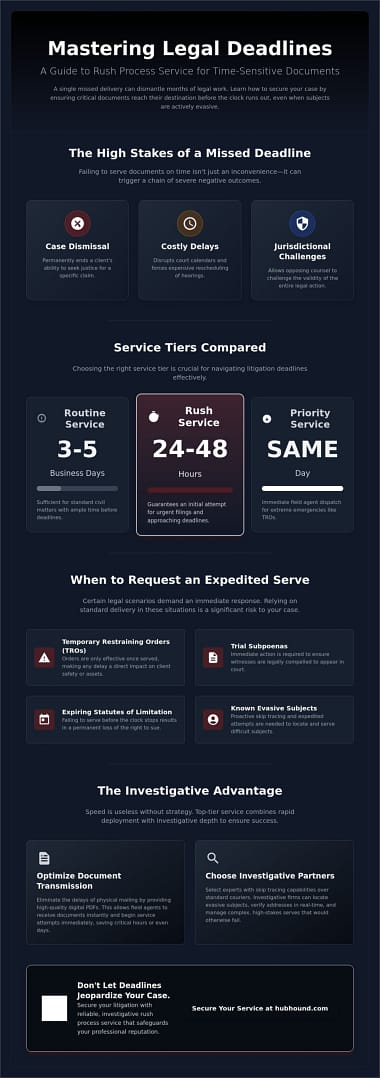
A missed service deadline often triggers a chain of negative procedural outcomes. It can lead to a case being dismissed with prejudice, effectively ending a client’s ability to seek justice for a specific claim. Beyond the risk of dismissal, late service disrupts court calendars and forces attorneys to reschedule hearings at a high cost. This delay creates an opportunity for opposing counsel to challenge the jurisdiction of the court or the validity of the entire action. The Statute of Limitations serves as an absolute legal barrier that permanently bars litigation once the prescribed timeframe expires. To navigate these risks, legal teams must move beyond routine delivery and embrace expedited strategies that prioritize the clock as much as the legal content itself.
Standard vs. Expedited Service Tiers
Routine service typically operates on a three to five day cycle, which is sufficient for many civil matters but inadequate for high-stakes litigation. Rush service accelerates this timeline by guaranteeing an initial attempt within 24 to 48 hours of document receipt. For extreme emergencies, priority or same-day tiers offer immediate field agent dispatch. When a priority request is flagged at HubHound, the administrative team bypasses the standard queue to assign an agent instantly. This level of urgency is vital for same-day filings or cases where a subject is known to be mobile. Selecting the appropriate tier depends on the time remaining before a court-mandated deadline and the complexity of the subject’s location. High-tier service ensures that even if the first attempt fails, there’s still a window for follow-up attempts before the legal opportunity vanishes.
When to Trigger an Expedited Legal Service Request
Distinguishing between routine and urgent filings requires a clear decision framework. If a case involves a Temporary Restraining Order (TRO), the window for service is often measured in hours, not days. These orders are only effective once served, meaning any delay directly impacts the safety or assets of your client. Similarly, subpoenas for upcoming trial dates require immediate action to ensure witnesses are legally compelled to appear. If your statute of limitations expires within the next 72 hours, you’ve reached the critical “last-minute” threshold. In these high-pressure scenarios, relying on a standard delivery timeline is a risk to the entire litigation. Identifying the need for rush process service for time-sensitive documents Portland early in the process prevents the panic of a missed deadline.
Statutes of Limitation and Filing Deadlines
Civil litigation and personal injury claims are governed by strict timelines. The clock starts the moment the cause of action occurs, and failing to serve the summons before that clock stops results in a permanent loss of the right to sue. Waiting until the final week to initiate service is a common point of failure. Evasive subjects or incorrect addresses can quickly consume a seven-day lead time. To mitigate this risk, audit your case files using these criteria:
- Identify all expiration dates falling within the next 14 business days.
- Verify the subject’s current residence or place of business via skip tracing if the last contact was over 90 days ago.
- Flag any case involving a known evasive subject for immediate expedited handling.
Following the Federal Rules of Civil Procedure ensures that your service meets national standards for validity, but only if that service is completed within the court’s prescribed window. Even a perfectly executed serve is worthless if it happens one day after the statute expires.
Urgent Notices and Orders to Show Cause
Orders to Show Cause (OSC) often carry exceptionally short service windows, sometimes requiring delivery within 24 hours of the judge’s signature. These orders demand that a party appear in court to justify why a specific action shouldn’t be taken. Failure to serve the OSC on time usually results in the hearing being vacated. Similarly, unlawful detainer notices are time-critical by design to prevent further property loss or damage. Multi-party litigation adds another layer of complexity, as all defendants must often be served simultaneously to keep the case on track. When the logistics of a case become this complex, a specialized civil litigation support team can provide the coordination needed to manage multiple attempts across different jurisdictions.
Volatile domestic relations cases also trigger the need for speed. In situations involving domestic violence or child custody, the safety of the parties often depends on the swift delivery of legal protections. Standard couriers aren’t equipped for the tactical awareness required in these environments. A professional server with an investigative background can navigate these sensitivities while maintaining the necessary speed to meet the court’s demands. Don’t wait for the deadline to loom before engaging a professional who understands the gravity of these documents.
Overcoming Evasion: The Investigative Advantage
Speed alone doesn’t guarantee success when a subject is actively avoiding service. Many standard providers offer a “rush” option that merely increases the frequency of attempts at an outdated or incorrect address. This approach wastes critical time and resources. Integrating investigative techniques into the workflow transforms a simple delivery into a high-probability operation. Using a rush process service for time-sensitive documents Portland that includes preliminary location verification ensures that field agents aren’t chasing shadows while the court clock ticks down. When litigation is pending, subjects often employ evasion tactics like ignoring the door or using third parties to screen visitors. Overcoming these hurdles requires more than a louder knock; it requires a data-driven strategy.
Skip Tracing: Finding the Subject Before the Deadline
Skip tracing is the systematic process of locating a person who has intentionally or unintentionally obscured their current residence. Unlike basic search engines, professional investigators access proprietary databases and utility records to identify real-time patterns of life. This investigative step is vital because a rush serve is only as good as the address provided. If the subject has relocated since the initial filing, standard service will fail, likely resulting in a missed deadline. By cross-referencing credit headers, vehicle registrations, and professional licenses, an expert curator of legal services can pinpoint a subject’s location quickly. This data-driven approach minimizes wasted attempts and maximizes the efficiency of the field agent, ensuring the documents reach the right hands on the first try.
Strategic Surveillance for Evasive Subjects
When a subject is aware of pending litigation, a standard “knock and talk” strategy is rarely successful. They might see a server approaching and simply refuse to answer. In these instances, surveillance becomes a necessary tool. By observing a residence from a distance, an investigator can confirm the subject is on-site before an attempt is made. This prevents the “not home” excuse and provides the documentation needed for alternative legal avenues. Under the Federal Rules of Civil Procedure, personal service is the primary requirement, but documenting a subject’s active evasion is often the prerequisite for a judge to authorize substitute service.
Surveillance ensures that the final attempt is timed perfectly, often occurring when the subject is entering or exiting their vehicle. This tactical awareness is what separates a specialized agency like HubHound from a general courier. In high-stakes domestic relations or corporate litigation, the subject’s behavior is often unpredictable. Having an investigator on-site who understands surveillance operations allows for real-time adjustments. If the subject leaves the primary location, the investigator can follow and execute service at a secondary site, ensuring the time-sensitive documents are delivered before the legal window closes.
Best Practices for Managing Urgent Legal Filings
Efficiency in the administrative phase is just as critical as the field agent’s speed. When initiating a rush process service for time-sensitive documents Portland, the quality of your initial submission dictates the success of the first attempt. Transitioning from physical mail to high-resolution digital files eliminates the transit time that often kills a case. Modern legal teams no longer rely on couriers to transport paper; they use secure digital portals to transmit documents instantly to agents already in the field. This administrative agility ensures that a “priority” flag actually results in immediate action rather than a delay in the mailroom.
Document Preparation and Digital Transmission
A complete service packet is the foundation of a successful serve. To avoid delays, ensure your digital transmission includes the summons, complaint, and any specific exhibits or coversheets required by the court. Electronic Service of Process (eSOP) has become the industry standard for speed, allowing for near-instant dispatch. Beyond the legal documents, providing “Subject Identifiers” is the single most effective way to accelerate a rush serve. Include the following details in your intake form:
- A recent, clear photograph of the subject.
- Specific vehicle descriptions, including make, model, and license plate numbers.
- Known work schedules or recurring appointments.
- Gate codes or specific entry instructions for secured complexes.
Providing these details allows the server to identify the subject immediately upon arrival, preventing the subject from claiming a case of mistaken identity. You can track this progress through modern process service platforms that offer real-time GPS-stamped updates, giving you the transparency needed to manage client expectations. For complex litigation involving multiple parties, use a centralized civil litigation support provider to maintain a single point of contact for all updates.
The Affidavit of Service: Ensuring Court Admissibility
The final step of a rush serve is the production of the Affidavit of Service. This document is the legal proof that the subject was notified and must be court-admissible to withstand challenges from opposing counsel. A professional affidavit must contain the exact date, time, and location of service, along with a detailed physical description of the individual who accepted the documents. In a rush scenario, the speed of returning this document is vital. Many jurisdictions now allow for e-filing of these affidavits, which further accelerates the process.
If a subject truly cannot be found within the rush window, a “Non-Service” report is issued. This report is not a failure; it’s a documented record of the “due diligence” required by the court to move toward alternative service methods. It details every attempt made, the investigative steps taken to verify the address, and the reasons why service was not completed. This paper trail is essential for justifying a motion for substituted service. To ensure your filings meet these rigorous standards, partner with HubHound for expert process service that prioritizes both speed and legal compliance.
Professional Process Service with HubHound
HubHound functions as a specialized investigative agency, moving beyond the limitations of standard delivery services. We operate at the intersection of legal logistics and deep-tier intelligence. With over 30 years of investigative experience, our team treats every serve as a tactical operation. We don’t just knock on doors; we evaluate the environment to ensure success. By integrating skip tracing directly into our rush workflow, we provide a level of reliability that standard couriers cannot match. This investigative depth is essential for executing rush process service for time-sensitive documents Portland, ensuring that even the most evasive subjects are located and served before the clock runs out. We position ourselves as the expert curator for legal teams that value efficiency and transparency.
Why Legal Professionals Trust HubHound
Our reputation is built on a foundation of rigorous validation. Every service attempt is documented with the precision required for high-stakes litigation. This commitment to quality assurance allows us to handle complex corporate due diligence alongside standard process service. We understand the nuances of the technical and business management sectors, offering specialized authority that broader directory sites lack. Our reporting is designed for the modern professional. It’s fast-paced, highly scannable, and delivers necessary information with minimal cognitive load. We save you time by doing the heavy lifting of research, filtering out the noise to provide clear, actionable updates on every file.
Getting Started with Your Rush Request
Initiate your request by transmitting your digital files through our secure platform. This action-oriented approach prioritizes clarity and speed, allowing our agents to begin work immediately. Identify your high-priority cases and leverage our niche expertise to navigate difficult serves that other providers might refuse. We focus on quality and compatibility, ensuring our methods align with your firm’s professional standards. Our specialized expertise makes us an indispensable ally for growth-focused companies facing tight legal windows. Don’t let a missed deadline jeopardize your litigation strategy. Secure your deadline with HubHound’s rush process service today.
Secure Your Litigation Strategy Against the Clock
Success in high-stakes litigation depends on more than just filing papers. It requires a strategic approach that combines rapid digital transmission with investigative depth. By prioritizing electronic service of process and providing detailed subject identifiers, legal teams can eliminate the administrative friction that leads to missed deadlines. Integrating skip tracing ensures that even the most evasive subjects are located before the statute of limitations expires.
Selecting a rush process service for time-sensitive documents Portland ensures you have a partner who understands the legal necessity of a court-ready Affidavit of Service. HubHound provides this specialized expertise through licensed investigators with over 30 years of experience. Our workflow is designed to alleviate the pressure of approaching court dates by delivering real-time updates and rigorous validation of every attempt. Secure your legal deadline with HubHound’s professional rush service. Trust in a process that values your professional time and the integrity of your case.
Frequently Asked Questions
What is considered “Rush” in process serving?
Rush service is defined as prioritized delivery where the first attempt is made within 24 to 48 hours. This contrasts with routine service, which typically spans three to five business days. For extreme emergencies, same-day tiers ensure immediate dispatch. This expedited timeline is critical when managing rush process service for time-sensitive documents Portland to meet strict court-mandated windows. It ensures the legal process remains on schedule despite late filings.
How much does rush process service typically cost?
Costs for expedited service vary based on the required turnaround time and the complexity of the subject’s location. Factors like mileage to remote areas, printing high page counts, and the need for investigative skip tracing influence the final fee. Most agencies offer tiered structures, such as routine, rush, and same-day priority. You should request a transparent fee schedule that outlines exactly what is included in each service level to avoid unexpected expenses.
Can a process server serve someone who is avoiding them?
Yes, professional servers use investigative tactics like surveillance and skip tracing to overcome active evasion. When a subject refuses to answer the door, documenting their behavior is essential for legal recourse. In many jurisdictions, this documentation allows a judge to authorize substitute service, where papers are left with a co-resident or posted as directed. This ensures litigation moves forward despite the subject’s attempts to hide or ignore the legal action.
What happens if the deadline passes before service is completed?
If a service deadline passes, the court may dismiss the case or vacate the hearing date. This often requires the plaintiff to refile documents and pay additional filing fees. To prevent this, professional agencies provide a “Non-Service” report detailing their due diligence. This report serves as evidence that every reasonable effort was made, which is necessary when asking the court for an extension or for permission to use alternative service methods.
Is an Affidavit of Service required for all rush serves?
An Affidavit of Service is a mandatory legal document that proves the subject was properly notified. It must contain the specific date, time, and location of the serve, along with a description of the individual who accepted the papers. Without this court-admissible proof, the judge will not recognize the service as valid. Professional firms prioritize the rapid return of these documents to meet filing deadlines and maintain the momentum of your legal strategy.
What documents are needed to start a rush process service?
You must provide a complete service packet, including the summons, complaint, and any specific court orders or coversheets. Providing a recent photograph and vehicle description of the subject significantly increases the success rate of a rush process service for time-sensitive documents Portland. High-resolution digital PDFs are preferred over physical copies to allow for immediate transmission to field agents. This digital workflow bypasses the delays associated with standard physical mail.
How many attempts are included in an expedited service request?
Most expedited service requests include a set number of attempts, typically ranging from three to four, within a specific timeframe. The exact number depends on the service level selected and the agency’s internal protocols. If service is not completed within these attempts, additional fees may apply for further field work. Always confirm the specific attempt policy with your provider before the assignment begins to ensure your expectations align with their operational standards.
Can you serve documents on weekends or holidays for a rush?
Many professional agencies offer weekend and holiday attempts for high-priority cases. Subjects are often easier to locate at home during non-business hours, making these times ideal for difficult serves. However, you must verify that the jurisdiction where the service occurs allows for legal delivery on these days. Some regions have specific restrictions regarding service on Sundays or designated public holidays that could invalidate the serve if not handled by an expert.

Article by
Joel R. Manley | President | Hubhound Investigations | OR PI-ID#: 90432 | 111 SW Fifth Avenue, Suite 3150 Portland, Oregon 97204 | 971-442-8170
Joel is licensed as a private investigator in Oregon and Tennessee. Joel started his career in 1987 serving as a Military Police Officer and Military Police Investigator.
After ending his military tour of duty, Joel became a civilian Police Officer and Deputy Sheriff. Joel took his strong background in Hostage Negotiations, Mediation and Conflict Resolution, with him to patrol some of the highest crime areas in SE Portland.
Joel was awarded Deputy of the Year for his efforts and for drastically reducing the crime rate in the area he patrolled. As a Deputy Sheriff, Joel assisted in leading a Neighborhood Livability Program that was nationally recognized for having the most innovative and progressive approach to policing.
In 2018, Joel retired as a Deputy Sheriff and founded Hubhound Investigations. Joel played an integral role in Hubhound Investigations receiving an A+ Accredited Business rating from the Better Business Bureau (BBB).
In his off time, Joel enjoys spending time with his wife, adult children and Hubhound’s Happiness Ambassador, Nya. Joel also enjoys Scuba Diving and Kayaking.
Disclaimer
DISCLAIMER: This article is provided for general informational and educational purposes only. It is not intended to constitute legal advice, professional investigative advice, or instruction to engage in any unlawful activity. Laws governing private investigations, surveillance, recording, tracking, access to information, evidence collection, privacy, trespass, licensing, and related investigative activities vary by jurisdiction and are subject to change.
Any investigative techniques, tactics, procedures, scenarios, or legal proceedings discussed in this article are presented for informational purposes and should not be interpreted as authorization or encouragement to use a particular method. Private investigators and members of the public are responsible for understanding and complying with all applicable federal, state, and local laws, licensing requirements, court rules, and professional standards.
The circumstances of every investigation and legal matter are different. Information contained in this article should not be relied upon as a substitute for advice from a qualified attorney or other appropriate licensed professional regarding a specific situation. No attorney-client, investigator-client, or other professional relationship is created by reading or using this information.