
A police report is rarely the definitive account of a collision. If a key observer vanishes before providing a formal statement, your entire legal strategy could collapse before it ever reaches a courtroom. You already know that a successful outcome relies on more than just photos of the scene. It requires credible human testimony that can withstand rigorous scrutiny. It’s incredibly frustrating when you need to locate a witness for a car accident case but find only incomplete reports or disconnected phone numbers.
This guide provides the advanced investigative framework you need to identify unknown observers and track down individuals who have moved across the country. We’ll examine technical skip tracing methods and the critical role of electronic evidence preservation, especially as some jurisdictions have recently shortened filing deadlines to as little as 18 months. You’ll learn how to turn fragmented leads into court-ready statements that secure your position and save you valuable time. This professional approach ensures you have the necessary resources to evaluate your case with total clarity and confidence.
Key Takeaways
- Understand why neutral third-party testimony carries more weight than passenger accounts in high-stakes settlement negotiations.
- Identify overlooked observers by canvassing for local security footage and cross-referencing police reports for individuals who were not formally interviewed.
- Deploy advanced skip tracing techniques and proprietary databases to locate a witness for a car accident case who has changed residency or contact information.
- Master the professional interview techniques required to build rapport and secure objective, court-ready statements that withstand legal scrutiny.
- Recognize when to utilize professional civil litigation support to maintain a strict chain of custody for all gathered evidence.
The Critical Importance of Eyewitness Testimony in Accident Litigation
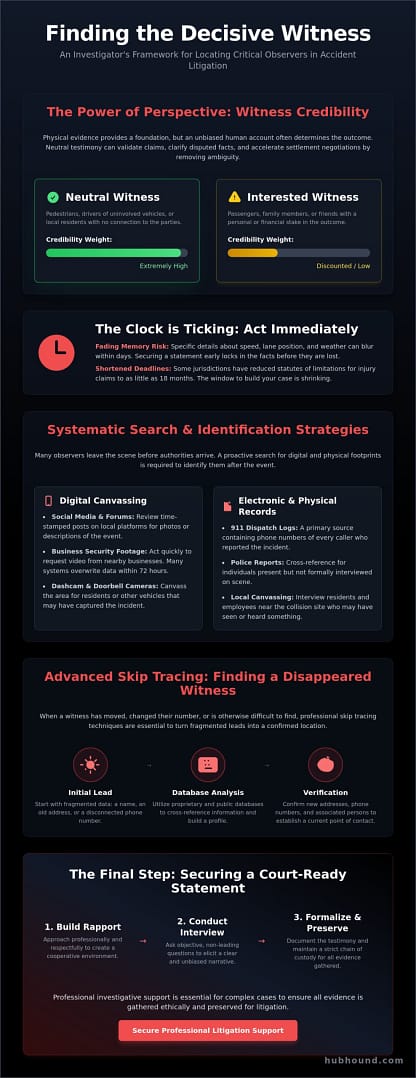
Physical evidence like skid marks and vehicle damage provides a technical foundation, but it rarely tells the whole story. In the context of civil litigation, the perspective of an unbiased observer often serves as the deciding factor in liability disputes. When you take steps to locate a witness for a car accident case, you’re securing more than just a name; you’re acquiring a narrative that can validate or refute the claims of the involved parties. Insurance adjusters prioritize these statements because they provide a glimpse into how a jury might perceive the event. A single credible account from a bystander can significantly accelerate settlement negotiations by removing the ambiguity that often stalls legal progress.
Neutral vs. Interested Witnesses
Not all testimony carries equal weight. Legal professionals distinguish between “interested” witnesses, such as passengers or family members, and “neutral” witnesses like pedestrians or occupants of unrelated vehicles. Judges and juries naturally discount testimony from individuals who have a personal or financial interest in the case’s outcome. To establish a robust position, you must prioritize observers who have no prior relationship with either driver. Utilizing professional witness interviews and statements ensures that these accounts are captured with the necessary technical precision and neutrality required for court.
Evidence Beyond the Police Report
Relying solely on a police report is a common tactical error. Officers often arrive after the vehicles have been moved and may only interview the drivers. This can lead to incomplete records or errors regarding the sequence of events. Eyewitness testimony serves as a critical supplement to official reports, clarifying disputed facts like vehicle speed or the color of a traffic light at the moment of impact. In complex hit-and-run cases, these witnesses are often the only source of information regarding “phantom vehicles” that caused a collision without making contact.
Memory is a perishable resource. The “fading memory” risk is a genuine concern in accident litigation, as specific details regarding lane position or weather conditions can blur within days. Initiating a search to locate a witness for a car accident case immediately after the event is vital, especially as some jurisdictions have shortened statutes of limitations for non-fatal injury claims to just 18 months as of 2026. By securing a statement early, you lock in the facts before they’re lost to time or external influence. This proactive approach is a hallmark of effective civil litigation support and is necessary for any growth-focused firm looking to maximize recovery for their clients.
Immediate Strategies for Identifying Witnesses Post-Accident
Securing contact information at the scene is ideal, but injuries or the chaos of a collision often make this impossible. Many observers leave before authorities arrive, assuming their help isn’t needed or simply wanting to avoid a legal process. To effectively locate a witness for a car accident case after the fact, you must pivot to a systematic search for digital and physical footprints left behind. This process requires a proactive approach that goes beyond the standard police report. Effective canvassing involves a dual-layered search of both physical environments and digital platforms to reconstruct the scene and identify those present.
Digital Canvassing Techniques
Modern investigations rely heavily on the digital breadcrumbs left by bystanders and local infrastructure. Social media platforms and neighborhood boards are often the first place witnesses go to share photos or describe what they saw. Reviewing time-stamped posts from the hour of the accident can lead you to specific individuals who were in the vicinity. Additionally, you must act quickly to secure footage from nearby businesses. Research indicates that many commercial security systems overwrite video data within 72 hours. While a NHTSA expert witness can provide a technical reconstruction of the crash, that analysis is significantly strengthened when supported by actual video evidence from a non-involved dashcam or storefront camera.
The “Silent” Witness: Electronic Records
When physical observers are scarce, electronic records often provide the necessary leads. 911 dispatch logs are a primary resource; they contain the phone numbers of every person who called to report the incident, even if those individuals didn’t stay to speak with an officer. Review the police report specifically for “reported by” annotations that lack a corresponding statement. You should also consider these sources:
- Commercial Vehicle Logs: Delivery drivers and long-haul truckers use GPS-tracked routes. Identifying which commercial vehicles passed through the intersection at the time of the crash can reveal professional drivers with high-quality dashcam footage.
- Public Transport Schedules: If the accident occurred near a bus stop or along a transit route, the transit authority’s records can help you identify which buses were present. These vehicles are almost always equipped with multiple exterior cameras.
- Rideshare Data: Digital records from rideshare apps can confirm if a driver was in the area, providing another potential source of neutral testimony.
If these initial digital leads prove difficult to track down, utilizing professional skip tracing and locate investigations can bridge the gap between a fragmented phone number and a verified address. This level of technical discovery ensures that no potential lead is abandoned simply because the initial data was incomplete. By treating the environment as a collection of data points, you can locate a witness for a car accident case even when the official record is silent.
Advanced Skip Tracing: Finding Witnesses Who Have Moved or Disappeared
Finding a name in a police report is only the first step. If months have passed since the collision, that individual may have relocated or changed contact information, rendering initial leads useless. When standard outreach fails, you must transition to advanced investigative techniques to locate a witness for a car accident case. This process, known as skip tracing, moves beyond public search engines to access non-public data streams that track residency changes in real-time. It requires a technical understanding of how data is aggregated across various professional and consumer sectors.
The Skip Tracing Process
Executing a successful locate requires a structured methodology to filter out noise and identify the specific individual involved. Professional investigators follow a tiered approach to ensure accuracy and efficiency:
- Step 1: Data Analysis. Begin by analyzing the last known address, social media handles, and any partial contact data. This establishes a baseline for the search and identifies potential connections.
- Step 2: Database Querying. Search proprietary, non-public databases for current credit headers or utility records. These sources are updated more frequently than public white pages or social media profiles.
- Step 3: Identity Verification. Cross-reference professional licensing boards or vehicle registration records to confirm the person located is indeed the witness from the scene.
Locating Witnesses Across State Lines
Witnesses often move across state lines for work or personal reasons, making them nearly invisible to localized search efforts. Traditional search engines fail to find these individuals because they rely on indexed web pages that may be years out of date. To maintain the momentum of your legal case, you must utilize nationwide skip tracing and locate investigations. These services operate within a legal framework that allows for the discovery of current residency while respecting privacy regulations. This is particularly crucial when dealing with witnesses who are intentionally avoiding legal proceedings. A professional investigator can navigate these complexities, using social media deep dives to identify current employers or frequent hangouts, ultimately delivering a verified location for process service. By employing these technical investigative tools, you ensure that a witness’s decision to move doesn’t result in a lost opportunity to strengthen your litigation strategy. You need reliable data to locate a witness for a car accident case, and advanced skip tracing provides the precision that basic searches lack.
Securing Credible Statements: From Initial Contact to Formal Interview
Success in skip tracing is only half the battle. Once you locate a witness for a car accident case, the challenge shifts to extracting a statement that carries legal weight. This phase requires a delicate balance of psychological rapport and technical precision. Your goal is to capture an objective account before external narratives or fading memories distort the facts. Insurance adjusters and opposing counsel will look for any sign of bias or coaching, so the integrity of the initial contact is paramount.
Start by establishing trust. Most bystanders are wary of legal involvement or fear being trapped in a lengthy trial. Explain that their contribution is about accuracy and fairness. When structuring the interview, avoid leading questions that suggest a specific answer. Instead of asking if the driver was speeding, ask the witness to describe the vehicle’s motion and speed relative to the flow of traffic. This approach ensures the resulting statement is viewed as an independent observation rather than a guided narrative.
Handling Reluctant Witnesses
Apathy and fear of legal repercussions are the primary drivers of witness non-cooperation. You must address these concerns directly by emphasizing the efficiency of the process. If a witness remains hesitant, involving a professional investigator can facilitate the conversation. Professionals are trained to navigate these social barriers without using coercion, which could otherwise disqualify the testimony. They can often alleviate the witness’s concerns by explaining the procedural steps and their limited role in the overall litigation.
Essential Elements of a Strong Statement
A court-ready statement must be granular. It’s not enough for a witness to say they saw the crash. You must document their exact vantage point, line of sight, and any potential obstructions like parked cars or foliage. Include environmental data points such as lighting conditions and weather at the precise time of the event. A signed and dated written declaration is legally necessary to ensure the statement is admissible for use in court proceedings.
The choice between a written statement and a recorded interview depends on the complexity of the case. Recorded interviews capture tone and hesitation, which can be invaluable during discovery. Written declarations provide a concise summary that is easy for juries to digest. For cases requiring high-stakes accuracy, you should secure professional witness interviews and statements to ensure every procedural requirement is met. This level of diligence transforms a simple conversation into a powerful asset for your litigation strategy. By acting quickly after you locate a witness for a car accident case, you preserve the integrity of the evidence before it is lost to time.
Why Professional Investigative Support is Essential for Complex Cases
Managing the discovery process in high-stakes litigation requires more than just persistence. While initial efforts to locate a witness for a car accident case may start with a police report, complex scenarios involving hit-and-runs or commercial vehicle collisions demand a higher level of technical sophistication. Attempting a DIY search often leads to incomplete data or, worse, legal complications that can jeopardize the entire case. Professional investigators act as a force multiplier for legal teams, providing the specialized tools and neutral perspective necessary to secure results that withstand trial scrutiny.
A primary advantage of professional support is the preservation of the chain of custody. Every interaction with a witness must be documented to prevent allegations of tampering or harassment. If a statement is gathered under questionable circumstances, opposing counsel will move to have it suppressed. By utilizing an independent third party, you ensure that the process of finding and interviewing observers is beyond reproach. This neutrality is vital when you need to locate a witness for a car accident case whose testimony contradicts the official police narrative.
Strategic Litigation Support
Comprehensive civil litigation support services streamline the path from discovery to deposition. These services allow attorneys to focus on legal strategy while investigators handle the logistical heavy lifting of tracking down elusive individuals. In cases where a witness is uncooperative, having a licensed professional handle process service is essential for ensuring that subpoenas are delivered in strict accordance with the law. Case results often hinge on these efforts; for instance, liability determinations have been completely reversed when a professionally located witness provided dashcam footage that proved a defendant ran a red light, a detail omitted from the original police report. This shift in evidence only occurs when the investigative team has the resources to search beyond the obvious leads.
The HubHound Advantage
HubHound provides a specialized environment for legal professionals who require fast, reliable investigative results. Our team brings decades of experience to every skip tracing operation and witness interview, utilizing a nationwide network that removes geographic barriers. We understand that time is a critical variable, especially when statutes of limitations are approaching or electronic evidence is at risk of being overwritten. Our services are designed for the modern professional who values efficiency, transparency, and niche expertise. By choosing a partner with a proven track record in technical discovery, you eliminate the choice paralysis often felt when selecting service providers. We deliver authoritative and discreet investigative support, ensuring your case is built on a foundation of verified, court-ready evidence.
Secure Your Case with Technical Investigative Precision
The success of your litigation strategy often rests on the shoulders of individuals who were simply in the right place at the right time. As we’ve examined, identifying these neutral observers and capturing their objective accounts requires a systematic approach that blends digital canvassing with advanced skip tracing. Relying on a static police report or a basic search engine isn’t sufficient in a landscape where witnesses frequently relocate or intentionally avoid involvement.
When you need to locate a witness for a car accident case, technical precision is your most valuable asset. HubHound provides the specialized civil litigation support required to navigate these complexities with total confidence. Our licensed investigators bring over 30 years of industry experience and a comprehensive nationwide reach to every search, ensuring that no lead remains cold. We prioritize efficiency and transparency, allowing you to focus on the legal nuances of your case while we handle the logistical heavy lifting.
Contact HubHound for professional witness locate and interview services to strengthen your legal position and streamline your discovery process. Take the decisive step toward building a more robust, evidence-backed case today.
Frequently Asked Questions
How do I find a car accident witness if they didn’t stop at the scene?
Start by reviewing 911 dispatch logs to identify callers who reported the incident but left before officers arrived. You should also canvass the area for commercial delivery vehicles or public transit buses whose GPS data or cameras might have captured the event. Digital tools like social media neighborhood boards often provide leads from bystanders who posted about the collision but didn’t provide a formal statement at the scene.
Can I use a witness statement if the person has since moved out of the country?
You can use the statement, but you must ensure it meets the specific legal requirements for admissibility in your jurisdiction. If the witness has relocated abroad, your legal team may need to coordinate a remote deposition or secure a signed, dated declaration. Professional skip tracing can verify their current international residency to ensure they are properly notified of any necessary legal proceedings or depositions.
What should I do if a witness refuses to give a statement to my lawyer?
Involve a professional investigator to facilitate the conversation and build rapport. Witnesses are often intimidated by formal legal counsel but are more willing to speak with a neutral investigator who is viewed as a fact-finder. If cooperation remains an issue and the case is in active litigation, your attorney can issue a subpoena to compel the witness to provide testimony under oath during a deposition.
Is a witness statement from a passenger in my car still useful in court?
Passenger statements are useful for corroboration, but they are considered “interested witnesses” and often carry less weight than a neutral third party. Juries and insurance adjusters naturally look for bias in testimony from friends or family members. To strengthen your position, you should prioritize efforts to locate a witness for a car accident case who was a bystander or an occupant of an unrelated vehicle.
How long do I have to find a witness before their testimony is considered unreliable?
You should act immediately because human memory degrades rapidly and specific details can blur within days. While testimony remains legally valid throughout the statute of limitations, statements captured shortly after the event are viewed as more credible by juries. As of 2026, some jurisdictions have shortened filing windows for injury claims to 18 months, making early witness location and statement procurement even more critical.
Can a private investigator find someone with only a partial license plate number?
Investigators can often identify a vehicle and its owner by cross-referencing partial plates with vehicle descriptions and location data in proprietary databases. By querying specialized records and local surveillance logs, a professional can reconstruct the vehicle’s path to identify the driver. This technical discovery is a primary method used to locate a witness for a car accident case when an observer fled the scene prematurely.
What is skip tracing and how does it help in car accident cases?
Skip tracing is a technical investigative process used to find individuals whose current location or contact information is unknown. It involves searching non-public databases for credit headers, utility connections, and professional licenses that aren’t accessible via standard search engines. This process is vital for finding witnesses who have relocated across state lines or are intentionally avoiding contact to stay out of a legal dispute.
How much does it cost to hire an investigator to locate a witness?
Professional investigative fees are typically structured as either an hourly rate or a flat fee for specific skip tracing services. The total cost depends on the complexity of the search and the amount of initial data you can provide. For an accurate assessment of your specific requirements, it’s best to consult with a licensed investigative firm to discuss the scope and technical needs of your witness search.

Article by
Joel R. Manley | President | Hubhound Investigations | OR PI-ID#: 90432 | 111 SW Fifth Avenue, Suite 3150 Portland, Oregon 97204 | 971-442-8170
Joel is licensed as a private investigator in Oregon and Tennessee. Joel started his career in 1987 serving as a Military Police Officer and Military Police Investigator.
After ending his military tour of duty, Joel became a civilian Police Officer and Deputy Sheriff. Joel took his strong background in Hostage Negotiations, Mediation and Conflict Resolution, with him to patrol some of the highest crime areas in SE Portland.
Joel was awarded Deputy of the Year for his efforts and for drastically reducing the crime rate in the area he patrolled. As a Deputy Sheriff, Joel assisted in leading a Neighborhood Livability Program that was nationally recognized for having the most innovative and progressive approach to policing.
In 2018, Joel retired as a Deputy Sheriff and founded Hubhound Investigations. Joel played an integral role in Hubhound Investigations receiving an A+ Accredited Business rating from the Better Business Bureau (BBB).
In his off time, Joel enjoys spending time with his wife, adult children and Hubhound’s Happiness Ambassador, Nya. Joel also enjoys Scuba Diving and Kayaking.
Disclaimer
DISCLAIMER: This article is provided for general informational and educational purposes only. It is not intended to constitute legal advice, professional investigative advice, or instruction to engage in any unlawful activity. Laws governing private investigations, surveillance, recording, tracking, access to information, evidence collection, privacy, trespass, licensing, and related investigative activities vary by jurisdiction and are subject to change.
Any investigative techniques, tactics, procedures, scenarios, or legal proceedings discussed in this article are presented for informational purposes and should not be interpreted as authorization or encouragement to use a particular method. Private investigators and members of the public are responsible for understanding and complying with all applicable federal, state, and local laws, licensing requirements, court rules, and professional standards.
The circumstances of every investigation and legal matter are different. Information contained in this article should not be relied upon as a substitute for advice from a qualified attorney or other appropriate licensed professional regarding a specific situation. No attorney-client, investigator-client, or other professional relationship is created by reading or using this information.