
In 2026, approximately 80% of criminal cases involve some form of digital evidence, yet many defense teams still rely entirely on the state’s discovery file. It’s a significant disadvantage when the prosecution has more resources and police reports contain critical omissions or errors. You’re likely dealing with witnesses who are hard to find or simply unwilling to speak, making it difficult to build a proactive defense. It’s frustrating to feel like you’re always one step behind the government’s narrative.
This guide shows you how professional criminal defense investigations level the playing field by uncovering the evidence essential for a successful legal strategy. You’ll learn how to establish reasonable doubt and verify the accuracy of the prosecution’s claims through rigorous assessment. We’ll preview the modern investigative tools and skip tracing techniques that identify new witnesses and secure court-ready documentation. By the end of this article, you’ll understand how to transform a reactive defense into a robust, evidence-driven case that prioritizes clarity and objective facts. We’ll walk through the process of auditing the state’s work to ensure no stone is left unturned.
Key Takeaways
- Professional criminal defense investigations provide an independent factual inquiry that ensures your legal team isn’t limited by the prosecution’s discovery file.
- Learn how specialized skip tracing and witness interview techniques locate critical individuals and secure accurate statements that challenge the state’s narrative.
- Identify procedural errors and inconsistencies by auditing police reports and conducting firsthand crime scene examinations to verify every detail.
- Maximize your firm’s resources by integrating expert investigators early in the process to build a proactive, evidence-driven defense strategy.
- Leverage high-tech investigative support to navigate the complexities of digital evidence and secure court-ready documentation for trial.
What are Criminal Defense Investigations and Why Do They Matter?
A criminal defense investigation is an independent inquiry designed to uncover facts specifically relevant to a defendant’s case. It isn’t merely a reaction to the prosecution’s claims; it’s a proactive search for the truth. While the state conducts its own process, the defense must ensure it has access to the same depth of information. To understand the necessity of this role, one must first look at the broader context of what is a criminal investigation? and how it differs from a defense-led inquiry.
The presumption of innocence is a foundational right, but it requires active support to remain effective. Police investigations often stop once they identify a likely suspect. In contrast, criminal defense investigations continue to explore alternative theories and overlooked evidence. This independent oversight ensures that the legal process remains fair and that the defense isn’t limited to a narrative constructed by the state.
The Imbalance of Investigative Resources
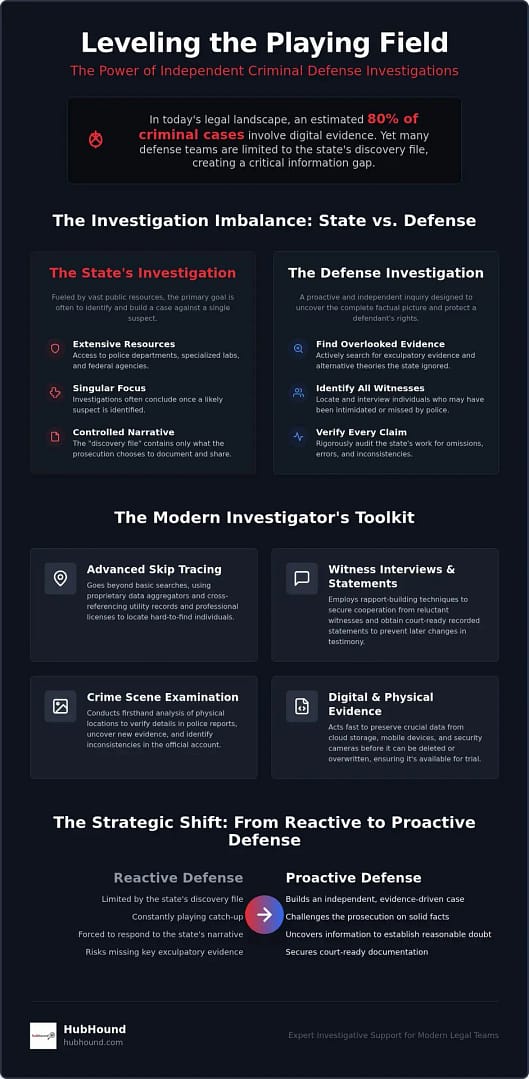
The state utilizes police departments, specialized labs, and federal agencies to build their narrative. This creates a massive resource gap for the average defendant. Relying solely on discovery documents is a strategic risk for any attorney. Discovery only contains what the police chose to document, which may exclude exculpatory evidence or context. Professional investigators from agencies like HubHound bridge this gap by providing defense teams with high-level surveillance, skip tracing, and witness location services. This specialized support allows legal teams to audit the state’s work and identify where the official narrative falls short.
Core Objectives of a Defense Inquiry
The primary goal of any defense inquiry is to provide a complete factual picture. This involves several critical tasks that go beyond what law enforcement typically provides:
- Identifying Favorable Witnesses: Investigators track down and interview individuals the police may have ignored or intimidated.
- Establishing Contradictory Timelines: By meticulously verifying movements and digital footprints, investigators can create a timeline that contradicts the prosecution’s theory.
- Securing Evidence: Digital and physical evidence can disappear quickly. Investigators act fast to preserve data from cloud storage, mobile devices, or private security cameras before it is overwritten.
Success in criminal defense investigations depends on speed and technical precision. This precision is essential when analyzing physical evidence; for example, forensic laboratories often rely on advanced color measurement technology from HunterLab (Hunter Associates Laboratory, Inc.) to provide objective data that can withstand the scrutiny of a courtroom. Professional support ensures that every lead is followed and every claim is verified, giving the defense the tools needed to establish reasonable doubt.
The Investigator’s Toolkit: Methods for Uncovering the Truth
Successful criminal defense investigations rely on a technical toolkit that goes far beyond reviewing police reports. It requires a blend of digital forensics, human intelligence, and field operations to uncover facts the state may have overlooked. By utilizing specialized methods, defense teams can proactively challenge the prosecution’s narrative rather than simply reacting to it. This proactive approach is essential for identifying the gaps in the state’s discovery file.
Advanced Skip Tracing and Locate Investigations
Modern skip tracing leverages proprietary data aggregators and social media footprinting to find individuals who don’t want to be found. Simple database searches often return stale information, such as old addresses or disconnected phone numbers. In contrast, professional locate investigations involve cross-referencing utility records, professional licenses, and credit headers to verify a person’s current physical location. For example, investigators recently located a key witness who had moved across multiple state lines by tracking changes in professional registration data that hadn’t yet hit public directories. This level of precision is vital for serving process or securing a statement before trial.
Witness Interviews and Statement Procurement
Securing testimony from reluctant or hostile witnesses is a specialized skill. These individuals often fear retaliation or believe their involvement won’t matter. Investigators use rapport-building techniques and transparency to encourage cooperation. Obtaining recorded statements is critical because they serve as a baseline for impeachment if a witness changes their story on the stand. An admissible statement is a voluntary, signed, or recorded account of facts that meets specific legal standards for reliability and authenticity to be introduced as evidence in court. Following the Performance Guidelines for Criminal Defense Representation, attorneys have a clear duty to conduct these inquiries to ensure a competent defense.
Credibility Vetting and Surveillance
The prosecution’s case often hinges on the credibility of their witnesses. Comprehensive background screening identifies prior convictions, financial incentives, or personal biases that could undermine their testimony. Additionally, surveillance operations provide objective proof of a person’s activities or physical capabilities. If a witness claims they were at a specific location but surveillance proves otherwise, the entire case narrative shifts. For legal teams looking to secure these critical facts, partnering with a specialized agency for criminal defense investigations ensures that every lead is professionally vetted and documented for court.
Challenging the Prosecution: Fact-Checking the State’s Case
Fact-checking the state’s case is a cornerstone of criminal defense investigations. Law enforcement often develops “tunnel vision,” a psychological bias where officers focus on a single suspect and ignore exculpatory evidence. Professional investigators audit the entire process to identify these cognitive biases and procedural failures. By scrutinizing the prosecution’s narrative, the defense can expose inconsistencies that would otherwise go unchallenged.
A police report is never a substitute for a firsthand crime scene examination. Investigators visit the scene to verify sightlines, lighting conditions, and acoustics mentioned in officer statements. They also meticulously vet the chain of custody for all physical evidence. Any gap in documentation or unauthorized access can render evidence unreliable. Understanding how a typical criminal defense case works helps legal teams anticipate where the state’s chain of custody might be weakest. This rigorous assessment is what allows a defense team to build a case based on objective reality rather than police assumptions.
Analyzing Police Procedures and Reports
Arrest reports often contain red flags, such as boilerplate language or conflicting witness accounts buried in supplemental notes. Investigators identify leads that were accidentally or purposely dropped, such as individuals mentioned at the scene who were never interviewed. This discovery process is vital for preparing an attorney for cross-examination. By providing the defense team with a list of verified contradictions, the investigator gives the lawyer the tools needed to impeach the credibility of state witnesses. When you need this level of detail, HubHound provides the expertise required to audit complex case files and identify procedural errors.
Evidence Review and Digital Forensics
As of 2026, approximately 80% of criminal cases involve some form of digital evidence. This makes digital forensics a critical component of modern criminal defense investigations. Investigators review surveillance footage, GPS data, and communication logs to verify or debunk the prosecution’s timeline. It’s not enough to simply have the data; the investigator must ensure it meets the strict standards for court admissibility. This involves verifying that the collection methods didn’t corrupt the files and that the metadata remains intact. Identifying patterns in digital footprints can often establish a defendant’s location more accurately than a witness’s memory.
Strategic Integration: Working with Professional Investigators
Integrating a professional investigator into your legal team shouldn’t be an afterthought. For the best results, bring an investigator on board the moment you’re retained—a practice prioritized by specialized firms like SLKQ Lawyers. Early involvement allows for the preservation of fleeting evidence, such as volatile digital data or witness memories that naturally fade. When an attorney hires a professional for criminal defense investigations, they extend the protection of the work-product doctrine and attorney-client privilege to the investigator’s findings. This ensures that sensitive discoveries remain confidential while you build your strategy.
To maximize billable hours and ensure a high return on investigative investment, follow a structured workflow that prioritizes clarity and efficiency:
- Define the scope: Provide a clear, written mandate. Focus the search on specific witnesses, digital footprints, or physical locations to prevent aimless searching.
- Open communication: Establish a rhythm for regular briefings. These updates allow the investigator to pivot their focus based on new discovery or changing legal theories.
- Rigorous Documentation: Demand reports that are concise and professional. Court-ready documentation is essential for pre-trial motions and impeachment.
- Strategic Review: Use every finding to adjust your defense strategy. If an investigator uncovers a contradiction, it’s better to address it in the office than in the courtroom.
- Trial Consultation: Utilize the investigator during jury selection or to monitor witness testimony for inconsistencies that can be used during cross-examination.
The Investigator as an Expert Witness
There are times when an investigator must transition from a consultant to a witness. When they take the stand, their reputation for unbiased and professional reporting is under scrutiny. Credibility is an investigator’s most valuable currency. They must be prepared to defend their methods, verify the chain of custody, and explain the technical nuances of their findings to a jury. Preparation for the witness stand starts on day one with meticulous note-taking and strict adherence to 2026 industry standards for digital evidence handling. A professional who can deliver a clear, authoritative testimony can be the deciding factor in establishing reasonable doubt. Expert criminal defense investigations provide the factual foundation that makes this level of testimony possible.
Why Expert Defense Support is Essential for Modern Legal Teams
The investigative landscape has shifted from the “gumshoe” tropes of the past to a high-tech professional discipline. Today, successful outcomes for criminal defense investigations depend on an investigator’s ability to navigate complex digital environments and secure court-ready evidence. Specialized agencies like HubHound provide the technical expertise that generalists simply can’t match. By utilizing advanced skip tracing and precise process service, these professionals ensure your legal timeline remains intact and your defense is never delayed by missing witnesses or unserved subpoenas.
Expert criminal defense investigations act as a necessary check on the state’s power. While law enforcement has the weight of the government behind it, a professional investigator provides the balance required for a fair trial. They aren’t just searching for leads; they’re curators of objective truth who verify every claim made by the prosecution. This level of scrutiny is what prevents wrongful convictions and ensures that the “presumption of innocence” remains a functional reality in the courtroom.
The Value of Specialization
Generalist investigators often fail in complex criminal defense environments because they lack a deep understanding of litigation support. A specialized agency understands the rigorous assessment required for modern cases, ensuring all findings meet the highest confidentiality and admissibility standards. In corporate white-collar cases, for instance, integrating background screening into the defense allows you to vet internal witnesses and identify potential biases before the prosecution does. This niche expertise ensures that your team isn’t just gathering information but is building a strategic advantage. It’s about quality and compatibility, focusing on the specific software environments and digital footprints that define 2026 industry standards.
Securing Your Defense Strategy Today
Delay is the enemy of a successful defense. Physical evidence can be lost, digital data can be overwritten, and witness memories fade with every passing day. To protect your client’s rights, you must act quickly to preserve the factual record. When evaluating an investigative firm, look for decades of industry experience and a clear mastery of surveillance and skip tracing. Ensure the agency has a proven track record of adhering to strict confidentiality and professional standards across the country. A reliable partner doesn’t just find evidence; they provide the peace of mind that every lead has been exhausted.
The investigator serves as the final protector of the truth, ensuring the legal process is based on objective facts rather than incomplete police narratives. By partnering with a dedicated professional, you provide your client with the robust defense they deserve. Don’t leave your case to chance or rely on the state’s limited discovery to do the heavy lifting for your defense strategy. Contact a professional today to begin your criminal defense investigation.
Securing the Future of Your Defense Strategy
Building a robust case in 2026 requires more than just reviewing discovery files. It demands a proactive approach that audits the state’s work and uncovers exculpatory evidence through technical precision. By integrating expert support early, legal teams can leverage advanced skip tracing and digital forensics to identify critical witnesses and secure court-ready documentation. These criminal defense investigations serve as the factual foundation for establishing reasonable doubt and ensuring the presumption of innocence remains a functional reality.
HubHound operates as a specialized expert curator of evidence, bringing over three decades of industry experience to every inquiry. Our specialized skip tracing and locate technology provide the depth of information needed to challenge the prosecution’s narrative effectively. We’re trusted by legal and corporate clients nationwide to maintain the highest confidentiality standards while identifying high-quality investigative solutions. You don’t have to navigate the complexities of modern evidence without a knowledgeable guide who has already done the heavy lifting of research.
Take the first step toward a more effective and evidence-driven legal strategy. Your case deserves a partner who values efficiency, transparency, and niche expertise to protect the truth.
Frequently Asked Questions
What is the difference between a police detective and a criminal defense investigator?
A police detective works for the state to gather evidence that supports a criminal charge, often focusing on a single narrative once a suspect is identified. In contrast, a criminal defense investigator works for the defense team to uncover exculpatory evidence and alternative theories. Their goal is to ensure the defense has access to the same depth of information as the prosecution, providing a necessary check on law enforcement’s findings.
Can a private investigator find witnesses who do not want to be found?
Professional investigators use advanced skip tracing and locate technology to find elusive individuals. While a standard database search might fail, an expert investigator cross-references utility records, professional licenses, and proprietary data aggregators to track a person’s physical location. This process is essential for securing witness statements or serving process when individuals are actively avoiding legal obligations. Expert investigators have the tools to track footprints that aren’t available through public search engines.
Is the information found by a defense investigator confidential?
Information discovered during criminal defense investigations is typically protected by the attorney-client privilege and the work-product doctrine. When a legal team hires an investigator, that investigator acts as an extension of the attorney. This legal shield ensures that sensitive findings, witness statements, and investigative reports remain confidential. It’s a critical component for building a successful legal strategy without prematurely tipping off the prosecution to the defense’s discoveries.
How much does a criminal defense investigation typically cost?
Costs vary depending on the case’s complexity and the specific investigative tasks required. Most professional firms utilize a retainer model for long-term cases or flat-fee structures for specific services like background checks or skip tracing. Factors such as the number of witnesses, the need for surveillance, and the volume of digital forensics needed will influence the final budget. It’s best to request a customized quote based on your firm’s specific investigative mandate.
Can an investigator testify in court on behalf of the defendant?
An investigator can testify in court to verify their findings, document the chain of custody, or describe witness interviews. They often serve as fact witnesses who present objective data, such as surveillance logs or recovered digital evidence. Their credibility is essential, so they must maintain a reputation for unbiased reporting. Professional investigators are prepared to defend their methods on the witness stand, helping to establish reasonable doubt through clear and authoritative testimony.
When is the best time to hire a defense investigator for a case?
The most effective time to hire an investigator is immediately after a legal team is retained. Early intervention is critical because evidence like surveillance footage is often overwritten within days, and witness memories fade quickly. By starting criminal defense investigations early, you secure a head start on the prosecution. This proactive approach allows your team to preserve volatile data and locate witnesses before they become unreachable or influenced by the state’s narrative.
What specific tools do investigators use for skip tracing?
Investigators utilize proprietary data aggregators that offer more depth than public records. These tools include access to credit headers, non-published phone numbers, and utility records. Modern skip tracing also involves sophisticated social media footprinting and the analysis of professional licensing boards across the country. By synthesizing data from multiple specialized platforms, investigators can identify a subject’s current residence, place of employment, or frequent associates with a high degree of technical precision.
How does an investigator handle hostile witnesses during an interview?
Handling hostile witnesses requires a blend of professional rapport-building and transparency. Investigators often use neutral environments to lower a witness’s defenses and explain that their goal is to ensure a fair legal process. They avoid aggressive tactics that might lead to coerced or unreliable statements. Instead, they focus on securing an accurate, voluntary account of the facts. This approach ensures that any resulting statement meets the legal standards for reliability and remains admissible for impeachment purposes.

Article by
Joel R. Manley | President | Hubhound Investigations | OR PI-ID#: 90432 | 111 SW Fifth Avenue, Suite 3150 Portland, Oregon 97204 | 971-442-8170
Joel is licensed as a private investigator in Oregon and Tennessee. Joel started his career in 1987 serving as a Military Police Officer and Military Police Investigator.
After ending his military tour of duty, Joel became a civilian Police Officer and Deputy Sheriff. Joel took his strong background in Hostage Negotiations, Mediation and Conflict Resolution, with him to patrol some of the highest crime areas in SE Portland.
Joel was awarded Deputy of the Year for his efforts and for drastically reducing the crime rate in the area he patrolled. As a Deputy Sheriff, Joel assisted in leading a Neighborhood Livability Program that was nationally recognized for having the most innovative and progressive approach to policing.
In 2018, Joel retired as a Deputy Sheriff and founded Hubhound Investigations. Joel played an integral role in Hubhound Investigations receiving an A+ Accredited Business rating from the Better Business Bureau (BBB).
In his off time, Joel enjoys spending time with his wife, adult children and Hubhound’s Happiness Ambassador, Nya. Joel also enjoys Scuba Diving and Kayaking.
Disclaimer
DISCLAIMER: This article is provided for general informational and educational purposes only. It is not intended to constitute legal advice, professional investigative advice, or instruction to engage in any unlawful activity. Laws governing private investigations, surveillance, recording, tracking, access to information, evidence collection, privacy, trespass, licensing, and related investigative activities vary by jurisdiction and are subject to change.
Any investigative techniques, tactics, procedures, scenarios, or legal proceedings discussed in this article are presented for informational purposes and should not be interpreted as authorization or encouragement to use a particular method. Private investigators and members of the public are responsible for understanding and complying with all applicable federal, state, and local laws, licensing requirements, court rules, and professional standards.
The circumstances of every investigation and legal matter are different. Information contained in this article should not be relied upon as a substitute for advice from a qualified attorney or other appropriate licensed professional regarding a specific situation. No attorney-client, investigator-client, or other professional relationship is created by reading or using this information.