
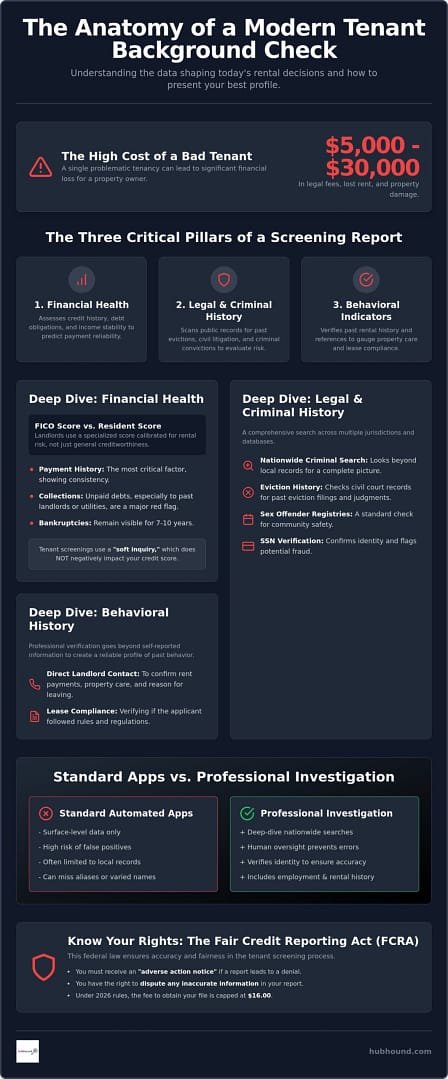
A single bad tenant can cost a property owner anywhere from $5,000 to $30,000 in legal fees, lost rent, and property damage. This high financial risk is why modern screening has moved beyond simple credit pulls into deep-dive investigations. If you’re applying for a new home, you’re likely wondering exactly what shows up on a tenant background check and how your personal data is being weighed. It’s natural to feel a sense of unease regarding your privacy or fear that a past mistake might result in an immediate denial.
This guide eliminates the mystery by detailing every metric landlords see, from specific credit behaviors to hidden legal records. You’ll gain a clear understanding of how to audit your own information and the right way to dispute errors under 2026 FCRA regulations, which now cap file disclosure fees at $16.00. We’ll break down the difference between automated apps and professional verification, ensuring you have the confidence to pass the screening process. We’ll examine income requirements, eviction history, and criminal records to give you the tools to present your best possible risk profile.
Key Takeaways
- Identify the three critical pillars of a modern report: financial health, legal history, and behavioral indicators.
- Differentiate between standard FICO scores and the specialized “Resident Scores” used to evaluate your specific rental risk.
- Understand exactly what shows up on a tenant background check regarding criminal records and how 2026 FCRA limits impact data visibility.
- Learn how professional investigative screening verifies your residency history through direct contact with former landlords to confirm property care.
- Evaluate the importance of human oversight in preventing the false positives that often plague shallow, automated screening applications.
The Anatomy of a Modern Tenant Background Check
A modern tenant background check functions as a multi-dimensional risk assessment tool. It provides a historical narrative of an applicant’s financial responsibility, legal standing, and past behavioral patterns. The primary objective is simple: identifying the probability of future non-payment or property damage. By aggregating data from national credit bureaus and vast public record databases, landlords can construct a profile that goes beyond a simple handshake. Understanding what shows up on a tenant background check is essential for both parties to ensure the data is accurate and the process is fair. This data aggregation pulls from thousands of sources, including civil courts, department of corrections records, and historical address logs. Typical data points include:
- National credit scores and active debt obligations.
- Civil litigation history, including past evictions.
- Multi-state criminal record searches.
- Verification of Social Security numbers to prevent identity fraud.
By utilizing the tenant screening process, landlords typically initiate a “soft inquiry” on your credit report. Unlike hard inquiries used for credit card or mortgage applications, soft pulls don’t negatively impact your credit score. This distinction allows landlords to verify financial health without damaging the applicant’s standing. Professionals like those at HubHound use these data points to build a comprehensive view of risk, moving beyond the shallow snapshots provided by low-cost automated tools. These investigators look for patterns rather than isolated incidents, providing a more nuanced evaluation of a candidate’s suitability.
Standard vs. Enhanced Screening Reports
While standard reports offer a surface-level glance, they often miss records from other jurisdictions or fail to catch alias names. These basic reports usually limit their scope to a credit score and local criminal records. Enhanced reports provide a deeper dive, including nationwide criminal searches, sex offender registries, and verified employment history. Professional investigative firms prioritize accuracy over speed, a standard also upheld by Elevated Background Checks in their comprehensive pre-employment screening services for businesses. They verify identity matches for common names to ensure a report doesn’t incorrectly attribute a record to an innocent applicant. This level of human oversight identifies discrepancies that instant apps frequently overlook, protecting both the landlord’s investment and the tenant’s reputation.
The Role of the Fair Credit Reporting Act (FCRA)
Under the regulatory backbone of the FCRA, all background checks must follow strict accuracy and currency mandates. This federal law protects tenant rights by ensuring that any data used to make a housing decision is verifiable. Landlords using third-party reports must provide applicants with an “adverse action notice” if the report results in a denial. This transparency allows you to review exactly what shows up on a tenant background check and exercise your right to dispute inaccuracies. As of 2026, the maximum fee for a consumer to obtain their file disclosure is $16.00, allowing you to audit your own data without excessive costs. This legal framework ensures the screening process remains objective and grounded in verifiable facts.
Financial Reliability: Credit Scores and Debt Analysis
Landlords prioritize financial stability to mitigate the risk of lost revenue. While most applicants are familiar with FICO scores used for mortgages, many are surprised by the “Resident Score.” This specialized metric is specifically calibrated to predict rental outcomes rather than general creditworthiness. It focuses heavily on behaviors that correlate with a successful lease, such as consistent payment history and a lack of prior evictions. When reviewing what shows up on a tenant background check, property managers look for a pattern of responsibility across all credit lines, including personal loans and credit cards.
Collections are a significant point of concern, especially when they involve previous utility providers or landlords. These specific debts suggest a history of prioritizing other expenses over housing-related obligations. While consumer debt is common, unpaid balances from a previous residence often result in an automatic rejection. Bankruptcies also remain visible on these reports for seven to ten years depending on the filing type. For a deeper understanding of your rights during this legal history risk assessment, consult federal guidelines to ensure your data is being reported accurately.
The debt-to-income ratio represents the percentage of an applicant’s gross monthly income that goes toward paying existing debts, serving as a key indicator of their remaining capacity to pay rent.
Identifying Red Flags in Financial History
Recent late payments are the most immediate indicator of current financial instability. If an applicant has missed payments within the last six months, it suggests a lack of liquidity. High credit utilization is another red flag, as it indicates the tenant may be living beyond their means with no emergency fund. However, many sophisticated landlords distinguish between medical debt and consumer debt. Medical collections are often viewed as unavoidable circumstances rather than a reflection of financial character, whereas excessive credit card debt suggests poor budgeting habits.
Verifying Income and Employment Status
Verification is the final step in confirming financial viability. Investigators reach out to employers to validate current salary levels and job titles. For self-employed applicants, this process involves a rigorous review of tax returns or bank statements to confirm a stable income stream. Utilizing professional pre-employment background checks can help verify an applicant’s professional history with precision. Ensuring your income is at least three times the monthly rent is the industry standard for approval. If you want to ensure your screening is handled with expert oversight, consider using HubHound’s specialized investigative services to vet your potential candidates.
Criminal Records and Legal History Risk Assessment
Landlords use criminal history to assess physical and financial safety. When asking what shows up on a tenant background check, the answer includes felony and misdemeanor convictions typically spanning the last seven to ten years. Most comprehensive reports also scan the nationwide sex offender registry and global terrorist watch lists to ensure community safety. Unlike automated apps, professional investigators also identify pending criminal cases. These active proceedings haven’t reached a verdict but represent a potential risk that landlords often consider when evaluating long-term stability. Traffic violations, however, are usually excluded unless they involve serious criminal charges like a DUI or vehicular manslaughter. These details help distinguish between minor lapses in judgment and patterns of high-risk behavior.
Understanding what shows up on a tenant background check regarding legal history is vital for effective risk management. High-quality reporting ensures that Financial Reliability and physical safety are maintained through accurate data. This level of scrutiny protects the property value and the well-being of existing residents by identifying individuals who may pose a threat to the premises or other tenants.
Eviction Records and Civil Litigation
Eviction history is a primary concern for property owners. Many don’t realize that an eviction filing can appear on a report even if it didn’t result in a final judgment. These records indicate a breakdown in the landlord-tenant relationship that property managers want to avoid. Reports also highlight civil judgments related to property damage or unpaid rent. Access to civil litigation support data allows landlords to identify litigious tenants who may have a history of filing frivolous lawsuits against previous housing providers. Identifying these patterns early saves thousands in potential legal fees and lost rent.
Look-back Periods and Reporting Limits
The Fair Credit Reporting Act (FCRA) generally enforces a seven-year rule for reporting most criminal and financial records. This limit prevents older mistakes from permanently barring access to housing. However, exceptions exist for high-value rental agreements where the monthly rent exceeds certain federal thresholds. In these high-stakes scenarios, a landlord might see a more extensive history to protect their significant investment. Professional investigators prioritize compliance by manually filtering out legally unreportable data that automated software might accidentally include. This rigorous validation ensures the final report is both comprehensive and legally defensible for the property owner.
Behavioral Indicators: Rental History and References
Behavioral indicators offer the most predictive data regarding a tenant’s future conduct. While credit scores reflect financial history, rental history reveals how an individual actually treats a property and interacts with management. Professional investigators verify previous addresses and dates of residency to ensure the application matches historical record logs. This process identifies “gap years” where a tenant may have been living at an unlisted location to hide an eviction, legal dispute, or period of instability. Understanding what shows up on a tenant background check in this category requires looking beyond the paperwork to the actual testimony of former property managers.
Interviews with previous landlords focus on two critical metrics: payment punctuality and property care. A tenant who pays on time but causes significant physical damage is just as costly as one who misses rent. Investigators also assess the stated reason for leaving a previous unit. If an applicant claims they left for a job relocation but the landlord reports a lease violation or a “skip,” the discrepancy serves as a major red flag. This investigative depth is why automated apps fail; they can’t ask follow-up questions or detect the hesitation in a reference’s voice during a live conversation.
The Art of the Professional Reference Interview
Investigators use specialized techniques to uncover hidden lease violations that a standard digital form might miss. They ask specific, open-ended questions designed to elicit details about noise complaints, unauthorized pets, or late-night disturbances. It’s essential to distinguish between “friendly” references, like a friend posing as a landlord, and actual professional property managers. By applying rigorous witness interviews and statements protocols, professionals can verify the legitimacy of the source. This ensures the feedback is objective and based on actual rental performance rather than personal bias or coached responses.
Spotting Discrepancies in Application Data
Consistency is the hallmark of a reliable tenant. Investigators cross-reference application details with public records and historical address logs to ensure every date and location aligns. Commonly falsified information often includes move-out dates to hide a legal dispute or the presence of pets that were previously documented in damage claims. Providing misleading information on an official application is often grounds for immediate disqualification by most property owners. When you understand what shows up on a tenant background check, you realize that transparency is always the best policy for a successful application. To ensure your properties are protected by the highest level of behavioral vetting, secure HubHound's landlord/tenant screening services today.
The Value of Professional Investigative Screening
Instant results often come at a cost to accuracy. Many automated screening apps pull data from broad databases that frequently contain outdated or misattributed records. When you rely solely on software to determine what shows up on a tenant background check, you risk rejecting a qualified candidate due to a simple clerical error. Professional firms like HubHound utilize licensed investigators to verify that a record actually belongs to the applicant. This human oversight is essential for common names where a database might pull a criminal record for a different person with the same birthdate. It’s the difference between a shallow search and a verified profile.
Bridging the gap between raw data and actionable insight requires a specialized skill set. Professional screening ensures landlords remain compliant with the Fair Credit Reporting Act, which significantly reduces the risk of costly litigation. By providing a rigorous validation of every data point, investigators help maintain organizational integrity. This meticulous approach ensures that the information used for high-stakes leasing decisions is both current and legally reportable. You don’t just get a report; you get a verified narrative of risk that protects your investment over the long term.
Beyond the Search Bar: Deep-Dive Due Diligence
For high-end residential or complex commercial leasing, standard checks are insufficient. Implementing corporate due diligence methods allows for a deeper examination of business interests and financial entanglements. Investigators use advanced skip tracing techniques to track a tenant’s actual history across multiple jurisdictions. This process uncovers hidden residences that automated software misses. This level of scrutiny ensures that what shows up on a tenant background check is a complete and unvarnished history of the applicant’s professional and personal conduct.
Making the Final Decision: Data vs. Context
Raw data requires professional interpretation to be useful. A high credit score doesn’t always guarantee a good neighbor, just as a poor rental reference might outweigh a solid income. Property owners must develop a consistent Rental Selection Criteria to ensure all applicants are evaluated against the same standard. This consistency helps avoid discrimination claims and ensures a fair process. Once the background report is verified, the final step is moving from the investigative phase to the signed lease agreement. This transition is smoother when you have total confidence in the accuracy of your screening partner.
Master Your Leasing Decisions
Navigating the complexities of modern property management requires a shift from passive data collection to active investigation. You now understand that what shows up on a tenant background check involves a sophisticated intersection of financial metrics, legal history, and behavioral references. While automated tools offer speed, they lack the critical human oversight needed to verify identity matches and filter out legally unreportable data. Relying on verified insights rather than raw data allows you to mitigate risk before it reaches your front door.
Prioritize accuracy to protect your investment and maintain organizational integrity. Don’t settle for shallow data when high-stakes decisions are on the line. HubHound’s expert investigators bring over three decades of experience to every report, providing the deep-dive verification that automated software misses. Ensure your process remains objective and reliable with our fully FCRA-compliant reporting. Secure your property with professional investigative screening from HubHound and move forward with total confidence in your next lease agreement. You’re now equipped to transform the screening process from a hurdle into a strategic advantage.
Frequently Asked Questions
Can a landlord see my full criminal record from my entire life?
No, landlords typically cannot see your entire criminal history due to Fair Credit Reporting Act (FCRA) regulations. Most reporting agencies limit criminal record visibility to the last seven years, though some jurisdictions allow ten. However, for high-value rental agreements, these restrictions may be waived. Professional investigators ensure that only legally reportable data is included, preventing older records from unfairly impacting your application.
Will a tenant background check lower my credit score?
No, a tenant background check will not lower your credit score because it is processed as a soft inquiry. Unlike hard inquiries for credit cards or car loans, a soft pull doesn’t impact your credit standing. This allows landlords to review your financial reliability without causing damage to your score. You can undergo multiple screenings during your housing search without any cumulative negative effect.
How far back does an eviction stay on my background check?
Seven years is the standard duration an eviction remains visible on a tenant screening report. This timeframe begins from the date the eviction was filed or the judgment was entered. Even if the case was dismissed, the filing itself may still appear. Understanding what shows up on a tenant background check helps you prepare explanations for past legal disputes that haven’t yet reached the seven-year expiration.
What should I do if my tenant background check has incorrect information?
Dispute the errors immediately by contacting the screening agency that provided the report. Under the FCRA, reporting agencies have 30 days to investigate and correct inaccuracies. Provide documentation to support your claim, such as proof of a paid debt or a dismissed court case. Landlords must also provide you with a copy of the report if they use the information to deny your application.
Can a landlord see my bank account balance or transaction history?
No, standard background checks do not provide access to your real-time bank account balances or private transaction history. Landlords verify your income through pay stubs, W-2s, or tax returns that you voluntarily provide. While a credit report shows your total debt and payment patterns, it doesn’t reveal how much cash you currently hold in your savings or checking accounts.
Do background checks show if I have pets or am a smoker?
Not directly, as there is no central database for pet ownership or smoking habits. However, this information often surfaces during professional reference interviews with former landlords. If a previous property manager mentions property damage from smoke or unauthorized animals, it will be documented in the final report. Professional investigators specifically look for these behavioral indicators to give landlords a complete view of property risk. For pet owners who prioritize their dog’s health and appearance, you can check out Bohemian Spaw for specialized grooming and wellness services.
What is the difference between a background check and a credit check?
A credit check is a specific financial review, whereas a background check is a holistic investigation into your history. A credit check focuses on your Resident Score, debt levels, and payment reliability. In contrast, what shows up on a tenant background check includes criminal records, eviction filings, and verified rental references. The background check uses the credit report as just one of several metrics to assess overall risk.
How long does it typically take to get the results of a tenant screening?
One to three business days is the typical timeframe for a comprehensive tenant screening report. While automated “instant” apps may deliver results in minutes, they often lack the verification required for high-stakes leasing. Professional investigative firms take extra time to contact previous landlords and verify identity matches for common names. This ensures the data is accurate, current, and fully compliant with federal reporting standards.

Article by
Joel R. Manley | President | Hubhound Investigations | OR PI-ID#: 90432 | 111 SW Fifth Avenue, Suite 3150 Portland, Oregon 97204 | 971-442-8170
Joel is licensed as a private investigator in Oregon and Tennessee. Joel started his career in 1987 serving as a Military Police Officer and Military Police Investigator.
After ending his military tour of duty, Joel became a civilian Police Officer and Deputy Sheriff. Joel took his strong background in Hostage Negotiations, Mediation and Conflict Resolution, with him to patrol some of the highest crime areas in SE Portland.
Joel was awarded Deputy of the Year for his efforts and for drastically reducing the crime rate in the area he patrolled. As a Deputy Sheriff, Joel assisted in leading a Neighborhood Livability Program that was nationally recognized for having the most innovative and progressive approach to policing.
In 2018, Joel retired as a Deputy Sheriff and founded Hubhound Investigations. Joel played an integral role in Hubhound Investigations receiving an A+ Accredited Business rating from the Better Business Bureau (BBB).
In his off time, Joel enjoys spending time with his wife, adult children and Hubhound’s Happiness Ambassador, Nya. Joel also enjoys Scuba Diving and Kayaking.
Disclaimer
DISCLAIMER: This article is provided for general informational and educational purposes only. It is not intended to constitute legal advice, professional investigative advice, or instruction to engage in any unlawful activity. Laws governing private investigations, surveillance, recording, tracking, access to information, evidence collection, privacy, trespass, licensing, and related investigative activities vary by jurisdiction and are subject to change.
Any investigative techniques, tactics, procedures, scenarios, or legal proceedings discussed in this article are presented for informational purposes and should not be interpreted as authorization or encouragement to use a particular method. Private investigators and members of the public are responsible for understanding and complying with all applicable federal, state, and local laws, licensing requirements, court rules, and professional standards.
The circumstances of every investigation and legal matter are different. Information contained in this article should not be relied upon as a substitute for advice from a qualified attorney or other appropriate licensed professional regarding a specific situation. No attorney-client, investigator-client, or other professional relationship is created by reading or using this information.