
In a courtroom, the parent with the most emotional plea rarely wins. The parent with the most verifiable data does. When you’re preparing for a child custody battle, the transition from defensive anxiety to offensive strategy is what separates a favorable ruling from a devastating loss. You’re likely worried about how to handle false narratives or what truly qualifies as admissible evidence in a high-stakes legal setting. It’s an environment where every digital footprint and interaction is subjected to rigorous assessment by judges and evaluators.
We understand that protecting your child’s best interests is your only priority. This guide provides a clear roadmap for gathering professional-grade evidence and building a fact-based case that withstands legal scrutiny. You’ll learn how to navigate the 2026 shift toward joint custody presumptions and utilize investigative tools to discredit false claims legally. By the end of this article, you’ll have the tactical knowledge needed to move past choice paralysis and secure a stable, favorable custody arrangement.
Key Takeaways
- Identify the core pillars of the “Best Interests of the Child” standard to align your case with judicial benchmarks for safety and stability.
- Develop a professional evidence portfolio when preparing for a child custody battle to ensure daily interactions and responsibilities are documented for court review.
- Utilize surveillance operations and background checks to uncover hidden risks or verify the suitability of individuals within the other parent’s circle.
- Secure unbiased witness statements through professional interviews to provide the court with third-party corroboration of your evidence.
- Coordinate investigative findings with legal strategy to meet the burden of proof and present a fact-based narrative that prioritizes your child’s future.
Understanding the Best Interests of the Child Standard
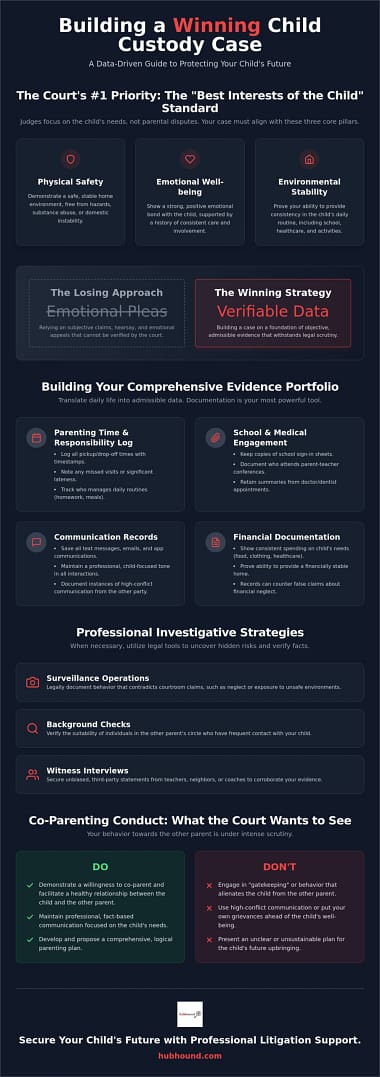
The “best interests of the child” is the universal legal benchmark used by family courts to determine custody arrangements. It shifts the focus from parental rights to the child’s specific needs. When you’re preparing for a child custody battle, your strategy must align with this standard. Judges aren’t looking for the most aggrieved parent; they’re looking for the parent who provides the most stable environment. This evaluation rests on three core pillars: physical safety, emotional well-being, and environmental stability.
Courts prioritize the “status quo” during litigation to minimize disruption to the child’s life. If you’ve been the primary caregiver, documenting your daily involvement is critical. This includes managing school schedules, medical appointments, and extracurricular activities. Judges look for consistency. They prefer to maintain the child’s existing routine unless there’s a compelling reason to change it. Your goal is to prove that your continued custody provides the highest level of stability for the child’s future development.
Key Factors Judges Weigh in Custody Rulings
- The Emotional Bond: Courts evaluate the strength of the relationship between the child and each parent through observable interactions and history of care.
- Stability of the Home Environment: This includes the physical safety of the residence and the parent’s ability to maintain a consistent daily routine.
- Household Safety: Judges conduct a rigorous assessment of any history of substance abuse or domestic instability that could jeopardize the child’s welfare.
The Role of Parental Cooperation
Your behavior toward the other parent is under intense judicial scrutiny. Courts favor parents who demonstrate a willingness to facilitate a healthy relationship with the other party. “Gatekeeping” or alienating behavior can severely damage your case. Judges view high-conflict communication styles as a sign that a parent cannot prioritize the child’s needs over their own emotional grievances. Professionalism is your best asset during these interactions.
Evidence of healthy co-parenting carries significant weight. A successful legal strategy often involves developing a comprehensive parenting plan that outlines clear boundaries and expectations. This document serves as a roadmap for the court, showing you have a logical, sustainable vision for the child’s upbringing. By focusing on cooperation and objective data, you demonstrate that you are the parent best equipped to foster the child’s long-term success.
Building a Comprehensive Evidence Portfolio
When you shift from the theoretical to the practical, the strength of your case depends entirely on the quality of your documentation. While Section 1 established the best interests of the child standard, this phase requires you to translate daily life into admissible data. Successful outcomes aren’t built on hearsay or emotional accusations. They’re built on a foundation of verifiable facts that withstand the scrutiny of opposing counsel and judicial review. Preparing for a child custody battle means moving beyond personal journals to professional-grade record-keeping.
The distinction between hearsay and verifiable facts is vital. A judge likely won’t accept a handwritten note stating the other parent was “late again.” However, a log showing a 6:45 PM pickup for a 6:00 PM scheduled time, corroborated by a timestamped text message or GPS data, constitutes objective evidence. Financial records also play a dual role. Beyond determining child support, these documents prove your ability to provide a stable environment. Consistent spending on education, healthcare, and nutrition demonstrates a commitment to the child’s well-being that verbal promises cannot match.
Documenting Parental Involvement and Neglect
Maintaining a systematic record of your daily parental duties is essential for establishing yourself as the primary caregiver. Use a dedicated calendar to track the following data points:
- Parenting Time: Log every pickup and drop-off. Note any instances where the other parent misses a visit or arrives late without prior notice.
- Educational and Medical Engagement: Keep copies of sign-in sheets from school events and summaries from medical appointments. These prove which parent is actively managing the child’s development.
- Contradictory Behavior: Document specific instances where the other parent’s actions directly conflict with the child’s safety or routine, such as missed medication or exposure to high-risk environments.
Preserving Digital and Communication Logs
Digital footprints are often the most influential evidence in modern custody cases. Use dedicated co-parenting apps or professional email threads for all communication to ensure a transparent, chronological record. Avoid the temptation to delete messages that seem irrelevant. You need the full context of the conversation to prevent claims of cherry-picking evidence. Securing professional civil litigation support ensures that your evidence portfolio meets the highest standards of verification before it enters the courtroom.
Digital evidence must be timestamped and unedited to be admissible in a court of law. When preparing for a child custody battle, your goal is to present a narrative that is impossible to refute. By using professional tools to export and authenticate your digital threads, you remove the “he-said, she-said” dynamic that often stalls legal proceedings. This disciplined approach to evidence gathering positions you as the more reliable, organized, and child-focused parent.
Investigative Strategies: Surveillance and Background Checks
While previous sections focused on documentation you can collect yourself, some truths remain hidden behind closed doors. When you’re preparing for a child custody battle, the other parent may present a curated version of their life to the court. Professional surveillance bridges the gap between what’s said in a deposition and what happens in reality. It provides the court with an objective, third-party perspective that personal testimony often lacks. This level of verification is essential for discrediting false narratives and establishing a fact-based record of the child’s environment.
Lifestyle investigations are a critical component of litigation support. They identify patterns of behavior that impact a child’s safety, such as substance abuse, neglect, or the presence of high-risk individuals in the home. Because professional investigators produce court-ready reports, their findings carry more weight than a parent’s accusations. As you prepare for your custody case, incorporating high-quality investigative data ensures your claims are backed by rigorous assessment rather than emotion. This strategic approach removes the ambiguity that often stalls legal proceedings.
Professional Surveillance for Safety Concerns
Courts rely on evidence that’s both relevant and admissible. Surveillance operations conducted by licensed professionals ensure that the data collected, whether it’s video footage of unsafe parenting transitions or documentation of cohabitation, meets legal standards. These operations observe parenting behaviors during unsupervised time to ensure the child’s safety is never compromised. If a parent is introducing “paramours” against court orders or safety standards, surveillance provides the necessary proof. This unbiased account is something judges trust because it removes the personal bias inherent in parental testimony.
While professional surveillance is key, many parents also choose to secure their own premises with high-quality hardware. For those looking to document home safety, a Hikvision NVR Australia provides a reliable way to capture high-definition footage of daily transitions and interactions.
Due Diligence and Background Screening
A child’s environment is only as safe as the people within it. While you may know the other parent, you likely know less about their new partners or household associates. Performing deep-dive background checks identifies potential criminal histories, domestic violence records, or safety risks that the other parent might intentionally conceal. Using HubHound's background screening services allows you to conduct thorough due diligence on any individual who has regular contact with your child. This proactive step ensures that the court has a full picture of the household’s stability and any potential threats to the child’s well-being. Identifying these risks early allows your legal team to build a more robust argument for a protected custody arrangement.
Litigation Support: Witness Interviews and Process Service
While physical evidence and digital logs provide a factual skeleton for your case, witness testimony provides the narrative depth that judges need to understand the daily reality of your child’s life. When you’re preparing for a child custody battle, relying solely on your own account can lead to a “he-said, she-said” stalemate. Credible third-party witnesses, such as educators or healthcare providers, offer the unbiased corroboration required to tilt the scales of justice. However, the method used to secure these statements is just as important as the testimony itself. Professional litigation support ensures that every statement is gathered legally and remains insulated from claims of parental influence.
Investigators play a vital role in this process by conducting professional witness interviews that secure unbiased testimony. If you attempt to interview witnesses yourself, you risk accusations of witness tampering or coaching, which can lead to your evidence being thrown out. A licensed investigator acts as a neutral party, asking structured questions that elicit objective facts about parental behavior and the child’s well-being. This professional distance protects the integrity of your evidence and ensures that the witness’s account carries maximum weight during court proceedings.
Securing Credible Witness Statements
Identifying the right individuals is the first step in building a robust witness list. Focus on professionals who observe the child in different environments, such as teachers, neighbors, or long-term childcare providers. These individuals can speak to the child’s emotional state and the consistency of each parent’s involvement. To ensure these accounts are court-ready, it’s essential to understand the role of witness interviews in legal cases. By using a professional to document these observations, you create a verifiable record that supports your broader legal strategy and demonstrates a commitment to the truth.
Professional Process Service and Skip Tracing
Legal momentum often depends on the timely delivery of documents. Professional process service ensures that the other parent and all relevant witnesses are notified according to strict jurisdictional rules, preventing procedural delays that could stall your case. In high-conflict situations, a parent may attempt to avoid service by moving without notice or hiding their location. This is where skip tracing and locate investigations become indispensable. Investigators use specialized databases and surveillance techniques to find individuals who are avoiding their legal responsibilities, ensuring your case moves forward without interruption. If you need to ensure your legal documents reach their destination, secure professional process service today to maintain your case’s timeline.
Strategic Preparation: Organizing Your Case for Success
Strategic preparation is the final filter that turns raw data into a winning legal argument. While previous sections focused on the mechanics of gathering evidence and securing witnesses, this stage is about synthesis and verification. The burden of proof in family court rests on your ability to present a preponderance of evidence that favors your position. When you’re preparing for a child custody battle, you must ensure that every piece of documentation, from digital logs to surveillance reports, supports a single, child-focused narrative. This requires a rigorous evidence audit to identify and eliminate any weak points before you face a judge.
Admissibility is the primary hurdle in high-conflict cases. Self-gathered notes are frequently dismissed as biased or hearsay, whereas professionally gathered evidence carries a presumption of objectivity. Your final audit should prioritize reports from licensed investigators and authenticated communication logs. By organizing your case through this lens, you move from a defensive posture to a proactive strategy that emphasizes environmental stability and parental fitness. This professional approach alleviates the anxiety of false claims by replacing emotional arguments with verifiable facts.
Collaborating with Your Legal and Investigative Team
Effective litigation requires seamless coordination between your attorney and your investigative partners. Your attorney understands the legal framework, but your investigator provides the factual foundation that the law applies to. This partnership ensures that all surveillance footage and witness statements meet the strict standards for courtroom entry. In complex family law cases, applying a high-level due diligence approach can be highly effective. This method treats the custody case with the same technical precision as a complex civil dispute, focusing on verifiable assets and behavioral patterns. Securing professional civil litigation support ensures that your investigative findings are integrated into your attorney’s strategy with maximum impact.
Final Courtroom Readiness
The final step is preparing for the intensity of the courtroom environment. Review all surveillance footage and interview transcripts with your legal counsel to anticipate potential challenges. Knowing the strengths and weaknesses of your evidence allows you to prepare for cross-examination without being caught off guard. During depositions and appearances, maintain a professional, child-focused demeanor at all times. Judges observe how you conduct yourself under pressure as a reflection of your parental stability. By following this roadmap, you ensure that your case is built on a foundation of professional-grade evidence that prioritizes your child’s long-term well-being and security.
Securing Your Child’s Future with Fact-Based Strategy
Success in family court requires a shift from emotional defense to professional-grade strategy. You’ve learned that the “best interests” standard is met through a combination of verifiable documentation, objective witness testimony, and rigorous surveillance. Preparing for a child custody battle is a high-stakes process where the quality of your evidence dictates the stability of your child’s future. By replacing hearsay with court-ready investigative reports, you remove the ambiguity that often fuels legal conflict.
Protecting your parental rights and your child’s well-being requires an expert guide who has already done the heavy lifting. HubHound provides the niche expertise needed to navigate this specialized legal landscape with confidence. Our team offers licensed investigators with over 30 years of experience, delivering court-ready surveillance and evidence reports designed to withstand judicial scrutiny. We also provide nationwide skip tracing and background screening capabilities to ensure no detail is overlooked.
Contact HubHound for Professional Litigation Support and Investigations to begin building your case today. You have the tools to secure a favorable outcome; now it’s time to take the first step toward a stable future.
Frequently Asked Questions
What is the most important thing to do when preparing for a child custody battle?
The most critical step is transitioning from emotional responses to a data-driven strategy. You must focus on documenting your daily involvement in the child’s life through verifiable logs and records. Consistency is the most influential factor judges consider during their initial assessment. When you are preparing for a child custody battle, having a structured evidence portfolio removes the ambiguity that often leads to unfavorable rulings.
Can I use a private investigator to prove the other parent is unfit?
Yes, a private investigator provides objective, court-ready evidence that personal testimony often lacks. They document specific safety concerns, substance abuse, or neglect through professional surveillance operations. This third-party verification is vital because it removes the bias inherent in parental accusations. A professional report serves as a reliable anchor for your legal team when presenting facts about the other parent’s lifestyle or behavior.
Is surveillance footage admissible in child custody court?
Surveillance footage is admissible if it’s obtained legally and authenticated by a licensed professional. Investigators ensure that the chain of custody is maintained and that the footage doesn’t violate privacy laws. This makes it a powerful tool for proving cohabitation, lifestyle concerns, or unsafe parenting behaviors. Courts trust professionally gathered video because it provides an unfiltered view of the child’s actual environment.
How do I prove the other parent is lying about me in court?
Discredit false narratives by presenting contradictory, verifiable evidence. Use timestamped communication logs, GPS data, and witness statements to refute specific false claims. When preparing for a child custody battle, your best defense is a proactive offense built on professional-grade documentation. If the other parent makes an accusation, providing a professional report that proves the opposite is the fastest way to protect your reputation.
What happens if the other parent is hiding their true income or assets?
Financial transparency is a legal requirement for fair custody and support rulings. If you suspect hidden assets, professional investigators conduct corporate due diligence or skip tracing to uncover undisclosed income streams. Courts view financial deception as a significant red flag regarding a parent’s character and honesty. Uncovering these hidden resources ensures that the final arrangement accurately reflects the financial reality of both households.
How can I find a witness who has moved or is avoiding my lawyer?
Utilize skip tracing and locate investigations to find essential witnesses who have disappeared or are intentionally avoiding service. Professional investigators use specialized databases and search techniques to track down individuals who haven’t left a forwarding address. This ensures that your case maintains momentum and that all critical testimony is secured before your court date. Finding these individuals is essential for corroborating your evidence with third-party accounts.
What are the red flags that judges look for in custody cases?
Judges prioritize safety and stability, so they look for signs of domestic instability, substance abuse, or “gatekeeping” behavior. Alienating the child from the other parent or failing to follow existing court orders are major red flags that can damage a case. Demonstrating a consistent, cooperative parenting style is the best way to avoid these negative assessments. Courts reward parents who show they can prioritize the child’s needs over personal conflict.
Can I background check the other parent’s new boyfriend or girlfriend?
You can and should perform background checks on any individual who has regular, unsupervised contact with your child. Identifying criminal histories or safety risks associated with a parent’s new associates is a vital part of protecting the child’s environment. This information allows the court to make informed decisions about the safety of the household. It’s a proactive step in due diligence that ensures your child remains in a secure setting.

Article by
Joel R. Manley | President | Hubhound Investigations | OR PI-ID#: 90432 | 111 SW Fifth Avenue, Suite 3150 Portland, Oregon 97204 | 971-442-8170
Joel is licensed as a private investigator in Oregon and Tennessee. Joel started his career in 1987 serving as a Military Police Officer and Military Police Investigator.
After ending his military tour of duty, Joel became a civilian Police Officer and Deputy Sheriff. Joel took his strong background in Hostage Negotiations, Mediation and Conflict Resolution, with him to patrol some of the highest crime areas in SE Portland.
Joel was awarded Deputy of the Year for his efforts and for drastically reducing the crime rate in the area he patrolled. As a Deputy Sheriff, Joel assisted in leading a Neighborhood Livability Program that was nationally recognized for having the most innovative and progressive approach to policing.
In 2018, Joel retired as a Deputy Sheriff and founded Hubhound Investigations. Joel played an integral role in Hubhound Investigations receiving an A+ Accredited Business rating from the Better Business Bureau (BBB).
In his off time, Joel enjoys spending time with his wife, adult children and Hubhound’s Happiness Ambassador, Nya. Joel also enjoys Scuba Diving and Kayaking.
Disclaimer
DISCLAIMER: This article is provided for general informational and educational purposes only. It is not intended to constitute legal advice, professional investigative advice, or instruction to engage in any unlawful activity. Laws governing private investigations, surveillance, recording, tracking, access to information, evidence collection, privacy, trespass, licensing, and related investigative activities vary by jurisdiction and are subject to change.
Any investigative techniques, tactics, procedures, scenarios, or legal proceedings discussed in this article are presented for informational purposes and should not be interpreted as authorization or encouragement to use a particular method. Private investigators and members of the public are responsible for understanding and complying with all applicable federal, state, and local laws, licensing requirements, court rules, and professional standards.
The circumstances of every investigation and legal matter are different. Information contained in this article should not be relied upon as a substitute for advice from a qualified attorney or other appropriate licensed professional regarding a specific situation. No attorney-client, investigator-client, or other professional relationship is created by reading or using this information.