
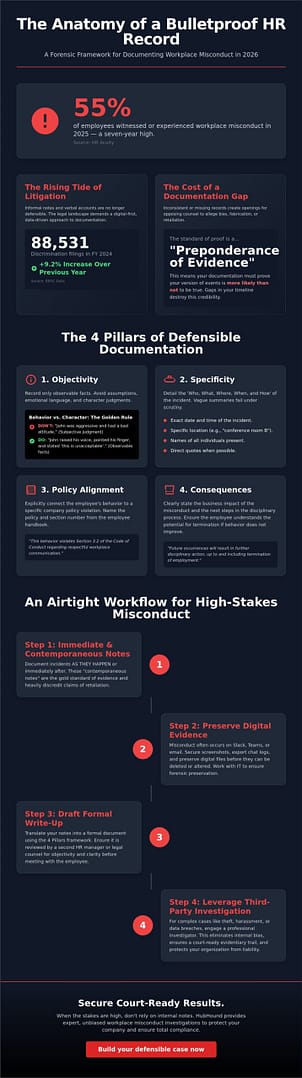
Did you know that 55% of employees witnessed or experienced workplace misconduct in 2025? This surge, reported by HR Acuity, marks a seven-year high and puts your internal processes under a microscope. Simply keeping informal notes is no longer a viable strategy for risk management. Effectively documenting employee misconduct for HR requires a forensic mindset to ensure every record stands up under intense legal scrutiny. You need evidence that remains bulletproof even as new 2026 regulatory standards and federal rules redefine what constitutes a defensible termination.
It’s common to feel uneasy when dealing with “invisible” misconduct like internal theft or harassment. You’re likely tired of inconsistent documentation from middle managers that leaves your organization vulnerable to wrongful termination lawsuits. This guide provides the solution. You’ll learn how to build an airtight evidentiary trail that protects your company from litigation and ensures total HR compliance. We’ll outline a clear, repeatable framework for write-ups that meets current legal standards, giving you the confidence to act decisively while significantly reducing your liability.
Key Takeaways
- Understand why rigorous documentation serves as your primary defense against wrongful termination and discrimination claims in the modern legal landscape.
- Master the essential components of documenting employee misconduct for HR by focusing on objective, observable facts rather than subjective interpretations.
- Identify the specific scenarios where internal notes are insufficient and professional investigative evidence is required to bridge the gap in complex cases.
- Adopt a repeatable, step-by-step workflow for reporting incidents and preserving critical digital evidence to ensure an airtight evidentiary trail.
- Evaluate the benefits of utilizing third-party workplace misconduct investigations to eliminate internal bias and secure court-ready results.
Why Documentation is Your Most Critical Defense Against Litigation
Relying on memory or informal manager notes is a dangerous gamble in 2026. Employment law has shifted away from verbal accounts toward forensic data. When a ‘he-said-she-said’ scenario reaches a tribunal, the party with the most consistent, dated, and objective records wins. Documenting employee misconduct for HR serves as your primary shield against wrongful termination and discrimination claims, which reached 88,531 filings in fiscal year 2024 according to EEOC data. This represents a 9.2% increase over the previous year, highlighting a clear trend toward increased litigation.
Beyond legal defense, consistent record-keeping builds organizational trust. It signals to your workforce that policies are enforced fairly and transparently. Today’s standards require a digital-first strategy. Since much of modern misconduct occurs on platforms like Slack or Teams, your documentation must capture these digital trails before they are deleted or modified. Failing to do so leaves a void that plaintiff attorneys are eager to fill. A robust evidentiary trail proves that your organization values due diligence and acts with integrity.
The Legal Burden of Proof in Workplace Misconduct
In civil and administrative hearings, the standard is usually a ‘preponderance of evidence.’ This means you must prove your version of events is more likely than not to be true. Gaps in a timeline are not just administrative errors; they are openings for opposing counsel to suggest bias or fabrication. If you cannot explain why a specific action was taken on a specific date, your credibility vanishes. The documentation gap represents the fiscal distance between a clean separation and a six-figure settlement caused by missing or inconsistent internal records in mid-sized firms.
Preventing Retaliation Claims Through Timely Records
Contemporaneous notes are the gold standard of evidence. These are records created at the time of the incident, making them far more credible than summaries written weeks later. This is especially critical when understanding whistleblower protections, as any adverse action taken after a report will be scrutinized for retaliatory intent. If your records don’t clearly pre-date the protected activity, proving a non-retaliatory motive becomes nearly impossible.
Your strategy should also include documenting positive performance. If a file only contains negative write-ups, a jury might see a targeted campaign rather than a fair assessment. Establishing a pattern of behavior is much more defensible than acting on an isolated incident without context. When documenting employee misconduct for HR, ensure the record reflects the full scope of the employee’s history. This proves that your response was measured, progressive, and consistent with company policy.
The Anatomy of Defensible Documentation: Core Components
Precision is the difference between a dismissed claim and a costly settlement. When documenting employee misconduct for HR, your records must act as a neutral transcript of events. The goal is to create a document so clear that a third party, such as a judge or an arbitrator, can visualize the incident without needing further explanation. This requires a structural approach focused on four pillars: objectivity, specificity, policy alignment, and consequences.
Specificity is your strongest ally. Vague summaries like “the employee was disruptive” fail to provide the necessary ‘Who, What, Where, When, and How’ required for legal validation. Instead, record the exact time of the incident, the specific location, and the names of all witnesses present. Directly link the behavior to a specific handbook violation. If the conduct violates a safety protocol or a code of ethics, name the policy. Finally, clearly state the business impact and the next disciplinary steps. This ensures the employee cannot later claim they weren’t warned of the potential for termination.
Behavior vs. Character: The Golden Rule of HR Writing
Avoid the trap of psychologizing or making assumptions about an employee’s intent. Describing someone as “aggressive” or “lazy” is a character judgment, not a behavioral observation. Objective writing focuses on what you can see and hear. For example, instead of writing “he was aggressive,” state that “he raised his voice to a level audible in the hallway and stood up from his chair.” This removes subjectivity and prevents the record from appearing biased. Understanding the EEOC investigation process highlights why this matters; investigators look for factual patterns, not manager opinions. When cases become too complex for internal staff, seeking workplace misconduct investigations from external experts ensures a higher standard of neutrality.
Capturing Digital Evidence and Footprints
In 2026, misconduct rarely happens in a vacuum. It leaves a digital trail across Slack, Teams, and internal email servers. Standard screenshots are often insufficient because they lack metadata and can be easily altered. To build court-ready evidence, preserve native files that include timestamps and sender ID verification. This is particularly critical as AI-generated content becomes more sophisticated; you must be able to prove the authenticity of the digital record. Effective documenting employee misconduct for HR now includes preserving these logs in a secure, tamper-proof environment immediately after an incident is reported. This proactive preservation prevents the “accidental” deletion of incriminating messages that often occurs once an employee realizes an investigation is underway.
Internal Notes vs. Professional Investigative Evidence: Bridging the Gap
Standard disciplinary records often suffice for routine issues like minor tardiness or missed deadlines. However, documenting employee misconduct for HR reaches a critical limit when cases involve theft, complex harassment, or corporate fraud. These scenarios demand more than just a manager’s observation; they require a forensic level of proof that internal teams aren’t always equipped to provide. Relying solely on internal notes in high-stakes situations can lead to claims of bias or incomplete investigation. This is particularly relevant given that 38% of misconduct reports in 2025 involved four or more distinct issues, according to HR Acuity’s May 2026 data.
Bridging this gap requires integrating professional investigative evidence into the HR file. Third-party investigators provide an essential layer of neutrality that’s difficult to achieve internally. This objectivity is vital when facing litigation. It demonstrates that the organization took the matter seriously enough to seek an unbiased assessment. Professional evidence, including surveillance and formal witness statements, transforms a subjective HR file into a robust, court-ready evidentiary trail that discourages frivolous lawsuits.
The Role of Surveillance in Workplace Misconduct
Surveillance is a powerful tool for confirming suspicions that digital logs cannot fully capture. It’s particularly effective for identifying time-theft or unauthorized secondary employment. While employees have a reasonable expectation of privacy, legal boundaries allow for surveillance in public areas or when there’s a legitimate business interest. Professional surveillance operations provide irrefutable visual proof that eliminates the “he-said-she-said” dynamic. For a deeper look at these methods, review our guide on Advanced Surveillance Techniques. Using these professional tactics ensures that the evidence gathered is both ethical and admissible in court.
Conducting Professional Witness Interviews
There’s a significant difference between a standard HR “chat” and a formal investigative interview. Professional interviews use structured techniques to gather specific, verifiable facts while minimizing the risk of coercion. When documenting employee misconduct for HR, the goal is to secure signed witness statements that can withstand cross-examination. This process is essential for resolving conflicting accounts between employees. By using an expert to conduct these interviews, you ensure that the narrative is built on observable actions rather than hearsay or office rumors. This level of detail is what ultimately protects the organization from liability during a wrongful termination challenge.
A Step-by-Step Workflow for Documenting High-Stakes Misconduct
Managing high-stakes misconduct requires a methodical approach that prioritizes evidentiary integrity over speed. Adopting a standardized workflow ensures that documenting employee misconduct for HR remains consistent across the organization. This reduces the risk of procedural errors that defense attorneys often exploit during litigation. Follow these five steps to build a defensible case.
- Step 1: Immediate reporting and preservation. Secure all physical and digital evidence immediately. This includes preserving email logs, Slack threads, and access card data before it’s overwritten or deleted.
- Step 2: Preliminary internal review. Evaluate the initial findings to determine the severity. If the case involves potential criminal activity or high-value fraud, decide if internal staff can remain objective or if external expertise is required.
- Step 3: Formal investigation. Execute a targeted investigation. This may involve professional surveillance or deep digital forensics to uncover hidden patterns of behavior that standard HR tools might miss.
- Step 4: Compiling the Final Investigative Report (FIR). Create a comprehensive document that synthesizes all findings. Ensure it includes a clear timeline and a verified chain of custody for every piece of evidence presented.
- Step 5: The disciplinary meeting. Present the findings to the employee in a controlled environment. Focus on the behavior and the evidence, then obtain the necessary signatures to close the file.
If your internal review suggests a high risk of litigation or complex fraud, don’t attempt a DIY investigation. Secure professional workplace misconduct investigations to ensure your evidence meets 2026 legal standards.
Maintaining the Chain of Custody for Evidence
Chain of custody refers to the chronological documentation that records the sequence of custody, control, and transfer of physical or electronic evidence. In a corporate setting, this means tracking exactly who handled a laptop, accessed an email server, or viewed surveillance footage. You must record the date, time, and purpose of every interaction with the evidence. Without this trail, a court may deem the evidence unreliable or tampered with, rendering it inadmissible. This is particularly vital in civil litigation where the authenticity of a digital footprint is often challenged.
Handling Employee Refusals and Rebuttals
Employees occasionally refuse to sign disciplinary forms as a tactic to delay or delegitimize the process. Legally, a signature usually only acknowledges receipt of the document, not agreement with its contents. If an employee refuses, don’t force the issue. Instead, document the refusal on the form itself and have a witness initial the statement. Provide a structured way for the employee to submit a written rebuttal within a specific timeframe, typically 48 hours. This ensures the HR file is complete and demonstrates that the organization provided the employee with a fair opportunity to respond to the allegations.
Leveraging Expert Investigations for Complex Workplace Misconduct
Internal HR departments often lack the specialized forensic training required for high-stakes cases. Attempting a “DIY” investigation into complex issues like embezzlement or systemic harassment introduces significant risk. Internal bias, whether real or perceived, can invalidate months of work and lead to the very litigation you’re trying to avoid. A professional firm ensures neutrality and thoroughness, providing a layer of protection that internal teams cannot replicate. The long-term ROI is clear. Considering the EEOC secured nearly $700 million for discrimination victims in fiscal year 2024, the cost of an expert investigation is a small fraction of a potential multi-million dollar settlement.
Effective documenting employee misconduct for HR means recognizing when a situation exceeds internal capabilities. This transition from reactive discipline to proactive organizational integrity is the hallmark of a mature business. By 2026, the convergence of compliance and culture has made these decisions more visible to the workforce than ever before. If an investigation feels biased or incomplete, it erodes trust across the entire company. External experts provide a level of thoroughness that survives the intense scrutiny of modern legal standards.
When to Call in Professional Investigators
Identify red flags early to prevent escalation. Suspected financial fraud, executive-level misconduct, or allegations involving multiple departments require external expertise. Engaging in professional workplace investigations protects your company’s reputation by demonstrating a commitment to objective truth. This is crucial when dealing with complex cases; 38% of employees reporting misconduct in 2025 encountered more than four distinct types of issues. If a case proceeds to a tribunal or civil court, having a licensed investigator provide expert testimony adds a level of credibility that internal HR staff cannot match. Their testimony is based on rigorous, third-party validation rather than internal company records that may be viewed as self-serving.
Building a Culture of Accountability
Use investigation findings to strengthen your organization from the inside out. Professional reports often reveal systemic gaps in existing policies, allowing you to update training and handbook language to prevent future occurrences. A robust, professional process also serves as a powerful deterrent. When employees understand that documenting employee misconduct for HR is handled with forensic precision, it reinforces a high standard of conduct. This proactive approach helps reduce the 33% of employees who currently remain silent due to fear of retaliation, as it builds confidence in the reporting system. Partnering with a specialized Corporate Investigation Firm ensures your business interests remain protected against evolving 2026 legal challenges while fostering a transparent, high-integrity environment.
Securing Your Organization’s Future Through Rigorous Evidence
Building a court-ready evidentiary trail is no longer a luxury; it’s a fundamental requirement for risk mitigation in 2026. Prioritize objectivity by stripping away character judgments and focusing solely on observable behaviors. Ensure your digital preservation strategies capture the full context of modern communication platforms before critical data is lost. By establishing a clear chain of custody and following a structured workflow, you transform standard personnel files into powerful legal shields.
Effective documenting employee misconduct for HR requires knowing when to handle matters internally and when to seek specialized support. High-stakes cases demand the neutrality and precision that only external experts provide. Protect your business with professional workplace misconduct investigations from HubHound. Our licensed investigators bring over 30 years of experience to every case, specializing in corporate due diligence and workplace misconduct. We deliver the court-ready evidence and detailed reporting you need to act with total confidence. Take control of your organizational integrity today and ensure your documentation meets the highest professional standards.
Frequently Asked Questions
What is the most important thing to include in an employee misconduct write-up?
Observable, behavioral facts are the most critical components of any disciplinary record. Avoid subjective adjectives like “rude” or “unprofessional” and instead describe the specific actions taken or words spoken. Including the names of witnesses, the exact time of the incident, and the specific handbook policy violated ensures the record remains defensible during legal challenges.
Can I use social media posts as evidence of employee misconduct?
Publicly available social media posts are generally admissible if they demonstrate a violation of company policy, such as harassment or disclosure of trade secrets. You must preserve the evidence properly by capturing the full page and metadata rather than a simple cropped screenshot. Ensure your social media policy explicitly outlines what constitutes off-duty misconduct to provide a clear legal basis for using these posts.
How long should a company keep records of employee misconduct?
Most organizations maintain personnel records for at least seven years after an employee’s departure to cover the statute of limitations for various civil claims. However, if a legal hold is issued or litigation is pending, you must preserve all related records indefinitely. Consistently following a documented retention schedule prevents claims that you selectively destroyed evidence to hide unfavorable facts.
What should I do if an employee refuses to sign a disciplinary action?
Record the refusal directly on the disciplinary form and have a neutral witness initial the statement to verify the employee received the document. A signature acknowledges receipt rather than agreement; a refusal doesn’t stop the disciplinary process. Documenting employee misconduct for HR remains effective as long as you can prove the employee was notified of the conduct expectations.
Is it legal to conduct surveillance on an employee suspected of misconduct?
Surveillance is legal when conducted in areas where employees don’t have a reasonable expectation of privacy, such as common offices or parking lots. It must be tied to a legitimate business interest, like investigating internal theft or safety violations. Professional investigators ensure these operations stay within legal boundaries while providing irrefutable visual proof that holds up in court.
How do I document verbal warnings so they hold up in court?
Convert a verbal warning into a “Memo to File” immediately after the conversation to create a contemporaneous record. Include the date, the specific feedback provided, and the employee’s response. Sending a brief follow-up email to the employee summarizing the talk creates a timestamped digital footprint, which is a key part of documenting employee misconduct for HR in a modern environment.
What is the difference between an HR write-up and a professional investigative report?
An HR write-up is a summary of a manager’s observation or a policy violation, while a professional investigative report is a forensic document. Professional reports include verified witness statements, a strict chain of custody for evidence, and a neutral analysis of facts. These reports are designed to withstand cross-examination in civil litigation, providing a depth of evidence that standard internal notes cannot match.
How can I ensure my documentation doesn’t look biased or discriminatory?
Apply disciplinary policies consistently across all employees regardless of their background or position. Focus your writing on the specific policy violation and the resulting business impact rather than the individual’s personality. Regularly auditing your records to ensure similar infractions result in similar consequences is the best way to prove that your documentation process is fair and objective.

Article by
Joel R. Manley | President | Hubhound Investigations | OR PI-ID#: 90432 | 111 SW Fifth Avenue, Suite 3150 Portland, Oregon 97204 | 971-442-8170
Joel is licensed as a private investigator in Oregon and Tennessee. Joel started his career in 1987 serving as a Military Police Officer and Military Police Investigator.
After ending his military tour of duty, Joel became a civilian Police Officer and Deputy Sheriff. Joel took his strong background in Hostage Negotiations, Mediation and Conflict Resolution, with him to patrol some of the highest crime areas in SE Portland.
Joel was awarded Deputy of the Year for his efforts and for drastically reducing the crime rate in the area he patrolled. As a Deputy Sheriff, Joel assisted in leading a Neighborhood Livability Program that was nationally recognized for having the most innovative and progressive approach to policing.
In 2018, Joel retired as a Deputy Sheriff and founded Hubhound Investigations. Joel played an integral role in Hubhound Investigations receiving an A+ Accredited Business rating from the Better Business Bureau (BBB).
In his off time, Joel enjoys spending time with his wife, adult children and Hubhound’s Happiness Ambassador, Nya. Joel also enjoys Scuba Diving and Kayaking.
Disclaimer
DISCLAIMER: This article is provided for general informational and educational purposes only. It is not intended to constitute legal advice, professional investigative advice, or instruction to engage in any unlawful activity. Laws governing private investigations, surveillance, recording, tracking, access to information, evidence collection, privacy, trespass, licensing, and related investigative activities vary by jurisdiction and are subject to change.
Any investigative techniques, tactics, procedures, scenarios, or legal proceedings discussed in this article are presented for informational purposes and should not be interpreted as authorization or encouragement to use a particular method. Private investigators and members of the public are responsible for understanding and complying with all applicable federal, state, and local laws, licensing requirements, court rules, and professional standards.
The circumstances of every investigation and legal matter are different. Information contained in this article should not be relied upon as a substitute for advice from a qualified attorney or other appropriate licensed professional regarding a specific situation. No attorney-client, investigator-client, or other professional relationship is created by reading or using this information.