
Why does one professional charge $50 per hour while another demands $200 for the same surveillance task? This massive price gap often leaves decision-makers feeling like they’re signing a blank check for an uncertain outcome. You likely worry that a fluctuating private investigator cost will lead to “bill padding” or low-quality evidence that fails to deliver a return. It’s a valid concern; a 2024 industry report found that 62% of clients struggle to predict the total spend on complex cases before the work begins.
We believe you deserve results without the budget leak. This 2026 guide helps you master the complexities of investigative pricing so you can budget for elite results without hidden surprises. We’ve tracked down the most transparent pricing frameworks and vetted the criteria you need to move forward with confidence. You’ll gain a clear path to hiring an expert who offers real ROI instead of just an hourly bill. We’re here to help you scent out the high-grade evidence your situation requires while keeping your financial optimization on track.
Key Takeaways
- Learn how to evaluate the core variables of expertise and technology to ensure your investigative results are both accurate and legally admissible.
- Identify when to utilize flat-fee models for standardized tasks versus hourly rates for complex cases to maintain complete financial transparency.
- Benchmark your budget with a detailed breakdown of private investigator cost across specialized services like corporate due diligence and vetted background checks.
- Master budget management by demystifying retainer structures and identifying common “extra” expenses like database fees and travel reimbursements.
- Frame investigative costs as a strategic investment to mitigate the financial risks associated with failed background checks and legal disputes.
Understanding the Variables: What Drives Private Investigator Costs?
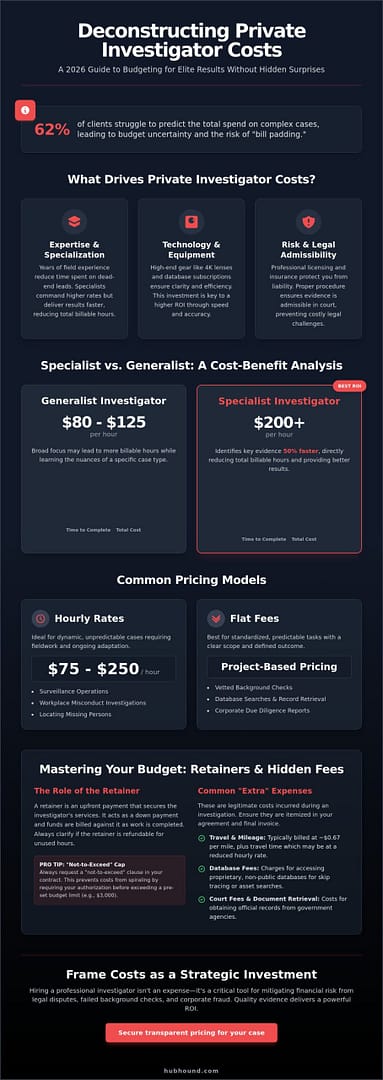
Calculating a realistic private investigator cost requires a look at the three pillars of professional operations: expertise, technology, and risk management. Many clients fall into the trap of selecting the lowest hourly rate, only to find that the evidence gathered is inadmissible in court. A 2024 industry analysis showed that 35% of cases handled by unvetted, low-cost contractors faced immediate legal challenges due to improper chain-of-custody procedures. Professional agencies prioritize precision over shortcuts, ensuring every piece of data stands up to judicial scrutiny.
The “Hound” approach to discovery relies on more than just physical surveillance. It involves tracking high-quality leads through sophisticated, non-public databases that aggregate billions of data points. These sources include credit headers, utility records, and historical location data not available on the open web. Accessing these tools requires significant investment, but they provide the vetted information necessary for a successful outcome. Professional licensing and high-limit liability insurance also impact the base rate. These overhead costs protect you from third-party litigation if an investigation leads to a legal dispute.
- Expertise: Years of field experience reduce the time spent on dead-end leads.
- Technology: High-end gear ensures clarity and reliability of evidence.
- Risk: Proper insurance and bonding mitigate client liability.
The Role of Experience and Specialization
Generalist investigators typically charge between $80 and $125 per hour, but their broad focus can lead to more billable hours as they learn the nuances of a specific niche. Specialists in corporate due diligence or criminal defense often command rates exceeding $200 per hour. While the initial rate is higher, their specialized knowledge allows them to identify key evidence 50% faster than a generalist. Specialized expertise serves as the primary catalyst for investigative efficiency, directly reducing the total billable hours required to close a case. By hiring for a specific skill set, you pay for results rather than a learning curve.
Technological Overhead and Equipment
Modern investigations rely on professional-grade hardware that far exceeds consumer capabilities. A standard surveillance kit includes 4K long-range lenses costing upwards of $2,500 and covert body-worn cameras that average $600 per unit. Beyond hardware, agencies pay for proprietary skip tracing and asset search software subscriptions that can cost $500 per month per user. This technology is vital for efficiency. For example, using advanced database cross-referencing can reduce the time required to locate a missing witness from 15 hours of manual work to just 90 minutes of digital analysis. These tools are a core component of the overall private investigator cost, but they deliver a higher ROI through speed and accuracy.
Common Pricing Models: Hourly Rates vs. Flat Fees
Private investigators generally split their billing into two distinct categories. You’ll encounter hourly rates for dynamic field operations and flat fees for static data retrieval. This distinction ensures you pay for the specific labor required rather than a generic estimate. Understanding the private investigator cost structure helps you manage expectations and project budgets with precision. Most professional agencies provide a transparent fee schedule during the initial consultation to prevent surprises.
Always include a “not-to-exceed” cap in your service agreement. This contract clause stops costs from spiraling if an investigation hits a dead end or requires more hours than originally projected. You should request this cap in writing before any field work begins. For example, you might set a limit of $3,000 for a surveillance operation. Once the billable hours reach that threshold, the investigator must pause and seek your explicit authorization to continue. This strategy maintains your control over the total spend.
When Hourly Rates Make Sense
Field operations require constant adaptation and carry unpredictable timelines. Surveillance and workplace misconduct investigations fall into this category. Expect hourly rates to range between $75 and $250 per hour. This variance often depends on the investigator’s experience level and the technical equipment required for the job. High-stakes corporate cases often command the upper end of that spectrum.
- Travel and Mileage: Agencies typically bill for travel time at a reduced hourly rate or the standard field rate. Mileage is often billed at $0.67 per mile, following national standards.
- Billable Documentation: Professional firms provide detailed daily logs. These logs justify every billable minute and provide the necessary evidentiary trail for legal proceedings.
- Minimums: Many investigators require a four-hour or eight-hour daily minimum to commit resources to a surveillance task.
The Benefits of Flat-Fee Investigative Packages
Predictability drives corporate decision-making. Flat-fee models apply to standardized tasks where the scope of work is clearly defined. These packages offer transparency and simplify internal approval processes for managers. A stable private investigator cost for recurring needs like employee vetting allows for more accurate annual budgeting. You can find vetted agencies that specialize in these streamlined, fixed-price services to ensure quality results.
- Standard Services: Process service, basic background screenings, and skip tracing usually carry fixed prices. A standard background check might cost between $150 and $500 depending on the depth of the search.
- Corporate Due Diligence: Many firms offer tiered reports. A Tier 1 report provides basic verification, while a Tier 3 deep dive offers comprehensive financial and reputational analysis at a higher, yet fixed, price point.
- Efficiency: Flat fees incentivize investigators to work efficiently. Since the price is set, the focus stays on delivering the final report rather than accumulating billable hours.
Cost Breakdown by Investigative Service Type
Service complexity drives the total private investigator cost. High-stakes corporate vetting requires a different resource allocation than a standard missing person search. Understanding these distinctions helps you budget effectively for vetted professional services. Most agencies categorize their fees based on the technical skills and equipment required for the job. You’ll find that specialized expertise often commands a premium but delivers a higher return on investment through more accurate data. Before committing to a budget, it helps to understand the full spectrum of pi services available in 2026, including how digital forensics and OSINT have shifted resource allocation across different case types.
Corporate and Workplace Investigation Costs
Corporate investigations focus on risk mitigation and asset protection. A basic tenant screening often costs between $50 and $150, focusing on public records and credit history. Deep-dive executive background checks are far more intensive. These curated reports often exceed $1,500 because they involve verifying international credentials, conducting deep-web searches, and interviewing former associates. For internal theft or workplace misconduct, agencies typically bill hourly. These rates range from $150 to $300 per hour depending on the need for forensic accounting or specialized digital surveillance tools. Companies seeking professional criminal defense support for employee-related litigation should expect tiered pricing based on the evidence volume. Investing in high-quality due diligence prevents long-term financial loss and protects your brand reputation within the business ecosystem.
Legal Support and Surveillance Pricing
Surveillance is a resource-heavy service that usually carries a daily minimum. Most firms require a four-hour or eight-hour block to ensure they capture sufficient activity. This structure accounts for travel time and setup. Standard process serving fees range from $75 to $150 for routine delivery. If a subject is actively evading service, “rush fees” or “difficult serve” surcharges can push the price above $250. Skip tracing is another critical legal tool. Locating a witness or debtor usually costs between $200 and $500, depending on the depth of the search and the age of the last known address.
Witness interviews for civil litigation are typically billed at the agency’s standard hourly rate. A single comprehensive interview, including the written statement and preparation time, often represents a $400 to $800 investment. Managing your private investigator cost effectively requires clear communication about these benchmarks before the investigation begins. Professional firms provide itemized estimates to ensure transparency and optimization of your legal budget. This approach allows you to select the specific services that align with your case objectives without overspending on unnecessary surveillance hours.
Managing the Budget: Retainers, Expenses, and Hidden Fees
Managing an investigative budget requires a clear understanding of how professionals allocate their time and resources. Effective fiscal management prevents project creep and ensures that the total private investigator cost aligns with your expected ROI. Most agencies operate on a drawdown system, where transparency is the primary metric for success.
How Retainers Work in 2026
A retainer is an industry-standard practice for securing professional time and dedicated resources. In 2026, typical retainer amounts fluctuate based on the complexity of the engagement. Basic background checks or asset searches often require a $1,500 deposit; however, complex corporate surveillance or fraud investigations frequently demand $5,000 or more upfront. This capital acts as a bank account from which the agency draws its hourly fees and expenses.
Long-term cases often utilize a replenishment model. Once the initial funds drop to a predetermined threshold, usually 20% of the original amount, the client must “top up” the account to continue the search. You must clarify if a retainer is refundable or non-refundable. Refundable retainers return the unused balance at the end of the case, while non-refundable agreements guarantee the investigator’s availability regardless of the hours logged.
Identifying and Avoiding Hidden Costs
Transparency starts with the initial engagement letter. High-quality firms provide line-item invoices that detail every cent spent on your behalf. You should expect to see 0.67 cents per mile or higher for travel, depending on current federal reimbursement rates. Database fees are another common expense. Investigators pay for access to proprietary data ecosystems, and these costs are typically passed to the client.
Watch for “administrative fees” that can add 10% to 15% to your total bill without providing clear value. Some agencies charge separately for report writing or video processing. Negotiate these rates before the work begins to avoid surprises. Understanding these variables helps you predict the final private investigator cost with higher accuracy.
- Confirm if the retainer balance is refundable upon case closure.
- Identify specific triggers for “replenishment” requests.
- Verify the exact hourly rate for report writing versus field surveillance.
- Check for “minimum hour” clauses per day of surveillance.
- Ensure all database and court filing fees are billed at cost without markups.
Vetted professionals prioritize clarity over complexity. By establishing these financial boundaries early, you protect your capital and ensure the investigator remains focused on delivering actionable intelligence. Find top-tier agencies and vetted investigative partners through the HubHound ecosystem to ensure your project stays on budget and on track.
The ROI of Professional Investigation: Why Quality Matters
Viewing private investigator cost as a simple expense misses the broader financial picture. It’s a strategic shield. According to 2023 data from CareerBuilder, the average cost of a single bad hire is $14,900. When that hire occupies a management position, the cost often exceeds $50,000 due to lost productivity and recruitment fees. A professional investigator provides the deep-dive verification that standard HR software misses. They identify red flags in professional histories and undisclosed legal conflicts. This prevents the massive drain of turnover and potential litigation before it starts.
Skip tracing offers another clear example of value. When a legal team can’t find a witness, the case stalls. Attorney fees for a mid-sized firm average $300 to $500 per hour. A professional investigator often locates a subject within 48 hours for a predictable fee. This speed saves the client dozens of billable legal hours. It moves the case toward a resolution faster. In many instances, the ROI on a professional skip trace exceeds 500% when measured against saved legal expenses and court delays.
Comparing Professional PIs to Online Search Sites
Don’t confuse $20 database searches with professional intelligence. Most online search sites use “scraped” data that’s often 12 to 24 months old. They don’t verify the information, leading to high rates of false positives. By hiring a licensed professional, you get court-ready evidence. This includes signed affidavits and high-definition surveillance footage. These assets are admissible in court, whereas a printed website report is usually dismissed as hearsay. This distinction is critical for businesses that need to win lawsuits or protect intellectual property.
Final Steps: How to Hire for Value
Finding the right partner requires a focus on efficiency over the lowest bid. Cheap investigators often take twice as long to get results, which actually increases the total private investigator cost. When searching for private detectives near me, look for these indicators of value during your initial consultation:
- Proven experience in your specific niche, such as insurance fraud or corporate due diligence.
- Clear communication protocols and transparent, itemized reporting.
- Strict adherence to investigator licensing standards to ensure all evidence is gathered legally.
Ask potential hires about their technology stack and their history with similar cases. An investigator with a 20-year track record has the network and tools to solve problems that would baffle a novice. You’re paying for their intuition and their established shortcuts. This expertise is what turns a higher hourly rate into a lower total project cost. Choosing a vetted agency ensures that your investment yields actionable data rather than just an invoice. Before committing to any agency, review our detailed framework on how to hire a private investigator to verify credentials, understand retainer structures, and confirm 2026 compliance standards.
Secure Your Firm’s ROI Through Strategic Investigation
Navigating the complexities of professional intelligence requires a balance between budget and results. Managing your private investigator cost effectively means looking beyond the base hourly rate and focusing on the total value of actionable data. High-quality investigative work relies on transparency and proven performance. You’ll find that the true return on investment comes from data that stands up to legal scrutiny and professional standards.
HubHound eliminates the guesswork by connecting you with a curated network of professionals. We’ve built a vetted and verified investigative ecosystem that prioritizes your firm’s security. With over three decades of industry experience, our platform provides access to licensed and insured professional investigators who meet rigorous standards. It’s time to stop losing hours to unverified leads and start leveraging high-quality intelligence today.
Discover how HubHound provides vetted, professional investigative results for your firm.
Take the next step toward professional clarity and secure the results your case deserves.
Frequently Asked Questions
How much does a private investigator cost per hour on average?
Professional investigators typically charge between $75 and $150 per hour for standard field operations. Rates depend on the investigator’s specific expertise and the technical requirements of the case. Specialized services like digital forensics or TSCM sweeps often command higher rates reaching $250 per hour. These figures represent national averages for vetted agencies that maintain proper licensing and insurance coverage for their clients.
Do private investigators require a retainer upfront?
Yes, most reputable agencies require a retainer fee before beginning any investigative tasks. This deposit usually ranges from $1,500 to $5,000 depending on the project scope. The investigator bills their hourly rate and expenses against this fund. You’ll receive an itemized statement showing how the funds were applied. This practice ensures the agency can dedicate immediate resources to your case without payment delays.
Is it cheaper to hire an investigator for a flat fee or an hourly rate?
Flat fees are generally more cost-effective for predictable tasks like background checks or license plate lookups. A comprehensive background profile might cost a flat $500. However, surveillance is almost always billed hourly because the duration is impossible to predict. Choosing the right fee structure ensures your private investigator cost stays manageable while providing the flexibility needed to capture essential evidence during unpredictable field operations.
What are the hidden costs associated with hiring a private investigator?
Common additional expenses include mileage reimbursements, database access fees, and travel-related costs. Agencies typically charge the 2024 federal mileage rate of 67 cents per mile for vehicle surveillance. You might also see line items for administrative time, video processing, or specialized equipment rentals. Always request a written fee schedule to understand these variables. This transparency prevents unexpected budget overruns when the final invoice arrives.
Can I get a refund on an investigative retainer if the case is solved quickly?
You’re entitled to a refund of the unearned portion of your retainer if the investigation concludes early. If you provide a $3,000 deposit and the investigator solves the case in four hours at $150 per hour, they’ll refund the remaining $2,400. Review your contract for specific clauses regarding non-refundable administrative fees or minimum hour requirements. Most professional agencies process these refunds within 30 days of case closure.
Does the cost of an investigator include court testimony time?
Court testimony is rarely included in the initial hourly rate and usually requires a separate fee. Investigators often charge between $150 and $300 per hour for depositions or trial appearances. Many agencies also enforce a four-hour minimum for court dates to account for travel and preparation time. This ensures the investigator’s availability as an expert witness, which is vital for legal proceedings and insurance claims.
Why do background check costs vary so much between agencies?
Price variations reflect the depth of the search and the manual effort involved. A $50 online search only accesses digitized public records, while a $500 professional check includes on-site courthouse visits and 10 years of verified history. High-end checks provide a 100% accuracy guarantee that automated tools can’t match. Investing in a vetted, hand-picked investigator ensures you receive a curated report that identifies risks automated systems miss.
Is a private investigator worth the cost for a small business?
Hiring an investigator is a high-ROI decision for businesses facing internal theft or fraudulent claims. The Association of Certified Fraud Examiners reports that typical organizations lose 5% of their annual revenue to fraud. Spending a few thousand dollars to mitigate these losses protects your company’s long-term health. Evaluating the private investigator cost against a potential $50,000 loss makes the financial benefit of professional intervention clear.