
What can a brief moment on video really say about someone’s recovery? Surveillance to verify a personal injury claim may document an activity that appears inconsistent with reported limitations, but a clip alone can’t explain pain, medical advice, or what happened before and after the observation.
That uncertainty is understandable. Ordinary activities can look different when viewed without context, and surveillance is only one part of evaluating a claim. Its value depends on whether observations relate to a specific issue, are documented clearly, and are considered alongside other evidence.
This article explains what surveillance may support or challenge, what makes the resulting evidence useful, and why a single observation shouldn’t be treated as a complete picture of an injury. You’ll also learn how professional investigators can document relevant activity for a broader evidence review. HubHound provides surveillance operations and civil litigation support through licensed investigators with more than three decades of industry experience.
Key Takeaways
- Use surveillance to verify a personal injury claim as one source of observable information, not a complete measure of someone’s recovery.
- Connect each observation to a specific disputed activity or limitation, then compare it with relevant records and other evidence.
- Consider context before drawing conclusions: a short recording may not show what happened before or after the activity.
- If surveillance raises questions about your claim, preserve relevant records and discuss the evidence with your legal representative.
- Focused professional surveillance can document relevant observations for later review, while legal and other appropriate professionals assess their significance.
How Surveillance Can Help Verify a Personal Injury Claim
Surveillance can add a documented view of activity that relates to a specific, disputed issue in an injury claim. If a person reports difficulty with a particular movement, for example, an investigator may observe and record activity that appears to involve that movement. The purpose of surveillance to verify a personal injury claim is not to judge someone’s character or decide whether an injury is real. It is to document observable information for comparison with the claim and other available evidence.
That distinction matters. A recording may show what someone did at a particular time, but it can’t establish their pain level, explain medical restrictions, or reveal how they felt before or afterward. It also can’t diagnose an injury or prove what caused it. A brief activity may be consistent with recovery, reflect a good or difficult day, or leave too much unknown to support a firm conclusion.
Definition: Claim-related surveillance is the documented observation of activity relevant to a disputed injury issue. It records observable events; it does not, on its own, determine their meaning, medical significance, or cause.
Assess investigative observations as part of a broader review. Their relevance depends on the question being examined, the accuracy and completeness of the documentation, and how the information compares with other evidence. An observation is something to evaluate, not a verdict about the claim.
What questions can surveillance help answer?
A focused investigation can help clarify whether an observed activity appears related to a reported functional limitation. If the issue concerns lifting, for instance, footage of someone carrying an object may prompt questions about the movement, the circumstances, and how long the activity continued. It doesn’t automatically establish that the person can lift without pain or repeat the task. The goal is to clarify a specific account, not assume dishonesty from an apparent inconsistency.
A useful investigative question is narrow: what activity is disputed, and what observation could help assess it? Broad monitoring without a defined claim-related purpose can produce material that is difficult to interpret. A focused question makes it easier to connect observations with relevant records and other information.
Who may use surveillance during a claim?
Insurers, attorneys, and claims professionals may consider investigative observations as they evaluate different questions about a claim. An insurer may assess whether recorded activity relates to a reported limitation, while an attorney may examine how the same material fits with the overall evidence. A private investigator may gather and document observations, but the people reviewing a claim determine what questions the evidence raises.
Different parties may interpret the same observation in light of their case objectives. That’s why the record should be assessed alongside relevant context rather than treated as a self-explanatory conclusion. Professional surveillance and civil litigation support can help create a clear record for later review without predicting what that review will establish.
How Personal Injury Surveillance Is Planned, Conducted, and Documented
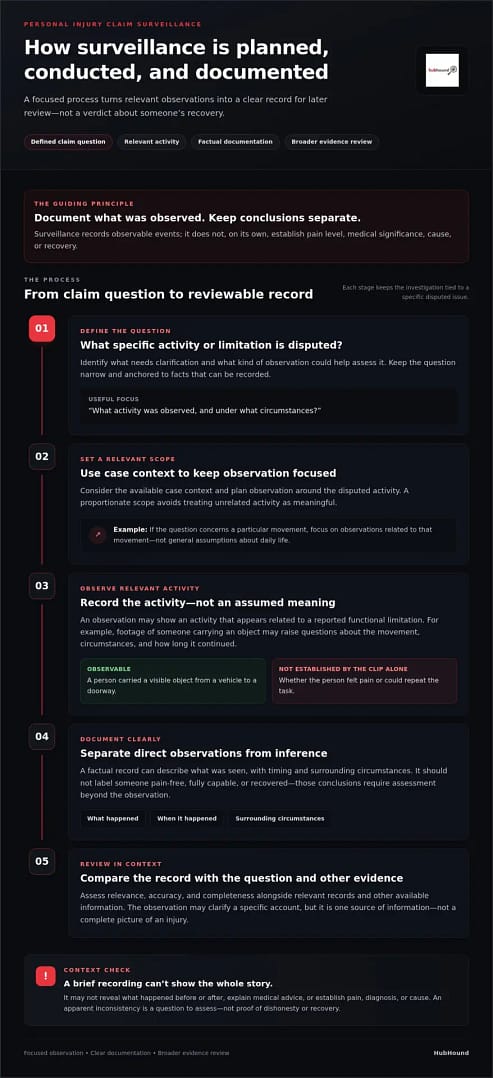
Useful surveillance starts with a defined claim question, not an open-ended effort to watch someone’s routine. The investigator identifies the disputed fact, considers the available case context, plans focused observation, and records relevant findings. The results can then be reviewed against the question that prompted the work. This sequence helps keep the investigation purposeful and the resulting material easier to assess.
For surveillance to verify a personal injury claim, the scope should relate to a specific issue, such as whether an observed activity relates to a reported functional limitation. The objective isn’t to capture every part of a person’s day. It’s to document relevant observations that can be considered alongside other claim information.
Start with a focused investigative question
Before observation begins, define what needs clarification. Identify the disputed activity or reported limitation, then consider what kind of observation could help assess it. Case context helps determine when observation may be relevant, while a proportionate scope avoids treating unrelated activity as meaningful. If the question concerns a particular movement, for example, observations should relate to that movement rather than general assumptions about someone’s daily life.
A focused question also helps distinguish evidence gathering from speculation. “What activity was observed, and under what circumstances?” can be answered through documentation. “Does this prove the person has recovered?” asks for a conclusion that observation alone can’t establish. Keep the investigation anchored to facts that can be recorded.
Document observations without overstating them
Clear records separate what an investigator directly observed from what someone might infer. A factual note could describe a person carrying a visible object from a vehicle to a doorway, with the timing and surrounding circumstances recorded. It shouldn’t label the person pain-free, fully capable, or recovered, because those conclusions require assessment beyond the observation.
Professional surveillance techniques should support accurate, reviewable documentation, not dramatic storytelling. HubHound’s surveillance operations are part of its broader investigative and civil litigation support.
Photographs or video can help preserve what was visible, while written notes add detail about the observation and its context. Neither format automatically explains the person’s medical condition, the effort involved, or what occurred outside the recorded view. Review the material alongside relevant claim information, including records and accounts that may clarify the activity.
- Define the question: Identify the disputed issue the investigation is meant to examine.
- Plan the scope: Focus observation on activity relevant to that issue.
- Record facts: Note what was observed, when it occurred, and the available context.
- Review in context: Compare findings with other claim information before drawing conclusions.
This process gives later reviewers a clearer basis for assessing what the evidence shows and what it leaves unanswered. Documentation can inform a broader claim review, but it doesn’t replace the work of legal, medical, or other appropriate professionals.
How to Assess Surveillance Evidence Without Losing Context
Evaluate surveillance by asking whether it captures an activity that directly relates to a specific claimed limitation, and what the recording leaves unknown. A clip may raise a useful question, but a moment of visible activity doesn’t establish someone’s overall medical condition or recovery. The circumstances, duration, and supporting information all affect how much weight an observation may reasonably carry.
Surveillance documents observed moments, not an entire injury experience. Separate what a recording shows from what someone might infer. A person appearing to complete a task doesn’t reveal, by appearance alone, whether it caused pain, required extra effort, or could be repeated later.
What makes an observation relevant to a claim?
Start with the functional issue under review. Consider whether the recording captures the specific task, how long the activity lasted, and the circumstances in which it occurred. General appearance, such as seeming energetic or moving comfortably, is not a substitute for evidence about a particular limitation. Avoid inferring pain levels, diagnosis, or long-term capacity from a visual impression.
The comparison below shows what an observation may contribute, what it cannot resolve by itself, and what other information could help complete the picture.
| Observation | Possible relevance | Missing context | Corroborating information |
|---|---|---|---|
| A person walks up a short flight of steps. | May relate to a reported difficulty using stairs. | Doesn’t show symptoms afterward, the person’s effort, or whether the activity is typical. | Relevant medical information, statements about stair use, and other claim records. |
| A person remains seated during an observed outing. | May offer limited information about activity during that period. | Doesn’t establish why the person sat, how they felt, or what they did outside the recording. | Accounts of functional limitations and records addressing the activity in question. |
| A person carries a bag from a vehicle. | May raise a question if carrying is a specific disputed limitation. | The recording may not establish the bag’s contents or weight, discomfort, or ability to repeat the task. | Claim statements and relevant clinical or other case information. |
Why should footage be reviewed with other evidence?
Compare footage with available medical information, statements, and claim records before drawing conclusions. Check whether the recording captures the complete task, whether its timing matters to the issue, and whether other information offers a reasonable explanation for what appears on screen. Missing context isn’t proof of a particular interpretation; it points to a question for further review.
Surveillance to verify a personal injury claim is one evidence source, not a substitute for clinical assessment. A qualified medical professional evaluates health and recovery; footage can document visible activity for consideration alongside that assessment. Comparing sources helps reviewers distinguish a relevant inconsistency from an incomplete snapshot, without asking the recording to answer questions it cannot resolve.
When Surveillance Questions Your Injury Claim
Surveillance may raise questions, but a recording should be reviewed in context rather than treated as a complete account of an injury. If evidence appears to conflict with what you reported, focus on responding accurately and organizing relevant information. Don’t guess at what a clip proves or change your account to match what you think someone expects to hear.
If you are a claimant reviewing surveillance
Describe the activity truthfully, including relevant circumstances the recording may not show, such as what happened before or afterward. If you don’t remember a detail, avoid filling the gap with an assumption. An accurate account gives your legal representative a clearer basis for considering the footage alongside the rest of the claim.
Organize records that may help explain the activity, such as relevant medical information, claim documents, and your own notes about the circumstances. Write down specific questions: Does the clip show the full activity? Is its timing relevant? What context may be missing? Discuss these points with your legal representative, who can assess the recording in light of your case. Don’t assume a clip has a particular legal effect without case-specific advice.
Legal questions about surveillance, evidence handling, and how material may be used require advice from qualified counsel. For claimants dealing with disputed evidence in Florida, consulting a Personal Injury Attorney in Fort Lauderdale can provide clarity on how state courts evaluate recorded observations. The appropriate response depends on the specific facts and applicable legal context.
If you are assessing a claim for an organization
Start with a clear, relevant question tied to the matter. A defined purpose helps keep investigative work focused and makes it easier to evaluate whether the findings address the issue under review. Avoid broad requests that treat all observed activity as meaningful simply because it was recorded.
Keep investigative findings factual, confidential, and available for appropriate case review. Separate what was directly observed from interpretation, and provide enough context for reviewers to assess the material fairly. If an observation seems inconsistent with a reported limitation, treat that as a question to examine, not an automatic conclusion about the claim.
An isolated activity does not, on its own, establish fraud or the absence of an injury. Review the observation with relevant claim information and allow qualified legal and medical professionals to assess questions within their roles. This supports a balanced evaluation, whether the footage appears to support, challenge, or add little to the claim.
If you are considering surveillance to verify a personal injury claim, preserve relevant records, list unanswered questions, and ensure the evidence is reviewed in context. For organizations, a focused investigative request and careful documentation can help keep that review disciplined. Neither approach requires conclusions that go beyond what the available evidence can show.
When Professional Surveillance Support Fits a Personal Injury Claim
Professional surveillance may be useful when a specific activity or reported functional limitation is disputed and an objective record could help clarify the issue. It isn’t a default step for every claim. Its value depends on whether the investigation can address a clear question and whether the resulting observations can be reviewed alongside other relevant information.
For example, a case may involve disagreement about whether a person performs a particular task they’ve described as difficult. A focused investigation can document relevant activity for later review. It can’t explain pain, diagnose a condition, determine the cause of an injury, or decide the outcome of a claim. Investigators gather and document observations; attorneys and appropriate professionals assess what those observations mean within the case.
What professional investigative support can contribute
Professional support can provide discreet surveillance focused on the assignment and clear documentation of relevant observations. Findings can be organized to help legal or claims professionals review what was observed, when it occurred, and how it relates to the question under consideration. HubHound provides surveillance operations and civil litigation support through licensed investigators with more than three decades of industry experience.
The investigator’s role is evidence gathering, not advocacy for a medical conclusion. A report can help reviewers identify what the material shows and what it does not establish. It may also help pinpoint follow-up questions for the broader review, such as whether the observed activity aligns with other claim information or needs additional context.
Set a clear scope before an investigation begins
Define the case question, the activities relevant to it, and the intended use of the findings. A defined scope helps keep the assignment proportionate and the resulting record useful. Keep confidentiality and factual reporting central throughout the process. Findings should describe observations accurately, without overstating their significance or promising a particular claim value or evidentiary outcome.
Legal or claims professionals can identify what information would be useful for review and how observations fit into the wider matter. That context helps focus the assignment and clarifies its limits. Surveillance to verify a personal injury claim is most appropriate when there is a concrete issue to examine, not simply a desire to collect more information.
After an investigation, review the documentation alongside relevant records and other evidence. Consider whether the observation addresses the original question, whether important context is missing, and what additional assessment may be needed. This keeps investigative findings in their proper role: one input to a broader case review, rather than a standalone decision about injury, recovery, or claim validity.
For legal and claims teams, HubHound provides surveillance support for personal injury matters.
Choose the Next Step With a Clear Question
Before deciding whether surveillance to verify a personal injury claim is appropriate, identify the uncertainty that needs resolving. Ask whether focused observation could add useful information to the matter, or whether the issue is better addressed through existing records or professional review. A clear purpose helps keep the next step proportionate and the evidence relevant.
If an investigative assignment makes sense, define the question and intended use of the findings with the legal or claims team. Keep expectations grounded: documented observations can inform a review, but they don’t determine medical conclusions or guarantee a particular case outcome. That distinction gives decision-makers a sound basis for moving forward.
A careful, question-led approach can make a complex claim easier to assess. Keep the broader picture in view and use investigative findings as one part of a well-supported review.
Frequently Asked Questions
Can surveillance prove that a personal injury claim is false?
No. Surveillance to verify a personal injury claim may document a specific activity, but it doesn’t by itself establish fraud, diagnose an injury, or prove full recovery. Its significance depends on how the observed activity relates to the issue being reviewed and what the recording leaves out. For example, a clip showing someone carrying groceries doesn’t establish how heavy the bags were or how the person felt afterward. Review it with other available evidence and case-specific legal advice.
Is surveillance legal during a personal injury claim?
There isn’t a universal yes-or-no answer. Legal boundaries can vary by jurisdiction, circumstances, and investigative method, so don’t assume every form of observation or recording is permissible. If you’re concerned about how surveillance was conducted or how a recording may be used, ask qualified counsel familiar with your situation, such as the personal injury team at mraccident.com for California matters. A general article can’t determine whether a particular investigation complied with the rules that apply to an individual case.
What do investigators look for when verifying an injury claim?
An assignment may focus on a specific activity tied to a reported functional limitation or disputed fact, such as whether a person performs a task they’ve described as difficult. The investigator’s role is to record relevant observations, not diagnose an injury or decide whether the claim is valid. Seeing a task completed once, for example, doesn’t establish how often it can be done. Reviewers assess the observation alongside other case information.
Can a short video clip affect a personal injury claim?
It may prompt questions if the activity shown relates to a limitation at issue, but a brief clip can omit important details. It may not capture the full task, its duration, what happened just before or afterward, or the person’s broader recovery experience. Avoid treating a fragment as a complete account. The wider claim record and appropriate professional review can help clarify what the footage does and doesn’t establish.
How does surveillance evidence get reviewed in an injury case?
Reviewers first identify what the recording visibly shows, then consider how it connects to the disputed issue. They can note gaps, such as an unclear view or an activity that begins before recording, and compare the footage with relevant statements, records, and other available information. Legal professionals determine how evidence applies to a specific matter. Whether a recording can be used for a particular purpose depends on case-specific review, not a guarantee based on possession of the footage.
Should I hire a private investigator to verify a personal injury claim?
Consider professional surveillance only if a clear, relevant question remains about an activity or reported limitation. Before work begins, define what needs clarification and what findings would be useful to the case review. An investigator can gather and document observations; legal or claims professionals assess their significance. Not every claim requires surveillance, and an investigation may add little if there’s no specific issue for it to address.

Article by
Joel R. Manley | President | Hubhound Investigations | OR PI-ID#: 90432 | 111 SW Fifth Avenue, Suite 3150 Portland, Oregon 97204 | 971-442-8170
Joel is licensed as a private investigator in Oregon and Tennessee. Joel started his career in 1987 serving as a Military Police Officer and Military Police Investigator.
After ending his military tour of duty, Joel became a civilian Police Officer and Deputy Sheriff. Joel took his strong background in Hostage Negotiations, Mediation and Conflict Resolution, with him to patrol some of the highest crime areas in SE Portland.
Joel was awarded Deputy of the Year for his efforts and for drastically reducing the crime rate in the area he patrolled. As a Deputy Sheriff, Joel assisted in leading a Neighborhood Livability Program that was nationally recognized for having the most innovative and progressive approach to policing.
In 2018, Joel retired as a Deputy Sheriff and founded Hubhound Investigations. Joel played an integral role in Hubhound Investigations receiving an A+ Accredited Business rating from the Better Business Bureau (BBB).
In his off time, Joel enjoys spending time with his wife, adult children and Hubhound’s Happiness Ambassador, Nya. Joel also enjoys Scuba Diving and Kayaking.
Disclaimer
DISCLAIMER: This article is provided for general informational and educational purposes only. It is not intended to constitute legal advice, professional investigative advice, or instruction to engage in any unlawful activity. Laws governing private investigations, surveillance, recording, tracking, access to information, evidence collection, privacy, trespass, licensing, and related investigative activities vary by jurisdiction and are subject to change.
Any investigative techniques, tactics, procedures, scenarios, or legal proceedings discussed in this article are presented for informational purposes and should not be interpreted as authorization or encouragement to use a particular method. Private investigators and members of the public are responsible for understanding and complying with all applicable federal, state, and local laws, licensing requirements, court rules, and professional standards.
The circumstances of every investigation and legal matter are different. Information contained in this article should not be relied upon as a substitute for advice from a qualified attorney or other appropriate licensed professional regarding a specific situation. No attorney-client, investigator-client, or other professional relationship is created by reading or using this information.