
If you’re asking what is an affidavit of service, it’s important to know what the document records and what it doesn’t establish. It may show that legal papers were delivered, but it doesn’t, by itself, confirm that every applicable service requirement was met. An affidavit, proof of service, and return of service may be used differently depending on the court and case, so the labels alone may not tell the whole story.
Understanding the document’s purpose helps you review it carefully. This guide explains what an affidavit of service typically records, how it relates to proof or return of service, and which details to check and preserve. It also covers common next steps, including reviewing the court’s instructions and seeking legal advice when you have case-specific questions. Requirements can vary by jurisdiction and case type, so treat the document as an important record to review, not a guarantee that every procedural detail is settled. Professional process service can help create a clear record of delivery.
Key Takeaways
- Learn what is an affidavit of service and why it records how legal documents were delivered without guaranteeing that every service requirement was met.
- Identify common details to review, such as the documents served, recipient, delivery date and time, location, and stated method.
- Distinguish an affidavit of service from proof of service and return of service by looking at how each term is used in the relevant court process.
- Use a simple review sequence to spot discrepancies, preserve the document, and avoid changing the original record.
- See how professional process service connects document delivery with clear service documentation, while reviewing applicable court instructions for next steps.
What Is an Affidavit of Service, and What Does It Prove?
An affidavit of service is a written record describing how legal documents were delivered. It may help show that service occurred by recording when, where, and how the papers were provided. The key point is that it documents an account of delivery. It doesn’t, by itself, guarantee that service met every applicable requirement or resolve a dispute about what happened.
An affidavit is generally a statement made under oath or affirmation. For a broader explanation of the term, see What is an Affidavit? An affidavit of service applies that kind of statement to the delivery of legal documents. Its required form and legal effect depend on the rules that apply to the proceeding, so read it in context.
A service record describes an event; it isn’t a court ruling on the case. A court may consider the record when assessing a dispute about service, but filing or possessing it doesn’t automatically resolve a procedural question.
Why Is an Affidavit of Service Used?
A written account gives the parties and the court a reference point for the reported delivery. It can identify the documents served and record the circumstances of service, helping readers understand what the server says took place. If someone disputes whether or how service occurred, those details may help clarify the disagreement.
The record is evidence of the server’s account, not an automatic determination that every step was proper. The relevant court instructions and rules help determine what weight to give it and whether further action is needed.
Who Prepares and Signs the Document?
The person who served the papers may prepare an account describing the delivery based on what they did or observed. The signer is generally expected to affirm the truth of the statement in the manner required for that document. Who may serve, sign, or administer an oath depends on applicable requirements, which can differ by jurisdiction and case type.
A person’s role in delivering documents doesn’t, on its own, establish whether they’re eligible to serve or whether the document was executed in the required form. Review the applicable court instructions if you need to assess those points. Professional process service connects document delivery with a written service record, giving the parties a clear account to review.
What Information Does an Affidavit of Service Usually Include?
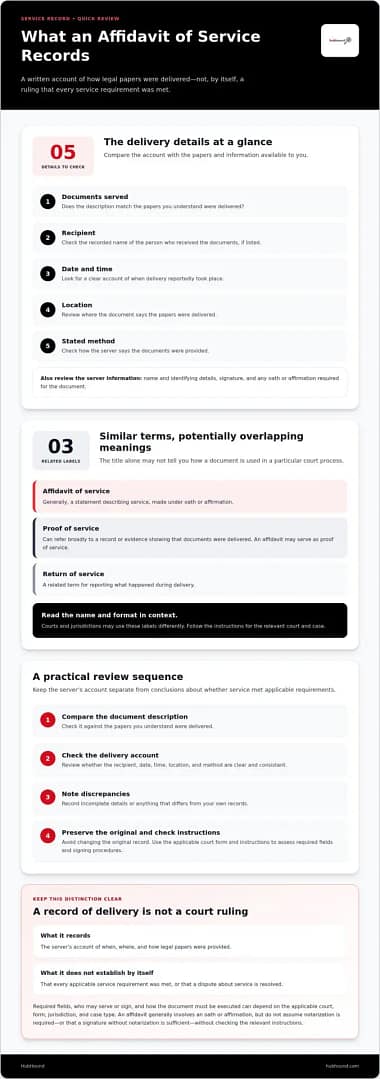
Details vary, but an affidavit of service often identifies the case and records what the server says happened. Common examples include:
- Documents served: A description of the papers delivered, such as a summons or complaint.
- Recipient: The name of the person who received the documents, if recorded.
- Delivery details: The date, time, location, and stated method of service.
- Server information: The server’s name and identifying details, along with a signature and any oath or affirmation required for the document.
Required fields vary by form, court, and proceeding. A document may use different labels or request additional information, so don’t assume one sample applies everywhere. For federal civil cases, the Federal Rules of Civil Procedure on Service of Process provide a framework for service. Review the instructions that apply to the specific court and case.
How to Read the Main Details
Start by comparing the document description with the papers you understand were delivered. Then check whether the recorded recipient, date, time, location, and method are clear and consistent. Note any incomplete description or detail that differs from your own records so you can follow up on it.
Keep reported facts separate from conclusions. For example, an affidavit may state that papers were delivered to a named recipient at a particular location. That records the server’s account; whether it satisfies applicable requirements is a separate question.
Does an Affidavit of Service Need to Be Notarized?
An affidavit generally involves a statement made under oath or affirmation, but that doesn’t mean every service record must be notarized. The required execution process can depend on the court, form, and type of proceeding. Some forms may call for a notary or another authorized person to administer the oath; others may give different signing instructions.
Use the applicable court form and instructions to determine how the document should be completed. Don’t rely on the word “affidavit” alone to infer that notarization is required, or that a signature without notarization is necessarily sufficient. Clear documentation starts with following the instructions for the specific filing. For delivery and service documentation support, see professional process service.
Affidavit of Service vs. Proof of Service: How Are They Different?
The labels can sound like separate legal documents, but their meanings may overlap. “Proof of service” can refer broadly to a record or evidence showing that documents were delivered. An affidavit of service is generally a statement describing service, made under oath or affirmation. Depending on the applicable requirements, an affidavit may serve as proof of service. A return of service is another related term for reporting what happened during delivery.
Use the name and format specified in the instructions for your case. Courts and jurisdictions may use these labels differently, and a different title doesn’t automatically mean a different legal effect. To understand what is an affidavit of service in a particular case, look beyond the heading and review the document’s contents and execution requirements.
| Term | General use | Typical format and relationship to delivery |
|---|---|---|
| Affidavit of service | A statement describing how service was carried out. | Often presented as a written statement made under oath or affirmation. It may document delivery and serve as proof when completed in the required form. |
| Proof of service | A broad term for information or a record showing that documents were served. | May refer to a specific court form, an affidavit, or another accepted record. Its required format depends on the applicable instructions. |
| Return of service | A report of the outcome or details of service. | May record whether and how delivery occurred. The document’s name, format, and filing process can vary. |
Affidavit of Service and Proof of Service
Think of “proof” as the function and “affidavit” as one possible form of the record. A proof of service may describe the evidence filed or presented to document delivery. An affidavit can fulfill that role if it meets the relevant requirements. Don’t assume the terms are interchangeable in every court or case. Check whether the instructions call for a particular form, statement, or method of signing.
Affidavit of Service and Return of Service
A return of service reports service details, but the phrase doesn’t establish one universal format. In one proceeding, it may name a form that records the delivery outcome; in another, different terminology or filing steps may apply. Match the document to the case instructions rather than relying on a familiar label. If the title and instructions seem inconsistent, note the discrepancy and consult the applicable court guidance or seek legal advice.
How to Review an Affidavit of Service and Next Steps
Review the document systematically. A mismatch deserves attention, but an error doesn’t automatically determine the outcome of a case. Its significance depends on the applicable rules and the facts, so avoid drawing conclusions from the document alone.
- Identify the case. Compare the case name and number, if shown, with your case records.
- Check the documents listed. See whether the papers described match the documents you understand were served.
- Review the delivery details. Note the stated recipient, date, time, location, and method. Mark anything unclear or inconsistent.
- Inspect the signature and execution. Check who signed and whether the document appears to follow the oath, affirmation, or other signing instructions that apply.
- Preserve the record. Keep the original document and related communications together. Make notes separately; don’t write on, edit, or otherwise alter the original.
This sequence helps you assess what the affidavit actually says without treating it as a final ruling on service. When reviewing the document in your case, distinguish the recorded account from your own knowledge and from any legal conclusion about whether service was valid.
What If the Document Lists Incorrect or Missing Details?
Record the specific issue, such as a date that differs from your records or a missing description of a document. Preserve the affidavit and related communications, and note when and how you identified the discrepancy. Don’t attempt to correct the filed document yourself.
The effect of an error depends on the rules and facts involved. A discrepancy doesn’t automatically invalidate service, require a correction, or end a case. Review the applicable court instructions and seek qualified legal advice if you need to understand how the issue may affect your matter.
What If You Never Received the Papers?
A filed service record and your account of whether you received the papers can differ. Don’t assume that the record resolves the disagreement. Review relevant case notices and court instructions promptly, and pay attention to any deadlines stated in them. If a deadline may be urgent or you have case-specific questions, seek qualified legal advice without delay.
For professional process service and service documentation, explore HubHound’s process service.
How Professional Process Service Connects to an Affidavit of Service
Document delivery and service documentation are linked steps. A process server handles delivery of legal papers, then records what happened during the service attempt or completed delivery. That record gives the parties a written account to review alongside the case documents and applicable court instructions.
In this process, an affidavit of service records the server’s account. It doesn’t guarantee that a court will accept a filing or reach a particular decision. Its value depends on whether it clearly and accurately reflects the service event and follows the requirements that apply to the proceeding.
What to Expect from a Process-Service Record
The record should correspond to what occurred. If documents were delivered, it should describe the delivery details recorded by the server. If an attempt didn’t result in delivery, the record may instead report that attempt. Review the account against the case information and the papers involved. Clear, factual documentation helps readers understand what the server reports without treating the record as a ruling on whether service was legally sufficient.
Accurate records also make it easier to communicate about service. A clear account gives legal teams and individuals specific details to refer to when reviewing the delivery or discussing a question about it. The document doesn’t promise filing acceptance or determine the outcome of a case.
When Process-Service Support May Be Useful
Legal teams and individuals may need professional help delivering documents and documenting the service event. A process-service provider can bring structure to that practical task, with a written account that helps the people involved review and communicate the reported details. Requirements still depend on the case and applicable court instructions, so assess service documentation in that context.
HubHound provides professional process service as part of its legal-support work. If you need help with document delivery and its accompanying service record, explore professional process-service support.
Review the Record and Choose Your Next Step
Knowing what an affidavit of service is helps you read it for what it is: a record of reported document delivery, not a ruling that every service requirement was met. Check the case details, papers listed, delivery information, and signature. Remember that “affidavit,” “proof,” and “return” of service may be used differently, so follow the instructions that apply to your case.
If you find missing or inconsistent information, preserve the document and note the exact issue without changing the original. Review the relevant court instructions, and seek legal advice for case-specific concerns or deadlines. A careful review gives you a clearer basis for deciding what to do next.
HubHound provides professional process service and legal-support services for document delivery and service documentation. The firm is operated by licensed investigators with over three decades of industry experience.
For help with document delivery and service documentation, explore HubHound’s professional process service.
Frequently Asked Questions
What is an affidavit of service?
An affidavit of service is a written statement describing how legal documents were delivered. It commonly records the papers, recipient, date, and delivery method, though the applicable form and rules determine the required contents. The statement can serve as evidence that service occurred. It doesn’t, by itself, establish that service was legally sufficient or decide the underlying case.
What information is included in an affidavit of service?
An affidavit of service may identify the documents delivered, the person served, and the date, location, and method of delivery. It may also include details about the person making the statement and a signature under oath or affirmation. These are common examples, not a universal checklist. Compare the document with the instructions and form for the specific proceeding, since requirements can vary.
What is the difference between an affidavit of service and proof of service?
Proof of service is a broad term for a record or evidence showing that documents were delivered. An affidavit of service is typically a statement made under oath or affirmation and may serve as proof when completed in the required form. Courts and proceedings can use these terms differently, so don’t assume they’re interchangeable. Follow the terminology and forms in the applicable case instructions.
Who can complete an affidavit of service?
The person who carried out service may record the details, but eligibility and signing requirements depend on the rules that apply. Don’t assume that a recipient, party, or witness can complete or sign the document. Check the relevant form and instructions to determine who may serve the papers and who must make the statement. If those requirements are unclear, seek qualified legal guidance.
What happens if an affidavit of service contains incorrect information?
An error doesn’t automatically determine the outcome of a case. Its significance depends on the detail, the applicable rules, and the circumstances. Keep the document as it is, note the precise discrepancy separately, and preserve related communications. Don’t alter the original. Review the relevant court instructions, and seek qualified legal advice promptly if the issue could affect a deadline or legal right.
Can I challenge an affidavit of service if I didn’t receive the papers?
You can raise a concern, but a difference between the service record and your account doesn’t automatically invalidate the document or resolve the issue. Preserve relevant notices and communications, and write down what you remember while the details are clear. Review case notices, deadlines, and applicable court instructions promptly. Because procedures vary and timing may matter, seek qualified legal advice about your specific situation.

Article by
Joel R. Manley | President | Hubhound Investigations | OR PI-ID#: 90432 | 111 SW Fifth Avenue, Suite 3150 Portland, Oregon 97204 | 971-442-8170
Joel is licensed as a private investigator in Oregon and Tennessee. Joel started his career in 1987 serving as a Military Police Officer and Military Police Investigator.
After ending his military tour of duty, Joel became a civilian Police Officer and Deputy Sheriff. Joel took his strong background in Hostage Negotiations, Mediation and Conflict Resolution, with him to patrol some of the highest crime areas in SE Portland.
Joel was awarded Deputy of the Year for his efforts and for drastically reducing the crime rate in the area he patrolled. As a Deputy Sheriff, Joel assisted in leading a Neighborhood Livability Program that was nationally recognized for having the most innovative and progressive approach to policing.
In 2018, Joel retired as a Deputy Sheriff and founded Hubhound Investigations. Joel played an integral role in Hubhound Investigations receiving an A+ Accredited Business rating from the Better Business Bureau (BBB).
In his off time, Joel enjoys spending time with his wife, adult children and Hubhound’s Happiness Ambassador, Nya. Joel also enjoys Scuba Diving and Kayaking.
Disclaimer
DISCLAIMER: This article is provided for general informational and educational purposes only. It is not intended to constitute legal advice, professional investigative advice, or instruction to engage in any unlawful activity. Laws governing private investigations, surveillance, recording, tracking, access to information, evidence collection, privacy, trespass, licensing, and related investigative activities vary by jurisdiction and are subject to change.
Any investigative techniques, tactics, procedures, scenarios, or legal proceedings discussed in this article are presented for informational purposes and should not be interpreted as authorization or encouragement to use a particular method. Private investigators and members of the public are responsible for understanding and complying with all applicable federal, state, and local laws, licensing requirements, court rules, and professional standards.
The circumstances of every investigation and legal matter are different. Information contained in this article should not be relied upon as a substitute for advice from a qualified attorney or other appropriate licensed professional regarding a specific situation. No attorney-client, investigator-client, or other professional relationship is created by reading or using this information.